


Overview
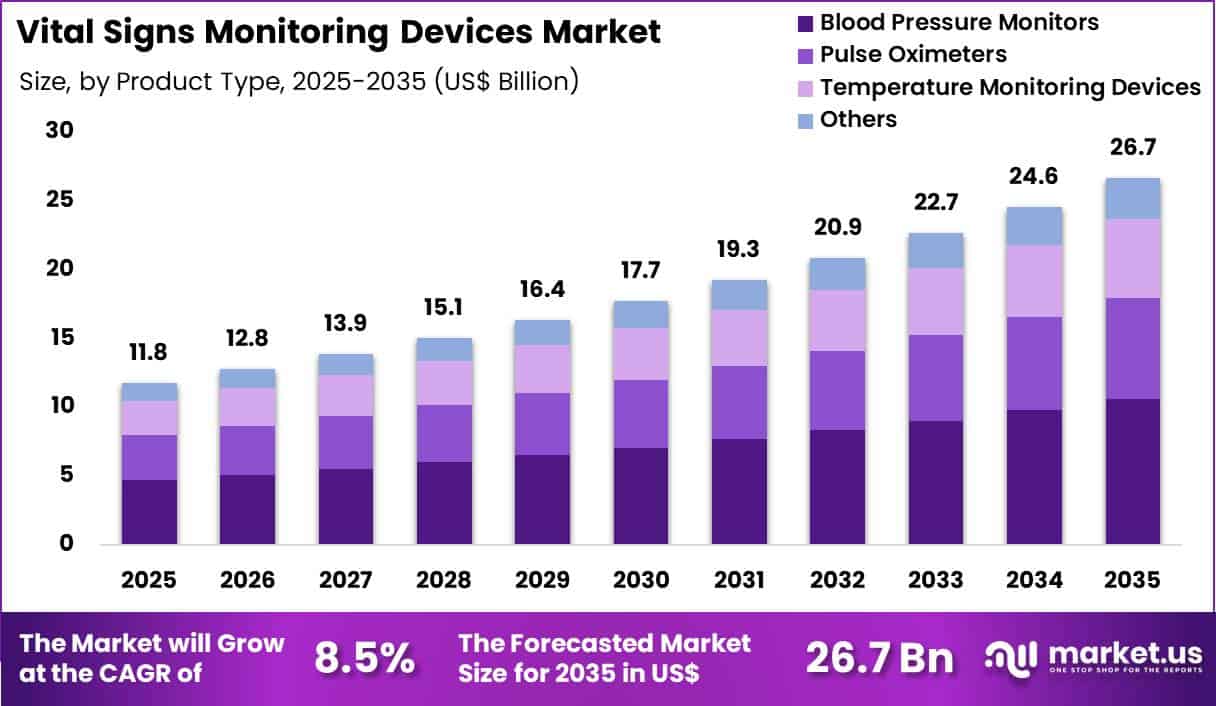
New York, NY – Oct 30, 2026 – Global Vital Signs Monitoring Devices Market size is expected to be worth around US$ 26.7 Billion by 2035 from US$ 11.8 Billion in 2025, growing at a CAGR of 8.5% during the forecast period 2026 to 2035. In 2025, North America led the market, achieving over 45.5% share with a revenue of US$ 5.4 Billion.
Vital Signs Monitoring Devices are medical equipment designed to measure, monitor, and record essential physiological parameters, including heart rate, blood pressure, body temperature, respiratory rate, and blood oxygen saturation (SpO₂). These devices play a critical role in the early detection of health abnormalities, continuous patient monitoring, and effective clinical decision-making.
The growing prevalence of chronic diseases, increasing geriatric population, rising demand for remote patient monitoring, and expanding adoption of digital healthcare technologies are key factors supporting market growth. Technological advancements, including wearable monitoring devices, wireless connectivity, artificial intelligence (AI), and Internet of Medical Things (IoMT), are further improving monitoring accuracy, accessibility, and patient convenience.
Vital signs monitoring devices are widely used across hospitals, clinics, ambulatory surgical centers, home healthcare settings, and emergency care facilities. Key product categories include blood pressure monitors, pulse oximeters, temperature monitoring devices, ECG monitors, and multi-parameter patient monitoring systems.
Furthermore, the increasing emphasis on preventive healthcare, decentralized patient care, and home-based disease management is expected to create new growth opportunities. Manufacturers are increasingly focusing on developing compact, connected, user-friendly, and technologically advanced monitoring solutions to address evolving healthcare requirements. Consequently, the market is expected to witness continued development, supported by rising healthcare investments and growing demand for efficient patient monitoring solutions.
Key Takeaways
- In 2025, the global market was valued at US$ 11.8 Billion and is projected to grow at a CAGR of 8.5%, reaching US$ 26.7 Billion by 2035.
- Based on product type, the market is segmented into blood pressure monitors, pulse oximeters, temperature monitoring devices, and others. Among these, blood pressure monitors dominated the market, accounting for a share of 39.8%.
- Based on end-user, the market is categorized into hospitals, home healthcare, ambulatory centers, and others. Hospitals emerged as the leading segment, capturing a significant market share of 46.7%.
- Regionally, North America dominated the global market, accounting for the largest revenue share of 45.5%.
Key Market Segments
- Product Type Analysis: Blood pressure monitors dominated the product type segment, accounting for 39.8% of the market share. Their widespread adoption is driven by the increasing prevalence of hypertension and cardiovascular disorders, along with their essential role in routine health assessments. Technological advancements in automated and digital monitoring devices further support segment growth.
- End-User Analysis: Hospitals dominated the end-user segment, accounting for 46.7% of the market share. This dominance is attributed to high patient admissions and the growing need for continuous patient monitoring across intensive care units, emergency departments, and general wards. Increasing healthcare investments and the adoption of advanced monitoring technologies further strengthen demand in hospitals.
Regional Analysis
North America Dominates the Vital Signs Monitoring Devices Market
North America accounted for a 45.5% market share in 2024, driven by the widespread adoption of advanced monitoring technologies across hospitals, clinics, and home healthcare settings. Increasing prevalence of chronic diseases, an aging population, and growing demand for remote patient monitoring have strengthened regional demand.
Additionally, technological advancements in connected monitors, wearable sensors, and digital healthcare infrastructure have supported market expansion. According to the CDC, nearly 48% of US adults had hypertension in 2023, highlighting the need for regular vital signs monitoring.
Asia Pacific is Expected to Register the Highest CAGR
The Asia Pacific vital signs monitoring devices market is expected to register the highest CAGR during the forecast period. Growth is supported by healthcare infrastructure development, rising healthcare expenditure, and increasing awareness of chronic disease management.
Government initiatives promoting early diagnosis, expanding home healthcare services, and growing adoption of digital health technologies are further accelerating demand. Additionally, increasing patient volumes and affordable locally manufactured monitoring devices are expected to create significant growth opportunities across the region.
Emerging Trends
- Growing adoption of wearable monitoring devices: Smartwatches, fitness bands, wearable patches, and smart rings are increasingly being developed to monitor heart rate, oxygen levels, sleep patterns, and other health measurements. These devices support regular health tracking outside hospitals.
- Increasing use of remote patient monitoring: Connected blood pressure monitors, pulse oximeters, and heart rate devices are enabling healthcare providers to collect patient information remotely. This approach is supporting home-based care and reducing the need for frequent hospital visits.
- Integration of artificial intelligence in patient monitoring: Artificial intelligence is being incorporated into monitoring systems to identify unusual changes in patient readings, support early risk detection, and improve clinical decision-making. It is also being explored to reduce unnecessary alarms.
- Development of compact and wireless monitoring devices: Healthcare manufacturers are developing smaller, wireless, and wearable monitoring solutions that allow patients to move comfortably while their vital signs are recorded. Single-use wireless sensors are also being explored for continuous patient monitoring.
- Improved connectivity and healthcare data integration: Vital signs monitoring devices are increasingly being connected with healthcare applications and digital medical systems. This allows patient readings to be shared with healthcare professionals, supporting better communication and more informed treatment decisions.
Use Cases
- Monitoring patients with chronic diseases: These devices are used to monitor patients with hypertension, heart disease, and respiratory conditions. Blood pressure monitors, pulse oximeters, and heart rate monitors help healthcare professionals track changes and adjust treatment when required.
- Post-surgical and recovery monitoring: Vital signs monitoring devices help healthcare providers observe patients recovering from surgery. Measurements such as heart rate, oxygen saturation, respiratory rate, and blood pressure can help identify unusual changes during the recovery period.
- Critical care and hospital patient monitoring: Hospitals and intensive care units use monitoring systems to continuously observe patients with serious medical conditions. These systems help healthcare professionals identify changes in vital signs and respond to patients’ immediate medical needs.
- Maternal and fetal health monitoring: Monitoring devices are used during pregnancy to track maternal blood pressure and fetal heart rate. Regular monitoring can help healthcare professionals identify potential health concerns and provide timely medical attention when necessary.
- Sleep and respiratory disorder management: Pulse oximeters, sleep monitoring devices, and respiratory monitoring equipment are used to assess oxygen levels, breathing patterns, and sleep-related conditions. These devices support the management of sleep apnea and other respiratory disorders.
Frequently Asked Questions About Vital Signs Monitoring Devices
- What are vital signs monitoring devices?
Vital signs monitoring devices are medical instruments used to measure important body functions, including heart rate, blood pressure, body temperature, respiratory rate, and oxygen saturation. They help healthcare professionals assess a patient’s health and identify possible medical concerns. - What are the different types of vital signs monitoring devices?
The major types include blood pressure monitors, pulse oximeters, electrocardiogram (ECG) monitors, temperature monitors, respiratory monitors, and multiparameter patient monitors. These devices are available in portable, wearable, bedside, and handheld formats for different healthcare requirements. - What are the major factors driving the vital signs monitoring devices market?
Market growth is supported by increasing chronic disease cases, an ageing population, rising healthcare needs, and growing adoption of remote patient monitoring. Technological improvements in wearable sensors and connected medical devices are also supporting market expansion. - Which healthcare settings are creating demand for vital signs monitoring devices?
Hospitals, intensive care units, diagnostic centres, outpatient clinics, rehabilitation facilities, and home healthcare settings are generating demand. The increasing use of remote monitoring services is also expanding device adoption beyond traditional hospital environments. - Which technologies are shaping the future of the vital signs monitoring devices market?
Artificial intelligence, wireless connectivity, wearable sensors, cloud-based data sharing, and continuous monitoring technologies are shaping market development. These innovations are supporting more convenient health tracking, faster identification of unusual readings, and improved patient monitoring. - Which product categories are included in the vital signs monitoring devices market?
The market generally includes blood pressure monitors, temperature monitoring devices, pulse oximeters, ECG monitors, respiratory monitors, and multiparameter patient monitoring systems. Wearable and portable monitoring devices are also important categories within this market. - What is the future outlook for the vital signs monitoring devices market?
The market is expected to benefit from increasing demand for continuous health monitoring, home healthcare, and connected medical equipment. Further improvements in sensor technology, wireless communication, and digital healthcare integration are likely to create new growth opportunities.
Conclusion
The global vital signs monitoring devices market is expected to witness significant growth, driven by the rising prevalence of chronic diseases, increasing geriatric population, and growing demand for continuous patient monitoring. Technological advancements in wearable devices, wireless connectivity, artificial intelligence, and remote patient monitoring are further supporting market development.
Blood pressure monitors and hospital-based applications are expected to maintain strong demand due to their widespread clinical use. Meanwhile, increasing healthcare investments and improving medical infrastructure across Asia Pacific are creating new growth opportunities. Overall, the market is expected to expand steadily, supported by the growing focus on preventive healthcare and patient-centered care.
Discuss your needs with our analyst
Please share your requirements with more details so our analyst can check if they can solve your problem(s)



