
Overview
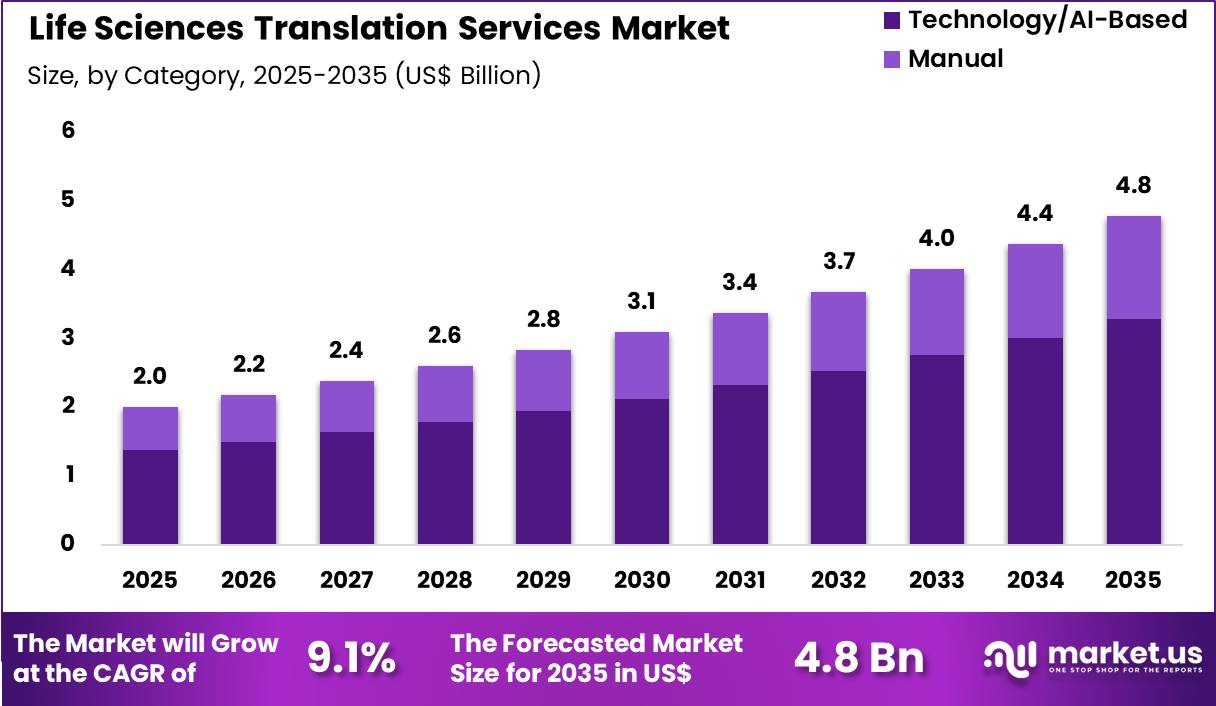
New York, NY – Nov 20 2026 – The Global Life Sciences Translation Services Market size is expected to be worth around US$ 4.8 Billion by 2035 from US$ 2.0 Billion in 2025, growing at a CAGR of 9.1% during the forecast period 2026-2035. In 2025, North America led the market, achieving over 46.2% share with a revenue of US$ 0.9 Billion.
Life sciences translation services play a vital role in supporting global communication across the pharmaceutical, biotechnology, medical device, and healthcare industries. These services involve the translation and localization of clinical trial documents, regulatory submissions, medical records, scientific publications, patient information leaflets, product labeling, and other technical content into multiple languages.
The growing globalization of clinical trials, increasing pharmaceutical research and development activities, and rising demand for international healthcare solutions are driving the adoption of life sciences translation services. Stringent regulatory requirements and the need for accurate medical communication across different regions are further supporting market growth.
Specialized translation providers are increasingly adopting advanced technologies, including artificial intelligence (AI), machine translation, and translation management systems, to improve efficiency, consistency, and turnaround times. However, human expertise and subject matter knowledge remain essential for ensuring linguistic accuracy, regulatory compliance, and cultural relevance.
North America and Europe represent significant markets due to their established pharmaceutical and biotechnology industries, while Asia-Pacific is expected to offer substantial growth opportunities supported by expanding clinical research activities and increasing healthcare investments.
Overall, the life sciences translation services market is expected to witness continued growth as pharmaceutical companies, healthcare organizations, and research institutions increasingly focus on global market expansion and effective multilingual communication.
Key Takeaways
- In 2025, the Life Sciences Translation Services Market was valued at US$ 2.0 Billion and is projected to grow at a CAGR of 9.1%, reaching approximately US$ 4.8 Billion by 2035.
- Based on service type, the market is segmented into clinical trial documentation, regulatory submission & compliance, medical device & technical documents, pharmaceutical & biotech content, patient education & healthcare, scientific & medical research, and others. Among these, medical device & technical documents dominated the market, accounting for a 38.4% share.
- Based on category, the market is segmented into manual and technology/AI-based services. The technology/AI-based segment held the leading position, capturing a significant market share of 68.7%.
- By end user, the market is categorized into healthcare professionals (HCPs), regulatory authorities, clinical research organizations (CROs) & researchers, marketing & regulatory teams, and others. Among these, clinical research organizations (CROs) & researchers emerged as the dominant segment, accounting for the largest revenue share of 28.4%.
- North America dominated the global market, accounting for the largest regional market share of 46.2%.
Key Market Segments
- Services Analysis: Medical device and technical documents dominated the services segment with a 38.4% market share, driven by increasing global medical device trade and stringent regulatory requirements. The growing need to translate product labels, safety instructions, technical specifications, and user manuals across multiple languages is supporting segment growth.
- Category Analysis: Technology and AI-based translation dominated the category segment with a 68.7% market share, supported by the growing adoption of machine translation, AI-powered localization, and automated language platforms. Increasing documentation volumes across pharmaceutical and biotechnology industries are driving demand for faster, cost-effective, and consistent multilingual translation solutions.
- End-User Analysis: Clinical research organizations (CROs) and researchers dominated the end-user segment with a 28.4% market share, driven by the increasing globalization of clinical trials and international research collaborations. Growing demand for multilingual patient consent forms, clinical protocols, investigator brochures, and regulatory documents is further supporting segment expansion.
Regional Analysis
North America Market Analysis
North America dominated the Life Sciences Translation Services Market in 2025, accounting for a market share of 38.8%. The region’s leadership is attributed to the strong presence of pharmaceutical companies, biotechnology firms, and medical device manufacturers, alongside increasing clinical research and regulatory activities.
The growing need for accurate translation of clinical trial documents, regulatory submissions, product labeling, and patient information is supporting market demand. Additionally, the expansion of multinational clinical trials and stringent regulatory compliance requirements are encouraging life sciences organizations to adopt specialized translation services. The increasing use of AI-assisted translation platforms and digital language management systems is further improving translation efficiency and accuracy across the region.
Asia Pacific Market Analysis
Asia Pacific is expected to register the highest CAGR during the forecast period, driven by expanding pharmaceutical manufacturing, clinical research activities, and biotechnology investments. Countries such as China, India, Japan, and South Korea are witnessing increasing participation in multinational clinical trials and international research collaborations.
Growing regulatory requirements, rising demand for multilingual medical documentation, and expanding CRO operations are supporting market growth. Furthermore, increasing investments in healthcare infrastructure, scientific research, and AI-powered translation technologies are expected to create significant growth opportunities for life sciences translation service providers across the region.
Emerging Trends
- Growing Adoption of AI-Powered Medical Translation: Artificial intelligence and machine translation are increasingly being used to manage large volumes of medical and scientific content. Translation providers are combining AI tools with human medical experts to improve translation speed, maintain terminology accuracy, and reduce processing time.
- Increasing Demand for Clinical Trial Document Translation: The expansion of clinical research across different countries is increasing demand for translated clinical trial documents. Informed consent forms, patient information sheets, research protocols, and safety documents must be available in languages understood by participants. The FDA recommends qualified translation procedures for clinical research involving non-English-speaking participants.
- Rising Focus on Regulatory Compliance and Localization: Pharmaceutical and biotechnology companies are giving greater attention to country-specific language requirements. Translation of regulatory submissions, product information, medical device instructions, and clinical documents is becoming important for supporting product approvals and international market entry. European Commission guidance identifies national-language requirements for certain clinical trial documents.
- Increasing Use of Multilingual Digital Healthcare Content: Healthcare providers and life sciences companies are expanding digital communication through patient portals, mobile applications, online medical resources, and electronic health platforms. This is increasing demand for translation of digital content, patient instructions, educational materials, and healthcare information into multiple languages.
- Greater Emphasis on Cultural Adaptation and Translation Quality: Translation services are moving beyond word-for-word conversion towards culturally appropriate communication. Medical terminology, patient instructions, and healthcare questionnaires are being adapted to local language and cultural needs. This approach supports better patient understanding and reduces the possibility of communication errors.
Use Cases
- Clinical Trial Documentation: Life sciences translation services are used to translate clinical trial protocols, informed consent forms, participant recruitment materials, and research instructions. These services help pharmaceutical companies conduct clinical studies across different countries while ensuring that participants understand the research process and their responsibilities.
- Pharmaceutical Product Information and Packaging: Pharmaceutical companies use translation services to localize medicine labels, packaging information, patient leaflets, dosage instructions, and product safety information. This helps ensure that patients, pharmacists, and healthcare professionals can understand important medicine-related information in their preferred languages.
- Medical Device Documentation: Medical device manufacturers require translation of user manuals, installation instructions, product specifications, safety warnings, and maintenance guidelines. These translations support the distribution and use of medical devices across international markets while helping users understand proper operating procedures.
- Regulatory and Scientific Documentation: Translation services are used for regulatory submissions, clinical evaluation reports, scientific publications, research papers, and pharmacovigilance documentation. Pharmaceutical and biotechnology companies depend on accurate translations to communicate scientific findings and provide supporting documents to regulatory authorities in different countries.
- Patient Education and Healthcare Communication: Hospitals, healthcare providers, and pharmaceutical companies use translated materials for patient education, disease awareness campaigns, treatment instructions, and post-treatment care information. These services help improve patient understanding and make healthcare information more accessible to linguistically diverse populations.
Frequently Asked Questions About Life Sciences Translation Services
- Why are translation services important in the life sciences industry?
Translation services help pharmaceutical companies, healthcare providers, and research organizations communicate medical information across different languages. They support patient safety, improve access to healthcare information, and help international research activities meet language requirements. - What types of documents require life sciences translation services?
Common documents include clinical trial protocols, informed consent forms, medical reports, pharmaceutical labels, patient information leaflets, regulatory submissions, medical device manuals, scientific publications, and drug safety documentation. - Which industries use life sciences translation services?
The major end users include pharmaceutical companies, biotechnology organizations, medical device manufacturers, hospitals, clinical research organizations, healthcare institutions, diagnostic laboratories, and academic research centers requiring accurate multilingual medical and scientific communication. - What is the role of medical terminology in life sciences translation?
Medical terminology ensures that scientific concepts, disease names, treatment instructions, drug information, and clinical findings retain their intended meaning. Consistent terminology is essential for reducing misunderstandings and maintaining accuracy across translated healthcare documents. - What are the major factors driving the life sciences translation services market?
Market growth is supported by increasing international clinical trials, pharmaceutical exports, biotechnology research, regulatory documentation requirements, medical device commercialization, and rising demand for multilingual healthcare information across developed and emerging economies. - Which segment holds a significant position in the life sciences translation services market?
Clinical trial translation represents an important service segment due to the need for multilingual informed consent forms, patient recruitment materials, research protocols, and safety documentation in international clinical studies. - How is globalization influencing the life sciences translation services market?
Globalization is increasing collaboration between pharmaceutical companies, research institutions, and healthcare organizations across countries. This is creating demand for multilingual regulatory documents, clinical research materials, product information, and scientific publications. - What role does technology play in the growth of this market?
Translation management systems, artificial intelligence, machine translation, and terminology databases are improving document processing and workflow management. These technologies help providers manage multilingual projects while supporting consistency and operational efficiency.
Conclusion
The Life Sciences Translation Services Market is expected to experience significant growth, supported by the globalization of clinical trials, increasing pharmaceutical and biotechnology research, and rising demand for multilingual healthcare communication. The growing adoption of AI-powered translation technologies and localization solutions is improving operational efficiency, while human expertise remains essential for maintaining medical accuracy and regulatory compliance.
Medical device documentation and technology-based translation services represent key market segments, while North America maintains a strong market position. Meanwhile, Asia-Pacific is expected to offer substantial growth opportunities. Overall, increasing international healthcare activities and regulatory requirements will continue to support market expansion.
Discuss your needs with our analyst
Please share your requirements with more details so our analyst can check if they can solve your problem(s)