


Overview
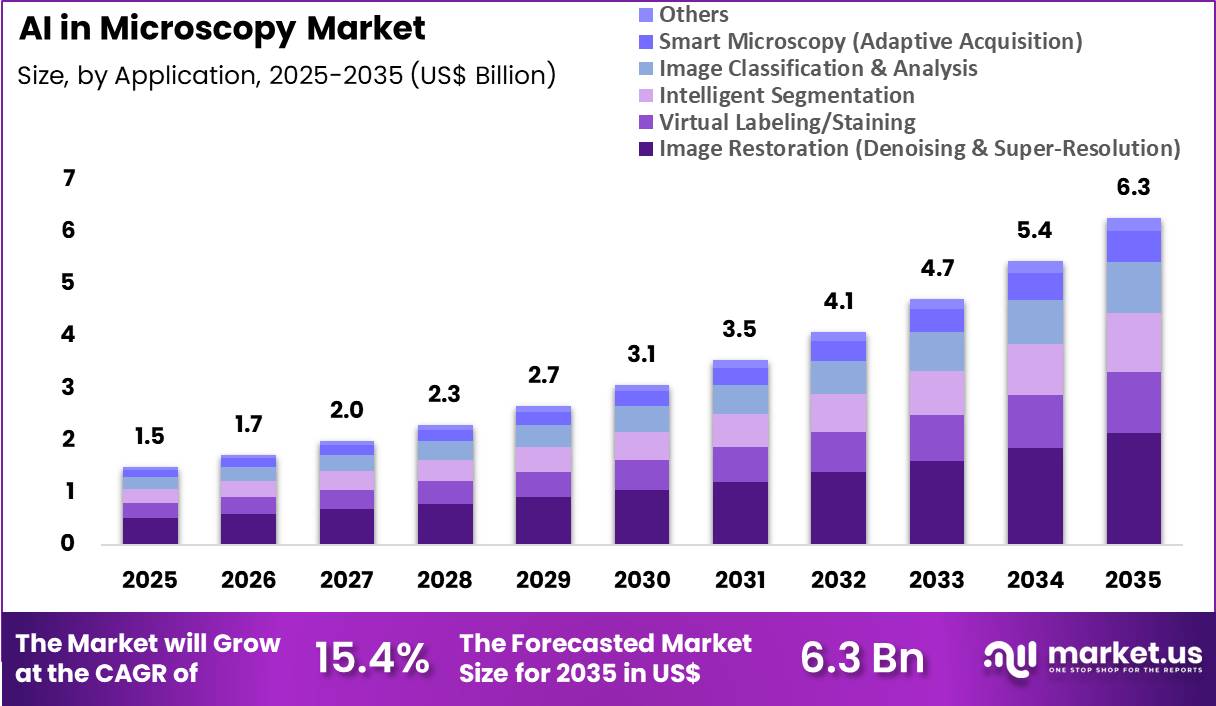
New York, NY – Nov 20 2026 – The Global AI in Microscopy Market size is expected to be worth around US$ 6.3 Billion by 2035 from US$ 1.5 Billion in 2025, growing at a CAGR of 15.4% during the forecast period 2026-2035. In 2025, North America led the market, achieving over 53.1% share with a revenue of US$ 0.8 Billion.
Artificial Intelligence (AI) in microscopy is emerging as a transformative technology that is improving the way microscopic images are captured, processed, analyzed, and interpreted. By integrating machine learning, deep learning, and computer vision technologies, AI-powered microscopy systems are enabling faster, more accurate, and automated analysis of complex biological, chemical, and material samples.
AI algorithms can identify patterns, detect abnormalities, classify cells, measure microscopic structures, and enhance image quality with reduced manual intervention. These capabilities are supporting applications across healthcare, life sciences, biotechnology, pharmaceutical research, materials science, and academic laboratories.
The adoption of AI in microscopy is being driven by the growing demand for high-throughput imaging, precision diagnostics, automated laboratory workflows, and advanced research capabilities. Furthermore, AI-based image reconstruction and noise reduction techniques are helping researchers obtain clearer images while improving imaging efficiency.
With continuous advancements in computational imaging, digital pathology, and automated microscopy platforms, AI is expected to play an increasingly important role in scientific discovery and laboratory operations. The integration of AI with microscopy is creating new opportunities for innovation, improved productivity, and data-driven decision-making across research and industrial applications.
Key Takeaways
- In 2025, the global market was valued at US$ 1.5 Billion and is projected to grow at a CAGR of 15.4%, reaching approximately US$ 6.3 Billion by 2035.
- Based on application, the market is segmented into image restoration (denoising & super-resolution), virtual labeling/staining, intelligent segmentation, image classification & analysis, smart microscopy (adaptive acquisition), and others. Among these, image restoration (denoising & super-resolution) dominated the market, accounting for a share of 34.2%.
- By microscopy type, the market is categorized into optical microscopy, fluorescence microscopy, electron microscopy, and others. Optical microscopy emerged as the leading segment, capturing a market share of 49.2%.
- Based on end use, the market is segmented into hospital laboratories, pharmaceutical & biotechnology companies, academic & research institutes, clinical research laboratories, and others. Hospital laboratories dominated the segment, accounting for the largest revenue share of 48.5%.
- Regionally, North America dominated the global market, accounting for a significant revenue share of 53.1%.
Key Market Segments
- Application Analysis: Image restoration dominated the application segment, accounting for 34.2% of the market share. Its growth is driven by the increasing demand for high-quality microscopy images through AI-powered denoising and super-resolution technologies. These solutions improve image clarity, recover structural details, reduce imaging time, and support more accurate downstream analysis.
- Microscopy Type Analysis: Optical microscopy dominated the microscopy type segment, capturing a 49.2% market share. Its leadership is attributed to widespread adoption across hospitals, diagnostic laboratories, pathology, and biological research. The integration of AI-powered image enhancement and automated interpretation is further supporting its adoption, particularly in digital pathology and routine clinical workflows.
- End-Use Analysis: Hospital laboratories dominated the end-use segment, accounting for 48.5% of the market share. This dominance is driven by high diagnostic testing volumes, increasing pathology workloads, and growing adoption of digital laboratory solutions. AI-powered microscopy supports image enhancement, automated analysis, faster turnaround times, and improved diagnostic consistency across hospital laboratories.
Regional Analysis
North America Market Analysis
North America dominated the AI in Microscopy Market in 2025, accounting for 39.2% of the global market share. This leadership is attributed to substantial investments in research and development, advanced healthcare infrastructure, and the growing adoption of AI-powered imaging technologies. Research laboratories, pharmaceutical companies, and academic institutions across the United States and Canada are increasingly integrating machine learning with microscopy to automate image analysis and improve research efficiency.
Furthermore, rising demand for high-throughput drug discovery, precision medicine, and digital pathology is supporting regional market growth. Strong research funding and continuous technological advancements are further strengthening the adoption of intelligent microscopy solutions across the region.
Asia Pacific Market Analysis
Asia Pacific is expected to register the highest CAGR during the forecast period, driven by increasing investments in biotechnology, artificial intelligence, and scientific research infrastructure. Countries such as China, Japan, South Korea, and Singapore are actively advancing microscopy technologies across life sciences, healthcare, and semiconductor manufacturing.
Growing pharmaceutical research activities and the adoption of AI-driven imaging platforms are further supporting regional expansion. Additionally, government initiatives, expanding academic research capabilities, and increasing investments in computational biology and digital pathology are expected to accelerate the adoption of AI-powered microscopy solutions across the region.
Emerging Trends
- Increasing Adoption of Deep Learning for Image Analysis: Deep learning is increasingly being integrated into microscopy systems to automate image classification, cell identification, and image segmentation. These technologies help researchers analyse complex microscopic images, reduce manual work, and identify patterns that may not be easily detected through conventional methods.
- Development of Self-Driving and Automated Microscopes: AI-powered microscopes are moving towards automated image acquisition, where software can adjust imaging conditions and select important areas for examination. This development is expected to reduce manual intervention, improve imaging efficiency, and support continuous observation of biological samples.
- Growing Use of AI in Live-Cell Imaging: AI is increasingly being applied to live-cell microscopy to monitor cell movement, growth, division, and responses to external conditions. Automated tracking and image analysis are helping researchers study biological processes over time while reducing the need for repeated manual observations.
- Integration of Generative AI and Advanced Image Reconstruction: Generative AI models are creating new opportunities to improve microscopic image reconstruction, remove image noise, and recover useful information from incomplete or low-quality images. These developments can support high-resolution imaging and improve the analysis of complex biological samples.
- Expansion of AI-Based Quantitative and Label-Free Microscopy: AI-enabled quantitative microscopy is gaining attention because it can extract measurable information about cells without always requiring conventional staining methods. Digital holographic microscopy and related approaches are supporting non-invasive cellular analysis and creating opportunities for more accessible diagnostic systems.
Use Cases
- Cancer Cell Detection and Tissue Examination: AI-powered microscopy is being used to identify abnormal cells, classify tissue structures, and examine microscopic changes associated with cancer. These capabilities can support pathologists in analysing tissue samples, identifying suspicious regions, and improving the consistency of diagnostic workflows.
- Blood Cell Analysis and Malaria Detection: AI-based digital microscopy can assist laboratories in identifying and counting blood cells and detecting malaria parasites. Automated image examination can reduce repetitive manual tasks and support diagnostic services, particularly in laboratories where experienced microscopy specialists are limited.
- Drug Discovery and Pharmaceutical Research: AI-assisted microscopy enables researchers to observe cellular responses to experimental drug compounds and compare changes across different samples. This supports high-content screening, cell-based experiments, and the identification of promising drug candidates during early pharmaceutical research.
- Microbiology and Infectious Disease Research: AI can analyse microscopic images of bacteria, viruses, and other microorganisms to identify structures and monitor biological changes. Researchers can use automated image processing to study infection-related cellular activities and investigate interactions between microorganisms and host cells.
- Immunology and Cellular Behaviour Analysis: AI-enabled microscopy can support the examination of immune cells, cell interactions, and tissue environments. Researchers can use automated segmentation and cell tracking to study immune responses, cellular movement, and changes in tissue structures during experimental investigations.
Frequently Asked Questions About AI in Microscopy
- How does artificial intelligence improve microscopy?
Artificial intelligence improves microscopy by automating image analysis, identifying complex patterns, enhancing image quality, and reducing repetitive manual tasks. It also helps researchers obtain quantitative information from biological samples with greater efficiency. - Which AI technologies are used in microscopy?
The major technologies include machine learning, deep learning, convolutional neural networks, image segmentation algorithms, generative AI, and computer vision. These technologies are used for image classification, cell detection, image reconstruction, and automated analysis. - What types of microscopy can benefit from AI?
AI can be integrated with fluorescence microscopy, optical microscopy, electron microscopy, digital holographic microscopy, and super-resolution microscopy. Its applications include image enhancement, cellular identification, automated observation, and quantitative biological analysis. - Can AI in microscopy support medical diagnosis?
Yes, AI-assisted microscopy can support medical diagnosis by analysing blood samples, identifying abnormal cells, detecting parasites, and examining tissue images. However, clinical use requires appropriate validation and, where applicable, regulatory authorization. - What are the major benefits of AI in microscopy?
The major benefits include faster image analysis, reduced manual workload, improved image consistency, automated cell counting, better image reconstruction, and the ability to examine complex biological samples more efficiently in research and diagnostic laboratories. - What are the major factors driving the AI in Microscopy market?
The market is being supported by increasing demand for laboratory automation, advancements in deep learning, growing biomedical research activities, rising diagnostic requirements, and the need for faster and more accurate microscopic image analysis. - What role does AI play in pharmaceutical research and drug discovery?
AI-powered microscopy helps pharmaceutical researchers examine cellular responses to drug compounds, conduct high-content screening, and monitor biological changes. These capabilities support experimental research and help identify potential drug candidates during early-stage development. - What is the future outlook for the AI in Microscopy market?
The future development of this market is expected to be influenced by automated microscopy, generative AI, advanced image reconstruction, and real-time cellular analysis. These technologies may expand adoption across healthcare, biotechnology, and pharmaceutical research.
Conclusion
The AI in Microscopy market is expected to witness significant growth, driven by increasing demand for automated imaging, advanced image analysis, and precision diagnostics. The integration of machine learning, deep learning, and computer vision is improving image quality, reducing manual workloads, and supporting faster research outcomes.
Growing applications across hospital laboratories, pharmaceutical companies, biotechnology, and academic research institutions are further strengthening market adoption. Additionally, advancements in digital pathology, live-cell imaging, and automated microscopy are creating new growth opportunities. With continuous technological innovation and rising investments in healthcare and research infrastructure, the market is expected to experience strong expansion during the forecast period.
Discuss your needs with our analyst
Please share your requirements with more details so our analyst can check if they can solve your problem(s)



