
Overview
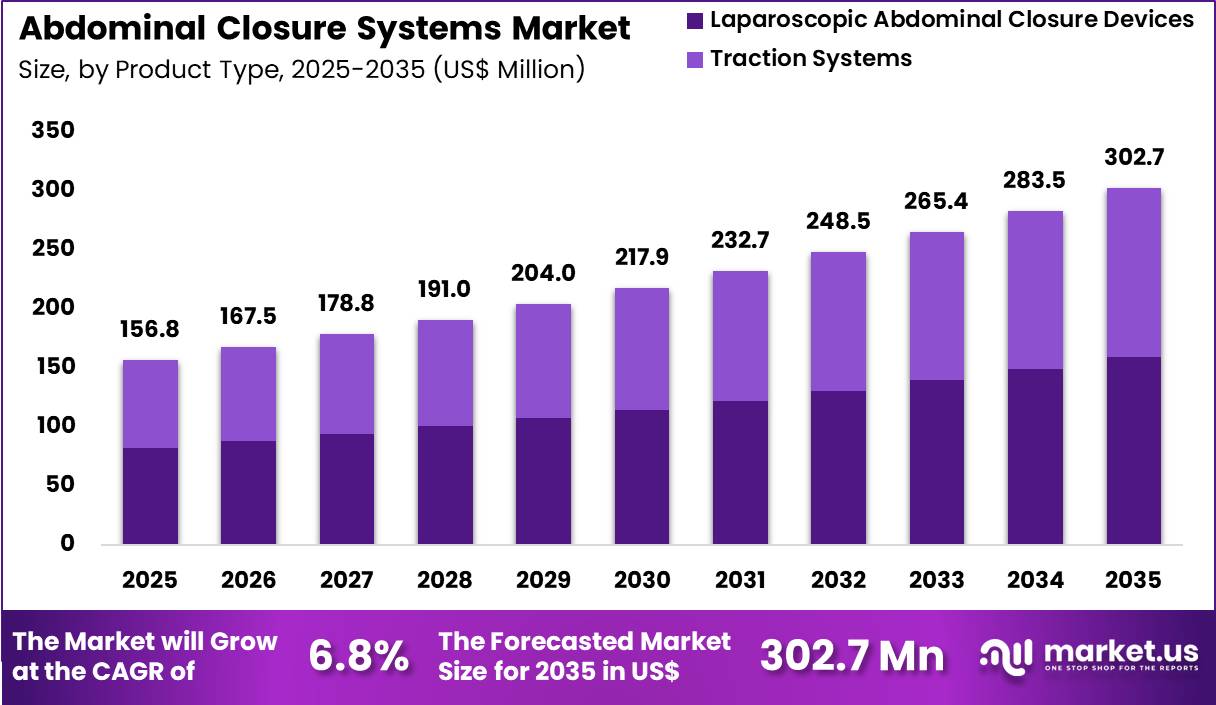
New York, NY – Nov 18 2026 – The Global Abdominal Closure Systems Market size is expected to be worth around US$ 302.7 Million by 2035 from US$ 156.8 Million in 2025, growing at a CAGR of 6.8% during the forecast period 2026-2035. In 2025, North America led the market, achieving over 45.3% share with a revenue of US$ 71.0 Million.
Abdominal Closure Systems are medical devices and surgical products used to close abdominal incisions following surgical procedures. These systems play an important role in maintaining wound integrity, supporting tissue healing, and reducing the risk of postoperative complications, including surgical site infections, wound dehiscence, and incisional hernias.
The market includes various products, such as sutures, surgical meshes, staples, tissue adhesives, and advanced wound closure devices. These solutions are widely used in general surgery, laparoscopic procedures, emergency surgeries, and other abdominal interventions. Increasing surgical volumes, a growing prevalence of chronic diseases, and the rising number of abdominal procedures are among the major factors supporting market growth.
Furthermore, technological advancements in surgical materials, the development of absorbable and biocompatible products, and the increasing adoption of minimally invasive surgical techniques are contributing to market expansion. Healthcare providers are increasingly focusing on effective wound management, faster patient recovery, and reduced hospital stays, further supporting demand for advanced abdominal closure solutions.
With continuous improvements in surgical technologies and growing investments in healthcare infrastructure, the global Abdominal Closure Systems market is expected to witness promising growth opportunities in the coming years.
Key Takeaways
- In 2025, the Abdominal Closure Systems market was valued at US$ 156.8 Million and is projected to grow at a CAGR of 6.8%, reaching US$ 302.7 Million by 2035.
- Based on product type, the market is segmented into laparoscopic abdominal closure devices and traction systems. Laparoscopic abdominal closure devices dominated the segment, accounting for a market share of 52.6%.
- By material type, the market is categorized into absorbable and non-absorbable materials. The non-absorbable segment held the dominant position, capturing 56.4% of the market share.
- Based on application, the market is segmented into general surgery, gynecology surgery, urology surgery, oncological surgery, and others. General surgery emerged as the leading segment, accounting for 45.3% of the total market revenue.
- By end user, the market is divided into hospitals, ambulatory surgical centers, and others. Hospitals dominated the segment, contributing 55.9% of the market revenue.
- Regionally, North America dominated the global Abdominal Closure Systems market, accounting for the largest market share of 45.3%.
Key Market Segments
- Product Type Analysis: Laparoscopic abdominal closure devices held a dominant share of 52.6% in the product type segment, driven by the increasing adoption of minimally invasive surgical procedures. These devices provide secure trocar-site closure, improved suturing precision, and reduced risk of postoperative complications. Growing demand for faster patient recovery and shorter hospital stays is expected to support segment growth.
- Material Type Analysis: Non-absorbable materials dominated the material type segment, accounting for 56.4% of the market share. Their strong tensile strength, durability, and reliable wound support make them suitable for abdominal wall closure procedures. Increasing demand for secure fascial approximation, reduced wound failure risks, and long-term mechanical stability is expected to sustain the segment’s leading position.
- Application Analysis: General surgery represents the leading application segment, accounting for 45.3% of the market share. The segment’s dominance is attributed to the high volume of abdominal procedures, including hernia repair, bowel surgery, and appendectomy. Increasing surgical interventions, growing adoption of minimally invasive techniques, and rising demand for effective wound closure solutions are supporting segment expansion.
- End-User Analysis: Hospitals dominated the end-user segment, accounting for 55.9% of the market share. Their leading position is supported by high surgical volumes, advanced operating room infrastructure, and the availability of specialized surgical teams. Increasing hospital investments in minimally invasive surgical technologies and rising demand for advanced abdominal procedures are expected to drive continued adoption of closure systems.
Regional Analysis
North America Dominates the Abdominal Closure Systems Market
North America dominated the Abdominal Closure Systems market in 2025, accounting for 45.3% of the global market share. The region’s leadership is supported by high surgical volumes, advanced healthcare infrastructure, and increasing adoption of innovative wound closure technologies. Rising prevalence of obesity, gastrointestinal disorders, and chronic diseases has further increased demand for abdominal surgical procedures.
Additionally, growing adoption of minimally invasive and robotic surgeries, along with advancements in antimicrobial sutures, surgical meshes, and biomaterials, is supporting regional market expansion. Strong investments in surgical facilities and advanced postoperative care are expected to sustain North America’s leading position.
Asia Pacific Expected to Register the Highest CAGR
Asia Pacific is expected to register the highest CAGR during the forecast period, driven by expanding healthcare infrastructure, increasing surgical volumes, and improving access to advanced medical technologies. Rising cases of abdominal hernias, gastrointestinal disorders, and age-related conditions are contributing to demand for effective closure solutions.
Countries such as China, India, and Japan are increasing investments in hospital infrastructure, surgical equipment, and medical training. Furthermore, growing adoption of minimally invasive procedures and cost-effective closure technologies is expected to create significant growth opportunities across the region.
Emerging Trends
- Increasing Adoption of Antimicrobial-Coated Sutures: The adoption of antimicrobial-coated sutures is increasing as healthcare providers focus on reducing surgical site infections. These sutures contain antimicrobial agents, such as triclosan, which help limit bacterial growth around surgical wounds. A 2025 systematic review published in JAMA Network Open, covering 17,968 patients across 31 randomized trials, reported fewer surgical site infections with triclosan-containing sutures.
- Growing Preference for Small-Bite Suturing Techniques: Small-bite suturing is gaining attention in abdominal wall closure because it can reduce the risk of complications, particularly incisional hernias. European and American Hernia Society guidelines suggest continuous small-bite closure using slowly absorbable sutures for elective midline abdominal surgery. This approach supports better abdominal wall healing.
- Increasing Use of Prophylactic Mesh Reinforcement: Prophylactic mesh reinforcement is becoming an important approach for patients undergoing selected abdominal surgeries with a higher risk of incisional hernias. Synthetic mesh is placed alongside conventional sutures to provide additional abdominal wall support. Clinical guidelines recognize this technique as an option for reducing hernia development after elective midline laparotomy.
- Development of Advanced and Device-Assisted Closure Systems: Medical device manufacturers are developing specialized instruments to improve the consistency and efficiency of abdominal wound closure. For example, the FDA-cleared Suture-TOOL System is intended for abdominal wall closure following laparotomy in adults. Such developments indicate growing interest in dedicated closure instruments.
- Greater Focus on Minimally Invasive Surgical Closure: The growing use of laparoscopic procedures is influencing abdominal closure requirements. Surgeons are paying greater attention to closing larger trocar openings to prevent postoperative complications, including port-site hernias. Guidelines recommend fascial closure of laparoscopic trocar sites measuring 10 mm or larger, particularly around the umbilicus.
Use Cases
- Open Abdominal Surgery (Laparotomy): Abdominal closure systems are widely used following laparotomy procedures involving large abdominal incisions. These systems help surgeons close the fascia and other tissue layers after operations involving the digestive system, liver, pancreas, and other abdominal organs. Appropriate closure techniques help maintain abdominal wall strength.
- Hernia Repair Procedures: Abdominal closure products are used during hernia repair surgeries to restore abdominal wall integrity and provide support to weakened tissues. Sutures and surgical meshes are selected according to the hernia type and surgical approach. Mesh reinforcement is particularly relevant in procedures requiring additional structural support.
- Laparoscopic and Robotic Abdominal Surgeries: Closure systems are used to close access points created during laparoscopic and robotic abdominal procedures. Specialized sutures and closure instruments help secure larger trocar openings, particularly those measuring 10 mm or more. Proper closure is important for reducing the possibility of port-site hernia formation.
- Caesarean Section and Obstetric Surgeries: Abdominal closure systems are used during caesarean deliveries to close surgical incisions after childbirth. Sutures and other wound closure materials are selected according to the tissue layer and clinical requirements. NICE recommends considering sutures instead of staples for skin closure to reduce superficial wound separation.
- Emergency Abdominal and Trauma Surgeries: Abdominal closure systems are used in emergency procedures involving abdominal injuries, internal bleeding, and other urgent surgical conditions. Depending on the patient’s condition, surgeons may use different suturing techniques and materials to close the abdominal wall or manage complex wounds.
Frequently Asked Questions About Abdominal Closure Systems
- What are the main types of abdominal closure systems?
The main types include absorbable sutures, non-absorbable sutures, surgical staples, mesh-based closure products, and specialized suturing devices. Each type is selected according to the surgical procedure, tissue requirements, and expected healing period. - What materials are commonly used in abdominal closure systems?
Common materials include polypropylene, polydioxanone, polyglactin, polyglycolic acid, and stainless steel. These materials offer different levels of strength, flexibility, and absorption, allowing surgeons to select suitable products for different abdominal closure requirements. - Why are absorbable sutures used in abdominal surgeries?
Absorbable sutures are designed to gradually break down inside the body over time. They are commonly selected when temporary tissue support is required, reducing the need for surgical removal after the healing process is sufficiently advanced. - What factors influence the selection of abdominal closure systems?
Product selection depends on incision size, surgical technique, tissue strength, infection risk, patient health, and expected healing time. Surgeons also consider product handling, material properties, closure strength, and the possibility of postoperative complications. - How do abdominal closure systems help prevent surgical complications?
Appropriate closure systems help maintain tissue alignment and abdominal wall strength after surgery. Selecting suitable materials and techniques can reduce the risk of wound separation, surgical site infections, and incisional hernias, although outcomes depend on several clinical factors. - What is the difference between absorbable and non-absorbable abdominal sutures?
Absorbable sutures gradually break down through biological processes, whereas non-absorbable sutures retain their strength for longer periods. The choice depends on the required duration of tissue support, surgical location, and individual patient requirements. - What role does surgical mesh play in abdominal closure?
Surgical mesh provides additional reinforcement to weakened abdominal tissues. It is commonly used in hernia repair and selected high-risk abdominal closures to improve structural support and reduce the likelihood of incisional hernia development. - Which factors are creating opportunities in the abdominal closure systems market?
Opportunities are emerging from antimicrobial sutures, advanced biomaterials, device-assisted closure technologies, and mesh reinforcement solutions. Increasing attention to surgical safety and reducing postoperative complications is also encouraging healthcare providers to consider improved closure products.
Conclusion
The global Abdominal Closure Systems market is expected to experience steady growth, supported by increasing surgical volumes, rising prevalence of abdominal disorders, and growing adoption of minimally invasive procedures. Advancements in absorbable materials, antimicrobial sutures, surgical meshes, and device-assisted closure technologies are further strengthening market development.
North America is expected to maintain its leading position, while Asia Pacific is anticipated to offer significant growth opportunities due to expanding healthcare infrastructure and improving access to surgical care. Furthermore, increasing emphasis on infection prevention, effective wound healing, and reduced postoperative complications is expected to drive demand for advanced abdominal closure solutions through 2035.
Discuss your needs with our analyst
Please share your requirements with more details so our analyst can check if they can solve your problem(s)