
Overview
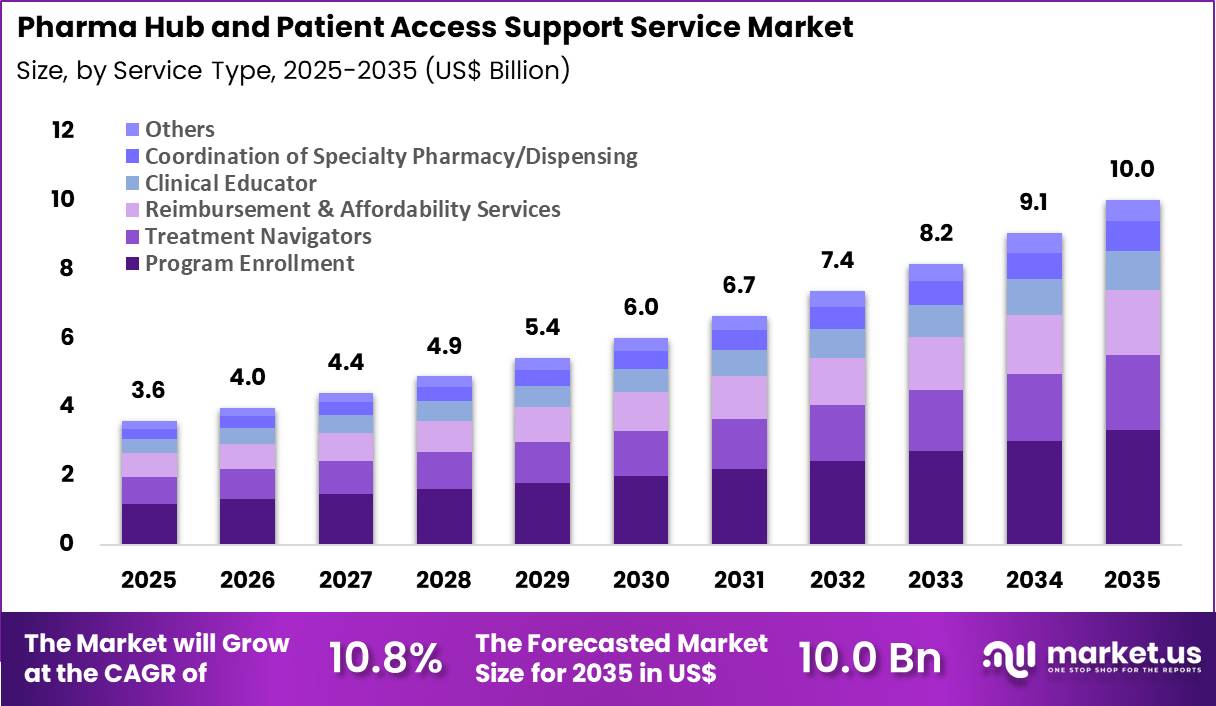
New York, NY – Nov 20 2026 – The Global Pharma Hub and Patient Access Support Service Market size is expected to be worth around US$ 10.0 Billion by 2035 from US$ 3.6 Billion in 2025, growing at a CAGR of 10.8% during the forecast period 2026-2035. In 2025, North America led the market, achieving over 45.6% share with a revenue of US$ 1.7 Billion.
Pharma Hub and Patient Access Support Services play an important role in improving patient experiences and supporting access to prescribed medications and healthcare solutions. These services are designed to simplify the patient journey by providing coordinated assistance, reliable information, and ongoing support throughout the treatment process.
Pharma Hub services typically include patient enrollment, benefits verification, insurance and reimbursement assistance, prescription coordination, medication access support, and treatment-related guidance. By connecting patients, healthcare professionals, pharmaceutical companies, pharmacies, and other stakeholders, these services help address common barriers to treatment access.
Patient Access Support Services are increasingly being adopted to improve treatment initiation, support medication adherence, and enhance continuity of care. Personalized assistance, patient education, financial support coordination, and follow-up services are among the key components contributing to improved patient engagement.
The growing focus on patient-centric healthcare, increasing complexity of specialty medications, and rising demand for streamlined access solutions are supporting the importance of Pharma Hub and Patient Access Support Services.
With the continued advancement of digital healthcare platforms and integrated patient support solutions, the sector is expected to play an increasingly significant role in strengthening healthcare accessibility, operational efficiency, and overall patient experience.
Key Takeaways
- In 2025, the market was valued at US$ 3.6 billion and is projected to grow at a CAGR of 10.8%, reaching US$ 10.0 billion by 2035.
- Based on service type, the market is segmented into program enrollment, treatment navigators, reimbursement & affordability services, clinical educators, specialty pharmacy/dispensing coordination, and others. Among these, program enrollment dominated the market with a 33.2% share.
- Based on end users, the market is categorized into healthcare providers (HCPs) & staff, pharmaceutical manufacturers, specialty pharmacies (SPs), and others. Healthcare providers (HCPs) & staff accounted for the largest market share of 52.1%.
- Regionally, North America dominated the global market, accounting for a 45.6% share.
Key Market Segments
- Service Type Analysis: Program enrollment dominated the service type segment, accounting for 33.2% of the market. Its leading position is attributed to its role in simplifying patient onboarding, benefit verification, consent collection, and prior authorization processes. Increasing adoption of specialty therapies and the need for faster treatment initiation are expected to support segment growth.
- End-User Analysis: Healthcare providers (HCPs) and staff dominated the end-user segment, accounting for 52.1% of the market. This leadership is driven by their growing reliance on hub services for benefit verification, prior authorization, reimbursement assistance, and patient coordination. Rising administrative workloads and increasing specialty treatment complexity are expected to further strengthen demand from this segment.
Regional Analysis
North America Market Analysis
North America dominated the Pharma Hub and Patient Access Support Service Market, accounting for 45.6% of the market share in 2025. This leadership is attributed to the strong presence of pharmaceutical manufacturers, increasing adoption of specialty medicines, and growing demand for patient assistance programs.
Rising healthcare expenditure and complex insurance procedures have further increased the need for benefit verification, prior authorization, reimbursement assistance, and patient enrollment services. Additionally, pharmaceutical companies and healthcare providers are increasingly adopting digital patient support platforms to improve treatment access, medication adherence, and patient engagement. These factors are expected to sustain regional market growth.
Asia Pacific Market Analysis
Asia Pacific is expected to register the highest CAGR during the forecast period, supported by expanding healthcare infrastructure, increasing pharmaceutical investments, and improving access to advanced therapies. Countries such as China, India, Japan, and South Korea are strengthening healthcare coverage and reimbursement systems.
Furthermore, growing adoption of digital healthcare platforms, rising specialty medicine demand, and increasing collaboration between pharmaceutical companies and healthcare providers are expected to accelerate the adoption of patient access support services across the region.
Emerging Trends
- Increasing adoption of digital patient support platforms: Pharmaceutical companies are increasingly adopting digital platforms to manage patient enrolment, treatment information, prescription status, and financial assistance. These platforms help patients access support services more easily while allowing service providers to manage patient information and communication more efficiently.
- Growing focus on electronic prior authorization: Electronic prior authorization is becoming an important part of patient access services. Digital processes help healthcare providers submit coverage requests, share supporting documents, and track decisions. is advancing standardized electronic processes to reduce administrative work and improve access to medically necessary treatments.
- Expansion of patient financial assistance programs: Pharmaceutical manufacturers are expanding financial support initiatives to help eligible patients manage prescription costs. These programs include copay assistance, free medicines, and patient assistance programs. recognizes manufacturer-sponsored programs as a source of financial assistance for eligible low-income individuals.
- Greater use of connected healthcare data: The use of connected healthcare information is increasing across patient support services. Standardized data exchange allows authorized healthcare stakeholders to access relevant patient information, improve coordination, and reduce repeated administrative steps. is promoting FHIR-based APIs to support better information sharing.
- Stronger focus on patient-centric treatment support: Pharma hubs are increasingly designed around individual patient requirements rather than only prescription processing. Services such as treatment education, appointment coordination, medication reminders, and ongoing patient communication are being used to support patients throughout their treatment journey.
- Development of integrated patient communication channels: Patient support providers are increasingly using multiple communication channels, including phone calls, email, text messages, and online portals. These channels allow patients to receive prescription updates, assistance information, treatment instructions, and service notifications through convenient communication methods.
- Growing importance of patient data analytics: Pharmaceutical companies are placing greater importance on analysing patient support information. Data related to enrolment, treatment continuation, access delays, and service usage can help identify patient needs, improve support processes, and measure program performance.
- Greater attention to reducing administrative burden: Pharma hubs are increasingly focusing on reducing paperwork and repeated administrative activities for healthcare providers. Standardized digital workflows, electronic documentation, and connected healthcare systems are helping simplify patient access processes. has identified reduced administrative burden as an important objective of healthcare interoperability initiatives.
Use Cases
- Patient enrolment and onboarding: Pharma hubs are used to register patients into manufacturer-sponsored support programs. The process includes collecting necessary patient information, confirming eligibility, obtaining required consent, and coordinating with healthcare providers to initiate the appropriate support services.
- Insurance verification and benefits investigation: Pharma hubs help healthcare providers and patients understand prescription coverage under their insurance plans. Benefits investigation involves checking coverage conditions, patient cost-sharing requirements, preferred pharmacies, and other insurance-related requirements before treatment begins.
- Prior authorization and appeals management: Pharma hub service teams assist healthcare providers with prior authorization documentation, submission tracking, and communication with insurance companies. When coverage requests are denied, administrative support may also be provided for gathering documents and coordinating appeal submissions.
- Copay assistance and patient financial support: Pharmaceutical manufacturers use patient support programs to provide eligible patients with financial assistance. Pharma hubs help manage program applications, verify eligibility, process copay support, and communicate available assistance options to patients facing prescription affordability challenges.
- Medication safety and treatment monitoring: Pharma hubs support medicines requiring additional safety procedures by coordinating patient registration, safety education, required testing, and follow-up documentation. These activities are particularly important for medicines covered by FDA-mandated REMS programs.
Frequently Asked Questions About Pharma Hub and Patient Access Support Service
- What are patient access support services?
Patient access support services help individuals obtain prescribed medicines by addressing financial, insurance, and administrative challenges. These services include benefits investigation, prior authorization assistance, copay support, patient education, and coordination with healthcare providers. - How do pharma hubs help patients access medicines?
Pharma hubs help patients navigate prescription coverage, insurance requirements, financial assistance applications, and pharmacy coordination. By managing these activities, they can reduce administrative difficulties and support a smoother process from prescription initiation to medicine access. - What services are commonly offered by pharma hubs?
Common pharma hub services include patient enrolment, insurance verification, prior authorization support, copay assistance, patient education, prescription tracking, pharmacy coordination, and treatment follow-up. The service mix generally depends on manufacturer requirements and medication characteristics. - Who uses pharma hub services?
Pharmaceutical manufacturers are the primary customers of pharma hub services. Patients, healthcare providers, specialty pharmacies, insurers, and other healthcare organizations also interact with these platforms to coordinate prescription access, financial assistance, and treatment-related activities. - How does technology improve pharma hub operations?
Technology helps pharma hubs automate patient enrolment, insurance verification, documentation, communication, and prescription tracking. Digital platforms and healthcare data exchange can improve operational efficiency, reduce manual work, and support better coordination among healthcare stakeholders. - What factors are driving the growth of this market?
Market growth is supported by increasing specialty medicine usage, complex insurance requirements, rising prescription costs, and growing demand for patient-focused healthcare services. Pharmaceutical manufacturers are also investing in support programs to improve medicine accessibility and patient experience. - How does the growing specialty pharmaceutical sector influence this market?
The increasing use of specialty medicines creates demand for services such as complex insurance verification, financial assistance, pharmacy coordination, and treatment monitoring. These requirements increase the importance of centralized patient support platforms within pharmaceutical operations. - What role does government regulation play in this market?
Government regulations influence patient data management, prescription coverage processes, drug safety requirements, and healthcare information exchange. FDA REMS requirements and CMS interoperability policies are important examples affecting how patient support activities are managed.
Conclusion
The Pharma Hub and Patient Access Support Service market is witnessing steady growth, driven by increasing demand for patient-centric healthcare solutions, rising specialty medication usage, and the need for simplified treatment access. Digital platforms, financial assistance programs, insurance verification, and integrated patient support services are improving treatment coordination and patient engagement.
North America currently holds a leading market position, while Asia Pacific is expected to offer significant growth opportunities during the forecast period. Furthermore, increasing pharmaceutical investments and advancements in healthcare technology are expected to strengthen market development. Overall, the market is expected to experience promising growth through 2035.
Discuss your needs with our analyst
Please share your requirements with more details so our analyst can check if they can solve your problem(s)