


Overview
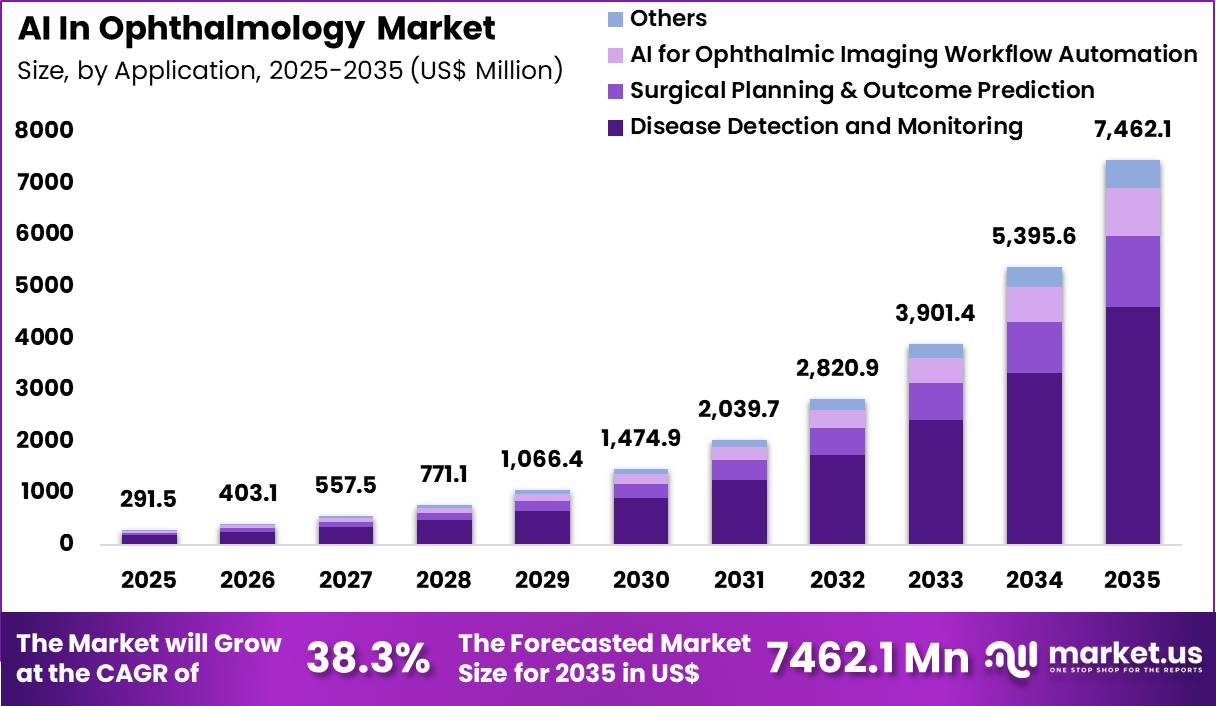
New York, NY – Nov 19 2026 – The Global AI In Ophthalmology Market size is expected to be worth around US$ 7462.1 Million by 2035 from US$ 291.5 Million in 2025, growing at a CAGR of 38.3% during the forecast period 2026-2035. In 2025, North America led the market, achieving over 52.4% share with a revenue of US$ 152.6 Million.
Artificial Intelligence (AI) in ophthalmology is emerging as a transformative technology that is improving the diagnosis, monitoring, and treatment of various eye diseases. By using advanced technologies such as machine learning, deep learning, and computer vision, AI systems can analyse retinal images, optical coherence tomography (OCT) scans, and other ophthalmic data with high accuracy.
AI is increasingly being used for the early detection of eye conditions, including diabetic retinopathy, glaucoma, age-related macular degeneration, and diabetic macular oedema. These technologies support ophthalmologists by identifying disease-related patterns, assessing disease progression, and assisting in clinical decision-making. AI-powered screening solutions are also helping to improve access to eye care, particularly in regions with limited availability of eye specialists.
The adoption of AI in ophthalmology is being driven by the growing prevalence of eye disorders, increasing demand for early diagnosis, advancements in medical imaging, and the rising integration of digital healthcare solutions. Hospitals, eye care centres, research institutions, and technology companies are increasingly investing in AI-based ophthalmic solutions.
Going forward, continuous advancements in AI algorithms, cloud-based healthcare platforms, and automated diagnostic tools are expected to create new opportunities for the ophthalmology sector. AI is anticipated to play an important supporting role in improving diagnostic efficiency, clinical workflows, and patient outcomes.
Key Takeaways
- In 2025, the AI in ophthalmology market was valued at US$ 291.5 million and is projected to grow at a CAGR of 38.3%, reaching US$ 7,462.1 million by 2035.
- Based on application, the market is segmented into disease detection and monitoring, surgical planning and outcome prediction, AI for ophthalmic imaging workflow automation, and others. Among these, disease detection and monitoring dominated the market, accounting for a share of 61.8%.
- By deployment mode, the market is categorized into on-premise and cloud-based solutions. The cloud-based segment dominated the market, capturing a significant share of 84.8%.
- Based on technology, the market is classified into machine learning, natural language processing, context-aware computing, and computer vision. The machine learning segment emerged as the leading category, accounting for 36.4% of the total market revenue.
- By end use, the market is segmented into hospitals, specialty ophthalmology clinics, academic and research institutions, payers and insurance companies, and others. The hospitals segment led the market, holding a revenue share of 38.2%.
- Regionally, North America dominated the AI in ophthalmology market, accounting for the largest market share of 52.4%.
Key Market Segments
- Application Analysis: Disease detection and monitoring dominated the application segment, accounting for 61.8% of the market share. This growth is driven by the increasing adoption of AI-powered diagnostic tools for early disease identification. AI algorithms analyse retinal images, fundus photographs, and OCT scans to detect conditions such as diabetic retinopathy, glaucoma, and age-related macular degeneration, supporting timely diagnosis and improved patient management.
- Deployment Mode Analysis: Cloud-based deployment dominated the market, accounting for 84.8% of the total share. Its growth is supported by scalability, remote accessibility, and cost-effective data management. Cloud-based AI platforms enable ophthalmologists to analyse medical images, share diagnostic information, and collaborate remotely. Increasing investments in digital healthcare infrastructure and teleophthalmology are further supporting segment expansion.
- Technology Analysis: Machine learning emerged as the leading technology segment, accounting for 36.4% of the market share. Its dominance is attributed to its ability to analyse extensive ophthalmic datasets and identify disease-related patterns. Machine learning algorithms support automated disease detection, diagnostic accuracy, and clinical decision-making. Growing integration into ophthalmic imaging systems is further driving adoption.
- End-Use Analysis: Hospitals dominated the end-use segment, accounting for 38.2% of the market share. Their leading position is supported by advanced diagnostic infrastructure, high patient volumes, and increasing adoption of AI-assisted screening technologies. Hospitals are integrating AI solutions into ophthalmology departments to improve diagnostic efficiency, streamline clinical workflows, and support early detection of vision-related disorders.
Regional Analysis
North America dominated the AI in ophthalmology market in 2025, accounting for a market share of 40.7%. Regional growth is driven by the increasing adoption of AI-powered diagnostic imaging, rising prevalence of eye disorders, and investments in digital healthcare infrastructure. Healthcare providers across the United States and Canada are integrating AI-enabled retinal imaging systems to detect diabetic retinopathy, glaucoma, and age-related macular degeneration. The growing demand for early diagnosis and automated screening solutions is further supporting market adoption.
Asia Pacific is expected to register the highest CAGR during the forecast period. Market expansion is supported by increasing investments in digital healthcare, telemedicine, and AI-based diagnostic technologies across China, India, Japan, and South Korea.
The rising prevalence of diabetes and associated vision complications is creating demand for automated retinal screening solutions. Government initiatives, expanding healthcare infrastructure, and collaborations between technology companies and research institutions are further accelerating the adoption of AI-powered ophthalmic diagnostic platforms across the region.
Emerging Trends
- Development of Autonomous AI-Based Eye Screening: Autonomous AI systems are increasingly being developed to examine retinal images and identify eye diseases without requiring an eye specialist to review every image initially. These systems can support faster screening, particularly in primary healthcare centres. The FDA granted De Novo authorization to IDx-DR in April 2018 for diabetic retinopathy detection.
- Integration of AI with Advanced Retinal Imaging: AI is increasingly being combined with advanced imaging technologies, including Optical Coherence Tomography (OCT) and adaptive optics. This integration helps improve image quality, identify small retinal changes, and support earlier disease detection. In December 2025, NIH researchers reported reducing the data required for advanced cellular-level eye imaging by 75%.
- Expansion of AI-Based Multi-Disease Detection: AI development is moving beyond diabetic retinopathy towards identifying multiple eye conditions, including glaucoma, age-related macular degeneration, and retinal disorders. This approach can help healthcare providers examine different eye conditions using retinal images and reduce dependence on separate screening processes.
- Growth of AI-Powered Teleophthalmology: The use of AI in remote eye screening is gaining attention because it allows retinal images to be collected at local healthcare centres and analysed digitally. This approach can support access to eye screening in rural and underserved regions where ophthalmologists may be limited.
- Development of Multimodal AI and Predictive Analytics: AI systems are increasingly being developed to combine retinal images, OCT scans, clinical records, and patient information. This development may support disease progression prediction, treatment monitoring, and more personalised eye care. Multimodal AI is an important emerging research direction in ophthalmology.
Use Cases
- Diabetic Retinopathy Screening: AI is used to examine retinal photographs and identify signs of diabetic retinopathy, a diabetes-related eye disease. Automated screening can help identify patients who require further examination by an ophthalmologist and support early intervention to reduce the risk of vision loss.
- Glaucoma Detection and Monitoring: AI algorithms can analyse retinal images and optic nerve characteristics to identify signs associated with glaucoma. They can also support the monitoring of structural changes over time, helping ophthalmologists assess disease progression and determine whether additional clinical evaluation is required.
- Age-Related Macular Degeneration Detection: AI-based imaging tools can identify retinal abnormalities associated with age-related macular degeneration (AMD). By analysing retinal photographs and OCT scans, these systems can help detect disease-related changes, measure fluid accumulation, and support the monitoring of patients receiving treatment.
- Retinopathy of Prematurity Screening: AI can assist in examining retinal images of premature infants to identify retinopathy of prematurity (ROP), a condition that can cause serious vision problems. Automated image assessment can support the identification of severe cases and improve screening efficiency in neonatal healthcare settings.
- AI-Assisted Ophthalmic Surgery Planning: AI can support ophthalmic surgeons by analysing eye measurements, medical images, and surgical information before procedures. Applications include cataract assessment, intraocular lens calculations, and surgical planning. These tools can help improve procedural consistency and support clinical decisions.
Frequently Asked Questions About AI In Ophthalmology
- How is artificial intelligence used in eye care?
Artificial intelligence is used in eye care to analyse retinal photographs, examine OCT scans, detect eye abnormalities, monitor disease progression, and support treatment planning. It also helps healthcare providers conduct eye screening in primary care settings. - Which eye diseases can AI detect?
AI technologies can help identify diabetic retinopathy, glaucoma, age-related macular degeneration, retinopathy of prematurity, and other retinal abnormalities. Detection capabilities depend on the algorithm, imaging technology, clinical validation, and intended medical application. - How does AI improve diabetic retinopathy screening?
AI improves diabetic retinopathy screening by automatically examining retinal photographs and identifying signs of disease. This allows healthcare providers to screen more patients efficiently and refer individuals with concerning results for further examination and appropriate treatment. - Can AI replace ophthalmologists?
AI is designed to support ophthalmologists rather than completely replace them. Although automated systems can analyse images and identify abnormalities, medical professionals remain important for confirming diagnoses, understanding patient conditions, selecting treatments, and managing complex eye diseases. - What technologies are used in AI-based ophthalmology systems?
AI-based ophthalmology systems commonly use machine learning, deep learning, computer vision, retinal imaging, fundus photography, and Optical Coherence Tomography. These technologies help analyse eye images, identify abnormalities, measure retinal changes, and support clinical assessments. - What are the major factors driving the AI in ophthalmology market?
The market is being supported by increasing eye disease screening requirements, growing adoption of digital imaging, rising demand for early diagnosis, advancements in machine learning, and the need to improve access to ophthalmic services across healthcare facilities. - How is AI supporting eye care in rural and underserved regions?
AI-enabled retinal screening can allow primary healthcare centres to capture eye images and obtain automated assessments without requiring an ophthalmologist at every screening location. This approach can support remote referrals and improve access to eye care services.
Conclusion
The AI in ophthalmology market is poised for substantial growth, driven by increasing eye disease prevalence, rising demand for early diagnosis, and advancements in artificial intelligence and medical imaging technologies. Valued at US$ 291.5 million in 2025, the market is projected to reach US$ 7,462.1 million by 2035, expanding at a CAGR of 38.3%.
Disease detection and monitoring, cloud-based deployment, machine learning, and hospital applications are expected to remain key market contributors. While North America currently leads the market, Asia Pacific is anticipated to witness the fastest growth, supported by digital healthcare investments and expanding AI adoption.
Discuss your needs with our analyst
Please share your requirements with more details so our analyst can check if they can solve your problem(s)



