


Overview
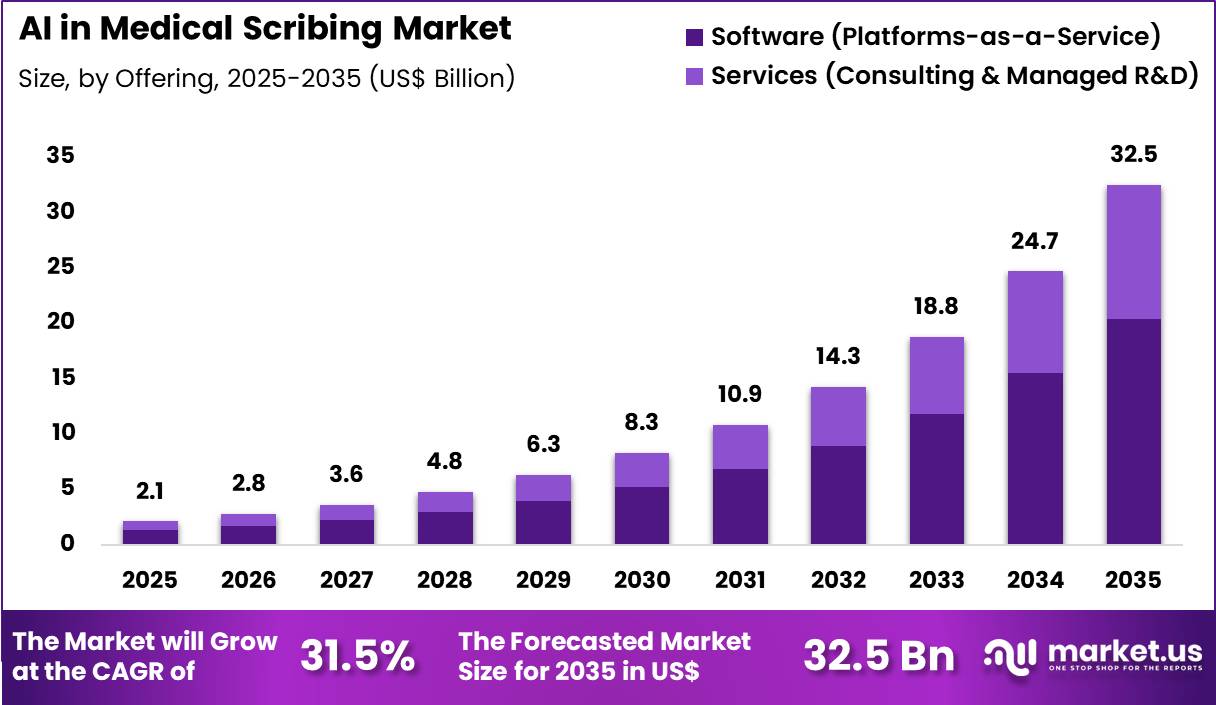
New York, NY – Nov 20 2026 – The Global AI in Medical Scribing Market size is expected to be worth around US$ 32.5 Billion by 2035 from US$ 2.1 Billion in 2025, growing at a CAGR of 31.5% during the forecast period 2026-2035. In 2025, North America led the market, achieving over 56.2% share with a revenue of US$ 1.2 Billion.
Artificial Intelligence (AI) in medical scribing is emerging as an important technology in the healthcare industry, helping healthcare professionals streamline clinical documentation and improve operational efficiency. AI-powered medical scribing solutions use advanced technologies such as Natural Language Processing (NLP), speech recognition, and machine learning to capture, interpret, and convert doctor-patient conversations into structured clinical notes.
These solutions are designed to reduce the administrative workload of healthcare professionals by automating documentation tasks, allowing physicians to dedicate more time to patient care. AI medical scribes can generate clinical summaries, record patient histories, document diagnoses, and support the preparation of electronic health records (EHRs).
The adoption of AI-based medical scribing is being supported by the growing demand for digital healthcare solutions, increasing EHR adoption, rising patient volumes, and the need to improve clinical workflow efficiency. Hospitals, clinics, and healthcare organizations are increasingly exploring these technologies to reduce documentation time, improve record accuracy, and enhance physician productivity.
Furthermore, continuous advancements in generative AI and ambient clinical intelligence are expected to expand the capabilities of medical scribing solutions. However, data privacy, regulatory compliance, integration challenges, and clinical accuracy remain important considerations for market participants.
Overall, AI in medical scribing is expected to play a significant role in the digital transformation of healthcare documentation.
Key Takeaways
- In 2025, the market was valued at US$ 2.1 billion and is projected to grow at a CAGR of 31.5%, reaching US$ 32.5 billion by 2035.
- Based on application, the market is segmented into target identification, lead discovery and lead optimization, de novo molecular design, drug repurposing, preclinical testing, and others. Target identification and lead discovery dominated the segment, accounting for 41.8% of the market share.
- Based on offering, the market is categorized into software (platform-as-a-service) and services (consulting and managed R&D). The software segment dominated the market, capturing a revenue share of 62.7%.
- Based on therapeutic area, the market is segmented into oncology, neurology, infectious diseases, cardiovascular diseases, rare diseases, and others. Pharmaceutical and biotechnology companies emerged as the dominant segment, accounting for 65.8% of the market revenue.
- Based on end user, the market is categorized into pharmaceutical companies, biotechnology companies, academic and research institutes, and contract research organizations (CROs). The deep learning (DL) segment held the leading position, with a revenue share of 48.0%.
- Regionally, North America dominated the market, accounting for the largest revenue share of 56.2%.
Key Market Segments
- Application Analysis: Target identification and lead discovery dominated the application segment, accounting for 41.8% of the market share. This growth is driven by the increasing adoption of AI technologies to accelerate early-stage drug discovery. AI platforms enable researchers to analyze complex biological datasets, identify potential therapeutic targets, and screen drug candidates more efficiently, reducing research timelines and development costs.
- Offering Analysis: The software segment dominated the offering category, accounting for 62.7% of the market share. Its leading position is supported by the growing adoption of cloud-based AI platforms and integrated analytical solutions. These technologies enable pharmaceutical and biotechnology companies to streamline research workflows, improve data analysis, and accelerate drug discovery through scalable computational capabilities.
- Therapeutic Area Analysis: Oncology emerged as the leading therapeutic area, accounting for 28.6% of the market share. The segment’s growth is driven by increasing cancer research activities and the rising volume of genomic and molecular data. AI technologies support researchers in identifying cancer biomarkers, analyzing genetic mutations, and accelerating the development of targeted therapies.
- End User Analysis: Pharmaceutical and biotechnology companies dominated the end-user segment, accounting for 65.8% of the market share. Their leading position is attributed to substantial investments in AI-driven drug discovery and biomedical research. These organizations increasingly adopt AI solutions to analyze complex datasets, improve research productivity, identify promising drug candidates, and optimize research and development processes.
Regional Analysis
North America Market Analysis
North America dominated the AI in Medical Scribing Market in 2025, accounting for 56.2% of the market share. Regional growth is driven by increasing adoption of AI-powered documentation solutions, rising physician administrative workloads, and growing demand for efficient clinical workflows.
Healthcare providers are integrating natural language processing and speech recognition technologies with electronic health records to automate clinical documentation and reduce physician burnout.
Asia Pacific Market Analysis
Asia Pacific is expected to register the highest CAGR during the forecast period, supported by increasing digital healthcare investments and the adoption of AI-based clinical solutions. Countries such as China, India, Japan, and South Korea are strengthening healthcare digitalization initiatives.
Growing telemedicine adoption, expanding hospital infrastructure, and increasing demand for multilingual documentation platforms are expected to accelerate the adoption of AI-powered medical scribing solutions across the region.
Emerging Trends
- Growing Adoption of Ambient AI Scribing Technology: Ambient AI technology is increasingly being adopted to capture doctor-patient conversations and automatically prepare clinical notes. Unlike traditional dictation software, these solutions can understand natural conversations and convert them into structured medical records, reducing manual documentation requirements.
- Increasing Integration with Electronic Health Records (EHRs): AI medical scribing solutions are increasingly being integrated with electronic health record systems to transfer generated clinical notes directly into patient records. This integration is expected to improve documentation workflows, reduce repeated data entry, and support smoother information management across healthcare facilities.
- Development of Specialty-Specific AI Scribing Solutions: AI scribing technologies are moving beyond general medical documentation towards specialty-specific applications. Solutions are being developed to understand medical terminology, consultation formats, and documentation requirements across specialties such as cardiology, pediatrics, primary care, and emergency medicine.
- Greater Focus on Data Privacy and Clinical Accuracy: Healthcare organizations are placing greater importance on patient consent, data protection, documentation accuracy, and clinical oversight. AI-generated notes are increasingly being evaluated through human review processes to identify missing information, incorrect statements, and potential documentation errors.
- Expansion into Hospital and Emergency Care Settings: AI medical scribing is expanding beyond outpatient clinics into emergency departments and other hospital environments. Recent clinical studies have examined its ability to reduce documentation time in emergency care, indicating opportunities for adoption across different healthcare settings.
Use Cases
- Automated Clinical Note Generation: AI medical scribes capture conversations between doctors and patients and convert them into structured clinical notes. These notes can include symptoms, medical history, examination findings, and treatment plans, reducing the time required for manual documentation.
- Patient Consultation Documentation: During routine consultations, AI scribing systems can capture relevant information from discussions between healthcare professionals and patients. This helps clinicians maintain detailed consultation records while allowing greater attention to patient communication and interaction.
- Emergency Department Documentation: Emergency departments handle multiple patient consultations and require timely medical records. AI scribes can assist emergency physicians by preparing encounter notes, documenting clinical findings, and reducing the time spent completing patient records.
- Medical Letters and Referral Documentation: AI scribing solutions can assist in preparing referral letters, consultation summaries, and other clinical correspondence using information collected during patient encounters. This application can reduce repetitive writing activities and support communication between healthcare professionals.
- Telehealth and Virtual Consultation Documentation: AI medical scribes can support telehealth services by capturing conversations during remote consultations and generating corresponding medical notes. This application can help healthcare providers document virtual appointments while maintaining organized patient records across digital healthcare platforms.
Frequently Asked Questions About AI in Medical Scribing
- How does AI medical scribing technology work?
AI medical scribing technology captures clinical conversations, processes spoken information using speech recognition, and applies language models to generate medical notes. The healthcare professional reviews and approves the generated documentation before it becomes part of the patient record. - What are the major benefits of AI medical scribing?
The major benefits include reduced documentation workload, improved clinical workflow efficiency, organized patient records, and more time for patient interactions. These solutions can also help healthcare professionals reduce repetitive administrative activities and documentation-related stress. - Which healthcare professionals use AI medical scribing solutions?
AI medical scribing solutions are used by physicians, general practitioners, specialists, emergency doctors, and other healthcare professionals. Their applications extend across outpatient clinics, hospitals, specialty departments, and telehealth services where clinical documentation is required. - What factors are driving the growth of the AI in medical scribing market?
Market growth is supported by increasing clinical documentation requirements, rising physician workloads, growing healthcare digitization, wider EHR adoption, and demand for administrative automation. These factors are encouraging healthcare organizations to implement AI-based documentation solutions. - Which technology is commonly used in AI medical scribing solutions?
The market uses technologies such as natural language processing, automatic speech recognition, machine learning, and generative AI. These technologies help capture conversations, identify medical terminology, understand clinical context, and generate structured medical documentation. - Which healthcare settings offer opportunities for AI medical scribing adoption?
Primary care clinics, emergency departments, outpatient facilities, specialty hospitals, and telehealth platforms offer important adoption opportunities. Growing demand for digital documentation across these settings is creating additional applications for AI-powered clinical scribing solutions. - What is the future outlook for the AI in medical scribing market?
The market is expected to benefit from improvements in generative AI, speech recognition, specialty-specific documentation, and EHR integration. However, future adoption will depend on clinical accuracy, data protection, regulatory requirements, and measurable workflow improvements.
Conclusion
The AI in Medical Scribing Market is expected to witness significant growth, driven by increasing healthcare digitalization, rising clinical documentation workloads, and growing demand for efficient clinical workflows. Advancements in generative AI, natural language processing, and ambient clinical intelligence are expected to enhance documentation accuracy and expand the application of AI-powered scribing solutions across healthcare settings.
Furthermore, increasing EHR integration and specialty-specific solutions are likely to create new growth opportunities for market participants. However, data privacy, regulatory compliance, and clinical accuracy will remain critical considerations. Overall, continuous technological advancements and growing healthcare adoption are expected to support long-term market expansion.
Discuss your needs with our analyst
Please share your requirements with more details so our analyst can check if they can solve your problem(s)



