
Overview
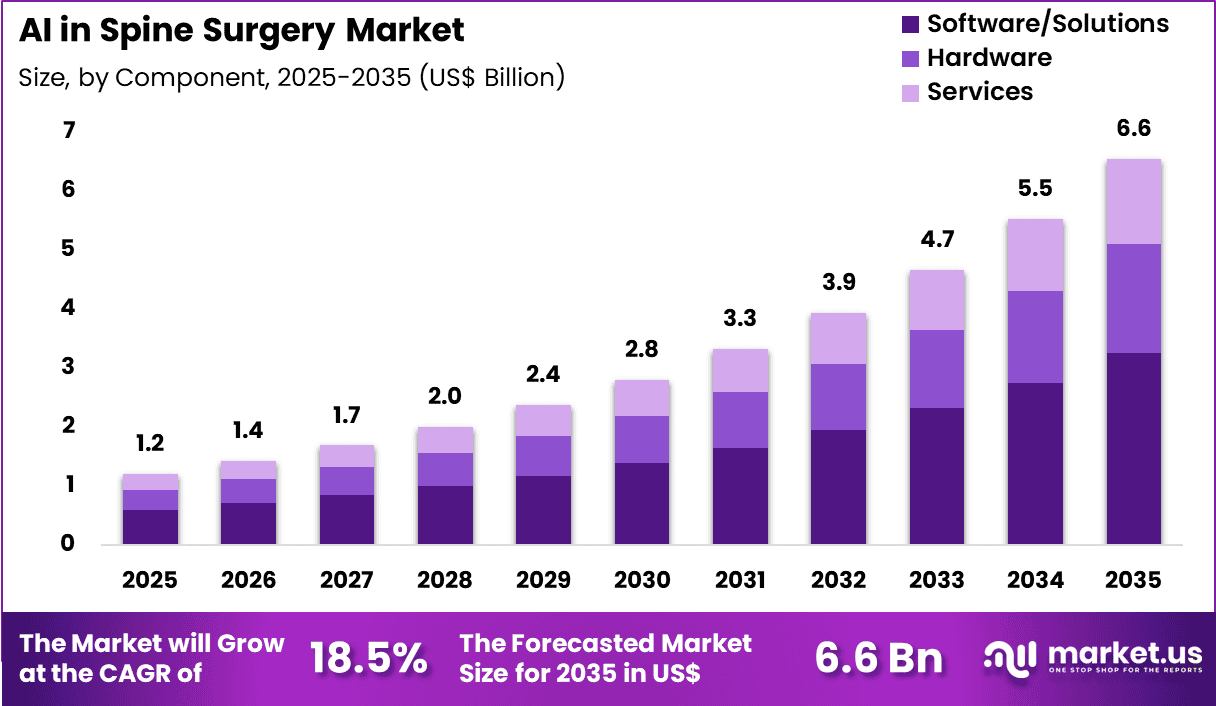
New York, NY – Nov 23 2026 – The Global AI in Spine Surgery Market size is expected to be worth around US$ 6.6 Billion by 2035 from US$ 1.2 Billion in 2025, growing at a CAGR of 18.5% during the forecast period 2026-2035. In 2025, North America led the market, achieving over 52.6% share with a revenue of US$ 0.7 Billion.
Artificial Intelligence (AI) is emerging as a transformative technology in spine surgery, supporting improvements in surgical planning, diagnosis, treatment accuracy, and patient outcomes. By integrating advanced algorithms, machine learning, and medical imaging technologies, AI is enabling healthcare professionals to make more informed clinical decisions.
AI-powered tools can analyse medical images, including MRI, CT scans, and X-rays, to identify spinal abnormalities, detect degenerative conditions, and assist in diagnosing disorders such as spinal stenosis, herniated discs, and spinal deformities. These technologies also support preoperative planning by helping surgeons assess spinal anatomy, determine optimal implant positioning, and develop personalised surgical approaches.
During surgical procedures, AI-assisted navigation systems, robotic technologies, and real-time imaging can improve precision and support minimally invasive techniques. Furthermore, predictive analytics can help assess potential surgical risks, estimate recovery patterns, and support postoperative patient monitoring.
The growing adoption of AI in spine surgery is being driven by increasing demand for advanced surgical technologies, rising spinal disorder cases, and the need for improved treatment efficiency. However, data privacy, clinical validation, implementation costs, and regulatory requirements remain important considerations.
Overall, AI is expected to play an increasingly important role in advancing spine surgery, supporting greater surgical precision, personalised treatment, and improved standards of spinal healthcare.
Key Takeaways
- In 2025, the AI in Spine Surgery Market was valued at US$ 1.2 Billion and is projected to grow at a CAGR of 18.5%, reaching US$ 6.6 Billion by 2035.
- Based on components, the market is segmented into software/solutions, hardware, and services. The software/solutions segment dominated the market, accounting for a revenue share of 49.6%.
- By application, the market is categorized into spinal fusion surgery, microdiscectomy, laminectomy, decompression surgery, spinal deformity correction, and others. Among these, spinal fusion surgery emerged as the leading segment, capturing a market share of 48.1%.
- Based on end users, the market is segmented into hospitals, ambulatory surgical centers (ASCs), specialty orthopedic centers, and others. The hospital segment held the largest market share of 56.8%, establishing its dominance in the market.
- Regionally, North America dominated the AI in Spine Surgery Market, accounting for the largest revenue share of 52.6%.
Key Market Segments
- Component Analysis: The software and solutions segment dominated the AI in spine surgery market, accounting for 49.6% of the component share. Its leadership is driven by the growing use of AI-powered tools for surgical planning, medical image analysis, 3D anatomical modelling, and intraoperative navigation. Increasing demand for surgical precision and improved clinical outcomes is expected to support segment growth.
- Application Analysis: Spinal fusion surgery emerged as the leading application segment, capturing 48.1% of the market share. The segment’s dominance is supported by the rising prevalence of degenerative spinal disorders and increasing surgical procedures. AI technologies assist surgeons in preoperative planning, implant positioning, and surgical navigation, improving procedural accuracy and supporting the growing adoption of advanced spine surgery techniques.
- End-User Analysis: The hospital segment dominated the AI in spine surgery market, accounting for 56.8% of the end-user share. This leadership is attributed to the availability of advanced surgical infrastructure, specialised medical professionals, and sophisticated imaging technologies. Increasing hospital investments in AI-enabled surgical platforms, robotic-assisted procedures, and digital healthcare solutions are expected to further strengthen segment growth.
Regional Analysis
North America Dominates the AI in Spine Surgery Market
North America held the largest share of the AI in spine surgery market, accounting for 52.6% in 2025. Regional growth is driven by the increasing adoption of AI-powered surgical navigation, robotic-assisted systems, and advanced imaging technologies. The high volume of spinal procedures, rising prevalence of degenerative spine disorders, and growing investments in healthcare technology are further supporting market expansion.
Hospitals and specialised surgical centres across the United States are increasingly integrating AI solutions to improve surgical precision, optimise implant placement, and enhance patient outcomes. Collaborations between healthcare institutions and technology companies are also accelerating innovation and clinical adoption.
Asia Pacific Expected to Register the Highest CAGR
Asia Pacific is projected to record the highest CAGR during the forecast period, supported by rapid healthcare infrastructure development and increasing investments in AI and robotic surgery. Countries such as China, Japan, India, and South Korea are adopting advanced surgical technologies to address the growing burden of spinal disorders.
Government-led digital healthcare initiatives, expanding hospital capabilities, and rising demand for minimally invasive procedures are expected to accelerate regional market growth.
Emerging Trends
- Increasing Adoption of AI-Based Preoperative Planning: AI-based planning tools are increasingly being developed to evaluate spinal anatomy, identify abnormalities, and support surgical decisions. Machine learning algorithms can analyze MRI, CT, and X-ray images to create patient-specific surgical plans and help surgeons assess treatment options before procedures.
- Integration of AI with Robotic-Assisted Spine Surgery: The integration of AI with robotic-assisted surgical systems is emerging as an important trend. These technologies can support surgical navigation, anatomical mapping, and accurate implant positioning. Their combined use is expected to strengthen procedural consistency and assist surgeons during complex spinal operations.
- Growing Use of Predictive Analytics for Surgical Outcomes: Machine learning models are increasingly being studied to predict postoperative complications, patient recovery, hospital stays, and treatment outcomes. These capabilities can help healthcare professionals identify high-risk patients before surgery and develop more suitable treatment and postoperative care plans.
- Development of AI-Powered Medical Imaging Solutions: Deep learning and computer vision technologies are advancing the analysis of spinal images. Automated image segmentation, vertebral identification, disc degeneration assessment, and spinal deformity detection are emerging applications. These solutions can reduce manual image assessment and support faster clinical interpretation.
- Increasing Focus on Personalized and Data-Driven Spine Care: AI systems are increasingly being explored for personalized treatment recommendations based on patient medical history, spinal anatomy, clinical records, and predicted outcomes. This approach supports individualized treatment planning and may improve the selection of appropriate surgical techniques for different patients.
Use Cases
- Automated Detection of Spinal Disorders: AI-based diagnostic systems can analyze medical images to identify spinal abnormalities, including degenerative disc disease, spinal stenosis, fractures, and deformities. These tools can assist radiologists and spine specialists in identifying potential conditions and supporting early clinical assessment.
- Accurate Pedicle Screw Placement: AI-assisted navigation systems can support surgeons in identifying suitable screw entry points, selecting appropriate trajectories, and monitoring implant positioning. These capabilities are particularly useful during spinal fusion procedures, where accurate screw placement is important for surgical safety and stability.
- Prediction of Postoperative Complications: AI algorithms can evaluate patient age, medical history, clinical conditions, and surgical information to estimate the risk of postoperative complications. These predictions can help surgeons identify patients who may require closer monitoring and additional postoperative care.
- Optimization of Hospital Resource Management: AI-powered predictive models can estimate hospital length of stay, discharge requirements, and healthcare resource needs following spinal procedures. Hospitals can use these insights to improve bed management, plan staff requirements, and support more efficient postoperative patient management.
- Postoperative Recovery and Rehabilitation Monitoring: AI-enabled monitoring solutions can assess patient-reported symptoms, mobility patterns, recovery progress, and clinical records. These applications can help healthcare professionals identify delayed recovery, monitor rehabilitation requirements, and determine when additional clinical evaluation may be necessary.
Frequently Asked Questions About AI in Spine Surgery
- What is AI in spine surgery?
AI in spine surgery refers to the use of artificial intelligence technologies, including machine learning and deep learning, to support spinal diagnosis, surgical planning, intraoperative navigation, risk assessment, and postoperative patient management. - How is artificial intelligence used in spine surgery?
Artificial intelligence is used to analyze spinal images, identify abnormalities, predict surgical outcomes, support implant positioning, and assess patient recovery. These applications help surgeons make informed clinical decisions and improve the efficiency of surgical workflows. - How does AI improve surgical accuracy in spine procedures?
AI can support surgical accuracy by analyzing anatomical structures, assisting with image-guided navigation, and identifying suitable implant positions. When integrated with navigation systems, it can provide additional information during complex spinal procedures. - Can AI predict complications after spine surgery?
Yes. Machine learning models can evaluate patient characteristics, medical history, and surgical information to estimate complication risks, hospital stays, and recovery outcomes. However, their predictions require clinical validation and should not replace professional medical judgment. - What factors are driving the growth of the AI in Spine Surgery market?
Market growth is supported by increasing spinal disorder cases, rising demand for minimally invasive procedures, advancements in medical imaging, growing robotic surgery adoption, and the need for improved surgical precision and efficient patient management. - Which technologies are commonly used in the AI in Spine Surgery market?
Major technologies include machine learning, deep learning, computer vision, predictive analytics, and natural language processing. These technologies are applied to medical image interpretation, clinical decision support, surgical navigation, patient risk assessment, and healthcare data analysis. - Which healthcare facilities are adopting AI-based spine surgery solutions?
Hospitals, specialty spine centers, academic medical institutions, and research hospitals represent important adoption settings. These facilities use AI-supported technologies to improve diagnostic assessment, assist surgical procedures, optimize clinical workflows, and monitor patient outcomes. - What is the future outlook for the AI in Spine Surgery market?
The market is expected to benefit from advancements in robotic surgery, automated medical imaging, predictive analytics, and personalized treatment planning. Wider adoption will depend on clinical validation, regulatory approvals, affordability, and successful integration into healthcare systems.
Conclusion
The AI in Spine Surgery market is witnessing strong growth, driven by increasing adoption of advanced imaging, robotic-assisted surgery, predictive analytics, and AI-based surgical planning. Valued at US$ 1.2 billion in 2025, the market is projected to reach US$ 6.6 billion by 2035, at a CAGR of 18.5%. Software solutions, spinal fusion procedures, and hospitals remain the leading market segments.
North America currently dominates, while Asia Pacific is expected to experience the fastest growth. Continued technological advancements, rising investments, and demand for personalized treatment are expected to create significant opportunities, although clinical validation, costs, and regulatory requirements remain important challenges.
Discuss your needs with our analyst
Please share your requirements with more details so our analyst can check if they can solve your problem(s)