
Overview
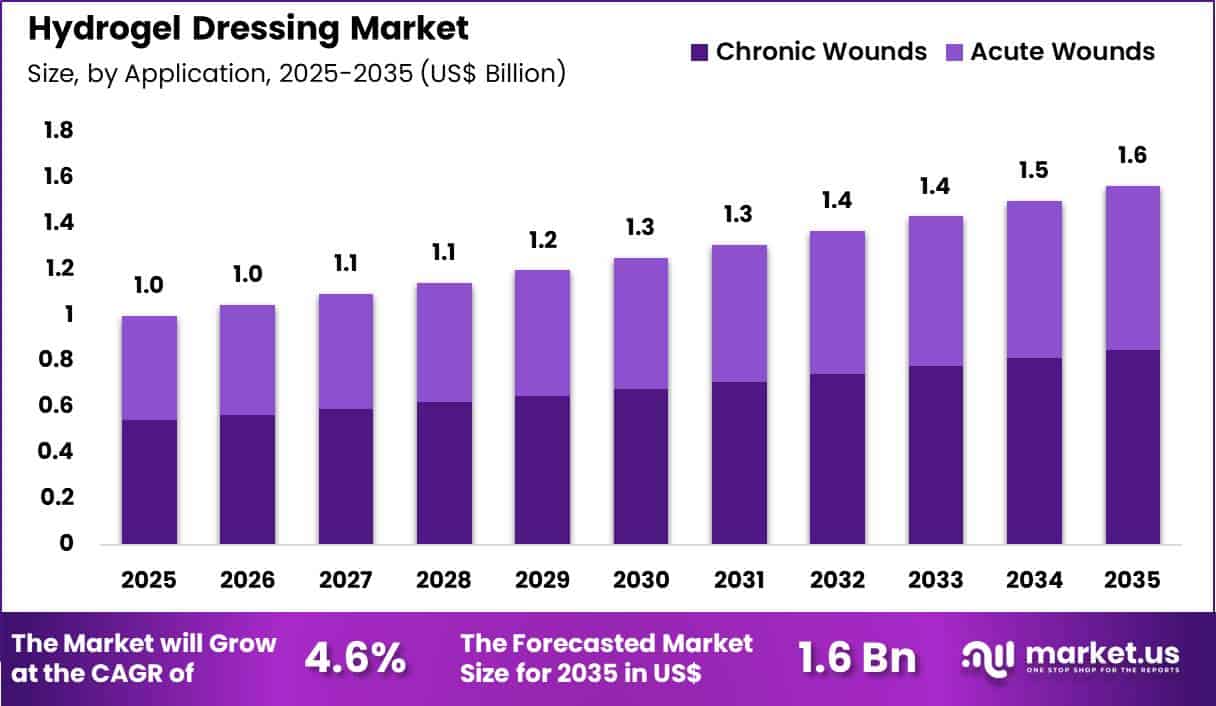
New York, NY – Nov 23 2026 – The Global Hydrogel Dressing Market size is expected to be worth around US$ 1.6 Billion by 2035 from US$ 1.0 Billion in 2025, growing at a CAGR of 4.6% during the forecast period 2026-2035. In 2025, North America led the market, achieving over 46.3% share with a revenue of US$ 0.5 Billion.
Hydrogel dressings are advanced wound care products designed to support the healing of various types of wounds by maintaining a moist wound environment. These dressings are primarily composed of water-based polymer networks that help hydrate dry wounds, soften dead tissue, and facilitate the natural wound healing process. They are commonly used for treating burns, pressure ulcers, diabetic foot ulcers, surgical wounds, and other chronic and acute wounds.
The hydrogel dressing market is gaining attention due to the increasing prevalence of chronic wounds, rising cases of diabetes, an ageing population, and growing demand for advanced wound care solutions. Compared with conventional wound dressings, hydrogel dressings offer several benefits, including effective wound hydration, cooling and soothing effects, reduced discomfort during dressing changes, and support for autolytic debridement.
Furthermore, technological advancements in wound care materials, increasing healthcare expenditure, and growing awareness regarding effective wound management are supporting market development. Healthcare facilities, including hospitals, specialty clinics, and home healthcare settings, represent major end-use segments.
Additionally, manufacturers are focusing on product innovation, including antimicrobial hydrogel formulations, improved absorption capabilities, and advanced wound management solutions. With the increasing focus on patient comfort, faster wound recovery, and effective infection management, the hydrogel dressing market is expected to witness significant growth opportunities in the coming years.
Key Takeaways
- In 2025, the global hydrogel dressing market was valued at US$ 1.0 Billion, registering a CAGR of 4.6%, and is projected to reach US$ 1.6 Billion by 2035.
- Based on product type, the market is segmented into amorphous hydrogel (gels/tubes), impregnated hydrogel (gauze/sponge-based), and sheet hydrogel (solid 3D networks). Among these, amorphous hydrogel dominated the market, accounting for a 58.4% share.
- By application, the market is categorized into acute wounds and chronic wounds, with chronic wounds accounting for a significant market share of 54.3%.
- Based on end use, the market is classified into hospitals, specialty clinics, home healthcare, and others. Among these, hospitals emerged as the leading segment, capturing 49.2% of the total market revenue.
- Regionally, North America dominated the global hydrogel dressing market, accounting for a market share of 46.3%.
Key Market Segments
- Product Analysis: Amorphous hydrogel dominated the product segment, accounting for 58.4% of the market share. Its leadership is attributed to its flexibility, ease of application, and effective moisture retention. These gels conform to irregular wound surfaces, support autolytic debridement, and reduce discomfort during dressing changes, making them suitable for various chronic wound care applications.
- Application Analysis: Chronic wounds dominated the application segment, accounting for 54.3% of the market share. The segment’s growth is driven by the rising prevalence of diabetic foot ulcers, pressure ulcers, and venous leg ulcers. Hydrogel dressings support wound hydration, tissue regeneration, and pain reduction, increasing their adoption in long-term wound management.
- End-Use Analysis: Hospitals dominated the end-use segment, accounting for 49.2% of the market share. Their leading position is supported by the high volume of surgical wounds, trauma injuries, and chronic wound cases treated in hospital settings. Increasing surgical procedures, advanced healthcare infrastructure, and the adoption of specialized wound care protocols further support segment demand.
Regional Analysis
North America Dominates the Hydrogel Dressing Market
North America dominated the hydrogel dressing market in 2025, accounting for 46.3% of the global market share. This leadership is attributed to the rising prevalence of diabetes, increasing demand for advanced wound care products, and widespread adoption of modern wound management technologies. The growing number of patients with diabetic ulcers, burns, and pressure injuries has further supported regional demand.
Strong healthcare infrastructure, increasing hospital expenditure, and the presence of established medical device manufacturers are also contributing to market expansion. Additionally, growing adoption of home healthcare services and continuous product innovations are strengthening the regional market position.
Asia Pacific is Expected to Register the Highest CAGR
Asia Pacific is anticipated to witness the highest CAGR during the forecast period, driven by improving healthcare infrastructure, rising diabetes prevalence, and increasing awareness of advanced wound management. Countries such as China, India, Japan, and South Korea are experiencing growing demand for effective wound care solutions.
Furthermore, government healthcare initiatives, expanding hospital facilities, rising healthcare expenditure, and the availability of cost-effective hydrogel products are expected to accelerate regional market growth.
Emerging Trends
- Development of multifunctional hydrogel dressings: Hydrogel dressings are increasingly being developed with additional functions, including moisture management, wound protection, and antimicrobial properties. Research is also exploring formulations that support different stages of wound healing, creating opportunities for more advanced wound care products.
- Increasing focus on diabetic wound management: The growing clinical focus on diabetic foot ulcers is encouraging the development of specialized hydrogel formulations. Research is examining functional hydrogels that may improve wound closure and support better treatment outcomes among patients with diabetes.
- Growing adoption of advanced hydrogel formulations: Manufacturers are exploring different polymer combinations and gel compositions to improve product performance. Clinical research is evaluating formulations designed to support tissue repair, maintain moisture, and improve the management of complex and chronic wounds.
- Increasing clinical research and evidence-based product development: Clinical studies are playing an important role in evaluating the effectiveness of hydrogel dressings. A 2025 systematic review covering 39 studies, 1,786 participants, and 1,818 wounds highlights the growing evidence base for hydrogel-based wound management.
- Expansion of product development for burn care: Hydrogel formulations are receiving increased research attention for burn management because of their moisture-retaining and wound-protective properties. Clinical investigations are examining their potential to improve healing time, reduce discomfort, and support the treatment of partial-thickness burns.
Use Cases
- Diabetic foot ulcers: Hydrogel dressings can be used in the management of diabetic foot ulcers, particularly where moisture is required to support wound healing. These products help maintain a moist wound environment and can support the management of selected chronic diabetic wounds.
- Burn wound treatment: Hydrogel dressings are used for selected superficial and partial-thickness burns. Their water-rich composition helps maintain moisture around the affected area while providing a protective covering, supporting wound management and patient comfort.
- Pressure ulcer management: Hydrogel dressings can be applied to selected pressure ulcers, particularly wounds with low levels of fluid discharge or dry wound tissue. They help maintain moisture and support wound management when selected according to the wound condition.
- Surgical wounds and donor sites: Hydrogel products can be used in the management of selected surgical wounds, post-operative incisions, skin graft donor sites, and related injuries. Their moisture-retaining properties help create suitable wound conditions during the recovery process.
- Radiation-related skin injuries and skin tears: Hydrogel dressings can be used for selected radiation-related skin injuries, superficial skin damage, and skin tears. They provide a protective wound covering and help maintain moisture, making them useful in different wound care settings.
Frequently Asked Questions About Hydrogel Dressing
- What are the main benefits of hydrogel dressings?
Hydrogel dressings help maintain a moist wound environment, support the removal of dead tissue through autolytic debridement, and provide wound protection. Their cooling and hydrating properties can also improve comfort during selected wound treatments. - What types of wounds can be treated with hydrogel dressings?
Hydrogel dressings are used for selected diabetic ulcers, pressure ulcers, superficial burns, surgical wounds, skin tears, and donor sites. Their suitability depends on wound characteristics, moisture levels, and recommendations from healthcare professionals. - Are hydrogel dressings suitable for burn treatment?
Yes, hydrogel dressings can be used for selected superficial and partial-thickness burns. Their high water content helps maintain moisture and protect injured skin. However, deeper or serious burns require professional medical assessment and appropriate treatment. - How do hydrogel dressings support wound healing?
Hydrogel dressings support wound healing by maintaining moisture around damaged tissue and helping soften dead tissue. This environment can facilitate natural wound cleaning and support tissue repair when the dressing is appropriate for the wound. - What are the different types of hydrogel dressings?
Hydrogel dressings are commonly available as amorphous gels, impregnated gauze, and sheet-based dressings. These formats provide different application methods and wound coverage, allowing healthcare professionals to select products according to individual wound care requirements. - What are the major factors driving the hydrogel dressing market?
The market is supported by increasing chronic wound cases, rising diabetes-related complications, demand for advanced wound care products, and growing clinical interest in moisture-retaining dressings for managing different types of skin injuries. - Which application segment contributes to hydrogel dressing demand?
Chronic wound management represents an important application area, particularly diabetic foot ulcers and pressure ulcers. Burn treatment and surgical wound management also contribute to demand across hospitals, specialist clinics, and other healthcare facilities. - What is the future outlook for the hydrogel dressing market?
The market outlook is supported by continued research into advanced wound care, increasing clinical interest in functional hydrogels, and demand for specialized wound management products. Further clinical validation and product development are expected to influence future adoption.
Conclusion
The global hydrogel dressing market is expected to experience steady growth, supported by the rising prevalence of chronic wounds, increasing diabetes cases, an ageing population, and growing demand for advanced wound care solutions. Valued at US$ 1.0 billion in 2025, the market is projected to reach US$ 1.6 billion by 2035.
Amorphous hydrogel, chronic wound management, and hospitals remain the leading market segments, while North America holds the largest regional share. Meanwhile, Asia Pacific is expected to register the highest growth rate. Continuous product innovation, antimicrobial formulations, and expanding clinical applications are anticipated to create further market opportunities.
Discuss your needs with our analyst
Please share your requirements with more details so our analyst can check if they can solve your problem(s)