


Overview
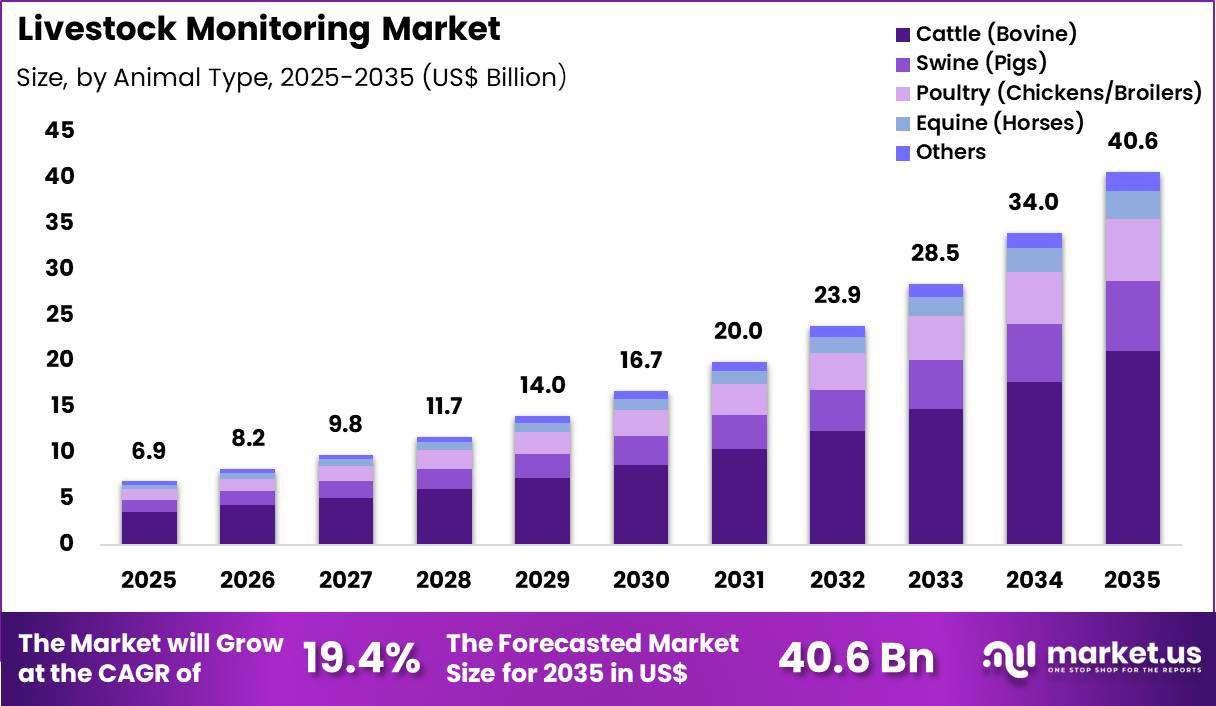
New York, NY – Nov 12 2026 – The Global Livestock Monitoring Market size is expected to be worth around US$ 40.6 Billion by 2035 from US$ 6.9 Billion in 2025, growing at a CAGR of 19.4% during the forecast period 2026-2035. In 2025, North America led the market, achieving over 29.5% share with a revenue of US$ 2.1 Billion.
The Livestock Monitoring Market is gaining significant attention as farmers increasingly adopt advanced technologies to improve animal health, productivity, and farm management. Livestock monitoring involves using digital tools, sensors, wearable devices, GPS trackers, and automated systems to track animal activities, health conditions, feeding patterns, and movement. These technologies help farmers identify diseases early, monitor breeding cycles, and reduce livestock losses.
Growing demand for meat, milk, and other animal-based products is encouraging livestock producers to improve farm efficiency. Smart monitoring solutions provide real-time information about animal behaviour, body temperature, location, and overall health. This allows farmers to make faster decisions and provide timely veterinary care.
Technological advancements in the Internet of Things (IoT), artificial intelligence (AI), cloud computing, and data analytics are further supporting market growth. Automated monitoring systems also help reduce manual labour and improve farm operations.
Additionally, rising awareness of animal welfare, increasing commercial livestock farming, and the need for better disease management are creating new growth opportunities. As precision livestock farming becomes more widely adopted, livestock monitoring solutions are expected to play an important role in modern agricultural practices.
Key Takeaways
- In 2025, the Livestock Monitoring Market generated revenue of US$ 6.9 Billion and is projected to reach US$ 40.6 Billion by 2035, registering a CAGR of 19.4% during the forecast period.
- Based on components, the market is segmented into hardware, software, and services. The hardware segment dominated the market, accounting for a leading share of 73.5%.
- By animal type, the market is categorized into cattle (bovine), swine (pigs), poultry (chickens/broilers), equine (horses), and others. Among these, cattle (bovine) held the largest market share of 52.1%.
- Based on application, the market is divided into health and disease detection, location and tracking, reproductive management, behavioral analysis, environmental monitoring, automated feeding, and others. Health and disease detection dominated the segment, capturing 61.3% of the total market share.
- By end user, the market is classified into dairy farms, beef farms and feedlots, poultry farms, swine farms, and others. The dairy farms segment led the market, accounting for a revenue share of 58.6%.
- North America dominated the global Livestock Monitoring Market, securing a significant market share of 29.5%.
Key Market Segments
- Components Analysis: The hardware segment dominated the livestock monitoring market, accounting for 73.5% of the market share. Its growth is driven by rising adoption of smart collars, wearable sensors, RFID tags, and automated monitoring devices. These technologies help farmers track animal health, detect diseases early, reduce manual work, and improve overall farm productivity.
- Animal Type Analysis: The cattle segment held the largest share of 52.1% in the livestock monitoring market. Its dominance is supported by the growing need to improve dairy and beef production. Monitoring solutions help farmers track cattle health, feeding habits, and reproductive cycles while improving milk yield, breeding efficiency, and herd management.
- Application Analysis: The health and disease detection segment dominated the application category with a market share of 61.3%. Increasing demand for early disease identification and preventive animal healthcare supports its growth. Real-time monitoring helps farmers identify health problems, reduce treatment costs, prevent disease outbreaks, and improve livestock welfare and productivity.
- End-User Analysis: The dairy farms segment led the livestock monitoring market, accounting for 58.6% of the total market share. Its growth is driven by the need to maintain milk production and improve cattle health. Digital monitoring solutions help dairy farmers track feeding patterns, lactation cycles, breeding activities, and potential health issues.
Regional Analysis
North America is Leading the Livestock Monitoring Market
North America dominated the livestock monitoring market with a 29.5% share in 2025, driven by rising adoption of digital farming technologies across the US and Canada. Farmers increasingly use smart sensors, RFID tags, automated feeding systems, and health monitoring platforms to improve productivity.
Government support for precision agriculture and labor shortages further encourage real-time livestock tracking. Growing investments in animal health surveillance and cloud-based farm management solutions also strengthen regional market growth.
Large dairy and beef farms are adopting connected technologies to detect diseases early, improve breeding decisions, and reduce operational losses. Rising focus on animal welfare further supports technology adoption.
Asia Pacific is Expected to Register the Highest CAGR
Asia Pacific is projected to record the highest CAGR during the forecast period, supported by livestock modernization across India, China, and Australia.
Rising protein demand, expanding internet access, and government initiatives are encouraging smart farming adoption. Increasing use of wearable sensors, automated disease alerts, and mobile-based monitoring tools helps farmers improve animal health, reproductive efficiency, and farm productivity.
Emerging Trends
- Growing Use of Wearable Sensors: Farmers are increasingly using smart collars, ear tags, and wearable sensors to track animal health and activity. These devices monitor movement, body temperature, and eating habits, helping farmers identify health problems early and improve herd management.
- Increasing Adoption of Artificial Intelligence: Artificial intelligence (AI) is becoming important in livestock monitoring. AI-powered systems analyze animal behavior, feeding patterns, and health records. These tools help farmers detect unusual activities, predict health risks, and make better decisions about animal care.
- Expansion of RFID-Based Animal Tracking: Radio-frequency identification (RFID) technology is gaining attention for tracking livestock throughout their production cycle. Electronic identification helps farmers maintain animal records, improve traceability, and support disease control and livestock movement management.
- Rising Demand for Automated Monitoring Systems: Livestock farms are adopting automated cameras, milking systems, and feeding equipment. These technologies reduce manual work and provide regular information about animal health, milk production, and feeding activities.
- Integration of Cloud-Based Monitoring Platforms: Cloud-based platforms allow farmers to access livestock information through computers and smartphones. These systems collect data from connected devices and provide remote monitoring, helping farm owners manage large herds more efficiently.
Use Cases
- Reproductive Health Management: Activity sensors and monitoring software help farmers identify heat periods and track breeding activity in cattle. This supports timely insemination, improves reproductive management, and helps reduce missed breeding opportunities.
- Milk Production Management: Dairy farms use automated monitoring systems to track milk yield, milking frequency, and animal activity. The collected information helps farmers identify production changes, improve feeding practices, and manage dairy operations more effectively.
- Livestock Location and Movement Tracking: GPS-enabled devices and electronic identification systems help farmers monitor animal locations and movement. These solutions are useful for managing grazing areas, preventing livestock loss, and maintaining records of animal transportation.
- Feed Management and Nutrition Monitoring: Smart feeding systems monitor feed consumption and provide information about individual animal requirements. Farmers can adjust feeding schedules and improve nutritional planning, helping maintain animal growth, health, and productivity.
- Greater Focus on Animal Welfare: Farmers are using continuous monitoring tools to understand animal comfort, stress, and living conditions. These systems help identify overcrowding, unusual behavior, and environmental problems, supporting better animal welfare practices.
- Adoption of IoT-Based Livestock Solutions: Internet of Things (IoT) technology connects sensors, cameras, and monitoring devices to central platforms. This allows farmers to collect animal-related information continuously and manage livestock operations with better accuracy.
Frequently Asked Questions About Livestock Monitoring
- What technologies are used in livestock monitoring?
Livestock monitoring uses technologies such as RFID tags, GPS trackers, wearable sensors, smart cameras, IoT devices, and artificial intelligence. These solutions collect animal-related information and help farmers monitor livestock more efficiently. - How does livestock monitoring help farmers?
Livestock monitoring helps farmers detect diseases early, track animal movements, manage breeding activities, and monitor productivity. It also reduces manual work and supports better decisions about animal health, feeding, and farm management. - How do wearable sensors help monitor livestock?
Wearable sensors track animal movement, body temperature, rumination, and activity levels. They help farmers identify unusual behavior and possible health problems, allowing timely veterinary attention and improved animal management. - Why is animal tracking important in livestock farming?
Animal tracking helps farmers identify individual animals, record their movements, and maintain accurate livestock information. It also supports disease investigations, improves traceability, and helps authorities respond more effectively to animal health emergencies. - What are the major growth drivers of the livestock monitoring market?
The market is driven by increasing demand for animal health management, rising adoption of smart farming technologies, disease prevention needs, labor shortages, and growing awareness of livestock productivity and animal welfare. - Which livestock monitoring technologies are gaining popularity?
Wearable sensors, RFID identification systems, GPS tracking devices, IoT platforms, and AI-based monitoring solutions are gaining popularity. These technologies help farmers collect real-time information and improve livestock management practices. - What is the future outlook for the livestock monitoring market?
The future of the livestock monitoring market is expected to benefit from AI, IoT, cloud computing, and automated farming solutions. Increasing investment in precision livestock farming will support better animal health monitoring and farm productivity.
Conclusion
The Livestock Monitoring Market is expected to experience strong growth, driven by increasing adoption of smart farming technologies and rising demand for improved animal health management. The market is projected to grow from US$ 6.9 Billion in 2025 to US$ 40.6 Billion by 2035, registering a CAGR of 19.4%.
Hardware, cattle, health and disease detection, and dairy farms remain key market segments. North America currently leads the market, while Asia Pacific offers strong growth opportunities. Advancements in AI, IoT, wearable sensors, and automated monitoring systems will further improve farm productivity, animal welfare, and livestock management.
Discuss your needs with our analyst
Please share your requirements with more details so our analyst can check if they can solve your problem(s)



