


Overview
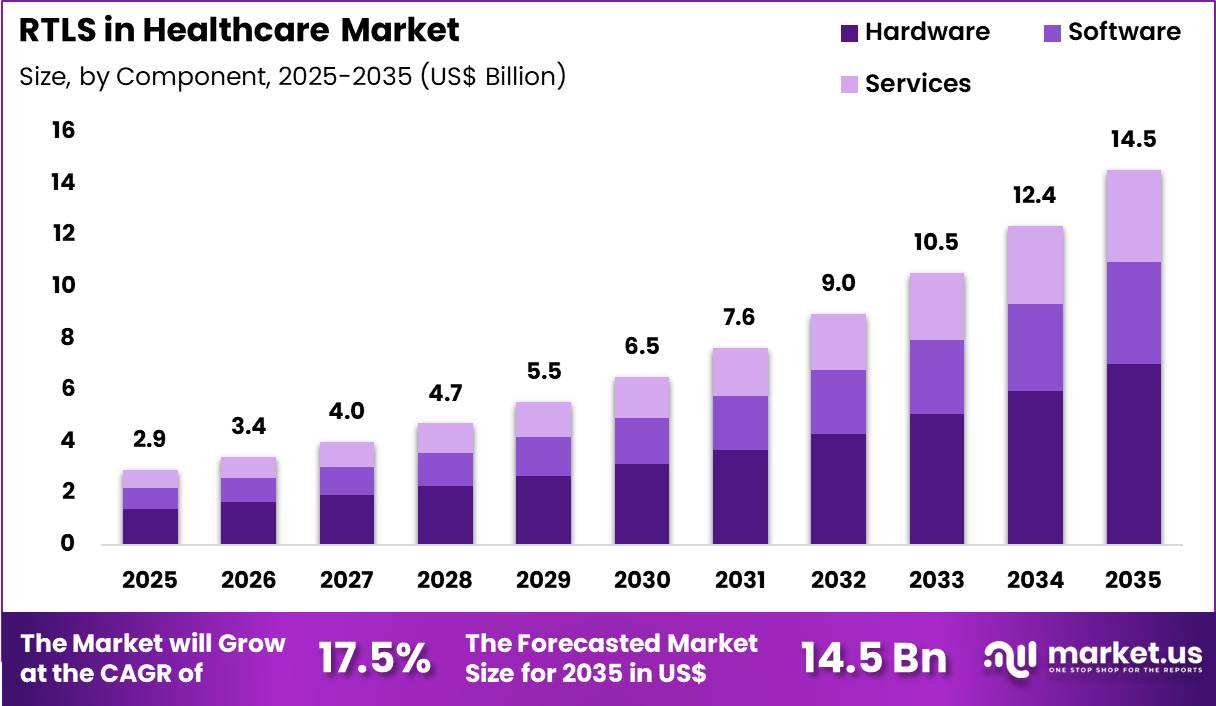
New York, NY – Nov 20 2026 – The Global RTLS in Healthcare Market size is expected to be worth around US$ 14.5 Billion by 2035 from US$ 2.9 Billion in 2025, growing at a CAGR of 17.5% during the forecast period 2026-2035. In 2025, North America led the market, achieving over 47.5% share with a revenue of US$ 1.4 Billion.
Real-Time Location Systems (RTLS) in healthcare refer to advanced technologies used to track and monitor the real-time location of patients, healthcare professionals, medical equipment, and other critical assets within healthcare facilities. These systems use technologies such as Radio Frequency Identification (RFID), Bluetooth Low Energy (BLE), Wi-Fi, infrared, and Ultra-Wideband (UWB) to provide accurate location data and improve operational efficiency.
The adoption of RTLS in healthcare is increasing as hospitals and healthcare providers focus on improving patient safety, optimizing resource utilization, and enhancing workflow management. These solutions help healthcare facilities locate medical equipment, monitor patient movement, manage staff allocation, reduce equipment search time, and support infection prevention protocols.
Furthermore, RTLS plays an important role in digital healthcare transformation by enabling data-driven decision-making and improving visibility across hospital operations. The integration of RTLS with Hospital Information Systems (HIS), Electronic Health Records (EHR), and other healthcare IT platforms is further expanding its application.
With the growing emphasis on smart hospitals, patient-centric care, and operational efficiency, RTLS is expected to gain wider adoption across hospitals, clinics, and other healthcare settings, creating new opportunities for technology providers and healthcare solution developers.
Key Takeaways
- In 2025, the global RTLS in healthcare market was valued at US$ 2.9 billion and is projected to grow at a CAGR of 17.5%, reaching US$ 14.5 billion by 2035.
- Based on component, the market is segmented into hardware, software, and services. The hardware segment dominated the market, accounting for a revenue share of 48.1%.
- Based on technology, the market is categorized into Bluetooth Low Energy (BLE), Wi-Fi, Active RFID, Infrared (IR), Ultra-Wideband (UWB), and others. Among these, Active RFID emerged as the leading technology segment, capturing 33.8% of the market share.
- By application, the market is divided into asset tracking and management, patient tracking and safety, staff safety and efficiency, infection control, workflow optimization, environmental monitoring, and others. Asset tracking and management dominated the market, accounting for 38.2% of the total revenue.
- Based on end user, the market is segmented into hospitals, long-term care facilities, ambulatory care centers, and others. The hospitals segment held the leading position, accounting for 51.6% of the market revenue.
- Regionally, North America dominated the global RTLS in healthcare market, accounting for a market share of 47.5%.
Key Market Segments
- Component Analysis: The hardware segment dominated the RTLS in healthcare market, accounting for 48.1% of the market share. Its leadership is driven by increasing investments in essential infrastructure, including tags, readers, sensors, gateways, and badges. Growing demand for equipment visibility, patient tracking, and staff monitoring is further supporting hardware adoption across healthcare facilities.
- Technology Analysis: Active RFID dominated the technology segment, accounting for 33.8% of the market share. Its growth is supported by the increasing need for continuous tracking of patients, healthcare professionals, and medical equipment. Battery-powered tags enable real-time location monitoring, helping hospitals improve equipment utilization, reduce search time, and enhance operational efficiency.
- Application Analysis: Asset tracking and management emerged as the leading application segment, capturing 38.2% of the market share. Hospitals increasingly adopt RTLS solutions to monitor medical equipment, including infusion pumps, wheelchairs, beds, and monitoring devices. Growing emphasis on equipment availability, cost reduction, workflow optimization, and efficient resource utilization is driving segment growth.
- End-User Analysis: The hospitals segment dominated the RTLS in healthcare market, accounting for 51.6% of the market share. High patient volumes, complex hospital infrastructure, and extensive medical equipment inventories are driving adoption. Increasing investments in digital healthcare infrastructure, patient safety, equipment tracking, and workflow optimization are further supporting RTLS implementation across hospitals.
Regional Analysis
North America Dominates the RTLS in Healthcare Market
North America accounted for 47.5% of the RTLS in healthcare market in 2025, driven by the increasing adoption of real-time tracking technologies across hospitals and healthcare facilities. Growing investments in RFID, Wi-Fi, and Bluetooth-based solutions are supporting efficient monitoring of patients, medical equipment, and healthcare professionals.
Hospitals are increasingly implementing RTLS to minimize equipment search time, improve patient transportation, enhance staff safety, and optimize operational workflows. Furthermore, the integration of RTLS with hospital information systems and electronic health records is supporting better resource management and data-driven decision-making. The growing focus on hospital automation, patient safety, and digital healthcare infrastructure is expected to sustain regional market leadership.
Asia Pacific is Expected to Register the Highest CAGR
Asia Pacific is expected to witness the highest CAGR during the forecast period, supported by rapid healthcare infrastructure development and increasing investments in smart hospital technologies.
Countries such as China, Japan, South Korea, and Singapore are adopting digital healthcare solutions to improve patient management and operational efficiency. Rising patient volumes, expanding hospital networks, and growing adoption of IoT-enabled tracking technologies are further accelerating regional RTLS demand.
Emerging Trends
- Integration of RTLS with Hospital Information Systems: RTLS is increasingly being connected with Electronic Health Records (EHR), hospital management systems, and asset management software. This integration allows healthcare facilities to access location information and operational data through connected digital platforms, supporting better resource management and faster decision-making.
- Growing Adoption of BLE and Wi-Fi-Based Tracking: Hospitals are increasingly using Bluetooth Low Energy (BLE) and Wi-Fi technologies to track medical equipment and other important assets. These technologies can use existing hospital network infrastructure, helping healthcare facilities improve location visibility while reducing the need for additional hardware installations.
- Increasing Use of Real-Time Data Analytics: Healthcare providers are using RTLS-generated location data to understand equipment movement, staff activities, and patient flow. This information helps hospitals identify operational delays, improve resource allocation, and make better decisions about hospital capacity and daily operations.
- Development of Automated Asset Management: RTLS solutions are increasingly supporting automated equipment monitoring, maintenance planning, and inventory management. Hospitals can use location information to identify misplaced devices, monitor equipment availability, and support timely maintenance, reducing manual tracking activities and unnecessary equipment purchases.
- Expansion of Indoor Navigation and Wayfinding Solutions: Healthcare facilities are adopting indoor navigation systems to help patients, visitors, and staff locate departments, treatment rooms, and hospital services. RTLS-supported wayfinding is becoming useful in large hospital buildings where finding the correct location can otherwise be difficult.
Use Cases
- Medical Equipment Tracking: RTLS tags are attached to medical equipment such as infusion pumps, wheelchairs, hospital beds, and patient monitors. Healthcare staff can identify the current location of these devices, reducing time spent searching and improving equipment availability.
- Patient Tracking and Monitoring: RTLS can help hospitals monitor patient locations during their movement between departments, treatment rooms, and diagnostic areas. It can also support patient safety by identifying movement outside permitted areas, particularly in facilities caring for patients who require additional supervision.
- Staff Location and Emergency Response: RTLS-enabled staff badges can help identify the location of healthcare professionals within hospital buildings. This capability supports faster staff coordination, emergency assistance, and communication when immediate clinical support is required.
- Hospital Bed and Patient Flow Management: RTLS can track the movement and availability of hospital beds, wheelchairs, and other patient transport equipment. Hospitals can use this information to improve bed allocation, coordinate cleaning activities, and reduce delays during patient admission and discharge.
- Inventory and Pharmaceutical Management: RTLS and RFID-based tracking can help healthcare facilities monitor the location and movement of medical supplies, pharmaceutical inventory, and other essential resources. This supports improved stock visibility, reduces manual inventory checks, and helps maintain the availability of critical supplies.
Frequently Asked Questions About RTLS in Healthcare
- How does RTLS work in hospitals?
RTLS works through wireless tags attached to medical equipment, staff badges, or patient identification devices. Sensors and receivers collect location signals and transfer the information to software platforms, allowing hospital staff to monitor locations in real time. - What are the major benefits of RTLS in healthcare?
RTLS helps healthcare facilities improve equipment availability, reduce asset searching time, strengthen patient safety, and manage hospital resources. It also supports better staff coordination, improved operational visibility, and more efficient patient movement across departments. - Which technologies are commonly used in healthcare RTLS?
Common technologies used in healthcare RTLS include Radio Frequency Identification (RFID), Bluetooth Low Energy (BLE), Wi-Fi, Ultra-Wideband (UWB), and infrared technology. Technology selection depends on tracking accuracy, hospital infrastructure, application requirements, and implementation costs. - What factors are driving the growth of the RTLS in Healthcare Market?
Market growth is supported by increasing demand for hospital automation, rising healthcare infrastructure investments, growing adoption of connected medical devices, and the need for better asset utilization. Hospitals are also focusing on improving patient safety and operational efficiency. - Which technology segment is important in the RTLS in Healthcare Market?
RFID, Bluetooth Low Energy, Wi-Fi, and Ultra-Wideband are important technologies in this market. Their adoption depends on tracking requirements, infrastructure availability, required location accuracy, battery performance, and the type of healthcare application. - Which regions offer growth opportunities in the RTLS in Healthcare Market?
North America and Europe offer established opportunities due to healthcare digitalization and hospital technology adoption. Asia-Pacific also presents growth potential through expanding healthcare infrastructure, increasing hospital investments, and rising adoption of connected healthcare technologies. - How is digital transformation influencing the RTLS in Healthcare Market?
Digital transformation is encouraging hospitals to connect RTLS with electronic health records, hospital management platforms, and asset management systems. This connectivity improves data availability, supports automated workflows, and helps healthcare administrators make informed operational decisions. - What is the future outlook for the RTLS in Healthcare Market?
The future market outlook is supported by increasing hospital automation, connected healthcare infrastructure, and demand for efficient resource management. Greater integration with analytics, wireless networks, and hospital information systems is expected to create additional adoption opportunities.
Conclusion
The global RTLS in healthcare market is expected to witness significant growth, driven by increasing hospital digitalization, rising demand for patient safety, and the need for efficient healthcare resource management. The growing adoption of RFID, BLE, Wi-Fi, and UWB technologies is enabling hospitals to improve asset tracking, staff coordination, patient monitoring, and workflow efficiency.
North America is expected to maintain its market leadership, while Asia Pacific offers substantial growth opportunities due to expanding healthcare infrastructure and smart hospital investments. Furthermore, integration with HIS, EHR, and advanced analytics platforms is expected to strengthen RTLS adoption, creating promising opportunities for technology providers and healthcare solution developers.
Discuss your needs with our analyst
Please share your requirements with more details so our analyst can check if they can solve your problem(s)



