
Overview
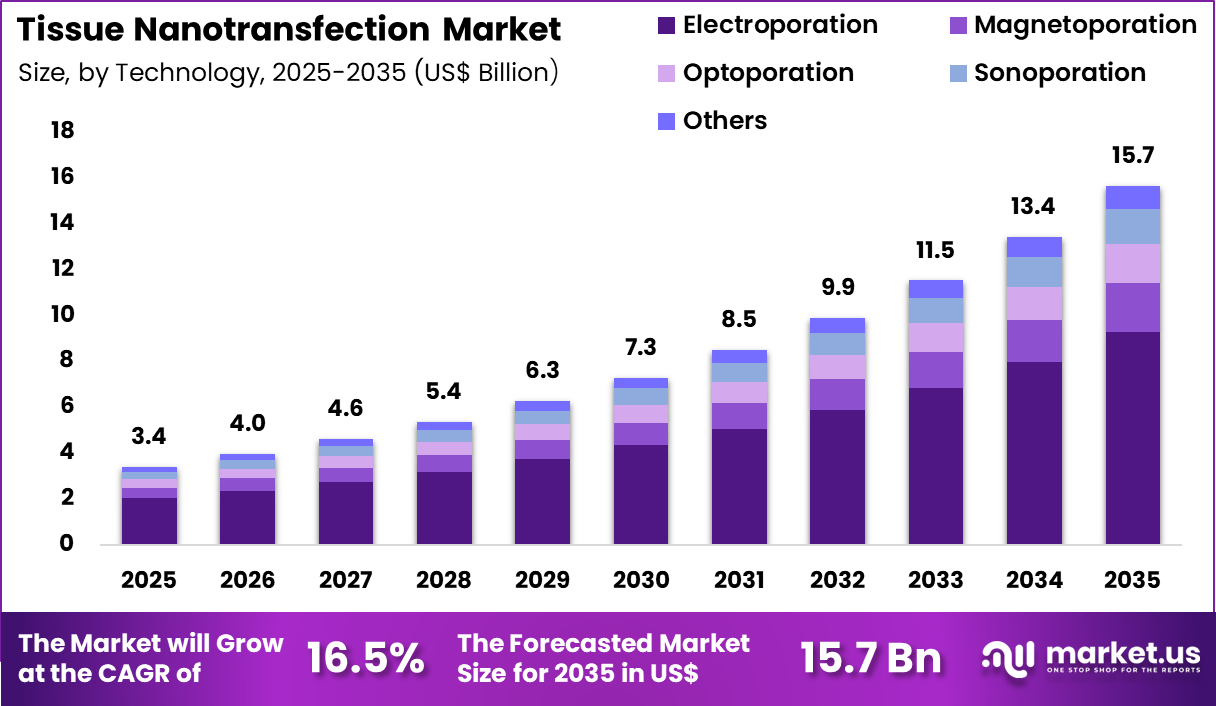
New York, NY – Nov 24 2026 – The Global Tissue Nanotransfection Market size is expected to be worth around US$ 15.7 Billion by 2035 from US$ 3.4 Billion in 2025, growing at a CAGR of 16.5% during the forecast period 2026-2035. In 2025, North America led the market, achieving over 42.2% share with a revenue of US$ 1.4 Billion.
Tissue Nanotransfection (TNT) is an innovative nanotechnology-based approach designed to promote tissue repair and regeneration by delivering genetic material directly into living tissues. This non-viral gene delivery technology uses a specially engineered silicon-based chip containing microscopic hollow channels to introduce specific genetic instructions into target cells.
The technology works through a process known as nanoelectroporation, in which brief, controlled electrical pulses temporarily increase cell membrane permeability, allowing genetic material to enter the cells. This process enables direct cellular reprogramming within the body without requiring conventional viral delivery systems.
TNT has demonstrated promising potential in regenerative medicine, particularly in wound healing, tissue repair, vascular regeneration, and recovery from ischemic injuries. It may also support the conversion of certain existing cells into other functional cell types, offering new possibilities for repairing damaged tissues.
One of the key advantages of this technology is its localized delivery approach, which may reduce exposure to unwanted systemic effects associated with some conventional gene delivery methods.
Although research findings are encouraging, further preclinical and clinical studies are required to establish its long-term safety, effectiveness, and suitability for widespread medical applications. TNT represents a promising research direction in the development of next-generation regenerative therapies.
Key Takeaways
- In 2025, the market was valued at US$ 3.4 billion and is projected to reach US$ 15.7 billion by 2035, growing at a CAGR of 16.5% during the forecast period.
- Based on technology, the market is segmented into electroporation, magnetoporation, optoporation, sonoporation, and others. Among these, electroporation dominated the market, accounting for a share of 59.4%.
- Based on application, the market is categorized into oncology, dermatology, neurology, cardiology and vascular, orthopedics, musculoskeletal and spine, wound healing, and others. Oncology emerged as the leading application segment, capturing a market share of 35.4%.
- Based on end user, the market is segmented into hospitals, specialty clinics, diagnostic centers, and others. Hospitals dominated the segment, accounting for the largest revenue share of 61.2%.
- Regionally, North America dominated the market, accounting for the largest share of 42.2%.
Key Market Segments
- Technology Analysis: Electroporation dominated the technology segment, accounting for 59.4% of the market share. Its leadership is attributed to its ability to deliver genetic material directly into cells using controlled electrical pulses. High delivery efficiency, precise cellular targeting, and reduced dependence on viral vectors have supported its adoption across regenerative medicine and gene therapy research.
- Application Analysis: Oncology emerged as the leading application segment, accounting for 32.4% of the market share. Its dominance is supported by increasing research into targeted cancer treatments, personalized medicine, and gene-based therapies. Tissue nanotransfection offers potential for localized genetic delivery and cellular reprogramming, creating new opportunities for advanced cancer treatment and therapeutic development.
- End-User Analysis: Hospitals dominated the end-user segment, capturing 61.2% of the market share. Their leadership is driven by advanced medical infrastructure, specialized equipment, skilled healthcare professionals, and expanding clinical research capabilities. Growing investments in regenerative medicine and translational research are expected to support hospital-based adoption of tissue nanotransfection technologies as clinical applications continue to develop.
Regional Analysis
North America Tissue Nanotransfection Market
North America dominated the tissue nanotransfection market in 2025, accounting for 42.2% of the global market share. Regional growth is driven by strong investments in biotechnology research, regenerative medicine, and advanced non-viral gene delivery technologies. The presence of leading research institutions, biotechnology companies, and well-established healthcare infrastructure has further supported market development.
Increasing research activities in wound healing, vascular repair, and cellular reprogramming are creating new opportunities for tissue nanotransfection applications. Government funding and academic collaborations are also accelerating technological advancements and clinical research across the region.
Asia Pacific Tissue Nanotransfection Market
Asia Pacific is expected to register the highest CAGR during the forecast period, supported by rising investments in biotechnology, gene therapy, and regenerative medicine. Countries such as China, Japan, South Korea, and Singapore are strengthening research capabilities through government funding and public-private partnerships.
Growing pharmaceutical research, expanding biotechnology infrastructure, and increasing focus on personalized medicine are supporting regional opportunities. Additionally, rising chronic disease prevalence and advancements in molecular biology and bioengineering are expected to accelerate the adoption of innovative gene delivery technologies across the region.
Emerging Trends
- Increasing Adoption of Non-Viral Gene Delivery Technology: The shift towards non-viral gene delivery is becoming an important trend in tissue nanotransfection research. TNT uses electrical pulses and nanoengineered silicon chips to deliver genetic material directly into tissues, potentially reducing dependence on viral delivery systems.
- Growing Research in Regenerative Medicine: Increasing research into regenerative medicine is creating opportunities for TNT technology. The technique can potentially reprogram existing skin cells into other functional cell types, supporting the development of new approaches for repairing damaged tissues and restoring biological functions.
- Development of Advanced Silicon-Based Nanotransfection Devices: Improvements in silicon nanochannel structures, microneedle systems, and electroporation technology are supporting the development of more precise TNT devices. These improvements aim to enhance genetic material delivery, improve tissue contact, and increase the consistency of treatment procedures.
- Increasing Focus on Neurological Tissue Repair: Research attention is expanding towards using TNT for nerve regeneration and neurological tissue repair. Scientists are investigating how cellular reprogramming and improved blood vessel formation could support recovery following nerve injuries and damage to nervous system tissues.
- Expansion of Research into Extracellular Vesicles: Extracellular vesicles are gaining attention in TNT research because they can carry biological signals between cells. Researchers are investigating whether TNT-engineered skin cells can produce therapeutic vesicles that influence tissue repair and support treatment development.
Use Cases
- Chronic Wound Healing and Skin Regeneration: TNT is being investigated for treating chronic wounds, burns, and damaged skin tissues. By delivering specific genetic instructions into skin cells, the technology may stimulate tissue regeneration, support blood vessel formation, and improve wound healing, particularly in difficult-to-heal wounds.
- Treatment of Ischemic Diseases and Vascular Damage: TNT has potential applications in treating ischemic conditions, where tissues receive insufficient blood supply. Researchers have demonstrated that vasculogenic cell reprogramming can support new blood vessel formation and improve blood circulation in experimental models of diabetic ischemic limb injury.
- Peripheral Nerve Regeneration: TNT is being studied as a potential approach for repairing damaged peripheral nerves. By reprogramming local cells towards a blood-vessel-forming phenotype, the technology may improve the tissue environment required for nerve regeneration and functional recovery following nerve injuries.
- Brain Tissue Repair Following Injury: Another potential application involves repairing brain tissue affected by injuries such as stroke. Preclinical research has investigated cellular reprogramming approaches that support vascular regeneration and tissue recovery, creating opportunities for future neurological treatment development.
- Cancer Research and Tumour Microenvironment Modification: TNT may also support cancer research through localized delivery of genetic material into selected tissues. Researchers can investigate how cellular reprogramming influences the tumour microenvironment, immune responses, and surrounding biological processes, potentially supporting future cancer treatment strategies.
Frequently Asked Questions About Tissue Nanotransfection
- How does tissue nanotransfection technology work?
TNT uses a silicon-based chip containing tiny channels to deliver genetic instructions into cells. Brief electrical pulses temporarily create openings in cell membranes, allowing genetic material to enter and influence cellular functions. - What are the major benefits of tissue nanotransfection?
The technology offers localized genetic delivery, rapid treatment procedures, and the possibility of directly reprogramming existing cells. Its non-viral approach may also reduce certain limitations associated with conventional viral gene delivery methods. - What are the major factors driving the tissue nanotransfection market?
Market development is supported by increasing regenerative medicine research, demand for non-viral gene delivery, advancements in nanotechnology, and growing interest in cellular reprogramming. These developments are encouraging research institutions and biotechnology companies to explore new applications. - Which application areas offer opportunities in the tissue nanotransfection market?
Major application opportunities include chronic wound management, vascular regeneration, peripheral nerve repair, neurological recovery, and cancer research. These areas are attracting scientific attention because localized genetic delivery may help modify cellular behaviour and support tissue repair. - Which technologies are used in the tissue nanotransfection market?
The technology landscape includes silicon-based nanochannel devices, nanoelectroporation systems, and microneedle-assisted delivery approaches. These technologies are being investigated to improve genetic material delivery, achieve localized cellular reprogramming, and support different tissue-specific applications. - What is the future outlook for the tissue nanotransfection market?
The market outlook is linked to successful clinical translation, improved device development, and broader therapeutic validation. Progress in wound healing, vascular repair, and nerve regeneration research could support future commercialization and adoption across specialized healthcare applications. - What is the role of biotechnology companies in this market?
Biotechnology companies can contribute through device development, genetic delivery research, technology licensing, and therapeutic development. Collaboration with universities and medical research centres may help move TNT from experimental studies towards clinically validated healthcare solutions. - What factors will influence commercial adoption of tissue nanotransfection?
Commercial adoption will depend on clinical trial outcomes, treatment safety, manufacturing scalability, device standardization, regulatory approvals, and healthcare costs. Demonstrating reliable results across different tissue types will be particularly important for future market development.
Conclusion
The tissue nanotransfection market is emerging as a promising segment of advanced regenerative medicine and non-viral gene delivery technologies. Market growth is supported by increasing research in cellular reprogramming, tissue regeneration, and targeted genetic delivery. Electroporation, oncology, hospitals, and North America represent key market segments.
Meanwhile, Asia Pacific is expected to experience strong growth due to rising biotechnology investments and research activities. Applications in chronic wound healing, vascular repair, and nerve regeneration are creating new opportunities. However, clinical validation, regulatory requirements, treatment safety, and manufacturing scalability will remain important factors influencing future market expansion.
Discuss your needs with our analyst
Please share your requirements with more details so our analyst can check if they can solve your problem(s)