
Overview
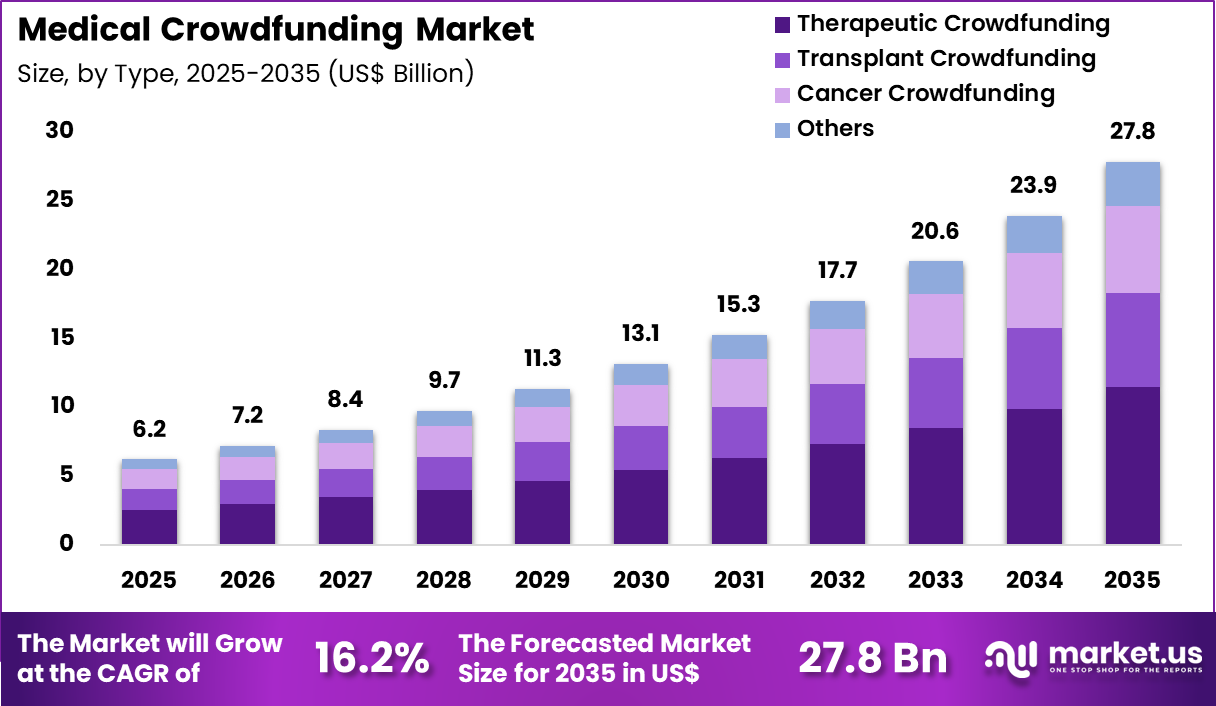
New York, NY – Nov 24 2026 – The Global Medical Crowdfunding Market size is expected to be worth around US$ 27.8 Billion by 2035 from US$ 6.2 Billion in 2025, growing at a CAGR of 16.2% during the forecast period 2026-2035. In 2025, North America led the market, achieving over 38.5% share with a revenue of US$ 2.4 Billion.
Medical crowdfunding is an emerging fundraising approach that enables individuals and families to collect financial support for medical treatments, surgeries, hospitalisation, and other healthcare-related expenses through online platforms. It involves raising funds from a large number of contributors, including friends, family members, social networks, and the general public.
The growth of medical crowdfunding is primarily driven by rising healthcare costs, increasing demand for advanced medical treatments, limited health insurance coverage, and growing awareness of digital fundraising platforms. It has become an important financial support mechanism for patients facing unexpected medical emergencies and high treatment expenses.
Online crowdfunding platforms have simplified the fundraising process by allowing patients to create fundraising campaigns, share medical information, upload supporting documents, and receive contributions through secure digital payment systems. Social media platforms have further strengthened campaign visibility and expanded donor participation.
The medical crowdfunding sector is also benefiting from increasing internet penetration, smartphone adoption, digital payment infrastructure, and growing public participation in online charitable activities. In addition, technological developments in payment security, campaign verification, and digital outreach are improving platform accessibility and donor confidence.
Going forward, the medical crowdfunding market is expected to witness further growth as healthcare affordability remains a major concern and digital fundraising solutions gain wider acceptance across developed and emerging economies.
Key Takeaways
- In 2025, the medical crowdfunding market was valued at US$ 6.2 billion and is projected to grow at a CAGR of 16.2%, reaching US$ 27.8 billion by 2035.
- Based on type, the market is segmented into therapeutic crowdfunding, transplant crowdfunding, cancer crowdfunding, and others. Among these, therapeutic crowdfunding dominated the market, accounting for a share of 41.2%.
- Based on application, the market is categorized into children, adults, elders, and others. The adults segment held a significant market share of 51.3%.
- By platform type, the market is classified into dedicated medical crowdfunding websites, general crowdfunding platforms, social media platforms, hospital and charity-integrated platforms, and others. Dedicated medical crowdfunding websites emerged as the leading segment, accounting for the largest revenue share of 57.6%.
- Regionally, North America dominated the medical crowdfunding market, accounting for the largest revenue share of 38.5%.
Key Market Segments
- Type Analysis: Therapeutic crowdfunding dominated the type segment with a 41.2% market share, driven by its application across chronic diseases, acute conditions, and medical emergencies. Rising treatment costs, limited insurance coverage, and increasing out-of-pocket healthcare expenditure are encouraging patients to seek financial assistance through digital fundraising platforms, supporting continued segment growth.
- Application Analysis: The adults segment dominated the application category with a 51.3% market share, primarily due to the rising prevalence of chronic diseases, lifestyle-related disorders, and medical emergencies. Increasing treatment expenses, financial responsibilities, and insurance coverage gaps are encouraging adult patients to seek crowdfunding support for surgeries, medications, and long-term healthcare requirements.
- Platform Type Analysis: Dedicated medical crowdfunding websites dominated the platform type segment with a 57.6% market share, supported by specialized fundraising services, medical verification processes, secure payment systems, and transparent fund management. Growing digital payment adoption, improved campaign visibility, and increasing donor confidence are further strengthening the adoption of dedicated medical crowdfunding platforms.
Regional Analysis
North America Medical Crowdfunding Market
North America dominated the medical crowdfunding market in 2025, accounting for a 38.5% market share. The region’s leadership is attributed to high healthcare costs, rising out-of-pocket medical expenses, and widespread adoption of digital fundraising platforms. High internet penetration, social media engagement, and established digital payment infrastructure have further supported market expansion.
Patients increasingly rely on crowdfunding to finance costly treatments, including cancer care, chronic disease management, surgeries, and specialized medical procedures. Limited insurance coverage and high deductibles have also encouraged individuals and families to seek financial assistance through online donation platforms.
Additionally, technological advancements, secure payment systems, and partnerships between crowdfunding platforms, nonprofit organizations, and healthcare providers are improving campaign accessibility and donor confidence. Growing public awareness of healthcare affordability challenges is further supporting the adoption of medical crowdfunding across the region.
Asia Pacific Medical Crowdfunding Market
The Asia Pacific medical crowdfunding market is expected to register the highest CAGR during the forecast period, driven by increasing healthcare expenditure, expanding internet penetration, and rising adoption of digital fundraising platforms. Countries such as India, China, Indonesia, and the Philippines are witnessing growing demand for online medical fundraising solutions.
Limited health insurance coverage and increasing treatment costs are encouraging patients to seek community-based financial assistance. Furthermore, widespread smartphone adoption, social media engagement, and mobile payment infrastructure are improving campaign accessibility and donor participation.
Regional platforms are introducing multilingual services and collaborating with hospitals and nonprofit organizations to strengthen fundraising opportunities. Increasing awareness of digital donations and healthcare affordability challenges is expected to further accelerate market growth across the Asia Pacific region.
Emerging Trends
- Increasing Adoption of Online Medical Fundraising Platforms: The adoption of online crowdfunding platforms is increasing as patients use digital channels to collect donations for medical treatments. Platforms allow individuals to create fundraising campaigns and share them with friends, relatives, and wider communities. This approach is particularly useful for patients who need financial assistance within a short period.
- Growing Demand for Cancer and Critical Illness Funding: Cancer, cardiovascular diseases, kidney disorders, and other serious medical conditions are creating demand for crowdfunding services. A 2025 study published in JAMA Network Open examined 2,440 medical crowdfunding campaigns in India and found that cancer accounted for 25.4% of the campaigns.
- Greater Use of Social Media for Fundraising: Social media platforms are becoming important channels for promoting medical fundraising campaigns. Patients and their families increasingly share campaign links, treatment updates, photographs, and videos to reach more potential donors. Wider online sharing can improve campaign visibility and encourage participation from people outside immediate social networks.
- Increasing Focus on Transparency and Donor Trust: Donors are showing greater interest in understanding how their contributions will be used. As a result, medical crowdfunding platforms are placing greater importance on patient documentation, hospital estimates, medical records, and fundraising updates. These measures can help improve donor confidence and reduce concerns about misleading fundraising campaigns.
- Growing Attention Towards Healthcare Financial Inequality: Medical crowdfunding is increasingly being used by individuals who face difficulties paying for expensive healthcare services. A 2025 systematic review published in the International Journal for Equity in Health examined 33 studies and identified unequal fundraising outcomes across different population groups. This highlights the importance of accessibility and fairness in crowdfunding services.
Use Cases
- Cancer Treatment and Chemotherapy Expenses: Medical crowdfunding platforms are used to collect donations for cancer treatment, including chemotherapy, radiation therapy, surgery, and related medicines. These campaigns help patients manage treatment expenses and reduce the immediate financial burden on their families.
- Organ Transplant and Surgical Procedures: Patients requiring kidney, liver, heart, and bone marrow transplants can use crowdfunding to raise funds for surgery and related medical expenses. Donations may also support hospital admission, post-operative care, and recovery-related costs.
- Emergency Medical Treatment and Accident Care: Crowdfunding is used to arrange financial support for patients requiring urgent medical attention following road accidents, serious injuries, and sudden illnesses. Funds can help cover emergency surgeries, intensive care, hospitalisation, and other immediate treatment expenses.
- Rare Diseases and Long-Term Medical Care: Patients suffering from rare genetic disorders, neurological conditions, and chronic diseases can use crowdfunding to support long-term treatment requirements. Campaigns may cover specialised medicines, diagnostic tests, rehabilitation, and recurring medical expenses.
- Paediatric and Newborn Healthcare Treatment: Parents can create medical fundraising campaigns to support treatment for children suffering from congenital disorders, premature birth complications, and serious childhood illnesses. Donations can help cover neonatal intensive care, specialised surgeries, medicines, and extended hospital stays.
Frequently Asked Questions About Medical Crowdfunding
- How does medical crowdfunding work?
Medical crowdfunding works by allowing patients or their families to create fundraising campaigns describing their medical conditions and financial requirements. The campaign is shared online, where donors can contribute money towards the patient’s treatment and healthcare expenses. - What medical expenses can be covered through crowdfunding?
Medical crowdfunding can support expenses related to hospitalisation, surgeries, cancer treatment, organ transplants, medicines, diagnostic tests, emergency care, and rehabilitation. The expenses covered depend on platform policies and the purpose of each fundraising campaign. - What factors are driving the medical crowdfunding market?
The market is supported by rising healthcare expenses, increasing digital platform adoption, social media usage, and demand for financial assistance. Limited insurance coverage and the cost of specialised treatments are also encouraging patients to explore alternative funding sources. - What are the major trends in the medical crowdfunding market?
Major market trends include mobile-based fundraising, social media campaign sharing, digital payment integration, improved campaign verification, and increased focus on donor transparency. These developments are helping platforms improve fundraising accessibility and strengthen donor engagement. - Which medical conditions generate demand for crowdfunding services?
Cancer, kidney disorders, cardiovascular diseases, neurological conditions, accidents, and rare genetic disorders generate demand for medical crowdfunding. These conditions can involve expensive treatments, specialised procedures, and long-term healthcare requirements, increasing the need for additional financial support. - What role does social media play in the medical crowdfunding market?
Social media supports medical crowdfunding by allowing campaign creators to distribute fundraising links, share patient stories, and communicate treatment updates. Wider online visibility can increase donor participation and help campaigns reach communities beyond personal networks. - What is the role of technology in medical crowdfunding?
Technology supports medical crowdfunding through digital payment systems, online campaign management, identity verification, and fundraising analytics. These tools can simplify donation processes, improve campaign monitoring, and help platforms provide a more accessible experience. - What is the future outlook for the medical crowdfunding market?
The market outlook is supported by increasing digital participation, growing awareness of online fundraising, and continued demand for healthcare financial assistance. Better verification systems, transparent reporting, and improved platform accessibility may support future market development.
Conclusion
The medical crowdfunding market is expected to experience strong growth, driven by rising healthcare costs, limited insurance coverage, and increasing adoption of digital fundraising platforms. Growing demand for financial assistance across cancer treatment, organ transplants, emergency surgeries, and chronic disease management is further supporting market expansion.
Technological advancements in digital payments, campaign verification, and social media outreach are improving accessibility and donor confidence. While North America currently leads the market, Asia Pacific is expected to witness the fastest growth. Increasing awareness of online fundraising, improved platform transparency, and expanding digital infrastructure are expected to create significant growth opportunities through 2035.
Discuss your needs with our analyst
Please share your requirements with more details so our analyst can check if they can solve your problem(s)