
Overview
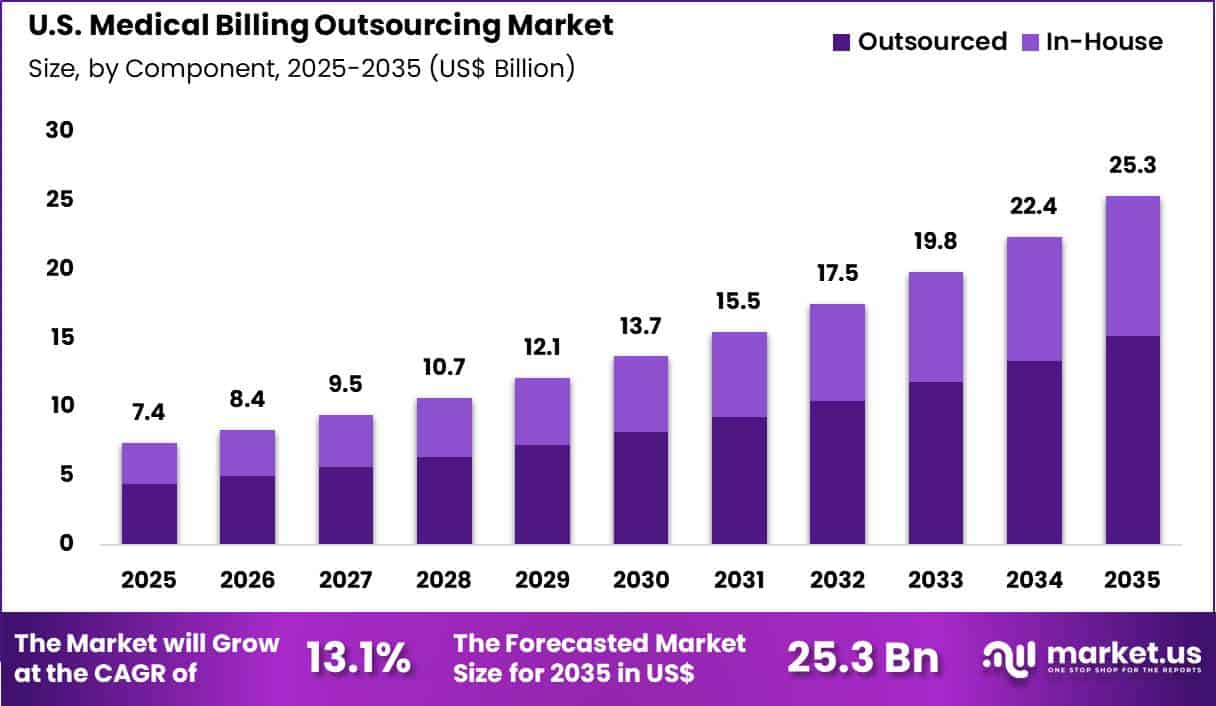
New York, NY – Nov 19 2026 – The U.S. Medical Billing Outsourcing Market size is expected to be worth around US$ 25.3 Billion by 2035 from US$ 7.4 Billion in 2025, growing at a CAGR of 13.1% during the forecast period 2026-2035.
The U.S. medical billing outsourcing market is experiencing steady growth, driven by the increasing complexity of healthcare reimbursement processes, rising administrative costs, and the growing need for efficient revenue cycle management. Medical billing outsourcing involves delegating billing-related activities, including claims submission, payment processing, coding, denial management, and accounts receivable follow-ups, to specialized third-party service providers.
The growing adoption of outsourcing services among hospitals, physician practices, diagnostic centers, and other healthcare facilities can be attributed to the need to reduce operational expenses, minimize billing errors, and improve cash flow. Additionally, frequent changes in healthcare regulations, insurance policies, and reimbursement procedures have increased the demand for specialized billing expertise.
Technological advancements, including artificial intelligence (AI), automation, cloud-based platforms, and data analytics, are further transforming the market by improving billing accuracy, processing speed, and operational efficiency. Moreover, the increasing focus on HIPAA compliance, data security, and transparent financial operations is encouraging healthcare organizations to partner with experienced outsourcing providers.
As healthcare providers continue to prioritize cost optimization and patient care, demand for medical billing outsourcing services is expected to increase, creating growth opportunities for established service providers and emerging market participants.
Key Takeaways
- In 2025, the U.S. medical billing outsourcing market was valued at US$ 7.4 billion and is projected to grow at a CAGR of 13.1%, reaching US$ 25.3 billion by 2035.
- Based on service, the market is segmented into full-service outsourcing, hybrid outsourcing, billing software as a service (SaaS), and consulting and advisory services. Among these, full-service outsourcing dominated the market, accounting for a 42.2% share.
- By component, the market is categorized into in-house and outsourced services. The outsourced segment held the leading position, capturing a 59.8% market share.
- Based on end use, the market is classified into hospitals, physician offices, and others. Among these, the hospital segment dominated the market, accounting for the largest revenue share of 48.6%.
Key Market Segments
- Service Analysis: Full-service outsourcing dominated the U.S. medical billing outsourcing market, accounting for a 42.2% market share, driven by increasing billing complexities and evolving reimbursement regulations. Healthcare providers increasingly engage specialized service providers to manage medical coding, claims processing, denial management, and revenue cycle operations, thereby improving billing accuracy, operational efficiency, and reimbursement timelines.
- Component Analysis: The outsourced component dominated the U.S. medical billing outsourcing market, accounting for a 59.8% market share. This dominance can be attributed to the growing preference among hospitals and physician practices for external billing expertise. Outsourcing helps reduce administrative expenses, minimize claim errors, improve reimbursement efficiency, and enable healthcare providers to concentrate on their core clinical operations.
- End-Use Analysis: Hospitals dominated the U.S. medical billing outsourcing market, accounting for the largest revenue share of 48.6%. The segment’s dominance is primarily driven by high patient volumes, complex billing procedures, and extensive insurance claims processing requirements. Increasing adoption of outsourced billing solutions enables hospitals to streamline revenue cycle management, reduce claim denials, and improve financial performance.
Emerging Trends
- Growing Adoption of AI-Based Medical Billing Solutions: Artificial intelligence is increasingly being used to improve medical billing accuracy and reduce manual work. AI-based systems can support medical coding, claim verification, error identification, and payment tracking. These capabilities are creating opportunities for outsourcing providers to deliver faster and more accurate billing services.
- Increasing Focus on Denial Management and Claim Recovery: Healthcare providers are placing greater importance on identifying rejected claims and recovering unpaid revenue. According to the AMA’s 2025 survey, 74% of physicians reported an increase in prior authorization denials over five years. This is increasing demand for outsourced denial management and claims follow-up services.
- Rising Demand for Electronic Claims Processing: The transition towards electronic healthcare transactions is encouraging medical billing outsourcing companies to adopt digital billing platforms. CMS supports standardized electronic transactions to simplify claim submission and payment processing. This trend is increasing the importance of electronic data interchange (EDI) and automated claims management.
- Increasing Importance of HIPAA Compliance and Data Security: Healthcare providers are placing greater emphasis on protecting sensitive patient information while outsourcing billing activities. Medical billing service providers are expected to follow HIPAA privacy and security requirements. As a result, demand is increasing for secure billing platforms, controlled data access, and compliant outsourcing arrangements.
- Growing Use of Automated Prior Authorization Support: Prior authorization requirements are creating additional administrative work for healthcare providers. The AMA’s 2025 survey found that physicians and their staff spend approximately 13 hours per week completing prior authorization requests. Outsourcing providers are increasingly positioned to support authorization checks, documentation, and follow-ups.
Use Cases
- Billing Support for Small and Independent Medical Practices: Small medical practices can outsource daily billing activities, including claim preparation, coding, submission, and payment follow-ups. This helps reduce the need for large in-house billing teams and allows healthcare professionals to focus more on patient care.
- Revenue Cycle Management for Hospitals: Hospitals can use outsourced billing services to manage large volumes of insurance claims, patient payments, reimbursement records, and outstanding balances. External service providers can support different stages of the revenue cycle and improve financial administration.
- Specialized Billing for Diagnostic and Imaging Centers: Diagnostic laboratories, radiology centers, and imaging facilities can outsource procedure coding, insurance verification, claim submission, and reimbursement tracking. These services help manage billing requirements associated with different diagnostic tests and medical procedures.
- Billing Management for Telehealth Providers: Telehealth companies and virtual healthcare providers can use outsourcing services to manage insurance eligibility, service coding, claim submission, and payment tracking. This is particularly useful when multiple insurance plans have different billing and reimbursement requirements.
- Multi-Location Healthcare Group Billing: Large physician groups and healthcare networks can outsource billing operations across multiple clinics and locations. Centralized billing support helps maintain consistent coding practices, standardize claim processing, monitor payments, and manage financial records across different facilities.
Frequently Asked Questions About U.S. Medical Billing Outsourcing
- Why do healthcare providers outsource medical billing services?
Healthcare providers outsource medical billing to reduce administrative workloads, manage billing costs, improve claim accuracy, and support timely reimbursements. External specialists also help practices manage complex insurance requirements without maintaining large internal billing departments. - What services are included in medical billing outsourcing?
Medical billing outsourcing generally includes patient registration, insurance eligibility verification, medical coding, charge entry, claim submission, denial management, payment posting, accounts receivable follow-ups, and patient billing support. Service coverage depends on the provider’s agreement. - Is medical billing outsourcing HIPAA compliant?
Medical billing outsourcing must follow applicable HIPAA privacy and security requirements when protected health information is handled. Healthcare providers generally need appropriate business associate agreements and safeguards to protect patient information during outsourced billing activities. - What factors are driving the growth of the U.S. medical billing outsourcing market?
Market growth is supported by increasing healthcare administrative costs, complex insurance reimbursement procedures, rising claim denials, staffing challenges, and growing adoption of digital billing systems. These factors are encouraging healthcare organizations to outsource financial administration. - What role does technology play in the U.S. medical billing outsourcing market?
Technology supports automated claim submission, medical coding, insurance verification, payment posting, and denial tracking. Artificial intelligence, cloud-based platforms, and electronic data interchange are helping outsourcing providers improve operational efficiency and manage billing information. - How are government regulations influencing the medical billing outsourcing market?
Government regulations are encouraging standardized electronic healthcare transactions, improved patient data protection, and more efficient claims processing. CMS’s 2026 claims attachment rule further supports electronic documentation exchange, with compliance deadlines scheduled 24 months after its effective date. - What opportunities exist for medical billing outsourcing companies in the United States?
Opportunities exist in automated claims processing, denial recovery, prior authorization support, specialty medical coding, and electronic documentation management. Increasing administrative complexity is creating demand for specialized outsourcing services across hospitals and independent healthcare practices.
Conclusion
The U.S. medical billing outsourcing market is expected to witness significant growth, supported by increasing healthcare administrative complexities, rising reimbursement challenges, and the growing need for cost-effective revenue cycle management. The adoption of full-service outsourcing, AI-driven automation, and cloud-based billing platforms is expected to improve operational efficiency, claim accuracy, and reimbursement processes.
Additionally, increasing demand for denial management, prior authorization support, and HIPAA-compliant billing solutions is creating new growth opportunities. As healthcare providers continue to focus on cost optimization and clinical efficiency, outsourcing services are expected to play an increasingly important role in strengthening financial performance across the U.S. healthcare industry.
Discuss your needs with our analyst
Please share your requirements with more details so our analyst can check if they can solve your problem(s)