
Overview
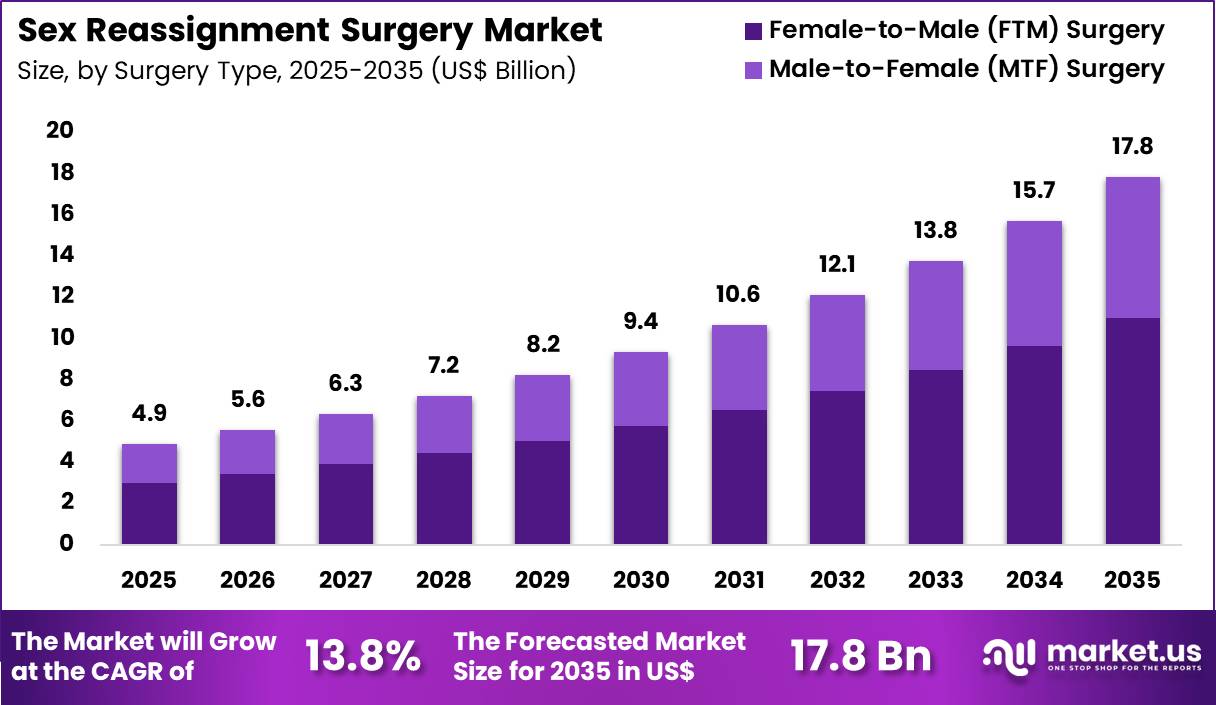
New York, NY – Nov 23 2026 – The Sex Reassignment Surgery Market size is expected to be worth around US$ 17.8 Billion by 2035 from US$ 4.9 Billion in 2025, growing at a CAGR of 13.8% during the forecast period 2026-2035. In 2025, North America led the market, achieving over 39.6% share with a revenue of US$ 1.9 Billion.
Sex reassignment surgery (SRS), also known as gender-affirming surgery, refers to a range of medical procedures designed to align an individual’s physical characteristics with their gender identity. These procedures are an important component of gender-affirming healthcare and may include genital reconstruction, chest surgery, facial feminization or masculinization, and other body contouring procedures.
The growing awareness of gender diversity, improved access to specialized healthcare, and advancements in surgical techniques are contributing to increased attention toward gender-affirming surgical procedures worldwide. These surgeries are generally performed by qualified surgeons with specialized training and are supported by multidisciplinary healthcare teams, including endocrinologists, mental health professionals, and other medical specialists.
The choice of surgical procedure depends on individual preferences, medical suitability, and personal healthcare goals. Preoperative assessment, informed consent, postoperative care, and long-term follow-up are essential components of treatment.
Technological advancements, improved surgical outcomes, and expanding healthcare infrastructure are expected to influence the development of the sex reassignment surgery landscape. As social acceptance and access to specialized medical services continue to evolve, the sector is receiving increasing attention from healthcare providers, medical device manufacturers, and other industry stakeholders.
Key Takeaways
- In 2025, the global sex reassignment surgery market generated revenue of US$ 4.9 billion and is projected to grow at a CAGR of 13.8%, reaching US$ 17.8 billion by 2035.
- Based on surgery type, the market is segmented into male-to-female (MTF) and female-to-male (FTM) surgeries, with the female-to-male (FTM) surgery segment dominating the market with a 61.5% share.
- By procedure type, the market comprises facial feminization/masculinization surgery, breast augmentation/mastectomy, hysterectomy/orchidectomy, vaginoplasty/phalloplasty/metoidioplasty, and others. Among these, mastectomy (top surgery) accounted for a significant market share of 22.4%.
- Based on end users, the market is categorized into hospitals, specialty clinics, and ambulatory surgical centers. Hospitals emerged as the leading segment, accounting for the largest revenue share of 56.9%.
- Regionally, North America dominated the global sex reassignment surgery market, accounting for a market share of 39.6%.
Key Market Segments
- Surgery Type Analysis: Female-to-male (FTM) surgery dominated the surgery type segment, accounting for 61.5% of the market share. Its leading position is attributed to rising demand for chest reconstruction, hysterectomy, and other gender-affirming procedures. Growing awareness, improved surgical techniques, multidisciplinary healthcare services, and expanding access to specialized treatment are expected to support segment growth.
- Procedure Type Analysis: Mastectomy (top surgery) dominated the procedure type segment, accounting for 22.4% of the market share. Its prominence is driven by strong patient demand for chest reconstruction and improved physical alignment. Wider procedure availability, advancements in surgical techniques, improved recovery outcomes, and increasing access to specialized gender-affirming healthcare are expected to sustain segment growth.
- End-User Analysis: Hospitals dominated the end-user segment, accounting for 56.9% of the market share. Their leading position is supported by advanced surgical infrastructure, specialized medical professionals, multidisciplinary care teams, and comprehensive postoperative services. Increasing investments in gender-affirming healthcare programs and the availability of complex surgical procedures are expected to strengthen hospital-based treatment demand.
Regional Analysis
North America Sex Reassignment Surgery Market Analysis
North America dominated the global sex reassignment surgery market in 2025, accounting for 39.6% of the market share. Regional growth is driven by increasing awareness of gender-affirming healthcare, expanding access to specialized surgical services, and well-established healthcare infrastructure.
The United States and Canada have witnessed growing investments in multidisciplinary treatment programs integrating surgical, hormonal, and mental health services. Improved insurance coverage in certain regions, advancements in surgical techniques, and increasing availability of trained specialists have further supported market development.
Additionally, supportive healthcare initiatives and growing recognition of transgender healthcare needs have contributed to the expansion of specialized treatment facilities across the region.
Asia Pacific Sex Reassignment Surgery Market Analysis
Asia Pacific is expected to register the highest CAGR during the forecast period, supported by increasing awareness, improving healthcare infrastructure, and expanding medical tourism.
Countries such as Thailand, India, South Korea, and Japan are strengthening specialized surgical services. Thailand remains a prominent destination for gender-affirming procedures due to its established surgical expertise and cost-effective treatment options. Rising healthcare investments, improved clinical training, and growing access to multidisciplinary care are expected to accelerate regional market growth.
Emerging Trends
- Increasing Demand for Gender-Affirming Surgical Procedures: The demand for gender-affirming surgeries has increased in several healthcare markets. A US study published in 2024 reported that surgical procedures increased nearly fivefold between 2016 and 2021, reflecting growing treatment utilisation and awareness.
- Growing Adoption of Facial and Chest Reconstruction Surgeries: Facial feminisation, chest reconstruction, and breast augmentation are becoming important components of gender-affirming treatment. These procedures provide additional options for individuals seeking physical changes beyond genital reconstruction, supporting the expansion of surgical service offerings.
- Increasing Focus on Personalised Surgical Treatment: Healthcare providers are increasingly following individualised treatment approaches based on patient anatomy, medical history, gender identity, and desired outcomes. This approach supports the selection of suitable procedures, improves treatment planning, and helps address individual healthcare requirements.
- Expansion of Multidisciplinary Healthcare Services: The market is witnessing greater emphasis on coordinated care involving psychiatrists, psychologists, endocrinologists, plastic surgeons, urologists, and gynaecologists. India’s Directorate General of Health Services recommends multidisciplinary involvement throughout assessment, treatment, surgery, and postoperative care.
- Increasing Government Attention Towards Treatment Accessibility: Government healthcare programmes and policy frameworks are creating greater opportunities for transgender healthcare access. In India, the Ayushman Bharat TG Plus initiative includes gender-affirmation surgery within its proposed healthcare coverage framework for eligible transgender beneficiaries.
Use Cases
- Male-to-Female Gender-Affirming Surgery: These procedures are used by transgender women seeking physical changes aligned with their gender identity. Common surgical applications include vaginoplasty, removal of testes, breast augmentation, and selected facial reconstruction procedures.
- Female-to-Male Gender-Affirming Surgery: These procedures support transgender men seeking masculine physical characteristics. Common applications include chest reconstruction, hysterectomy, removal of ovaries, metoidioplasty, and phalloplasty, depending on individual medical requirements and treatment preferences.
- Genital Reconstruction and Reproductive Organ Surgery: Genital reconstruction is used to modify reproductive and external genital anatomy according to individual treatment goals. Procedures include vaginoplasty, phalloplasty, metoidioplasty, hysterectomy, and other reconstructive surgical interventions.
- Facial and Voice-Related Gender-Affirming Procedures: Facial reconstruction and selected voice-related procedures are used to modify physical characteristics associated with gender presentation. These interventions may include forehead reconstruction, jaw contouring, rhinoplasty, and voice surgery, depending on patient preferences.
- Comprehensive Gender Transition Healthcare: Surgical procedures are also used as part of broader gender-transition healthcare programmes. These programmes may combine surgery with hormone therapy, psychological support, fertility preservation counselling, medical monitoring, and postoperative follow-up to support long-term healthcare needs.
Frequently Asked Questions About Sex Reassignment Surgery
- What are the different types of sex reassignment surgery?
Major procedures include vaginoplasty, phalloplasty, metoidioplasty, mastectomy, breast augmentation, hysterectomy, orchiectomy, and facial feminisation surgery. The selection depends on individual preferences, medical suitability, and desired physical changes. - Who can undergo sex reassignment surgery?
Individuals seeking gender-affirming surgery must undergo appropriate medical assessment and meet applicable clinical requirements. In India, the 2024 government guidelines specify adulthood, informed consent, clinical assessment, and additional treatment-readiness requirements before surgery. - What are the benefits of sex reassignment surgery?
Gender-affirming surgery can help individuals achieve physical characteristics that better match their gender identity. It may improve personal comfort and reduce gender-related distress, although individual experiences and psychological outcomes can vary considerably. - What are the possible risks associated with sex reassignment surgery?
Potential risks include infection, bleeding, scarring, wound complications, changes in sensation, and complications related to reconstruction. Risks vary according to the procedure, individual health conditions, surgical expertise, and postoperative care requirements. - What are the major factors driving the sex reassignment surgery market?
Increasing awareness of gender-affirming healthcare, improved surgical techniques, expanding healthcare infrastructure, supportive government initiatives, and greater availability of specialised medical professionals are contributing to market development across several countries. - Which surgical procedures represent important market segments?
Major market segments include vaginoplasty, phalloplasty, metoidioplasty, mastectomy, breast augmentation, hysterectomy, and facial feminisation surgery. These procedures address different patient requirements and contribute to the overall range of surgical services available. - Which regions are witnessing growth in gender-affirming surgery?
North America has reported increasing surgical utilisation, particularly in the United States. Other regions, including Europe and Asia-Pacific, are also developing specialised healthcare services, although regional access, regulations, and treatment availability differ. - How is technological development influencing the sex reassignment surgery market?
Advancements in reconstructive surgery, surgical planning, tissue techniques, and minimally invasive approaches are improving treatment options. These developments support greater procedural precision, although clinical suitability and outcomes depend on individual patient conditions.
Conclusion
The global sex reassignment surgery market is expected to witness strong growth, driven by increasing awareness of gender-affirming healthcare, improving surgical techniques, and expanding access to specialised medical services.
Valued at US$ 4.9 billion in 2025, the market is projected to reach US$ 17.8 billion by 2035, growing at a CAGR of 13.8%. Rising demand for FTM procedures, particularly mastectomy, and the expansion of hospital-based surgical services are supporting market development. While North America currently leads, Asia Pacific is expected to emerge as a key growth region, supported by healthcare investments and medical tourism.
Discuss your needs with our analyst
Please share your requirements with more details so our analyst can check if they can solve your problem(s)