
Overview
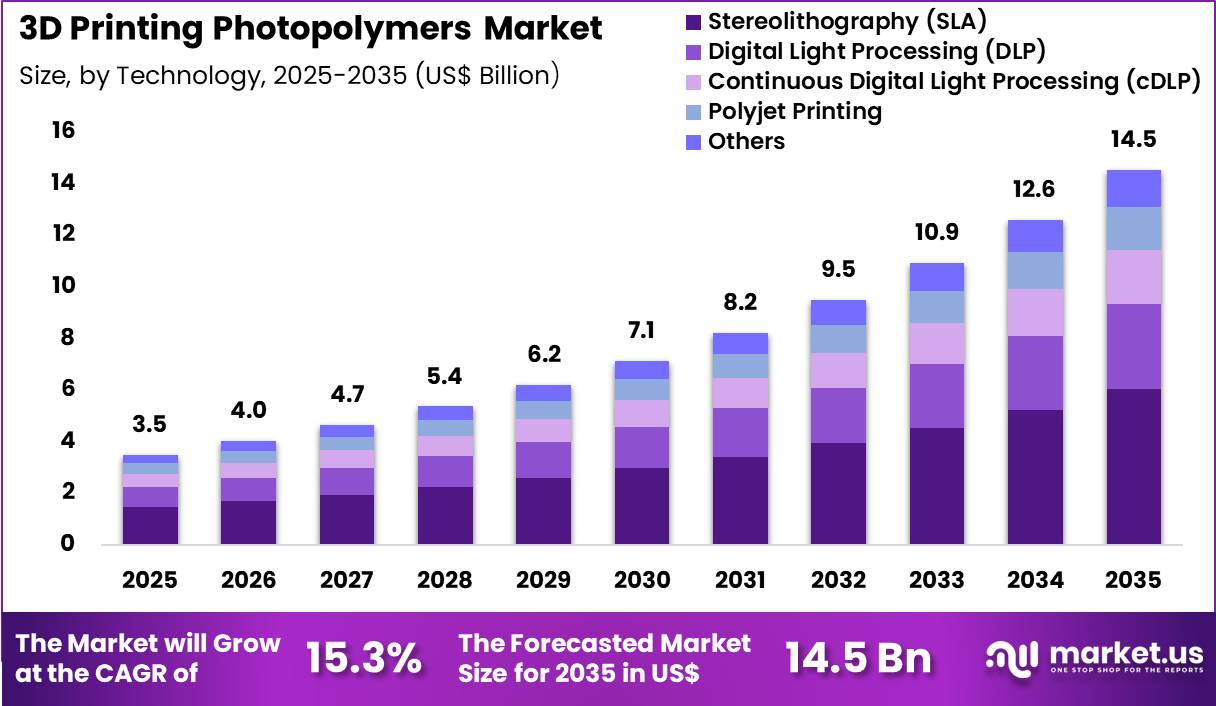
New York, NY – Nov 18 2026 – The Global 3D Printing Photopolymers Market size is expected to be worth around US$ 14.5 Billion by 2035 from US$ 3.5 Billion in 2025, growing at a CAGR of 15.3% during the forecast period 2026-2035. In 2025, North America led the market, achieving over 39.4% share with a revenue of US$ 1.4 Billion.
3D printing photopolymers are specialized light-sensitive materials used in additive manufacturing technologies to produce high-precision, complex, and detailed components. These materials undergo a chemical reaction called photopolymerization when exposed to specific light sources, typically ultraviolet (UV) light, resulting in rapid curing and solidification. They are widely used in technologies such as Stereolithography (SLA), Digital Light Processing (DLP), and Material Jetting.
Photopolymers are available in various formulations, including standard, flexible, rigid, transparent, high-temperature-resistant, and biocompatible resins. Their ability to deliver excellent surface finishes, dimensional accuracy, and intricate geometries makes them suitable for applications across healthcare, automotive, aerospace, consumer goods, electronics, and industrial manufacturing.
The growing adoption of rapid prototyping, customized manufacturing, and advanced product development is supporting demand for 3D printing photopolymers. In the healthcare sector, these materials are increasingly utilized for dental models, surgical guides, hearing aids, and customized medical devices. Similarly, automotive and aerospace manufacturers are using photopolymer-based 3D printing for prototyping and specialized components.
Continuous advancements in resin chemistry, material performance, and 3D printing technologies are expected to expand the application scope of photopolymers. Increasing industrial interest in lightweight designs, product customization, and efficient manufacturing processes is further supporting the development of this market.
Key Takeaways
- In 2025, the global 3D printing photopolymers market generated revenue of US$ 3.5 billion and is projected to grow at a CAGR of 15.3%, reaching US$ 14.5 billion by 2035.
- Based on technology, the market is segmented into stereolithography (SLA), digital light processing (DLP), continuous digital light processing (cDLP), PolyJet printing, and others. Among these, stereolithography (SLA) dominated the market, accounting for a 41.6% share.
- Based on application, the market is categorized into dental, medical and healthcare, audiology, jewellery, automotive, prototyping, industrial and engineering, electronics, and others. The dental segment held a significant market share of 28.4%.
- By performance type, the market is classified into low-performance, mid-performance, and high-performance photopolymers. The high-performance segment emerged as the leading category, capturing the largest revenue share of 36.0%.
- Regionally, North America dominated the global 3D printing photopolymers market, accounting for a market share of 39.4%.
Key Market Segments
- Technology Analysis: Stereolithography (SLA) dominated the technology segment with a 41.6% market share, driven by its high precision, superior surface finish, and compatibility with liquid photopolymers. Its extensive use in dental, healthcare, and electronics applications, combined with advancements in resin formulations and printing resolution, continues to support segment growth.
- Application Analysis: The dental segment dominated the application category with a 28.4% market share, supported by the increasing adoption of digital dentistry and customized dental solutions. Photopolymer resins are widely used to manufacture dental models, aligner molds, and surgical guides. Growing demand for orthodontic treatments and biocompatible materials further supports market expansion.
- Performance Type Analysis: The high-performance segment accounted for the largest revenue share of 36.0%, driven by increasing demand for photopolymers offering superior mechanical strength, thermal stability, and chemical resistance. Their growing application in automotive, electronics, and medical device manufacturing, particularly for functional prototyping and end-use components, is supporting segment growth.
Regional Analysis
North America Dominates the 3D Printing Photopolymers Market
North America dominated the global 3D printing photopolymers market in 2025, accounting for a 39.4% market share. This leadership was supported by the strong adoption of additive manufacturing across healthcare, aerospace, automotive, and electronics industries.
The United States remains a major innovation hub, driven by substantial investments in research and development, advanced manufacturing infrastructure, and material science. Growing applications of photopolymers in dental models, surgical guides, medical devices, and aerospace prototypes have further strengthened regional demand.
Additionally, continuous advancements in resin formulations, including improved heat resistance, flexibility, and biocompatibility, are supporting wider industrial adoption. The presence of established manufacturers, research institutions, and technology developers is also contributing to the region’s market leadership.
Asia Pacific Expected to Register the Highest CAGR
Asia Pacific is anticipated to register the highest CAGR during the forecast period, driven by rapid industrialization, expanding electronics manufacturing, and increasing investments in advanced manufacturing technologies. Countries such as China, Japan, South Korea, and Singapore are actively adopting additive manufacturing across industrial and healthcare applications.
Growing demand for customized dental products, medical components, and precision prototypes is further supporting photopolymer adoption. Additionally, government initiatives, expanding research capabilities, and domestic development of advanced resin materials are expected to accelerate regional market growth.
Emerging Trends
- Development of Bio-Based and Sustainable Photopolymers: The development of bio-based photopolymer resins is gaining attention as manufacturers explore alternatives to conventional petroleum-based materials. Research is increasingly focused on renewable raw materials, recyclable resin systems, and improved waste management to reduce the environmental impact of photopolymer manufacturing.
- Growing Adoption of Photopolymers in Healthcare: The use of photopolymer materials in healthcare is expanding through applications such as dental restorations, medical models, and customized devices. Research into photocurable hydrogels is also supporting the development of tissue-engineering structures and advanced biomedical manufacturing solutions.
- Advancements in High-Resolution Printing Technologies: Improvements in stereolithography (SLA), digital light processing (DLP), and other light-based printing technologies are increasing the accuracy of photopolymer manufacturing. These developments support the production of complex geometries, detailed components, and smaller structures with improved surface quality.
- Increasing Development of Application-Specific Resin Formulations: Manufacturers are developing specialized photopolymer formulations to meet different industrial requirements. These include flexible, high-temperature-resistant, transparent, ceramic-filled, and biocompatible materials. Such developments are allowing photopolymers to serve applications that require specific mechanical, thermal, and functional properties.
- Integration of Advanced Process Monitoring and Material Standards: Greater attention is being given to process monitoring, material characterization, and standardized testing. Research organizations are working to improve the measurement of printing accuracy and material performance, supporting better product consistency and more reliable manufacturing outcomes.
Use Cases
- Dental and Orthodontic Applications: Photopolymer resins are widely used in dental manufacturing to produce crowns, bridges, dentures, orthodontic retainers, night guards, and other dental components. Their ability to reproduce detailed shapes supports customized dental solutions and improves the accuracy of dental device production.
- Medical Models and Surgical Planning: Photopolymer materials are used to manufacture detailed anatomical models from medical imaging data. These models help healthcare professionals examine complex anatomical structures, understand patient-specific conditions, and prepare for surgical procedures before performing actual operations.
- Prototyping and Product Development: Industries use photopolymer 3D printing to create prototypes of consumer products, electronic components, automotive parts, and industrial equipment. The technology supports rapid design testing, shape verification, and product modifications before large-scale manufacturing begins.
- Tissue Engineering and Biomedical Research: Photocurable polymer hydrogels are being investigated for producing structures used in tissue engineering. These materials can support the development of artificial tissue models, cartilage structures, and research platforms for studying biological processes and potential regenerative treatments.
- Jewellery, Fashion, and Detailed Manufacturing: Photopolymer resins are used to create detailed jewellery patterns, miniature components, decorative products, and customized design models. Their ability to reproduce intricate features makes them suitable for applications where fine details and smooth surface finishes are important.
Frequently Asked Questions About 3D Printing Photopolymers
- What are the different types of photopolymers used in 3D printing?
Common types include standard, flexible, rigid, transparent, high-temperature-resistant, castable, and biocompatible photopolymer resins. Each type offers different properties and is selected according to the mechanical strength, appearance, flexibility, and performance required. - How do photopolymers work in 3D printing?
Photopolymers work through a process called photopolymerization. When light reaches the liquid resin, chemical reactions cause its molecules to form a solid polymer structure. The process is repeated in controlled layers until the final object is produced. - What are the advantages of using photopolymers in 3D printing?
Photopolymers offer high printing accuracy, smooth surface finishes, detailed designs, and faster production of complex prototypes. Different resin formulations also provide flexibility, transparency, rigidity, and other specialized properties for industrial and healthcare applications. - Are photopolymer materials suitable for medical applications?
Yes, certain photopolymer materials are suitable for specific medical and dental applications when they meet the required safety and performance standards. Their suitability depends on material formulation, intended use, testing, and applicable regulatory approvals. - What factors are driving the growth of the 3D printing photopolymers market?
Market growth is supported by increasing demand for customized products, advancements in 3D printing technologies, expanding dental applications, and the need for high-precision manufacturing. Continuous improvements in resin properties are also creating additional application opportunities. - Which industries are the major consumers of 3D printing photopolymers?
Healthcare, dentistry, automotive, aerospace, electronics, jewellery, and consumer goods are important end-use industries. These sectors utilize photopolymer materials for customized components, functional prototypes, detailed models, medical devices, and specialized manufacturing requirements. - What role does material innovation play in the 3D printing photopolymers market?
Material innovation helps manufacturers develop resins with improved strength, flexibility, transparency, heat resistance, and biocompatibility. These improvements expand the range of applications and enable photopolymer printing to address more specialized manufacturing requirements. - Which technologies are commonly used in photopolymer 3D printing?
Stereolithography (SLA), digital light processing (DLP), and liquid crystal display (LCD) based printing are commonly used technologies. These processes employ controlled light exposure to solidify liquid photopolymer resins and produce detailed three-dimensional structures.
Conclusion
The global 3D printing photopolymers market is expected to witness significant growth, driven by increasing adoption of additive manufacturing, rising demand for customized products, and continuous advancements in resin technologies. Valued at US$ 3.5 billion in 2025, the market is projected to reach US$ 14.5 billion by 2035, growing at a CAGR of 15.3%.
The growing use of photopolymers in dental, healthcare, automotive, aerospace, and electronics applications will further support market expansion. While North America currently leads the market, Asia Pacific is expected to register the highest growth, supported by industrial development and increasing investments in advanced manufacturing technologies.
Discuss your needs with our analyst
Please share your requirements with more details so our analyst can check if they can solve your problem(s)