


Overview
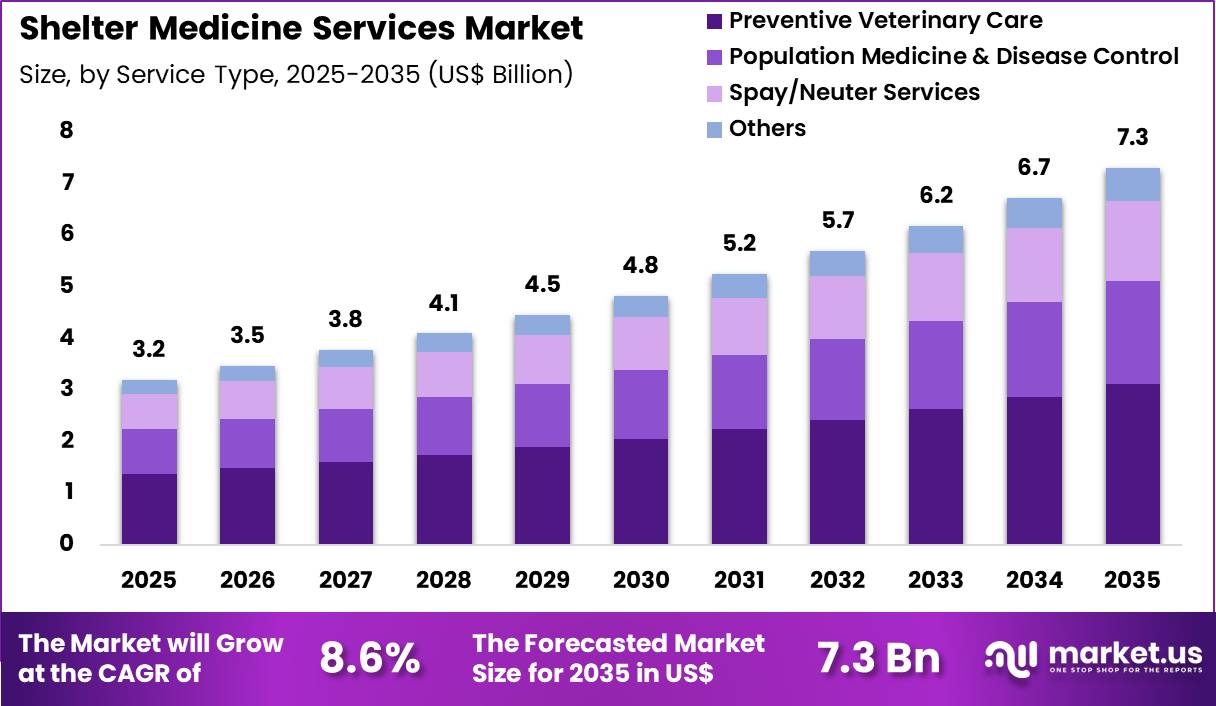
New York, NY – Nov 19 2026 – The Global Shelter Medicine Services Market size is expected to be worth around US$ 7.3 Billion by 2035 from US$ 3.2 Billion in 2025, growing at a CAGR of 8.6% during the forecast period 2026-2035. In 2025, North America led the market, achieving over 42.2% share with a revenue of US$ 1.3 Billion.
Shelter Medicine Services is a specialized branch of veterinary medicine focused on improving the health, welfare, and quality of life of animals living in animal shelters, rescue centres, and other group housing facilities. These services are designed to address the unique medical and healthcare needs of shelter animals, including dogs, cats, and other rescued animals.
Shelter medicine focuses on preventive healthcare, disease diagnosis, treatment, vaccination, parasite control, sterilization, and infection prevention. It also includes regular health assessments, nutritional management, animal population management, and behavioural health support. Special attention is given to controlling the spread of infectious diseases, maintaining hygienic shelter environments, and ensuring appropriate medical care for newly admitted and recovering animals.
The growing importance of animal welfare, increasing pet abandonment, and rising demand for animal rescue and rehabilitation services are contributing to the need for professional shelter medicine services. Veterinary professionals, animal welfare organizations, rescue groups, and shelter operators play an important role in delivering these services.
Through integrated veterinary care and preventive health management, shelter medicine services help improve animal survival rates, support successful adoptions, reduce disease outbreaks, and promote responsible animal welfare practices. These services are becoming an essential part of modern animal shelter management and the broader veterinary healthcare ecosystem.
Key Takeaways
- In 2025, the global shelter medicine services market was valued at US$ 3.2 billion and is projected to grow at a CAGR of 8.6%, reaching US$ 7.3 billion by 2035.
- Based on service type, the market is segmented into preventive veterinary care, population medicine and disease control, spay/neuter services, and others. Among these, preventive veterinary care dominated the market, accounting for a share of 42.6%.
- By animal type, the market is categorized into cats, dogs, and other small animals. The cat segment accounted for a significant market share of 35.1%.
- Based on service delivery, the market is segmented into onsite shelter services, mobile clinics, telemedicine, and others. Onsite shelter services dominated the segment, capturing the largest revenue share of 48.3%.
- By application, the market is classified into municipal/city animal shelters, private non-profit rescue organizations, disaster response units, community animal outreach, and others. Municipal/city animal shelters emerged as the leading segment, accounting for 52.7% of the market revenue.
- Regionally, North America dominated the global shelter medicine services market, accounting for the largest revenue share of 42.2%.
Key Market Segments
- Service Type Analysis: Preventive veterinary care dominated the service type segment, accounting for 42.6% of the market share. Its growth is driven by increasing emphasis on vaccination, routine health screening, parasite control, and nutritional management in shelters. Rising animal intake and infectious disease risks further encourage shelters to adopt preventive healthcare programs.
- Animal Type Analysis: Cats accounted for 35.1% of the animal type segment, driven by the growing population of stray and abandoned felines entering shelters. Increasing demand for feline vaccinations, disease screening, sterilization, and reproductive healthcare is supporting segment growth. Furthermore, expanding trap-neuter-return programs are strengthening demand for specialized veterinary services.
- Service Delivery Analysis: Onsite shelter services dominated the service delivery segment, accounting for 48.3% of the market share. Their prominence is attributed to immediate veterinary access, continuous health monitoring, and efficient disease management. Increasing investments in dedicated shelter clinics and in-house veterinary infrastructure are further supporting the adoption of onsite services.
- Application Analysis: Municipal and city animal shelters dominated the application segment, accounting for 52.7% of the market share. Their leading position is supported by high animal intake volumes and government investments in vaccination, sterilization, and disease control programs. Expanding public animal welfare initiatives are further strengthening demand for shelter medicine services.
Regional Analysis
North America Shelter Medicine Services Market
North America dominated the global shelter medicine services market in 2025, accounting for 42.2% of the market share. The region’s leading position is supported by established animal welfare organizations, expanding veterinary infrastructure, and increasing investments in shelter healthcare programs.
Municipal shelters, nonprofit organizations, and veterinary institutions are strengthening preventive care initiatives, including vaccination, sterilization, disease surveillance, and behavioral rehabilitation. According to Shelter Animals Count, approximately 6.3 million dogs and cats entered U.S. shelters and rescue organizations in 2023, highlighting the substantial demand for veterinary services.
Furthermore, growing public awareness, philanthropic funding, government support, and collaborations between veterinary clinics and animal welfare organizations are encouraging the expansion of shelter-based healthcare services across the region.
Asia Pacific Shelter Medicine Services Market
Asia Pacific is expected to register the highest CAGR during the forecast period, driven by increasing stray animal populations and expanding animal welfare initiatives. Countries such as India, Thailand, and Indonesia are strengthening vaccination, sterilization, and animal rescue programs.
Additionally, government initiatives, nonprofit partnerships, veterinary training programs, and growing awareness of responsible animal management are supporting demand for organized shelter healthcare services. Rising investments in veterinary infrastructure and preventive medicines are expected to further accelerate regional market growth.
Emerging Trends
- Increasing Focus on Preventive Veterinary Care: Preventive veterinary care is becoming an important part of shelter medicine services. Animal shelters are increasingly focusing on early health examinations, vaccination, parasite control, and infectious disease screening to reduce medical complications, prevent disease transmission, and improve animal survival rates.
- Growing Adoption of Population Health Management: Shelter medicine is moving beyond individual animal treatment towards population-based healthcare management. Veterinary professionals are increasingly using daily health assessments, animal grouping, capacity planning, and medical records to manage large animal populations while maintaining appropriate care standards.
- Expansion of Community-Based Veterinary Services: The scope of shelter medicine is expanding through community outreach clinics, mobile veterinary services, and trap-neuter-vaccinate-return (TNVR) programmes. These services help provide affordable veterinary care to underserved pet owners and control the population of free-roaming animals.
- Greater Emphasis on Infectious Disease Surveillance and Biosecurity: Animal shelters are strengthening disease surveillance through diagnostic testing, isolation procedures, sanitation protocols, and outbreak management. Emerging disease threats, including avian influenza in cats, are increasing the importance of veterinary monitoring and biosecurity practices.
- Increased Focus on Animal Behaviour and Stress Management: Shelters are increasingly integrating behavioural assessments, enrichment activities, socialisation, and stress-reduction programmes into veterinary services. These practices support animal welfare, improve behavioural outcomes, and help prepare animals for successful adoption.
Use Cases
- Medical Screening and Treatment of Newly Admitted Animals: Shelter medicine services are used to examine animals when they enter shelters. Veterinary professionals identify injuries, infections, nutritional deficiencies, and existing health conditions. Early diagnosis supports timely treatment and helps reduce the possibility of disease spreading to other animals.
- Vaccination and Infectious Disease Control Programmes: These services are used to protect shelter populations against common infectious diseases through vaccination, diagnostic testing, isolation, and treatment. Such programmes are particularly important in facilities receiving animals with unknown medical histories and frequent population turnover.
- Spaying, Neutering, and Community Animal Population Control: Veterinary teams provide sterilisation services for shelter animals, owned pets, and free-roaming community animals. These procedures help prevent unwanted pregnancies, manage animal populations, and reduce the number of animals entering shelters.
- Emergency Veterinary Care and Disease Outbreak Management: Shelter medicine services support the treatment of injured animals, infectious disease outbreaks, and urgent medical conditions. Veterinary professionals establish isolation procedures, treatment plans, and infection-control measures to protect affected animals and the wider shelter population.
- Animal Rehabilitation, Behavioural Care, and Adoption Preparation: These services are applied to animals requiring physical recovery, nutritional support, behavioural rehabilitation, and socialisation. Veterinary and shelter teams work together to improve animal health and behaviour before adoption or transfer to rescue organisations.
Frequently Asked Questions About Shelter Medicine Services
- Why are shelter medicine services important?
Shelter medicine services are important because they help prevent infectious diseases, improve animal health, and reduce mortality. They also support better living conditions, early medical intervention, and the overall welfare of animals housed in shelters. - What types of animals receive shelter medicine services?
Dogs and cats represent the primary populations receiving shelter medicine services. However, depending on the facility, veterinary care may also be provided to rabbits, birds, small mammals, and other rescued or abandoned animals. - What are the major treatments provided under shelter medicine?
Major treatments include physical examinations, vaccinations, parasite control, infectious disease management, wound treatment, spaying, neutering, dental care, and nutritional support. Behavioural assessments and rehabilitation are also provided to improve animal health and welfare. - Who provides shelter medicine services?
Shelter medicine services are delivered by licensed veterinarians, veterinary technicians, animal health professionals, and trained shelter staff. Animal welfare organisations and veterinary colleges also support these services through medical programmes, consultations, and professional training. - What are the major factors driving the Shelter Medicine Services Market?
Market growth is supported by increasing animal adoption, rising awareness of animal welfare, growing demand for preventive veterinary care, expanding rescue activities, and the need for effective infectious disease management in animal shelter facilities. - How is technology influencing the Shelter Medicine Services Market?
Technology is supporting shelter medicine through digital medical records, diagnostic equipment, laboratory testing, and remote veterinary consultations. These solutions can improve health monitoring, treatment coordination, medical documentation, and operational efficiency across shelter facilities. - What role do government organisations play in the Shelter Medicine Services Market?
Government organisations support shelter medicine through animal welfare regulations, public veterinary health programmes, disease surveillance, vaccination initiatives, and funding for animal welfare activities. Their involvement helps establish healthcare standards and improve access to veterinary services. - What is the future outlook for the Shelter Medicine Services Market?
The market is expected to benefit from increasing adoption of preventive healthcare, community veterinary programmes, population management, and improved disease surveillance. Greater awareness of animal welfare is also likely to support demand for specialised shelter veterinary services.
Conclusion
The global Shelter Medicine Services Market is expected to witness significant growth, supported by increasing animal welfare awareness, rising pet abandonment, and growing demand for preventive veterinary healthcare. The increasing adoption of vaccination, disease management, sterilization, and rehabilitation services is strengthening market demand.
North America currently holds a leading position, while Asia Pacific is expected to experience faster growth due to expanding animal rescue initiatives and veterinary infrastructure.
Furthermore, advancements in diagnostic technologies, mobile veterinary clinics, and community-based healthcare programmes are creating new opportunities. Overall, the market is expected to benefit from continued investments in organized animal healthcare and shelter management.
Discuss your needs with our analyst
Please share your requirements with more details so our analyst can check if they can solve your problem(s)



