


Overview
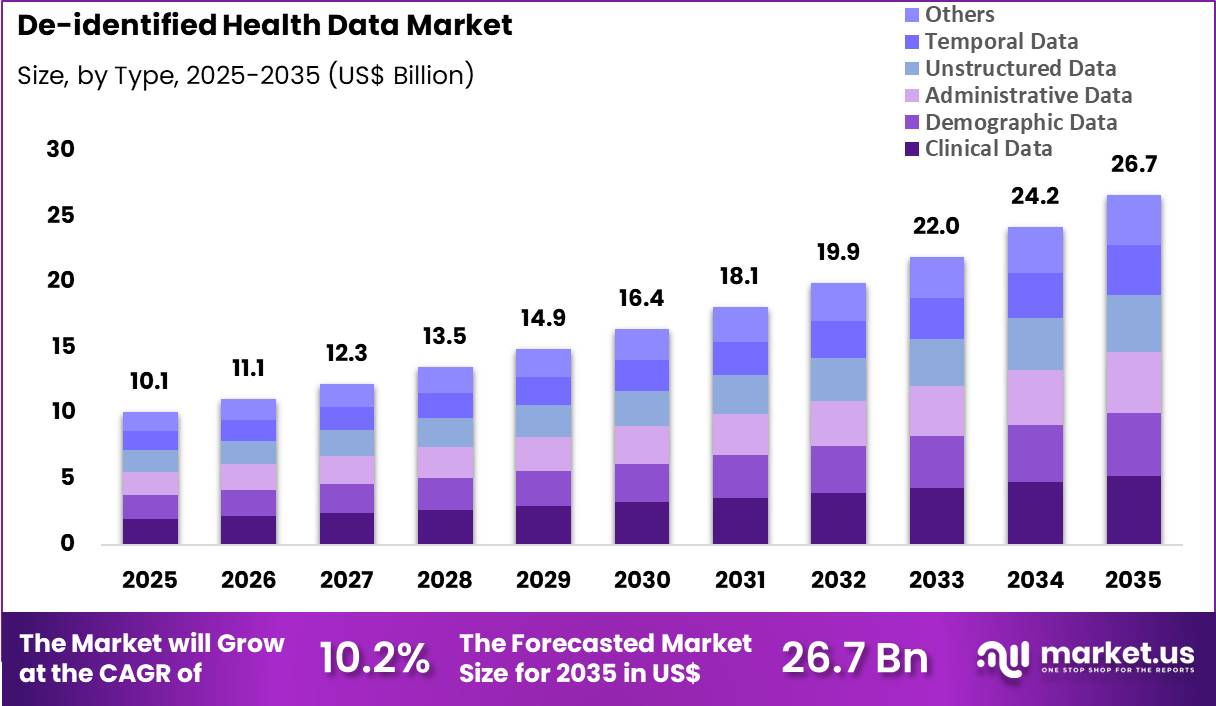
New York, NY – Nov 19 2026 – The Global De-identified Health Data Market size is expected to be worth around US$ 26.7 Billion by 2035 from US$ 10.1 Billion in 2025, growing at a CAGR of 10.2% during the forecast period 2026-2035. In 2025, North America led the market, achieving over 38.5% share with a revenue of US$ 3.9 Billion.
De-identified health data refers to medical and healthcare information from which personally identifiable details, such as patient names, addresses, contact information, medical record numbers, and other identifying attributes, have been removed or modified. This process helps protect patient privacy while allowing health information to be used for research, analysis, and healthcare improvement.
De-identified health data may include electronic health records, medical histories, diagnostic information, laboratory test results, treatment records, prescription details, clinical outcomes, and healthcare utilization data. Such information plays an important role in medical research, public health studies, pharmaceutical development, clinical trials, and healthcare market analysis.
The use of de-identified data enables researchers, healthcare providers, pharmaceutical companies, and policymakers to identify disease patterns, evaluate treatment outcomes, understand patient populations, and support evidence-based decision-making.
With the growing adoption of digital healthcare systems, the demand for high-quality, secure, and reliable de-identified health data is increasing. Strong data governance, privacy protection measures, and compliance with applicable data protection regulations remain essential for maintaining data quality and public trust.
Overall, de-identified health data is emerging as an important resource for advancing healthcare research, improving operational efficiency, and supporting innovation across the global healthcare ecosystem.
Key Takeaways
- In 2025, the market was valued at US$ 10.1 Billion and is projected to grow at a CAGR of 10.2%, reaching US$ 26.7 Billion by 2035.
- Based on type, the market is segmented into clinical data, demographic data, administrative data, unstructured data, temporal data, and others. Among these, clinical data dominated the segment, accounting for a market share of 19.6%.
- By application, the market is categorized into clinical and medical research, AI and machine learning training, electronic health records (EHR) data sharing, healthcare analytics and marketing, public health and disease surveillance, and others. Clinical and medical research emerged as the leading application segment, capturing 18.3% of the market share.
- Based on end users, the market is classified into healthcare providers, pharmaceutical companies, biotechnology firms, medical device manufacturers, insurance companies/healthcare payers, research institutions, government agencies, and others. Healthcare providers accounted for the largest revenue share of 36.4%, establishing their dominance in the market.
- Regionally, North America dominated the global market, accounting for a revenue share of 38.5%.
Key Market Segments
- Type Analysis: Clinical data held a dominant share of 19.6% in the de-identified health data market, driven by its growing use in clinical research, healthcare analytics, and treatment evaluation. Increasing adoption of electronic health records, diagnostic systems, and digital healthcare platforms has expanded clinical data generation. Healthcare providers increasingly de-identify patient records to support research while maintaining privacy compliance.
- Application Analysis: Clinical and medical research accounted for the largest application share of 18.3% in the de-identified health data market. The growing need for real-world patient information to study disease patterns, treatment effectiveness, and clinical outcomes is supporting segment growth. Pharmaceutical companies, research institutions, and academic organizations increasingly utilize anonymized datasets to advance drug discovery and medical research.
- End-User Analysis: Healthcare providers dominated the end-user segment with a market share of 36.4%, primarily due to their extensive generation of patient records and clinical information. Hospitals and healthcare networks increasingly adopt electronic health records and digital diagnostic systems, creating substantial data volumes. Growing collaborations with pharmaceutical companies and research institutions are further supporting the use of de-identified healthcare data.
Regional Analysis
North America Dominates the De-identified Health Data Market
North America accounted for 39.6% of the de-identified health data market in 2025, driven by widespread adoption of electronic health records, advanced healthcare infrastructure, and increasing demand for anonymized patient information. Healthcare providers, pharmaceutical companies, and research institutions increasingly utilize de-identified datasets for clinical research, AI development, drug discovery, and healthcare analytics.
According to the Office of the National Coordinator for Health Information Technology, approximately 96% of U.S. non-federal acute care hospitals had adopted certified electronic health record systems by 2023. Growing investments in digital health technologies, secure data exchange, and privacy-preserving solutions are further strengthening regional market growth.
Asia Pacific Expected to Register the Highest CAGR
Asia Pacific is projected to record the highest CAGR during the forecast period, supported by rapid digital healthcare transformation and expanding medical research activities.
Countries such as China, Japan, South Korea, and Singapore are investing in digital health infrastructure, electronic medical records, and healthcare data interoperability. Increasing pharmaceutical research, clinical trials, government initiatives, and adoption of AI-driven healthcare analytics are expected to accelerate demand for de-identified health data across the region.
Emerging Trends
- Increasing Use of Artificial Intelligence in Healthcare Data Analysis: The adoption of artificial intelligence (AI) and machine learning is increasing the demand for de-identified health data. These technologies use large patient datasets to identify disease patterns, study treatment outcomes, improve diagnostic models, and support healthcare decision-making without directly exposing patient identities.
- Growing Demand for Real-World Health Data: Pharmaceutical companies, healthcare providers, and research institutions are increasingly using de-identified electronic health records (EHRs) and medical claims data. These datasets help evaluate treatment effectiveness, understand patient outcomes, and support evidence generation beyond traditional clinical trials.
- Expansion of Privacy-Preserving Data Sharing: Healthcare organizations are adopting stronger data protection methods to support secure information sharing. Techniques such as data masking, statistical disclosure control, and expert-based de-identification are helping organizations make health information available for research and analysis while reducing patient identification risks.
- Development of Large-Scale Health Data Repositories: The development of centralized health data repositories is improving access to de-identified patient information. Government-backed initiatives, such as the NIH All of Us Research Program, are providing structured research datasets through different access levels to support scientific studies.
- Increasing Adoption of Standardized and Interoperable Health Data: Healthcare organizations are increasingly adopting standardized data formats and exchange technologies. Standards such as Fast Healthcare Interoperability Resources (FHIR) are helping improve data compatibility between healthcare systems, making de-identified information easier to organize, combine, and analyze across different platforms.
Use Cases
- Clinical Research and Medical Studies: De-identified health data is used by universities, medical institutions, and research organizations to study diseases, patient characteristics, and treatment outcomes. Researchers can examine large patient populations without directly accessing personal identifying information, supporting broader medical investigations.
- Drug Development and Pharmaceutical Research: Pharmaceutical companies use de-identified patient records and healthcare claims to understand how medicines perform in real-world settings. These datasets help researchers examine treatment effectiveness, adverse events, patient responses, and medicine usage patterns during drug development.
- Healthcare Cost and Utilization Analysis: Insurance providers, healthcare administrators, and policymakers use de-identified claims data to evaluate medical spending, hospital admissions, prescription usage, and healthcare service utilization. This information supports cost management, resource allocation, and healthcare policy planning.
- Artificial Intelligence and Predictive Model Development: Technology developers and healthcare researchers use de-identified datasets to train and test machine learning models. These datasets can support the development of disease prediction tools, diagnostic applications, patient risk assessment systems, and other data-driven healthcare technologies.
- Public Health Monitoring and Disease Pattern Analysis: Government health agencies and public health researchers use de-identified information to study disease occurrence, population health patterns, and healthcare service demand. Such analysis supports health planning, disease surveillance, and the identification of healthcare needs across population groups.
Frequently Asked Questions About De-identified Health Data
- Why is de-identification important in healthcare?
De-identification is important because it allows healthcare organizations to share and analyze patient information while protecting individual privacy. It supports medical research, healthcare analytics, and scientific studies without directly exposing patients’ personal identities. - What are the main methods of health data de-identification?
The two main HIPAA methods are Safe Harbor and Expert Determination. Safe Harbor removes specified identifiers, while Expert Determination uses qualified statistical and scientific expertise to establish a very small identification risk. - What types of information are included in de-identified health data?
De-identified health data can include medical diagnoses, treatment records, laboratory results, prescription information, hospital admissions, medical claims, and patient demographics. Personal identifiers are removed or modified according to the applicable de-identification requirements. - Can de-identified health data be used for medical research?
Yes, de-identified health data can be used for medical research, disease analysis, and treatment evaluation. It allows researchers to examine patient information and healthcare outcomes while reducing the risks associated with accessing identifiable medical records. - What are the major factors driving the de-identified health data market?
Market growth is supported by increasing medical research activities, wider adoption of artificial intelligence, rising demand for real-world evidence, expanding digital health records, and growing requirements for privacy-conscious healthcare information sharing. - Who are the major end users of de-identified health data?
Major end users include pharmaceutical companies, biotechnology firms, hospitals, healthcare providers, insurance companies, academic institutions, and government agencies. These organizations use de-identified datasets for research, treatment evaluation, healthcare planning, and data analysis. - How is artificial intelligence influencing the de-identified health data market?
Artificial intelligence is increasing demand for large and reliable healthcare datasets. De-identified information supports machine learning development, disease prediction, diagnostic research, and clinical analytics while helping organizations address patient privacy concerns.
World Health Organization
Conclusion
The de-identified health data market is expected to experience steady growth, driven by the increasing adoption of digital healthcare systems, artificial intelligence, and real-world data analytics. Rising demand for secure patient information is supporting its use across clinical research, pharmaceutical development, healthcare analytics, and public health monitoring.
North America currently leads the market, while Asia Pacific is expected to witness faster growth due to expanding healthcare infrastructure and digital transformation initiatives. Increasing investments in data interoperability, privacy-preserving technologies, and healthcare research are expected to create new growth opportunities. However, data security, quality, and regulatory compliance will remain important market considerations.
Discuss your needs with our analyst
Please share your requirements with more details so our analyst can check if they can solve your problem(s)



