
Overview
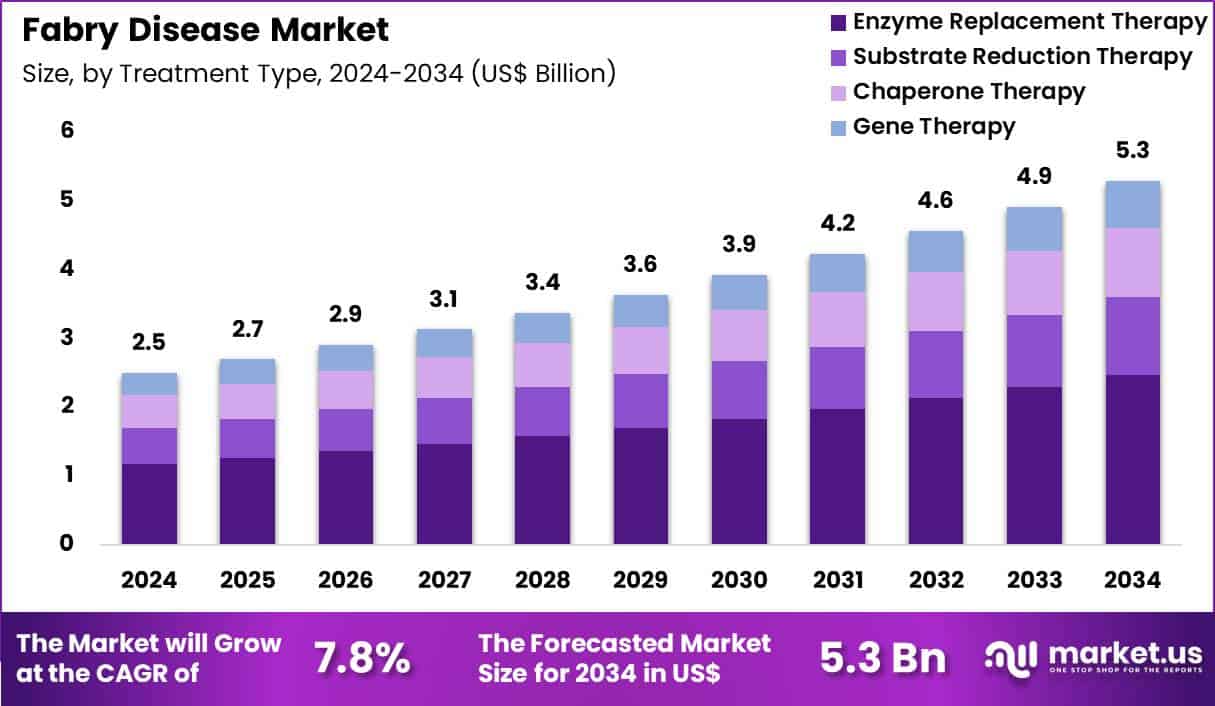
New York, NY – Oct 26, 2026 – Global Fabry Disease Market size is expected to be worth around US$ 5.3 Billion by 2034 from US$ 2.5 Billion in 2024, growing at a CAGR of 7.8% during the forecast period 2025 to 2034. In 2024, North America led the market, achieving over 41.1% share with a revenue of US$ 1.0 Billion.
Fabry disease is a rare, inherited genetic disorder classified as a lysosomal storage disorder. It is caused by mutations in the GLA gene, which lead to a deficiency or reduced activity of the enzyme alpha-galactosidase A. As a result, a fatty substance called globotriaosylceramide (Gb3 or GL-3) accumulates in cells, gradually affecting multiple organs and tissues.
The disease is inherited in an X-linked pattern and can affect both males and females, although disease severity and symptoms may vary. Common symptoms include burning pain in the hands and feet, reduced sweating, heat intolerance, skin lesions known as angiokeratomas, and gastrointestinal discomfort. Over time, Fabry disease may cause serious complications involving the kidneys, heart, and nervous system, including kidney failure, cardiac abnormalities, and stroke.
Diagnosis is often based on enzyme activity testing, genetic analysis, and clinical evaluation. Genetic testing is particularly important for identifying affected females and supporting family screening.
Treatment options include enzyme replacement therapy (ERT), which helps address the underlying enzyme deficiency, and oral pharmacological chaperone therapy for eligible patients with specific GLA variants. Supportive care and regular monitoring are also important for managing symptoms and preventing complications.
Greater awareness, early diagnosis, and timely treatment are essential to improving disease management and patient outcomes. Continued research into innovative therapies and diagnostic approaches is expected to support advances in the care of individuals living with Fabry disease.
Key Takeaways
- In 2024, the Fabry disease market generated US$ 2.5 billion in revenue and is projected to reach US$ 5.3 billion by 2034, growing at a CAGR of 7.8%.
- By treatment type, the market is segmented into enzyme replacement therapy, substrate reduction therapy, chaperone therapy, and gene therapy. Enzyme replacement therapy dominated the segment, accounting for 46.7% of the market share.
- By diagnosis method, the market is categorized into genetic testing, enzyme activity assay, biopsy, and imaging techniques. Genetic testing held a significant market share of 42.8%.
- By disease severity, the market is divided into moderate, mild, severe, and asymptomatic categories. The moderate segment dominated the market, accounting for 39.5% of total revenue.
- Regionally, North America dominated the Fabry disease market, accounting for 41.1% of the total market share.
Key Market Segments
- Treatment Type Analysis: Enzyme replacement therapy dominated the Fabry disease market, accounting for 46.7% of the segment. Its established role in addressing enzyme deficiency, reducing substrate accumulation, and slowing organ damage, supported by clinical evidence, reimbursement coverage, and improved treatment access, drives its adoption.
- Diagnosis Method Analysis: Genetic testing dominated the diagnosis method segment, accounting for 42.8% of the market. Its accuracy in identifying pathogenic mutations, supporting family screening, enabling early diagnosis, and guiding treatment decisions, alongside advances in sequencing technology, strengthens its adoption in Fabry disease management.
- Disease Severity Analysis: The moderate disease severity segment dominated the Fabry disease market, accounting for 39.5% of total revenue. Increased diagnosis rates, visible symptoms, treatment eligibility, and regular disease monitoring support segment growth, while early intervention strategies aim to prevent severe complications and irreversible organ damage.
Regional Analysis
North America dominated the Fabry disease market, accounting for 41.1% of the global market share in 2024. Regional growth is supported by advanced healthcare infrastructure, increased awareness, improved diagnostic capabilities, and access to approved therapies. Investments in gene therapy research, precision medicine, and clinical trials are further strengthening treatment development. Patient advocacy initiatives and expanded reimbursement coverage also support early diagnosis and treatment accessibility.
Asia Pacific is expected to register the highest CAGR during the forecast period, driven by improving healthcare infrastructure, expanding rare disease awareness, and increasing access to advanced therapies. Government initiatives, enhanced reimbursement frameworks, and improved diagnostic protocols are supporting regional market development.
Investments in patient registries, specialized infusion facilities, and local pharmaceutical manufacturing are expected to improve treatment accessibility. Furthermore, regulatory efforts to accelerate the availability of rare disease medicines and growing research collaborations are creating opportunities for market expansion across countries such as China, India, South Korea, and Singapore.
Emerging Trends
- Development of gene therapy: Gene therapy is being studied as a potential long-term treatment for Fabry disease. The approach aims to help the body produce the missing alpha-galactosidase A enzyme. Clinical research is assessing its safety, effectiveness, and ability to reduce the need for repeated treatments.
- Improved diagnosis through newborn screening: Newborn screening is gaining attention because early identification can help patients receive medical monitoring and treatment before serious organ damage develops. Screening programs can also identify people with later-onset forms of Fabry disease, although further assessment is needed to understand the significance of individual genetic findings.
- Growth in personalized treatment approaches: Treatment selection is increasingly based on a patient’s genetic variant, symptoms, organ involvement, and disease progression. For example, migalastat is suitable only for adults with specific amenable GLA gene variants. This approach supports more targeted treatment decisions rather than using the same therapy for every patient.
- Research into treatments that reduce fat accumulation: Researchers are investigating substrate reduction therapy, which aims to decrease the production of certain fatty substances that accumulate in patients with Fabry disease. This method differs from enzyme replacement therapy because it targets the production of the substances rather than directly replacing the missing enzyme.
- Development of improved enzyme replacement therapies: Research is exploring new enzyme replacement treatments designed to improve enzyme stability, treatment delivery, and patient convenience. Longer-lasting formulations and less burdensome administration methods may help address some limitations of existing therapies. Their clinical value will depend on demonstrated safety and effectiveness.
Use Cases
- Early identification of affected patients: Genetic testing and enzyme activity testing can help identify Fabry disease before advanced complications appear. Newborn screening and testing of relatives can support earlier diagnosis, allowing healthcare professionals to plan follow-up assessments and evaluate the need for treatment.
- Management of kidney complications: Fabry disease can cause progressive kidney damage. Regular kidney function tests, urine assessments, and specialist consultations are used to monitor disease progression. Enzyme replacement therapy and supportive kidney care may be included in an individualized treatment plan.
- Prevention and monitoring of heart complications: Cardiac monitoring is an important application of Fabry disease care because the condition can affect heart muscle and function. Electrocardiograms, echocardiography, and cardiac magnetic resonance imaging may be used to identify abnormalities and guide clinical management.
- Genetic testing to guide medicine selection: Genetic testing can determine whether a patient’s GLA gene variant is suitable for a specific treatment. This is particularly important for migalastat, which is effective only for eligible variants. The results help clinicians assess treatment options and avoid unsuitable therapy choices.
- Clinical trials for future treatment options: Clinical trials provide a setting for evaluating new medicines, gene therapies, and alternative treatment methods. Eligible patients may participate under study-specific criteria. The findings help researchers assess treatment safety, measure clinical benefits, and determine whether an investigational therapy should proceed to further development.
Frequently Asked Questions About Fabry Disease
- What are the common symptoms of Fabry disease?
Common symptoms include burning pain in the hands and feet, reduced sweating, small dark-red skin spots, stomach problems, and fatigue. Over time, the disease may also affect the kidneys, heart, nervous system, and hearing. - What causes Fabry disease?
Fabry disease develops because of a disease-causing variant in the GLA gene, which affects alpha-galactosidase A enzyme production or function. As a result, fatty substances accumulate inside cells, gradually affecting different tissues and organs throughout the body. - How is Fabry disease diagnosed?
Fabry disease can be diagnosed through enzyme activity testing and genetic testing. Enzyme testing is particularly useful in males, while genetic testing is important in females because enzyme activity may be within the normal range despite disease-causing variants. - Which organs are affected by Fabry disease?
Fabry disease can affect several organs, particularly the kidneys, heart, brain, skin, and nervous system. The severity varies among individuals, and some patients develop mainly cardiac or kidney complications later in life rather than widespread symptoms during childhood. - What treatments are available for Fabry disease?
Treatment options include enzyme replacement therapies, such as agalsidase beta and pegunigalsidase alfa, and oral migalastat for eligible patients. Additional medicines and supportive care may be used to manage pain, kidney problems, heart complications, and other symptoms. - Which treatments are important in the Fabry disease market?
Enzyme replacement therapies and oral migalastat are important treatment categories. In the United States, the FDA has approved Fabrazyme for patients aged two years and older, while Elfabrio is approved for adults and Galafold for eligible adults with amenable GLA variants. - What opportunities exist for new treatments in the Fabry disease market?
Potential opportunities include longer-lasting enzyme replacement therapies, easier treatment administration, and gene-based approaches. Clinical studies are evaluating whether these options can provide lasting benefits. Their commercial potential will depend on safety, effectiveness, regulatory approval, affordability, and patient access. - What is the future outlook for the Fabry disease market?
The market’s future development will depend on earlier diagnosis, wider access to approved treatments, and progress in clinical research. Gene therapy and improved drug delivery may expand future options, but their impact will depend on trial results and regulatory decisions.
Conclusion
In conclusion, the Fabry disease market is expected to experience steady growth, increasing from US$ 2.5 billion in 2024 to US$ 5.3 billion by 2034, at a CAGR of 7.8%. Market expansion is supported by improved diagnostic capabilities, growing disease awareness, and increasing access to advanced therapies.
Enzyme replacement therapy and genetic testing remain key market segments, while North America maintains regional leadership. Meanwhile, Asia Pacific is expected to offer significant growth opportunities. Continued research into gene therapy, personalized medicine, and improved treatment formulations is anticipated to strengthen future treatment options and support long-term market development.
Discuss your needs with our analyst
Please share your requirements with more details so our analyst can check if they can solve your problem(s)