


Overview
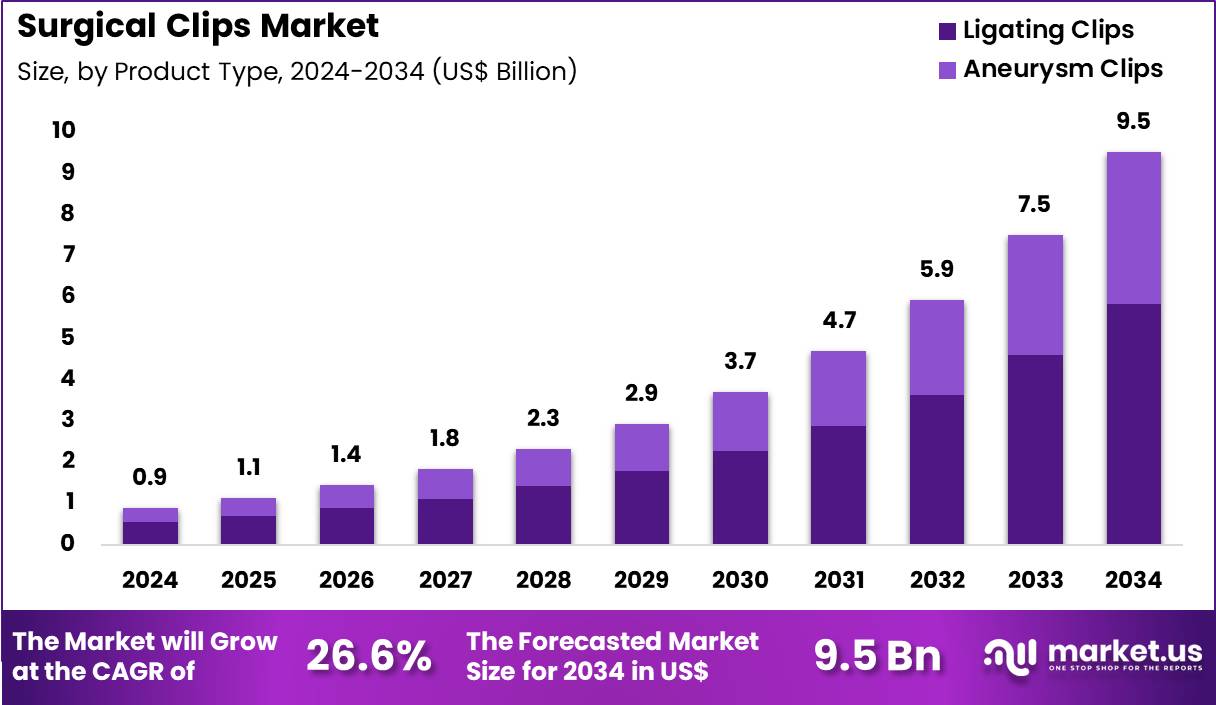
New York, NY – Oct 29, 2026 – Global Surgical Clips Market size is expected to be worth around US$ 9.5 Billion by 2034 from US$ 0.9 Billion in 2024, growing at a CAGR of 26.6% during the forecast period 2025 to 2034. In 2024, North America led the market, achieving over 44.4% share with a revenue of US$ 0.4 Billion.
Surgical clips are medical devices widely used in surgical procedures to close blood vessels, secure tissues, and control bleeding. They are designed to provide reliable closure and support surgical efficiency across various medical specialties, including general surgery, cardiovascular surgery, gastrointestinal surgery, and gynecology.
Based on material composition, surgical clips are primarily classified into metallic clips, commonly made from titanium or stainless steel, and polymer clips manufactured from biocompatible materials. They are also available in different sizes and designs to meet specific surgical requirements. Depending on the application, clips can be used in open surgeries as well as minimally invasive procedures, including laparoscopic and robotic-assisted surgeries.
The demand for surgical clips is supported by the increasing number of surgical procedures, the growing prevalence of chronic diseases, and the rising adoption of minimally invasive surgical techniques. Technological advancements in surgical instruments and the development of advanced clip appliers are also contributing to product innovation and improved procedural efficiency.
North America and Europe represent important markets due to their established healthcare infrastructure and adoption of advanced surgical technologies. Meanwhile, improving healthcare access, expanding hospital infrastructure, and increasing surgical capabilities across Asia-Pacific are creating additional growth opportunities.
However, product costs, stringent regulatory requirements, and the risk of complications associated with improper clip placement may influence market development. Overall, continued advancements in surgical technologies and increasing demand for efficient surgical solutions are expected to support the long-term development of the surgical clips market.
Key Takeaways
- In 2024, the surgical clips market was valued at US$ 0.9 billion and is projected to reach US$ 9.5 billion by 2034, registering a CAGR of 26.6% during the forecast period.
- By product type, the market is segmented into ligating clips and aneurysm clips, with ligating clips dominating the market with a share of 61.3%.
- Based on material, the market is categorized into titanium, polymer, and other materials. Titanium held a significant market share of 54.8%.
- By surgery type, the market is segmented into general surgery and automated and robotic-assisted surgery. General surgery accounted for the largest revenue share of 57.4%.
- By end use, the market is divided into hospitals and clinics and ambulatory surgical centers. Hospitals and clinics dominated the market, accounting for 69.1% of total revenue.
- Regionally, North America dominated the surgical clips market in 2024, accounting for a market share of 44.4%.
Key Market Segments
- Product Type Analysis: Ligating clips dominated the surgical clips market, accounting for 61.3% of the product type segment. Their widespread use in vessel and duct closure across open and laparoscopic procedures supports demand. Increasing minimally invasive surgeries, ease of application, reduced operative time, and rising surgical volumes are expected to sustain segment growth.
- Material Analysis: Titanium held a leading position in the surgical clips market, accounting for 54.8% of the material segment. Its strength, biocompatibility, corrosion resistance, and reliable closure performance support widespread adoption. Increasing emphasis on surgical safety, material reliability, and compatibility with medical imaging technologies is expected to sustain demand for titanium clips.
- Surgery Analysis: General surgery dominated the surgical clips market, accounting for 57.4% of the surgery segment. High procedure volumes across appendectomy, hernia repair, and gallbladder removal support demand. Growing adoption of laparoscopic techniques, standardized surgical practices, and increasing prevalence of abdominal and gastrointestinal conditions are expected to support continued segment growth.
- End-Use Analysis: Hospitals and clinics dominated the surgical clips market, accounting for 69.1% of the end-use segment. High surgical volumes, complex procedures, and centralized operating facilities support product demand. Expanding surgical capacity, modernized operating rooms, standardized procurement practices, and increasing emphasis on patient safety are expected to strengthen segment growth.
Regional Analysis
North America accounted for 44.4% of the surgical clips market in 2024, supported by high surgical volumes and increasing adoption of minimally invasive procedures. Hospitals and ambulatory surgical centers continued to utilize surgical clips for efficient vessel closure and bleeding control.
Growing elective surgery volumes, established healthcare infrastructure, advanced surgical technologies, and surgeons’ familiarity with clip-based closure methods further supported regional demand. The United States remained a major contributor due to its extensive hospital network and substantial surgical care requirements.
Asia-Pacific is expected to register the highest CAGR during the forecast period, driven by expanding healthcare infrastructure, improving access to surgical services, and rising adoption of minimally invasive techniques. Government healthcare initiatives, increasing medical tourism in India, Thailand, and South Korea, and growing investments in hospital facilities are supporting regional market expansion.
Additionally, local manufacturing capabilities and surgeon training programs are improving product accessibility and clinical adoption. Rising surgical volumes and continued healthcare modernization are expected to create significant growth opportunities for surgical clips manufacturers across the region.
Emerging Trends
- Growing use of minimally invasive surgery: Surgical clips are widely used in laparoscopic procedures to close blood vessels and secure tissue. As surgical techniques increasingly focus on smaller incisions and faster recovery, the need for reliable clip-based tissue closure is expected to remain important.
- Increasing adoption of robotic-assisted surgery: Robotic surgical systems allow surgeons to perform complex procedures through small incisions. Surgical clips compatible with robotic and laparoscopic instruments can support vessel sealing and tissue management in selected procedures, creating opportunities for device manufacturers.
- Development of absorbable and advanced-material clips: Medical device development includes materials designed for specific clinical needs, including absorbable polymers and biocompatible metals. These materials offer different benefits depending on the procedure, such as temporary tissue support or long-term closure, subject to clinical suitability.
- Greater focus on surgical safety and precision: Healthcare providers continue to emphasize secure vessel closure, reduced bleeding risks, and fewer procedure-related complications. This supports demand for clips with consistent application, reliable locking mechanisms, and designs suited to different vessel sizes and surgical conditions.
- Expansion of specialized surgical applications: Surgical clips are used across general surgery, gynecology, urology, and other specialties. Continued development of procedure-specific instruments and clip designs may expand their use in complex operations and support demand for a wider range of surgical closure products.
- Improved clip application systems: Manufacturers are developing preloaded and disposable clip applicators that can support efficient placement during surgery. Recent U.S. Food and Drug Administration (FDA) records show continued clearance of polymer ligation clips and delivery systems, indicating ongoing product development in this category.
Use Cases
- Gallbladder removal surgery: Surgical clips are used to close the cystic duct and blood vessels during laparoscopic gallbladder removal. Proper clip placement helps prevent leakage and bleeding during and after the procedure.
- Blood vessel ligation: Clips are applied to selected blood vessels to stop blood flow before a vessel is cut or separated. This use is common in general surgery, where secure closure helps reduce the risk of bleeding.
- Gastrointestinal bleeding control: Endoscopic clips can be placed through an endoscope to close selected bleeding sites in the digestive tract. They are used in appropriate cases of gastrointestinal bleeding, depending on the location and cause.
- Gynecological and urological procedures: In selected gynecological and urological operations, clips are used to close blood vessels or other suitable tubular structures. Their use depends on the procedure, tissue size, and the surgeon’s chosen closure method.
- Tissue site marking: Specialized implantable markers can identify a biopsy site or an area that requires later surgical removal. These marking clips are different from ligating clips because their primary purpose is to help locate tissue rather than close a blood vessel.
Frequently Asked Questions About Surgical Clips
- What materials are used to manufacture surgical clips?
Surgical clips can be manufactured from metals such as titanium or from medical-grade polymers. Material selection depends on the intended application, required strength, compatibility, and device design. Not all surgical clips are absorbable. - Are surgical clips permanent inside the body?
Many ligating clips, including commonly used titanium and polymer clips, are designed to remain in the body. Other specialized clips serve different purposes. Whether a clip remains or is removed depends on its type and intended use. - Are surgical clips safe for patients?
Surgical clips are regulated medical devices intended for specific clinical uses. Their safety depends on appropriate device selection, correct placement, and patient factors. Potential complications include clip slippage or migration, making surgical technique and follow-up important. - What factors are driving the growth of the surgical clips market?
Market demand is supported by minimally invasive surgery, increasing surgical procedure volumes, and the development of specialized closure devices. Growing use of laparoscopic and endoscopic techniques may further support demand across hospitals and surgical centers. - What role does product innovation play in the surgical clips market?
Product innovation supports the development of clips with improved application mechanisms, suitable material properties, and designs for specific procedures. FDA clearance records for polymer clips and clip applicators demonstrate continued development in this medical device category. - How do regulatory requirements affect the surgical clips market?
Regulatory requirements influence product development, testing, manufacturing, and commercialization. In the United States, the FDA classifies implantable clips under applicable medical device regulations. Manufacturers must meet the relevant requirements before marketing their products. - Which regions offer opportunities for the surgical clips market?
Market opportunities depend on surgical infrastructure, healthcare spending, access to minimally invasive procedures, and medical device availability. Regions expanding hospital capacity and surgical services may offer opportunities, although growth rates vary by country and require local data validation. - What is the future outlook for the surgical clips market?
The outlook is linked to surgical procedure demand, advances in endoscopic and minimally invasive techniques, and improvements in clip designs. However, reliable market forecasts require verified sales data, regional procedure volumes, pricing information, and regulatory developments.
Conclusion
The surgical clips market is expected to witness substantial growth, driven by increasing surgical procedure volumes, rising adoption of minimally invasive techniques, and continuous advancements in surgical devices. Ligating clips, titanium materials, general surgery, and hospitals and clinics represent key market segments.
North America currently leads the market, while Asia-Pacific is expected to offer significant growth opportunities due to expanding healthcare infrastructure and improving surgical access. However, high product costs, regulatory complexities, and potential complications may present challenges. Continued product innovation, improved clip application systems, and increasing demand for precise and reliable surgical closure solutions are expected to support long-term market development.
Discuss your needs with our analyst
Please share your requirements with more details so our analyst can check if they can solve your problem(s)



