
Overview
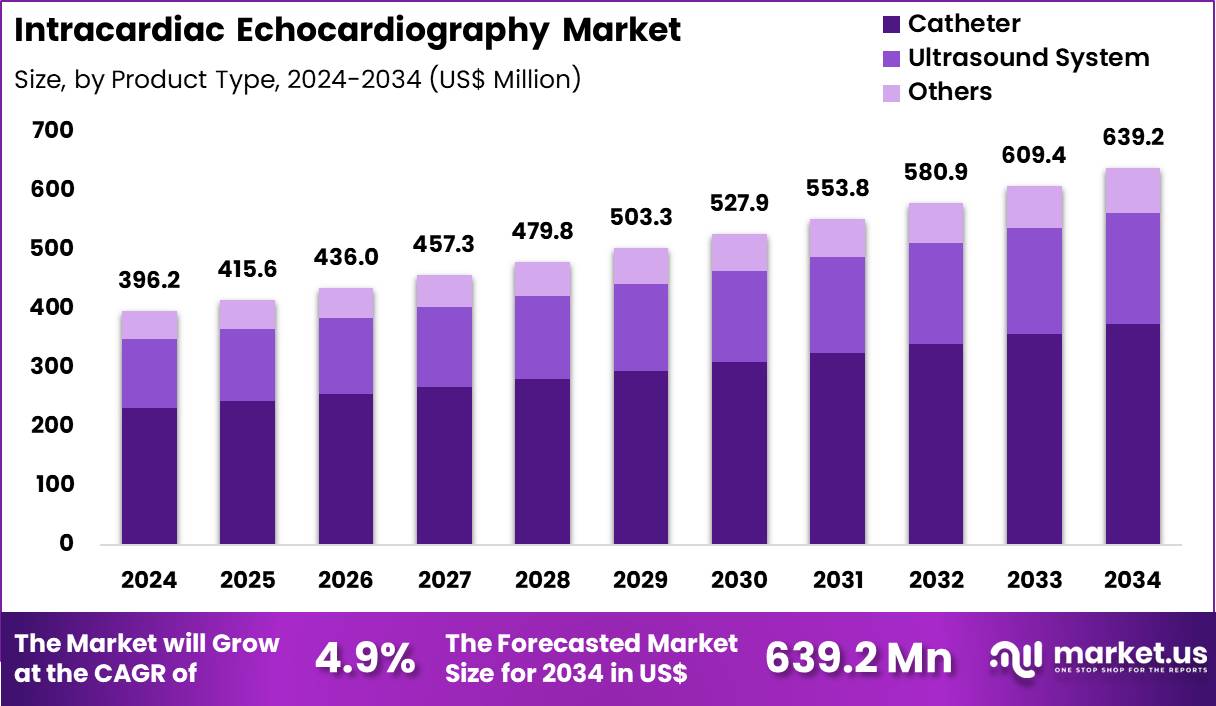
New York, NY – Oct 26, 2026 – Global Intracardiac Echocardiography Market size is expected to be worth around US$ 639.2 Million by 2034 from US$ 396.2 Million in 2024, growing at a CAGR of 4.9% during the forecast period 2025 to 2034. In 2024, North America led the market, achieving over 42.5% share with a revenue of US$ 168.4 Million.
Intracardiac Echocardiography (ICE) is an advanced medical imaging technology used to obtain real-time images of the heart from within its chambers. The procedure involves inserting a specialized ultrasound catheter through a blood vessel, typically in the groin, and guiding it into the heart. This approach provides detailed visualization of cardiac structures, helping physicians perform complex cardiovascular procedures with greater precision.
ICE is increasingly used in electrophysiology and interventional cardiology, particularly for catheter ablation procedures, structural heart interventions, and the evaluation of cardiac abnormalities. It enables clinicians to visualize heart chambers, valves, septal structures, and surrounding tissues during treatment. The technology can also help guide catheter positioning and identify potential complications during procedures.
One of the key advantages of ICE is that it can reduce or eliminate the need for general anesthesia in selected procedures and may reduce reliance on transesophageal echocardiography, which requires an ultrasound probe to be placed in the esophagus. Depending on the procedure and clinical setting, ICE may also support reduced radiation exposure and improved procedural efficiency.
The growing adoption of minimally invasive cardiac procedures, advancements in catheter technology, and increasing demand for real-time imaging are supporting interest in ICE. As cardiovascular care continues to evolve, intracardiac echocardiography is expected to remain an important tool in improving procedural guidance and supporting more informed clinical decision-making.
Key Takeaways
- In 2024, the market was valued at US$ 396.2 million and is projected to grow at a CAGR of 4.9%, reaching US$ 639.2 million by 2034.
- By product type, the market is segmented into catheters, ultrasound systems, and others. The catheter segment dominated the market, accounting for 58.7% of the total share.
- By application, the market is categorized into electrophysiology, left atrial appendage closure, and others. The electrophysiology segment held a significant market share of 54.2%.
- By end user, the market is divided into hospitals, ambulatory surgical centers (ASCs), and others. The hospital segment led the market with a 63.5% revenue share.
- Regionally, North America dominated the market, accounting for 42.5% of the total market share.
Key Market Segments
- Product Type Analysis: The catheter segment dominated the intracardiac echocardiography market with a 58.7% share, driven by its essential role in real-time cardiac imaging during minimally invasive procedures. Improved imaging quality, enhanced maneuverability, and growing adoption of electrophysiology and structural heart interventions support segment growth.
- Application Analysis: The electrophysiology segment accounted for 54.2% of the intracardiac echocardiography market, supported by increasing arrhythmia cases and rising ablation procedures. ICE enables precise catheter navigation, improves anatomical visualization, reduces fluoroscopy dependence, and supports procedural safety, strengthening its adoption across electrophysiology laboratories.
- End-User Analysis: The hospital segment dominated the intracardiac echocardiography market with a 63.5% share, driven by advanced cardiac care infrastructure and high procedure volumes. Investments in imaging technologies, specialized catheterization laboratories, multidisciplinary teams, and increasing complex cardiac interventions continue to support hospital-based adoption.
Regional Analysis
North America Dominates the Intracardiac Echocardiography Market
North America accounted for 42.5% of the global intracardiac echocardiography market in 2024, supported by rising electrophysiology procedures, structural heart interventions, and advanced cardiac care infrastructure.
Favorable reimbursement policies, technological advancements, and increasing adoption of integrated imaging and mapping systems have further strengthened regional growth. Growing demand for minimally invasive procedures and specialized clinician training also supports ICE adoption.
Asia Pacific Expected to Register the Highest CAGR
The Asia Pacific region is expected to record the highest CAGR during the forecast period, driven by healthcare infrastructure development, increasing investments in advanced cardiac imaging, and rising cardiovascular disease prevalence. Hospitals across emerging economies are upgrading catheterization laboratories and adopting advanced imaging technologies to improve procedural accuracy.
Additionally, expanding clinician training programs, improved access to specialized cardiac care, and supportive government initiatives are expected to accelerate market growth. Technological innovation and increasing adoption of minimally invasive cardiac procedures will further strengthen regional demand for intracardiac echocardiography solutions.
Emerging Trends
- Growing adoption of 3D and 4D imaging: The development of three-dimensional (3D) and four-dimensional (4D) ICE is improving the visualization of complex heart structures. These technologies can help physicians assess anatomical relationships and guide structural heart interventions. Their adoption creates opportunities for manufacturers to develop advanced imaging catheters and compatible ultrasound systems.
- Integration with electroanatomical mapping systems: ICE is increasingly being combined with electroanatomical mapping, which creates a digital map of the heart’s structure and electrical activity. This integration can support catheter navigation during arrhythmia treatment and may reduce reliance on X-ray imaging in selected procedures.
- Expansion into structural heart interventions: ICE is extending beyond traditional electrophysiology applications into procedures involving heart valves and abnormal openings between heart chambers. Its use in mitral and tricuspid valve interventions and closure of the left atrial appendage is creating additional opportunities for device makers and healthcare providers.
- Increasing focus on imaging automation and AI: Automation and artificial intelligence (AI) are emerging areas of development in cardiac imaging workflows. AI-assisted image interpretation and automated anatomical mapping may help simplify image acquisition and support consistent procedural guidance. Wider commercial adoption will depend on clinical validation, system compatibility and regulatory requirements.
- Greater emphasis on radiation reduction and procedural efficiency: Hospitals are increasingly evaluating ICE as part of efforts to reduce radiation exposure during selected cardiac procedures. When combined with suitable mapping systems, ICE may support low-fluoroscopy or zero-fluoroscopy approaches, while potentially reducing dependence on general anesthesia in certain interventions.
Use Cases
- Atrial fibrillation and cardiac arrhythmia ablation: ICE is used during catheter ablation to visualize heart chambers, guide catheter movement and monitor the delivery of treatment. It can help physicians locate relevant anatomical structures and observe possible complications. This application supports demand from electrophysiology laboratories treating abnormal heart rhythms.
- Transseptal puncture guidance: During certain cardiac procedures, a catheter must pass through the wall separating the heart’s upper chambers. ICE provides real-time images that help physicians identify the appropriate puncture location and monitor needle movement, particularly when the anatomy is difficult to assess.
- Left atrial appendage closure: ICE can guide the placement of a closure device in the left atrial appendage, a small pouch associated with blood clot formation in some patients with atrial fibrillation. This application may help selected patients undergo treatment with less reliance on transesophageal imaging and general anesthesia.
- Structural heart and valve interventions: ICE supports selected procedures involving the mitral and tricuspid valves, as well as the closure of atrial septal defects and patent foramen ovale. Real-time imaging helps physicians assess anatomy, position devices and evaluate the results of treatment during these minimally invasive procedures.
- Endomyocardial biopsy and complication monitoring: ICE can help physicians guide tissue sampling from the heart muscle and assess structures during selected biopsies. It can also support the detection of fluid around the heart, intracardiac masses and certain procedure-related complications, allowing the clinical team to respond promptly.
Frequently Asked Questions About Intracardiac Echocardiography
- How does intracardiac echocardiography work?
An ICE catheter is inserted through a blood vessel and guided into the heart. Its ultrasound transducer sends sound waves and receives returning echoes, which are converted into images that help physicians visualize anatomy during treatment. - What are the main benefits of intracardiac echocardiography?
ICE provides real-time cardiac imaging, supports accurate catheter positioning and helps identify certain complications during procedures. It may also reduce radiation exposure and the need for general anesthesia in selected cases, depending on the clinical approach. - What is the difference between ICE and transesophageal echocardiography?
ICE uses an ultrasound catheter positioned inside the heart, whereas transesophageal echocardiography uses a probe inserted through the mouth into the esophagus. Both provide cardiac images, but their suitability depends on procedural needs and clinical expertise. - Which procedures commonly use intracardiac echocardiography?
ICE is used during cardiac arrhythmia ablation, transseptal puncture, left atrial appendage closure and selected structural heart interventions. Additional applications include endomyocardial biopsy and assessment of certain intracardiac masses or procedure-related complications. - Which product segments are included in the intracardiac echocardiography market?
The market generally includes ICE catheters, ultrasound imaging systems, consoles, integrated software and related accessories. Segmentation varies between research providers, particularly regarding the treatment of disposable catheters, advanced imaging technologies and supporting equipment. - What is the future outlook for the intracardiac echocardiography market?
The market outlook is supported by advances in three-dimensional imaging, integration with mapping systems and wider use in structural heart procedures. Future growth will depend on clinical evidence, product innovation, reimbursement policies and the ability of hospitals to manage costs. - What should manufacturers consider when entering the intracardiac echocardiography market?
Manufacturers should assess clinical needs, catheter performance, imaging quality, regulatory requirements and compatibility with existing cardiac equipment. Pricing, physician training, hospital procurement processes and clinical evidence are also important factors for establishing adoption and long-term commercial competitiveness.
Conclusion
In conclusion, the intracardiac echocardiography market is expected to experience steady growth, increasing from US$ 396.2 million in 2024 to US$ 639.2 million by 2034, at a CAGR of 4.9%. Rising adoption of minimally invasive cardiac procedures, increasing electrophysiology interventions, and advancements in imaging technologies are key growth drivers.
Catheters, electrophysiology applications, and hospitals are expected to remain major market segments. North America currently leads the market, while Asia Pacific offers significant growth opportunities. Furthermore, advancements in 3D and 4D imaging, artificial intelligence, and integrated mapping systems are expected to strengthen market development and expand clinical applications.
Discuss your needs with our analyst
Please share your requirements with more details so our analyst can check if they can solve your problem(s)