
Overview
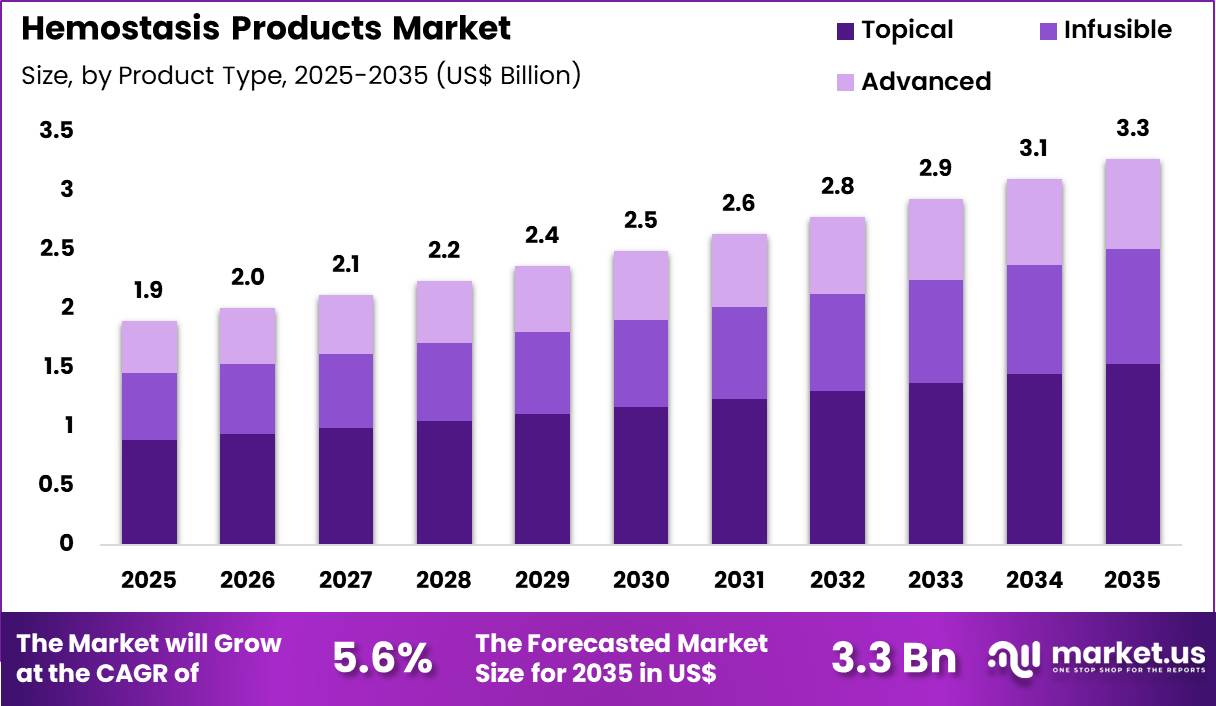
New York, NY – Nov 06 2026 – The Global Hemostasis Products Market size is expected to be worth around US$ 3.3 Billion by 2035 from US$ 1.9 Billion in 2025, growing at a CAGR of 5.6% during the forecast period 2026-2035. In 2025, North America led the market, achieving over 41.3% share with a revenue of US$ 0.8 Billion.
Hemostasis products are medical devices and materials used to control or stop bleeding during surgical procedures, trauma care, and other medical treatments. These products help healthcare professionals achieve faster bleeding control, reduce blood loss, and support patient safety. They are widely used in hospitals, ambulatory surgical centers, emergency departments, and specialty clinics.
The market includes different products such as thrombin-based hemostats, gelatin-based hemostats, oxidized regenerated cellulose, collagen-based products, fibrin sealants, and synthetic sealants. These products work through different mechanisms to support blood clot formation and control bleeding. They are available in various forms, including powders, gels, sponges, patches, and liquid solutions.
The primary purpose of hemostasis products is to minimize surgical blood loss, improve bleeding management, and support effective wound closure. Growing numbers of surgical procedures, rising cases of traumatic injuries, and increasing demand for minimally invasive surgeries are supporting the adoption of these products. Technological improvements in absorbable materials and advanced bleeding-control solutions are also creating new opportunities for market growth.
Hospitals and surgical centers represent important end users due to their high volume of surgical procedures. The market is also benefiting from greater awareness of patient safety and the need for efficient bleeding management across healthcare settings.
Key Takeaways
- In 2025, the Hemostasis Products Market recorded revenue of US$ 1.9 Billion and is projected to reach US$ 3.3 Billion by 2035, expanding at a CAGR of 5.6%.
- By product type, the market is categorized into topical, infusible, and advanced products. The topical segment dominated the market, accounting for a 46.8% share.
- Based on application, the market is segmented into surgery, myocardial infarction, trauma, hemophilia, and others. The surgery segment led the market with a 38.9% share.
- By end user, the market is classified into hospitals, ASCs, and others. Hospitals emerged as the leading segment, capturing the largest revenue share of 57.2%.
- Regionally, North America dominated the Hemostasis Products Market, accounting for a 41.3% market share.
Key Market Segments
- Product Type Analysis: The topical segment dominated the Hemostasis Products Market, accounting for 46.8% of the product type segment. Its growth is supported by widespread use in surgical and emergency care. These products help surgeons control bleeding quickly, improve operating room efficiency, and reduce blood loss. Demand is increasing across cardiovascular, orthopedic, and general surgeries.
- Application Analysis: The surgery segment held the leading position in the Hemostasis Products Market, capturing 38.9% of the application segment. Rising surgical procedures worldwide are driving demand for effective bleeding control solutions. Surgeons increasingly use hemostatic products to minimize complications, reduce blood loss, and support faster recovery across cardiovascular, oncology, and other complex procedures.
- End-User Analysis: The hospitals segment dominated the Hemostasis Products Market, accounting for 57.2% of the end-user segment. Hospitals perform a high volume of surgical and emergency procedures, creating strong demand for effective bleeding management solutions. Growing investments in advanced operating rooms, specialty departments, and patient safety initiatives further support the adoption of hemostasis products.
Regional Analysis
North America is leading the Hemostasis Products Market
North America dominated the Hemostasis Products Market with a 41.3% share in 2024. Regional growth is supported by high surgical volumes and strong adoption of advanced bleeding control technologies. Increasing cardiovascular, orthopedic, and trauma procedures drive demand for topical sealants, patches, and hemostatic agents.
Well-established hospitals, favorable reimbursement policies, and growing focus on patient safety further support market expansion. Manufacturers are also introducing advanced absorbable materials and innovative sealant technologies to improve surgical outcomes and reduce blood loss.
Asia Pacific is expected to register the highest CAGR during the forecast period
Asia Pacific is projected to experience strong growth due to rising healthcare investments and expanding surgical infrastructure. Increasing road accidents and trauma cases in countries such as India and China are creating demand for effective bleeding control solutions.
Growing medical tourism, improved insurance coverage, and increasing access to advanced surgical treatments further support regional adoption. Additionally, domestic manufacturing and surgeon training initiatives are expected to strengthen market growth.
Emerging Trends
- Growing Demand for Advanced Hemostatic Materials: Healthcare providers are increasingly adopting advanced materials such as gelatin, collagen, oxidized cellulose, and thrombin-based products. These materials help control bleeding during complex surgeries and improve surgical efficiency.
- Development of Bioabsorbable Hemostatic Products: Manufacturers are focusing on absorbable products that break down naturally inside the body. These solutions reduce the need for additional removal procedures and support better recovery after surgery.
- Increasing Adoption of Minimally Invasive Surgery: The growing use of laparoscopic and robotic-assisted surgeries is increasing demand for easy-to-apply hemostatic agents. Surgeons need products that can control bleeding in small or difficult-to-reach surgical areas.
- Innovation in Flowable Hemostatic Agents: Flowable products and hemostatic matrices are gaining attention because they can reach irregular wound surfaces and complex bleeding areas. These products help surgeons manage bleeding where traditional methods may be difficult to apply.
- Greater Focus on Patient Blood Management: Hospitals are strengthening blood management practices to reduce unnecessary blood transfusions and surgical blood loss. This is encouraging the use of effective hemostatic products as part of broader patient safety strategies.
Use Cases
- Cardiovascular Surgeries: Hemostasis products are used in cardiac and vascular procedures to control bleeding around blood vessels and surgical connections. They help manage bleeding from delicate tissues and support safer surgical closure.
- Orthopedic Surgeries: Surgeons use gelatin sponges, collagen-based agents, and other hemostatic materials during bone and joint procedures. These products help control bleeding from bone surfaces and surrounding tissues during surgical treatment.
- Emergency Trauma Care: Hemostatic dressings and powders are used to manage bleeding caused by accidents, deep wounds, and traumatic injuries. They support rapid bleeding control when immediate surgical treatment or advanced medical care is not available.
- Gynecological Procedures: Topical hemostatic agents are used during selected gynecological and obstetric surgeries to manage bleeding from tissues. They provide additional support when conventional methods, such as sutures or electrocautery, are unsuitable or insufficient.
- Neurosurgical Procedures: Hemostatic matrices, absorbable materials, and sealants are used during brain and spinal surgeries. They help control bleeding from delicate surgical areas and support tissue closure where precise bleeding management is important.
Frequently Asked Questions About Hemostasis Products
- What are hemostasis products?
Hemostasis products are medical materials and agents used to stop or control bleeding. They support blood clot formation and are commonly applied during surgeries, trauma treatment, and wound management to reduce blood loss. - What are the major types of hemostasis products?
Major types include gelatin-based products, collagen-based agents, oxidized regenerated cellulose, thrombin-based products, fibrin sealants, and synthetic sealants. They are available as powders, sponges, patches, gels, and liquid formulations for different clinical needs. - How do hemostasis products work?
Hemostasis products work through different mechanisms, including absorbing blood, creating a physical barrier, supporting platelet activity, or promoting clot formation. Their effectiveness depends on the product type, bleeding condition, and patient’s clotting ability. - Where are hemostasis products commonly used
These products are commonly used in hospitals, surgical centers, emergency departments, and specialty clinics. They help manage bleeding during cardiovascular, orthopedic, general, gynecological, and neurological procedures, depending on the product’s approved clinical use. - Are hemostasis products absorbable?
Many hemostasis products are absorbable and gradually break down inside the body after application. However, absorption time varies by material and product. Surgeons must follow product instructions to avoid complications associated with excessive application. - What factors are driving the growth of the Hemostasis Products Market?
Market growth is driven by increasing surgical procedures, rising trauma cases, growing demand for minimally invasive surgeries, and greater focus on patient blood management. Hospitals are also adopting advanced bleeding control solutions to improve surgical outcomes. - Which product type dominates the Hemostasis Products Market?
Topical hemostasis products hold the leading position due to their widespread use in surgical and emergency settings. Their easy application and ability to control localized bleeding make them important tools across different medical procedures. - Which application segment dominates the Hemostasis Products Market?
Surgery represents the leading application segment because hemostatic products are widely used to manage bleeding during complex and routine procedures. Growing cardiovascular, orthopedic, and general surgeries continue to support demand across healthcare facilities.
Conclusion
The Hemostasis Products Market is expected to experience steady growth, supported by increasing surgical procedures, rising trauma cases, and growing demand for advanced bleeding control solutions. The topical segment, surgery application, and hospitals remain key contributors to market expansion.
North America continues to lead due to its advanced healthcare infrastructure and strong adoption of surgical technologies, while Asia Pacific offers promising growth opportunities. Technological advancements in bioabsorbable materials, flowable agents, and innovative sealants are further strengthening market potential. Increasing focus on patient safety, reduced blood loss, and improved surgical outcomes will continue to drive market growth through 2035.
Discuss your needs with our analyst
Please share your requirements with more details so our analyst can check if they can solve your problem(s)