
Overview
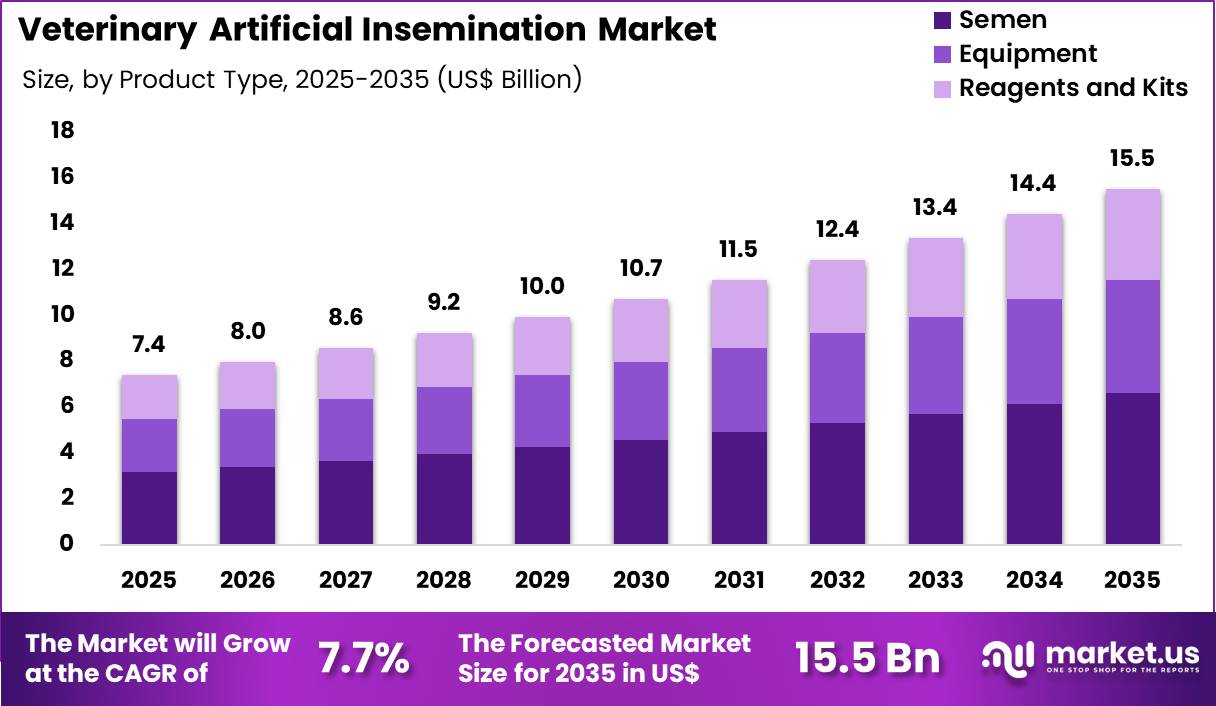
New York, NY – Nov 26 2026 – The Global Veterinary Artificial Insemination Market size is expected to be worth around US$ 15.5 Billion by 2035 from US$ 7.4 Billion in 2025, growing at a CAGR of 7.7% during the forecast period 2026-2035. In 2025, North America led the market, achieving over 35.8% share with a revenue of US$ 2.7 Billion.
Veterinary Artificial Insemination (AI) is an advanced reproductive technology used in animal breeding to improve genetic quality, reproductive efficiency, and livestock productivity. The technique involves the controlled collection, processing, preservation, and artificial introduction of semen into the reproductive tract of female animals without natural mating.
Artificial insemination is widely used in cattle, buffaloes, sheep, goats, pigs, and other livestock species. It enables farmers and breeders to access superior genetics from high-quality male animals, thereby supporting improvements in milk production, meat quality, disease resistance, and overall animal performance.
The growing adoption of artificial insemination is being supported by advancements in semen preservation, cryopreservation, reproductive biotechnology, estrus synchronization, and veterinary healthcare services. These technologies have improved breeding efficiency and enabled the wider use of genetically superior animals across geographical regions.
Veterinary artificial insemination also contributes to better breeding management, reduced transmission of certain reproductive diseases, and more efficient utilization of valuable breeding males. Government initiatives promoting livestock development, increasing demand for animal protein, and growing awareness of scientific breeding practices are further supporting market adoption.
With continuous technological advancements and increasing emphasis on livestock productivity, veterinary artificial insemination is expected to remain an important component of modern animal husbandry and sustainable livestock development.
Key Takeaways
- In 2025, the Veterinary Artificial Insemination Market was valued at US$ 7.4 Billion and is projected to grow at a CAGR of 7.7%, reaching US$ 15.5 Billion by 2035.
- Based on animal type, the market is segmented into bovine, porcine, ovine, caprine, equine, canine, and others. The bovine segment dominated the market, accounting for a revenue share of 58.4%.
- By product type, the market is categorized into semen, equipment, and reagents and kits. Among these, the semen segment held the leading position, capturing a market share of 42.7%.
- Based on end users, the market is classified into veterinary hospitals, breeding centers, dairy farms, pig farms, poultry farms, and others. The dairy farms segment emerged as the largest contributor, accounting for 38.4% of the total market revenue.
- Regionally, North America dominated the Veterinary Artificial Insemination Market, accounting for the largest revenue share of 35.8%.
Key Market Segments
- Animal Type Analysis: The bovine segment dominated the veterinary artificial insemination market, accounting for 58.4% of the market share. Its leadership is driven by increasing demand for genetic improvement, higher milk and meat production, and enhanced herd productivity. Established breeding programs, wider semen availability, and growing dairy consumption are further supporting segment growth.
- Product Type Analysis: The semen segment held the leading position in the veterinary artificial insemination market, capturing 42.7% of the market share. Its dominance is attributed to the increasing adoption of selective breeding and demand for superior livestock genetics. Advancements in cryopreservation, semen storage, and transportation technologies are further supporting segment expansion.
- End-User Analysis: The dairy farms segment dominated the veterinary artificial insemination market, accounting for 38.4% of the market share. Growth is primarily driven by increasing demand for higher milk production, improved herd genetics, and efficient reproductive management. Rising dairy consumption and the adoption of structured breeding programs are further supporting segment expansion.
Regional Analysis
North America Dominated the Veterinary Artificial Insemination Market
North America accounted for 35.8% of the veterinary artificial insemination market in 2025, driven by its well-established livestock industry and widespread adoption of advanced breeding technologies. Increasing focus on genetic improvement, higher milk production, disease resistance, and efficient herd management is supporting regional growth.
The presence of organized dairy and beef farming operations, established breeding programs, and technological advancements in semen preservation, genomic selection, and estrus synchronization are further strengthening market adoption. Additionally, investments in reproductive healthcare services and precision livestock management are contributing to regional market expansion.
Asia Pacific is Expected to Register the Highest CAGR
Asia Pacific is anticipated to witness the highest CAGR during the forecast period, supported by livestock modernization, rising demand for milk and meat, and government-led genetic improvement initiatives.
Countries such as India, China, and Australia are increasingly adopting artificial insemination to enhance livestock productivity. Expanding veterinary infrastructure, growing farmer awareness, increasing availability of quality semen, and investments in reproductive biotechnology are further expected to accelerate the adoption of artificial insemination across the region.
Emerging Trends
- Increasing Adoption of Sex-Sorted Semen Technology: Sex-sorted semen is gaining attention because it allows livestock breeders to increase the probability of producing offspring of a preferred sex. This technology is particularly useful in dairy farming, where female calves are preferred for herd expansion and future milk production. Improvements in sperm-sorting techniques are supporting wider adoption. The University of Missouri Extension reports that modern commercial sex-sorting systems can achieve approximately 85–95% accuracy.
- Growing Use of Fixed-Time Artificial Insemination (FTAI): Fixed-time artificial insemination is becoming an important reproductive management approach in livestock farming. It uses hormone-based programmes to synchronize the reproductive cycles of female animals, allowing insemination at a planned time without depending entirely on natural heat detection. This approach can improve breeding management, reduce labour requirements, and support large-scale livestock operations.
- Integration of Genetic Selection and Advanced Breeding Technologies: Artificial insemination is increasingly being combined with genetic evaluation and selective breeding programmes. Breeders can select semen from males with desirable characteristics, including higher milk production, improved growth, better fertility, and disease resistance. The integration of genetic information into breeding decisions is helping farmers improve herd quality over successive generations.
- Development of Improved Semen Preservation and Storage Methods: Advancements in semen freezing, cryopreservation, and liquid nitrogen storage are improving the availability and distribution of high-quality animal genetic material. These technologies allow semen collected from genetically superior males to be stored and transported over long distances. Improved preservation methods are also supporting breeding programmes and the conservation of valuable livestock breeds.
- Expansion of Government-Supported Artificial Insemination Programmes: Government initiatives are supporting the expansion of artificial insemination services, particularly in developing countries. In India, the Department of Animal Husbandry and Dairying is promoting doorstep insemination services, improved semen availability, and the genetic development of indigenous cattle and buffalo breeds. Such programmes are increasing access to reproductive technologies among small and medium-sized livestock farmers.
Use Cases
- Dairy Cattle Breeding and Milk Production Improvement: Artificial insemination is widely used in dairy farming to produce calves from genetically superior bulls. Semen from selected males can help improve desirable characteristics such as milk yield, udder quality, fertility, and productive lifespan. This application supports dairy farmers in developing productive herds without maintaining breeding bulls on individual farms.
- Genetic Improvement of Beef Cattle: In beef production, artificial insemination is used to introduce desirable genetic characteristics into cattle herds. Farmers can select semen from bulls with favourable growth rates, carcass quality, feed efficiency, and calving characteristics. This helps improve the quality of future livestock and supports more efficient meat production systems.
- Breeding Management in Sheep and Goat Farming: Artificial insemination is used in sheep and goat breeding programmes to introduce superior male genetics into local livestock populations. It supports breed improvement, reproductive management, and the development of animals with desirable production characteristics. Government programmes are also encouraging the use of semen banks and insemination facilities for small ruminants.
- Commercial Pig Breeding and Herd Development: In commercial pig farming, artificial insemination allows breeders to use semen collected from selected boars for breeding multiple female pigs. This reduces the need to maintain several breeding males and supports planned genetic improvement. Semen collection, processing, and distribution facilities also help commercial farms manage breeding activities more efficiently.
- Poultry Breeding and Genetic Development: Artificial insemination is used in commercial poultry breeding, particularly in turkey production, where differences in body size between males and females can make natural mating difficult. The technique helps manage breeding activities and supports the production of offspring from selected parent birds.
Frequently Asked Questions About Veterinary Artificial Insemination
- Which animals can benefit from artificial insemination?
Artificial insemination is commonly used in cattle, buffaloes, pigs, sheep, goats, and poultry. Its application varies depending on reproductive characteristics, breeding requirements, semen availability, and the management practices followed in different livestock production systems. - What are the major benefits of veterinary artificial insemination?
Artificial insemination helps improve livestock genetics, increase breeding efficiency, reduce the need to maintain breeding males, and support disease-risk management. It also provides farmers with access to semen from genetically superior animals located in different geographical regions. - What is sex-sorted semen in veterinary artificial insemination?
Sex-sorted semen is processed to increase the proportion of sperm carrying either X or Y chromosomes. It helps farmers improve the probability of producing offspring of a preferred sex, particularly female calves for dairy herd expansion. - What factors influence the success of artificial insemination in animals?
The success of artificial insemination depends on semen quality, correct insemination timing, female reproductive health, nutrition, reproductive cycle management, and proper semen storage. Veterinary supervision and trained insemination technicians also contribute to successful breeding outcomes. - What are the major factors driving the veterinary artificial insemination market?
Market growth is supported by increasing demand for animal protein, higher livestock productivity, genetic improvement programmes, and expanding dairy farming activities. Government initiatives promoting scientific animal breeding and improved reproductive technologies are also contributing to market development. - Which animal segment dominates the veterinary artificial insemination market?
Cattle represent an important application segment because artificial insemination is widely established in dairy and beef breeding programmes. Growing demand for improved milk production, superior cattle genetics, and organised dairy farming continues to support this segment. - Which technology is gaining popularity in the veterinary artificial insemination market?
Sex-sorted semen technology is gaining attention because it helps farmers increase the probability of producing offspring of a preferred sex. Improvements in sperm separation, semen preservation, and reproductive cycle management are supporting its adoption. - How are government initiatives supporting the veterinary artificial insemination market in India?
The Indian government supports artificial insemination through the Rashtriya Gokul Mission and Nationwide Artificial Insemination Programme. These initiatives promote doorstep services, improved semen availability, sex-sorted semen technology, and genetic improvement of indigenous cattle and buffalo breeds. - What is the future outlook for the veterinary artificial insemination market?
The market is expected to benefit from increasing livestock breeding activities, wider availability of frozen and sex-sorted semen, improved reproductive technologies, and government-backed genetic improvement programmes. Greater access to veterinary services may further support adoption across developing livestock markets.
Conclusion
The Veterinary Artificial Insemination Market is expected to witness steady growth, driven by increasing demand for livestock productivity, genetic improvement, and advanced reproductive technologies. Valued at US$ 7.4 billion in 2025, the market is projected to reach US$ 15.5 billion by 2035, growing at a CAGR of 7.7%.
The dominance of bovine applications, semen products, and dairy farms highlights the importance of artificial insemination in livestock breeding. Furthermore, advancements in sex-sorted semen, cryopreservation, and reproductive management, along with government-supported breeding programmes, are expected to create new growth opportunities, particularly across emerging markets in Asia Pacific.
Discuss your needs with our analyst
Please share your requirements with more details so our analyst can check if they can solve your problem(s)