
Overview
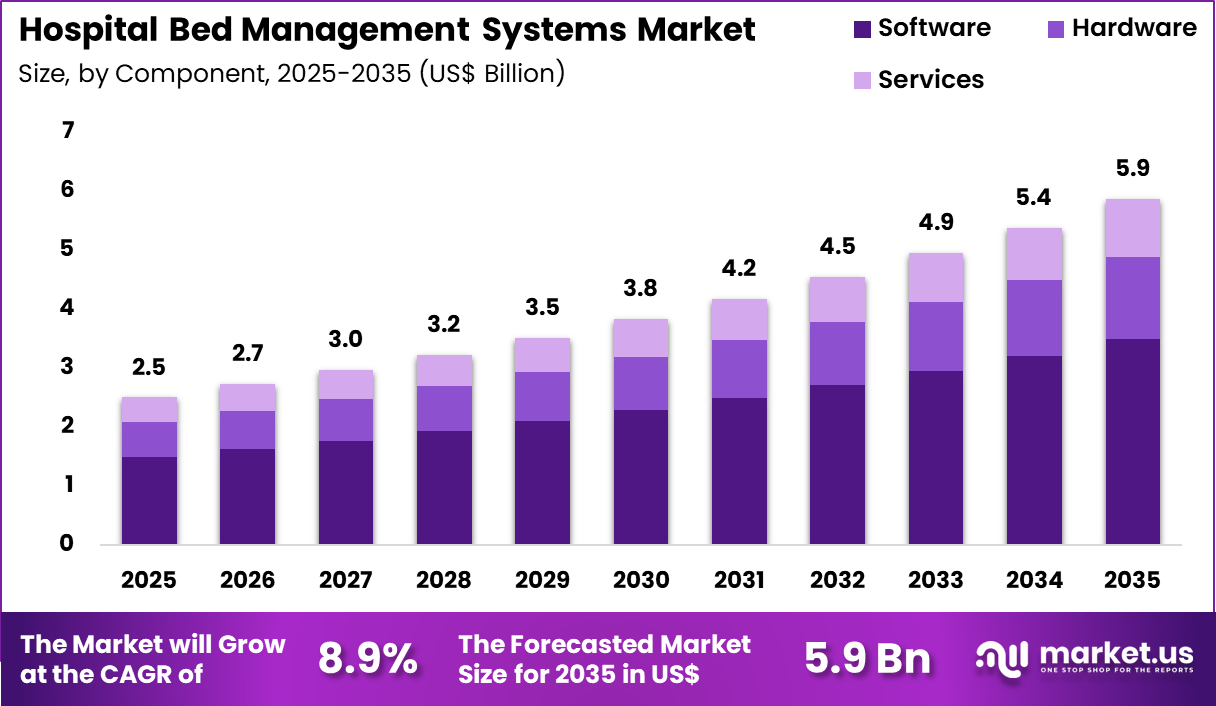
New York, NY – Nov 25 2026 – The Global Hospital Bed Management Systems Market size is expected to be worth around US$ 5.9 Billion by 2035 from US$ 2.5 Billion in 2025, growing at a CAGR of 8.9% during the forecast period 2026-2035. In 2025, North America led the market, achieving over 41.5% share with a revenue of US$ 1.0 Billion.
Hospital Bed Management Systems are digital solutions designed to streamline the allocation, monitoring, and utilization of hospital beds across healthcare facilities. These systems help hospitals manage bed availability, patient admissions, discharges, and transfers through a centralized platform, improving operational efficiency and patient flow.
The growing demand for healthcare services, increasing hospital admissions, and the need for efficient resource utilization are driving the adoption of Hospital Bed Management Systems. These solutions provide real-time visibility into bed occupancy and availability, enabling healthcare administrators and staff to make faster and more informed decisions.
Key features include real-time bed tracking, automated admission and discharge management, patient transfer coordination, occupancy monitoring, and integration with Hospital Information Systems (HIS) and Electronic Health Records (EHR). By reducing administrative delays and improving coordination among hospital departments, these systems support better patient experiences and more effective resource management.
The adoption of advanced technologies, including cloud computing, artificial intelligence, and data analytics, is further enhancing system capabilities. As healthcare facilities increasingly focus on digital transformation, operational efficiency, and improved patient care, Hospital Bed Management Systems are expected to play an important role in modern healthcare infrastructure.
Key Takeaways
- In 2025, the global Hospital Bed Management Systems Market was valued at US$ 2.5 Billion and is projected to grow at a CAGR of 8.9%, reaching US$ 5.9 Billion by 2035.
- Based on component, the market is segmented into software, hardware, and services. Among these, the software segment dominated the market, accounting for a 59.6% share.
- By deployment mode, the market is categorized into cloud-based and on-premises solutions, with the cloud-based segment leading with a 61.5% market share.
- Based on system type, the market is segmented into real-time bed tracking systems, patient flow management systems, bed capacity planning systems, and integrated bed management platforms. The patient flow management systems segment dominated the market, capturing a 44.3% revenue share.
- By hospital size, the market is classified into small, medium-sized, and large hospitals. The large hospitals segment accounted for the largest revenue share of 51.8%.
- Based on end user, the market is divided into general hospitals, specialty hospitals, ambulatory surgical centers, and others. The general hospitals segment held a significant market share of 42.1%.
- Regionally, North America dominated the global Hospital Bed Management Systems Market, accounting for a 41.5% market share.
Key Market Segments
- Component Analysis: The software segment dominated the Hospital Bed Management Systems Market, accounting for 59.6% of the component share. Its leading position is attributed to its role in bed allocation, patient flow coordination, and real-time occupancy monitoring. Increasing adoption of digital healthcare solutions, EHR integration, and data analytics is expected to support segment growth.
- Deployment Mode Analysis: The cloud-based segment dominated the Hospital Bed Management Systems Market, capturing 61.5% of the deployment mode share. Its growth is driven by scalability, flexibility, lower infrastructure costs, and real-time data accessibility. Increasing investments in digital healthcare infrastructure, interoperability, and smart hospital initiatives are expected to further support the adoption of cloud-based solutions.
- Type Analysis: The patient flow management systems segment led the Hospital Bed Management Systems Market, accounting for 44.3% of the type segment share. Its dominance is attributed to its ability to streamline patient admissions, transfers, and discharges. Rising patient volumes, overcrowding concerns, and the growing need to improve hospital efficiency are expected to drive segment adoption.
- Hospital Size Analysis: The large hospitals segment dominated the Hospital Bed Management Systems Market, accounting for 51.8% of the hospital size segment share. This dominance is primarily driven by high patient volumes, complex operational structures, and extensive bed management requirements. Increasing investments in advanced healthcare IT infrastructure and integrated digital solutions are expected to support segment growth.
- End User Analysis: The general hospitals segment dominated the Hospital Bed Management Systems Market, capturing 42.1% of the end-user share. Its leading position is supported by high patient admissions, diverse medical services, and the need for efficient bed allocation across departments. Increasing healthcare utilization and investments in hospital digitalization are expected to drive segment adoption.
Regional Analysis
North America Dominates the Hospital Bed Management Systems Market
North America dominated the Hospital Bed Management Systems Market in 2025, accounting for 41.5% of the global market share. This leadership is attributed to advanced healthcare infrastructure, increasing patient admissions, and growing adoption of digital hospital management solutions.
Hospitals across the United States are implementing real-time bed tracking platforms to improve patient flow, monitor bed occupancy, and reduce overcrowding. Integration of bed management software with electronic health records and hospital information systems is further supporting operational efficiency.
Additionally, rising investments in healthcare IT, predictive analytics, and centralized command centers are accelerating the adoption of advanced bed management solutions across the region.
Asia Pacific Expected to Register the Highest CAGR
Asia Pacific is expected to register the highest CAGR during the forecast period, driven by expanding healthcare infrastructure, rising patient volumes, and increasing investments in hospital digitalization.
Countries such as China, India, and Japan are adopting digital solutions to address bed availability challenges and improve hospital efficiency. Government initiatives supporting smart hospitals, growing electronic health record adoption, and increasing demand for cost-effective healthcare technologies are expected to accelerate regional market growth.
Emerging Trends
- Integration of Artificial Intelligence and Predictive Analytics: Artificial intelligence (AI) and predictive analytics are increasingly being incorporated into hospital bed management systems to forecast patient admissions, discharges, and bed requirements. These technologies help hospitals identify expected capacity shortages, plan bed allocation, and make better decisions during periods of high patient demand.
- Growing Adoption of Real-Time Bed Tracking Systems: Hospitals are increasingly adopting real-time bed tracking solutions to monitor occupied, vacant, reserved, and cleaning-required beds. Integration with electronic patient records and tracking technologies provides hospital administrators with updated information, enabling faster bed allocation and improved coordination between departments.
- Development of Centralized Hospital Command Centers: Centralized hospital command centers are emerging as an important approach to managing patient flow and hospital capacity. These centers combine information about bed availability, patient transfers, admissions, and discharges, allowing hospital teams to coordinate operational activities and respond quickly to capacity-related challenges.
- Increasing Integration with Electronic Health Records: Integration with electronic health records (EHRs) is improving information exchange between bed management platforms and hospital information systems. Patient admission details, clinical requirements, discharge status, and expected length of stay can be accessed more efficiently, supporting appropriate bed allocation and continuity of care.
- Adoption of Cloud-Based and Interconnected Hospital Management Platforms: Cloud-based hospital management platforms are gaining attention because they support centralized information access across multiple departments and healthcare facilities. These solutions can improve coordination between hospitals, enable remote access to bed availability information, and support capacity planning across larger healthcare networks.
Use Cases
- Emergency Department Bed Allocation: Hospital bed management systems help emergency departments identify available beds and allocate them to patients requiring inpatient admission. Staff can review bed availability across wards, reducing delays in patient transfers and helping emergency departments manage increasing patient volumes.
- Patient Admission and Discharge Management: These systems support the management of patient admissions and discharges by tracking each patient’s hospital journey. Healthcare teams can monitor discharge readiness, pending clinical activities, and bed availability, helping hospitals prepare beds for incoming patients more efficiently.
- Bed Cleaning and Turnaround Management: Hospitals use these systems to monitor bed cleaning and preparation activities after patient discharge. Notifications can be sent to housekeeping and support teams when beds become vacant, allowing cleaning tasks to be completed and beds to be made available for new admissions.
- Interdepartmental and Interhospital Patient Transfers: Bed management platforms support patient transfers between departments, wards, and healthcare facilities by providing information about available beds and patient requirements. This helps hospitals identify suitable destinations, coordinate transfer activities, and improve the movement of patients across healthcare networks.
- Hospital Capacity Planning and Resource Optimization: Hospital administrators use bed management data to evaluate occupancy levels, identify capacity shortages, and plan resource requirements. Historical admission patterns and current bed utilization information can support decisions regarding staffing, bed expansion, ward allocation, and emergency capacity planning.
Frequently Asked Questions About Hospital Bed Management Systems
- What are the key features of hospital bed management systems?
Key features include real-time bed tracking, automated bed allocation, patient admission management, discharge tracking, occupancy monitoring, bed reservation, reporting dashboards, and integration with electronic health records. These features help improve hospital operations. - How do hospital bed management systems improve hospital efficiency?
Hospital bed management systems improve efficiency by providing updated information about available beds, reducing manual coordination, and streamlining patient transfers. They also help hospitals reduce bed turnaround time and improve the utilization of existing resources. - How does artificial intelligence support hospital bed management?
Artificial intelligence supports hospital bed management by analyzing patient admission patterns, predicting bed requirements, and identifying potential capacity shortages. These insights help hospital administrators plan resources, manage patient flow, and improve operational decisions. - What are the major factors driving the hospital bed management systems market?
The market is driven by increasing hospital patient volumes, growing demand for efficient bed utilization, healthcare digitalization, rising adoption of electronic health records, and the need to reduce patient waiting times and operational delays. - What role does cloud computing play in the hospital bed management systems market?
Cloud computing enables hospitals to access bed availability information across departments and facilities through centralized platforms. It supports remote access, information sharing, system scalability, and coordination between healthcare providers while reducing dependence on locally maintained infrastructure. - What is the role of government initiatives in the hospital bed management systems market?
Government healthcare digitalization initiatives encourage hospitals to adopt electronic health records, connected information systems, and digital operational tools. Such initiatives can support improved hospital resource management, information exchange, and more coordinated healthcare service delivery. - How does hospital bed management software help reduce hospital operating costs?
Hospital bed management software helps control operating costs by reducing unused bed time, improving cleaning coordination, minimizing manual administrative work, and supporting better resource allocation. These improvements can increase the productive use of existing hospital infrastructure. - What is the future outlook for the hospital bed management systems market?
The market outlook remains positive as healthcare facilities increasingly prioritize digital hospital operations, real-time capacity monitoring, and efficient patient flow. Further integration of AI, cloud computing, and connected healthcare platforms is expected to support adoption.
Conclusion
The global Hospital Bed Management Systems Market is expected to witness steady growth, supported by increasing hospital admissions, rising demand for efficient bed utilization, and ongoing healthcare digitalization. The growing adoption of cloud-based platforms, artificial intelligence, predictive analytics, and real-time bed tracking is further improving patient flow and hospital operational efficiency.
Software solutions and patient flow management systems are expected to maintain strong market positions due to their role in streamlining hospital operations. While North America currently leads the market, Asia Pacific is expected to offer significant growth opportunities through healthcare infrastructure expansion and digitalization initiatives. Overall, technological advancements and increasing healthcare demand will support market expansion.
Discuss your needs with our analyst
Please share your requirements with more details so our analyst can check if they can solve your problem(s)