
Overview
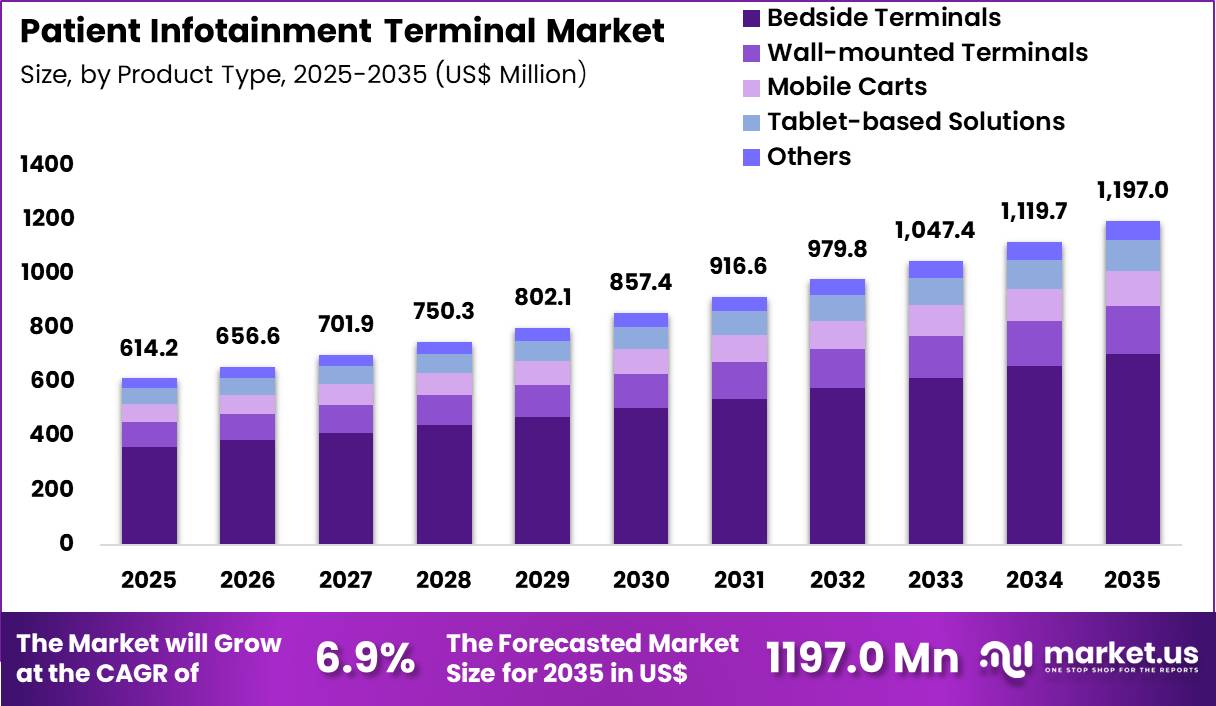
New York, NY – Nov 25 2026 – The Global Patient Infotainment Terminal Market size is expected to be worth around US$ 1197.0 Million by 2035 from US$ 614.2 Million in 2025, growing at a CAGR of 6.9% during the forecast period 2026-2035. In 2025, North America led the market, achieving over 44.6% share with a revenue of US$ 243.9 Million.
A Patient Infotainment Terminal is an advanced digital solution designed to improve the overall patient experience in hospitals and healthcare facilities. It provides patients with convenient access to entertainment, information, and selected healthcare services through an interactive touchscreen interface installed at the bedside or in patient rooms.
These terminals typically offer a range of features, including television, internet access, video and audio entertainment, patient education, hospital information, meal ordering, and communication services. Depending on the system configuration, integration with hospital information systems (HIS) and electronic health records (EHR) may also enable access to personalized healthcare information and selected administrative services.
The adoption of Patient Infotainment Terminals is being supported by the growing focus on patient-centric healthcare, hospital digitalization, and improved patient engagement. By combining entertainment and essential information services on a single platform, these solutions can help hospitals enhance patient comfort, streamline communication, and improve operational efficiency.
As healthcare facilities continue to invest in smart hospital infrastructure, Patient Infotainment Terminals are expected to play an increasingly important role in creating connected, comfortable, and technology-enabled patient environments.
Key Takeaways
- In 2025, the Patient Infotainment Terminal Market was valued at US$ 614.2 Million and is projected to grow at a CAGR of 6.9%, reaching US$ 1,197.0 Million by 2035.
- Based on product type, the market is segmented into bedside terminals, wall-mounted terminals, mobile carts, tablet-based solutions, and others. Among these, bedside terminals dominated the market, accounting for a share of 58.9%.
- By connectivity, the market is categorized into wired and wireless solutions, with the wired segment accounting for the largest market share of 65.1%.
- Based on application, the market is classified into entertainment services, communication services, internet access, education and information, food ordering, and others. The entertainment services segment dominated the market, capturing a revenue share of 42.7%.
- By end user, the market is divided into hospitals, ambulatory surgical centers, long-term care facilities, rehabilitation centers, and specialty clinics. The hospitals segment emerged as the leading end-user category, accounting for 48.3% of the total market revenue.
- Regionally, North America dominated the Patient Infotainment Terminal Market, accounting for the largest market share of 44.6%.
Key Market Segments
- Product Type Analysis: The bedside terminals segment dominated the market, accounting for 58.9% of the product type segment. Its leadership is attributed to easy accessibility, integration with hospital beds, and multiple features, including television, internet access, nurse calling, and service requests. Growing investments in smart hospital infrastructure are expected to support segment growth.
- Connectivity Analysis: The wired connectivity segment dominated the market, accounting for 65.1% of the connectivity segment. Its leading position is supported by reliable network performance, secure data transmission, minimal signal interference, and uninterrupted connectivity. Increasing hospital investments in robust IT infrastructure are expected to sustain demand for wired connectivity solutions.
- Application Analysis: The entertainment services segment dominated the market, accounting for 42.7% of the application segment. Growth is primarily driven by increasing demand for television, streaming platforms, and interactive media that enhance patient comfort. Growing adoption of digital entertainment solutions and patient-centric healthcare practices is expected to support segment expansion.
- End-User Analysis: The hospitals segment dominated the market, accounting for 48.3% of the end-user segment. Its dominance is attributed to high patient volumes and increasing investments in digital healthcare infrastructure. Growing adoption of smart hospital solutions, improved patient engagement initiatives, and integration with clinical workflows are expected to strengthen segment growth.
Regional Analysis
North America Market Analysis
North America accounted for 44.6% of the patient infotainment terminal market in 2025, driven by increasing investments in patient-centric care, hospital digitalization, and bedside connectivity. Hospitals across the United States and Canada are adopting digital terminals that integrate entertainment, communication, nurse calling, and access to clinical information.
The emphasis on improving patient satisfaction, supported by healthcare quality initiatives such as HCAHPS, is encouraging hospitals to invest in advanced infotainment solutions. Furthermore, integration with electronic health records, multilingual content, and hospital service platforms is enhancing patient engagement and operational efficiency. Growing smart hospital initiatives and advancements in touchscreen technology are expected to sustain regional market growth.
Asia Pacific Market Analysis
Asia Pacific is expected to register the highest CAGR during the forecast period, supported by healthcare infrastructure modernization and increasing adoption of smart hospital technologies. Countries such as China, Japan, South Korea, and Singapore are investing in digital healthcare infrastructure to improve patient experiences.
Rising private hospital investments, expanding medical tourism, and growing internet connectivity are further supporting demand. Additionally, increasing emphasis on patient satisfaction, digital communication, and affordable healthcare technologies is expected to accelerate the adoption of patient infotainment terminals across the region.
Emerging Trends
- Integration with Electronic Health Records (EHR): Patient infotainment terminals are increasingly being connected with hospital electronic health record systems. This allows patients to access selected medical information, treatment updates, clinical notes, and care instructions directly from their bedside screens. The trend is supported by the growing adoption of digital patient engagement systems.
- Growth of Interactive Patient Engagement Solutions: Hospitals are moving beyond traditional television and entertainment services by adopting interactive terminals. These systems allow patients to access educational videos, communicate with healthcare staff, review hospital services, and receive information about their treatment, supporting greater patient involvement in care.
- Increasing Adoption of Telehealth Features: Telehealth capabilities are becoming an important addition to connected bedside systems. Patient infotainment terminals can support virtual consultations, remote discussions with specialists, and video communication with healthcare professionals, reducing the need for unnecessary movement within hospitals.
- Development of Personalized Patient Experiences: Healthcare facilities are increasingly focusing on providing personalized digital services. Modern terminals can be configured to display patient-specific information, preferred entertainment, language options, dietary details, and treatment-related instructions, helping improve convenience during hospital stays.
- Growing Demand for Secure and Connected Systems: Data security and system connectivity are receiving greater attention as bedside terminals become connected with hospital networks. Manufacturers are focusing on secure user access, controlled information sharing, reliable network connections, and integration with existing hospital infrastructure.
Use Cases
- Patient Entertainment and Recreation: Terminals provide access to television, movies, music, internet browsing, and games. These services help patients remain occupied during hospital stays, reduce boredom, and provide entertainment during recovery periods.
- Digital Health Education: Hospitals use bedside terminals to share educational videos, disease information, medication guidance, and post-treatment instructions. Patients can review this information at their convenience, improving their understanding of medical conditions and treatment procedures.
- Communication with Healthcare Staff: Patients can use interactive terminals to request assistance, communicate with nurses, access hospital service information, and make service requests. This supports communication between patients and hospital staff while improving access to essential services.
- Virtual Consultations and Remote Care: Terminals equipped with cameras, microphones, and internet connectivity can support video consultations with doctors and specialists. This application is particularly useful for patients requiring specialist opinions or consultations without leaving their hospital rooms.
- Patient Information and Hospital Service Management: Hospitals can use terminals to display meal schedules, appointment details, visiting information, hospital guidelines, and discharge instructions. This helps patients and caregivers access important hospital-related information from a single bedside device.
Frequently Asked Questions About Patient Infotainment Terminal
- What are the main features of Patient Infotainment Terminals?
The main features include television, internet access, video calling, interactive touchscreens, patient education materials, nurse assistance requests, meal ordering, hospital information, and integration with selected hospital information systems. - Where are Patient Infotainment Terminals commonly used?
Patient Infotainment Terminals are commonly installed in hospital patient rooms, intensive care units where appropriate, private wards, maternity wards, and specialty healthcare facilities. Their configuration depends on patient needs and hospital infrastructure. - How do Patient Infotainment Terminals improve patient experience?
These terminals provide convenient access to entertainment, healthcare information, and hospital services. Patients can communicate with healthcare staff and access relevant instructions, helping reduce information gaps and making hospital stays more comfortable. - How is patient information protected on these terminals?
Patient information can be protected through user authentication, access restrictions, secure network connections, and automatic session logout. Healthcare providers must implement appropriate privacy and security safeguards when electronic health information is accessed. - What are the major factors driving the Patient Infotainment Terminal market?
The market is driven by increasing hospital digitalisation, rising demand for improved patient experiences, expansion of smart hospital infrastructure, greater adoption of electronic health records, and growing interest in interactive bedside communication solutions. - What technologies are shaping the Patient Infotainment Terminal market?
Touchscreen interfaces, cloud-based platforms, wireless connectivity, electronic health record integration, video conferencing, and interactive software are shaping the market. These technologies support improved communication, information access, and delivery of personalised bedside services. - What opportunities are emerging in the Patient Infotainment Terminal market?
Opportunities are emerging through smart hospital development, telehealth integration, personalised patient services, digital health education, and expansion of connected healthcare infrastructure. These developments can encourage hospitals to upgrade traditional bedside entertainment systems. - Which factors are important when selecting a Patient Infotainment Terminal?
Hospitals generally consider screen quality, ease of use, connectivity, software compatibility, data security, installation costs, maintenance requirements, and available patient services. Integration with existing hospital systems is also an important purchasing consideration.
Conclusion
The Patient Infotainment Terminal Market is expected to witness steady growth, driven by increasing hospital digitalization, rising demand for patient-centric healthcare, and investments in smart hospital infrastructure. Valued at US$ 614.2 Million in 2025, the market is projected to reach US$ 1,197.0 Million by 2035, growing at a CAGR of 6.9%.
Bedside terminals, wired connectivity, and entertainment services are expected to remain key market segments. North America currently leads the market, while Asia Pacific is anticipated to record the highest growth. Advancements in EHR integration, telehealth, and personalized digital services are expected to create further opportunities for market expansion.
Discuss your needs with our analyst
Please share your requirements with more details so our analyst can check if they can solve your problem(s)