


Overview
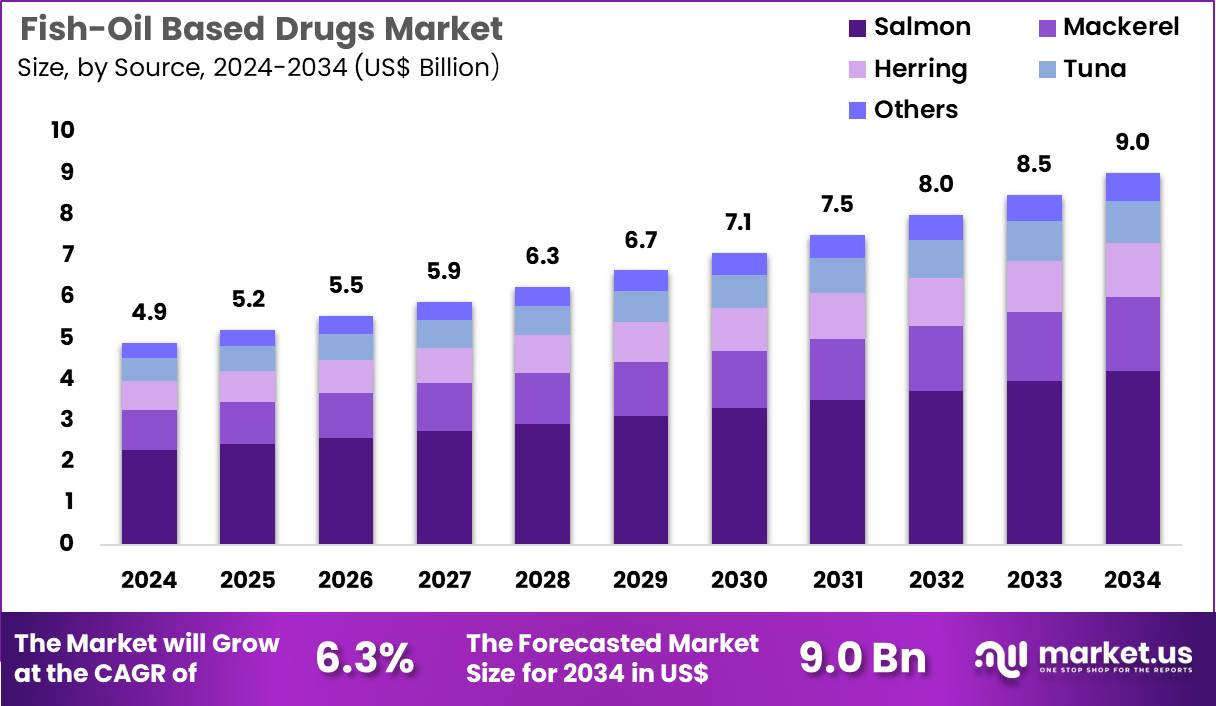
New York, NY – Oct 07, 2026 – The Global Fish-Oil Based Drugs Market size is expected to be worth around US$ 9.0 Billion by 2034 from US$ 4.9 Billion in 2024, growing at a CAGR of 6.3% during the forecast period 2025 to 2034. In 2024, North America led the market, achieving over 43.5% share with a revenue of US$ 2.1 Billion.
The fish-oil-based drugs market is gaining importance within the pharmaceutical and cardiovascular healthcare sectors, primarily due to the therapeutic benefits of omega-3 fatty acids, particularly eicosapentaenoic acid (EPA) and docosahexaenoic acid (DHA).
These drugs are primarily used to manage elevated triglyceride levels and support cardiovascular health. Unlike conventional dietary supplements, prescription fish-oil-based medicines are developed and regulated to deliver standardized concentrations of active ingredients.
The market is being supported by the increasing prevalence of hypertriglyceridemia, cardiovascular diseases, obesity, and other metabolic disorders. Growing awareness regarding the clinical benefits of omega-3 therapies and the increasing adoption of preventive healthcare are further contributing to market development. Pharmaceutical companies are also focusing on highly purified and concentrated formulations to improve efficacy, consistency, and patient outcomes.
North America and Europe represent important markets due to established healthcare systems, higher prescription-drug adoption, and strong clinical research activity. Meanwhile, Asia-Pacific is expected to offer significant growth opportunities, supported by expanding healthcare infrastructure, rising disease burden, and increasing healthcare expenditure.
Future market growth is expected to be influenced by ongoing clinical research, product innovation, regulatory developments, and the expansion of pharmaceutical distribution networks. Competitive strategies are likely to focus on formulation improvements, clinical differentiation, geographic expansion, and strategic partnerships.
Key Takeaways
- In 2024, the fish-oil-based drugs market was valued at US$ 4.9 billion and is projected to grow at a CAGR of 6.3%, reaching US$ 9.0 billion by 2034.
- Based on source, the market is segmented into salmon, mackerel, herring, tuna, and others. The salmon segment dominated in 2024, accounting for a market share of 46.8%.
- By form, the market is categorized into docosahexaenoic acid (DHA) and eicosapentaenoic acid (EPA). The DHA segment held the leading position, with a market share of 57.4% in 2024.
- Based on application, the market is segmented into coronary heart disease (CHD), stroke, rheumatoid arthritis, Raynaud’s syndrome, dysmenorrhea, and others. The CHD segment dominated the market, accounting for the largest revenue share of 49.8%.
- By distribution channel, the market is divided into supermarkets/hypermarkets, online retailers, drug stores & pharmacies, and others. The supermarkets/hypermarkets segment led the market, representing a revenue share of 44.2%.
- Geographically, North America dominated the global fish-oil-based drugs market in 2024, accounting for a market share of 43.5%.
Key Market Segments
- Source Analysis: Salmon dominated the source segment with a 46.8% share, supported by its high omega-3 content, consistent DHA and EPA profiles, and reliable year-round supply from aquaculture. Strong traceability, lower contamination risks, and advanced purification processes further support its pharmaceutical use. Sustainable sourcing and established supply partnerships are expected to sustain segment leadership.
- Form Analysis: DHA accounted for 57.4% of the form segment, supported by its recognized cardiovascular, neurological, and cellular health benefits. Growing clinical evidence, increasing demand for DHA-rich formulations, and its integration into prescription and OTC products are driving adoption. Rising awareness of cognitive and preventive healthcare is expected to support continued growth.
- Application Analysis: Coronary heart disease (CHD) represented 49.8% of the application segment. Growing cardiovascular disease prevalence, aging populations, and the use of omega-3 therapies for triglyceride management are supporting demand. Continued clinical adoption and preventive cardiovascular care are expected to maintain its leading position.
- Distribution Channel Analysis: Supermarkets and hypermarkets held 44.2%, driven by accessibility, broad product availability, strong shelf visibility, and promotional activities. Expanding health and wellness sections and organized retail networks are expected to support continued segment dominance.
Regional Analysis
North America
North America dominated the fish-oil-based drugs market in 2024, accounting for 43.5% of the global market. Growth has been supported by rising prescriptions for omega-3 therapies used to manage hypertriglyceridemia and cardiovascular risk.
Increasing adoption of purified EPA formulations, advances in extraction and dosage technologies, and growing demand for marine-derived therapies have further strengthened the regional market. In the United States, 244,271 fish-oil prescriptions were recorded in 2023, according to ClinCalc’s DrugStats Database.
Asia Pacifi
Asia Pacific is projected to register the highest CAGR during the forecast period. Market expansion is being driven by the increasing prevalence of metabolic disorders, growing healthcare expenditure, and government initiatives supporting affordable cardiovascular therapies.
Rising demand for concentrated omega-3 formulations among diabetic and aging populations is further supporting adoption. Localized manufacturing, clinical research collaborations, improved product stability, and expanding healthcare access are expected to create significant growth opportunities across the region.
Emerging Trends
- Increasing focus on triglyceride management: The market is being supported by continued clinical focus on high triglyceride levels. Prescription omega-3 medicines are established options for severe hypertriglyceridemia, with omega-3-acid ethyl esters indicated for adults with triglycerides of 500 mg/dL or higher.
- Shift toward EPA-focused therapies: Greater attention is being given to EPA-only medicines, particularly icosapent ethyl. FDA information identifies icosapent ethyl as a medicine used with statins in selected patients to reduce risks of heart attack, stroke, and certain cardiovascular events.
- Stronger differentiation between drugs and supplements: The market is increasingly being divided between regulated prescription therapies and dietary supplements. The American Heart Association states that prescription omega-3 medicines can effectively lower high triglycerides, while supplements are not approved for this treatment purpose.
- Greater attention to treatment safety: Safety monitoring is becoming an important market consideration as high-dose omega-3 therapy is used more widely. Current prescribing information highlights issues such as LDL changes, liver monitoring, fish or shellfish sensitivity, and possible recurrence of atrial fibrillation.
- Evidence-based expansion of cardiovascular applications: Clinical research is increasingly separating the effects of different omega-3 formulations and doses. NIH evidence notes that results differ across studies, while high-dose prescription EPA has shown cardiovascular benefits in selected high-risk populations.
Use Cases
- Treatment of severe hypertriglyceridemia: A major use case is lowering very high triglyceride levels in adults. Prescription omega-3-acid ethyl esters are used alongside diet for severe hypertriglyceridemia, generally at a daily prescription dose of 4 grams.
- Cardiovascular risk reduction in selected patients: Icosapent ethyl is used with statin therapy in specific adults with cardiovascular disease or diabetes and additional cardiovascular risk factors. This application expands the role of fish-oil-derived medicines beyond triglyceride reduction alone.
- Adjunct therapy with statins: Prescription omega-3 medicines can be used alongside cholesterol-lowering treatments when triglyceride management remains necessary. The American Heart Association reports that prescription omega-3 therapies can lower triglycerides whether patients are receiving statin therapy or not.
- Management of patients with metabolic risk factors: High triglycerides frequently occur alongside conditions such as obesity and diabetes. Consequently, fish-oil-based prescription therapies can form part of broader lipid-management strategies where triglyceride reduction is clinically required.
- Oral alternative within lipid-lowering treatment: Omega-3-based medicines provide an oral treatment option for triglyceride reduction. This is commercially relevant because they can be incorporated into existing lipid-management programs without requiring injectable administration.
Frequently Asked Questions About Fish-Oil Based Drugs
- What are the main ingredients in fish-oil based drugs?
The principal active omega-3 fatty acids are EPA and DHA. Some prescription medicines contain both compounds, while others, such as icosapent ethyl, contain EPA only. Their formulation and concentration determine their specific therapeutic application. - What conditions are fish-oil based drugs mainly used for?
These medicines are mainly used to manage high triglyceride levels. Certain formulations also have approved cardiovascular risk-reduction uses in appropriately selected patients receiving other treatments, particularly statins and appropriate lifestyle management. - Are fish-oil based drugs the same as fish-oil supplements?
No. Prescription fish-oil medicines contain standardized pharmaceutical formulations and are approved for specific medical uses. Dietary supplements are different products and are not approved by the FDA as treatments for high triglyceride levels. - Can fish-oil based drugs cause side effects?
Yes. Reported concerns include gastrointestinal symptoms, possible LDL increases with some formulations, liver-enzyme changes, bleeding considerations, and possible atrial fibrillation recurrence. Product labeling recommends appropriate monitoring and consideration of individual patient risks during treatment. - Can people with fish allergies take these medicines?
Caution is required. Some prescription omega-3 products are derived from fish oils, and their labeling states that it is not known whether people with fish or shellfish allergies face increased allergic-reaction risk. Medical advice is therefore recommended. - Which product types are important in this market?
The major product categories include omega-3-acid ethyl ester medicines containing EPA and DHA, and EPA-only products such as icosapent ethyl. These formulations differ in composition, approved indications, clinical evidence, and cardiovascular applications. - What safety issue could influence future market development?
Atrial fibrillation is an important safety consideration for high-dose omega-3 therapy. Recent evidence suggests that risk may increase with higher doses, while product labeling also highlights possible recurrence in patients with existing atrial fibrillation or flutter. - How are regulatory requirements shaping the market?
Regulatory requirements favor standardized pharmaceutical formulations with clearly demonstrated safety, quality, and effectiveness. FDA-approved products such as omega-3-acid ethyl esters and icosapent ethyl therefore have a different market position from non-prescription fish-oil supplements.
Conclusion
The fish-oil-based drugs market is positioned for steady growth, supported by the rising burden of cardiovascular diseases, hypertriglyceridemia, obesity, and metabolic disorders. Increasing adoption of prescription omega-3 therapies, particularly EPA- and DHA-based formulations, is strengthening clinical demand.
North America currently leads the market, while Asia Pacific is expected to provide significant future opportunities due to improving healthcare infrastructure and rising healthcare expenditure. Product innovation, clinical research, safety monitoring, and regulatory developments will remain important market factors.
Manufacturers are expected to focus on highly purified formulations, improved therapeutic efficacy, geographic expansion, and strategic partnerships to strengthen their competitive position through 2034.
Discuss your needs with our analyst
Please share your requirements with more details so our analyst can check if they can solve your problem(s)




