


Overview
New York, NY – Sep 17, 2026 – The Global Hospital Bedsheet & Pillow Cover Market size is expected to be worth around US$ 13.85 Billion by 2034 from US$ 7.24 Billion in 2024, growing at a CAGR of 6.7% during the forecast period 2025 to 2034. In 2024, Asia Pacific led the market, achieving over 33.4% share with a revenue of US$ 2.42 Billion.
Hospital Bedsheet & Pillow Cover is gaining momentum as healthcare providers increasingly prioritize infection prevention, patient comfort, and operational efficiency. Rising healthcare investments and the expansion of hospitals are fueling demand for high-quality medical linens. Globally, there are over 165,000 hospitals with approximately 30–35 million hospital beds, generating significant and recurring demand for bedsheets and pillow covers.
According to the World Health Organization (WHO), healthcare-associated infections affect 7 out of every 100 hospitalized patients in high-income countries and 15 out of every 100 patients in low- and middle-income countries, increasing the need for hygienic and frequently replaced hospital linens.
Additionally, more than 310 million major surgeries are performed worldwide each year, further boosting linen consumption across operating rooms and recovery wards. Hospital bedsheets are commonly manufactured with 180–300 thread count fabrics and can withstand 150–200 industrial wash cycles, making them suitable for repeated use under stringent healthcare standards. A 300-bed hospital may process 2–3 tonnes of linen every day, while each patient bed typically requires 3–5 complete linen sets to ensure uninterrupted operations.
Hospitals generally replace bedsheets and pillow covers every 12–24 months, depending on usage frequency and infection-control protocols. The increasing adoption of antimicrobial, fluid-resistant, stain-resistant, and eco-friendly textiles is enhancing product durability while reducing maintenance costs.
Furthermore, global healthcare expenditure now exceeds US$ 10 trillion annually, supporting investments in modern healthcare infrastructure and high-performance medical textiles. These factors, combined with growing patient admissions and stricter hygiene regulations, are expected to drive sustained demand for hospital bedsheets and pillow covers throughout the forecast period.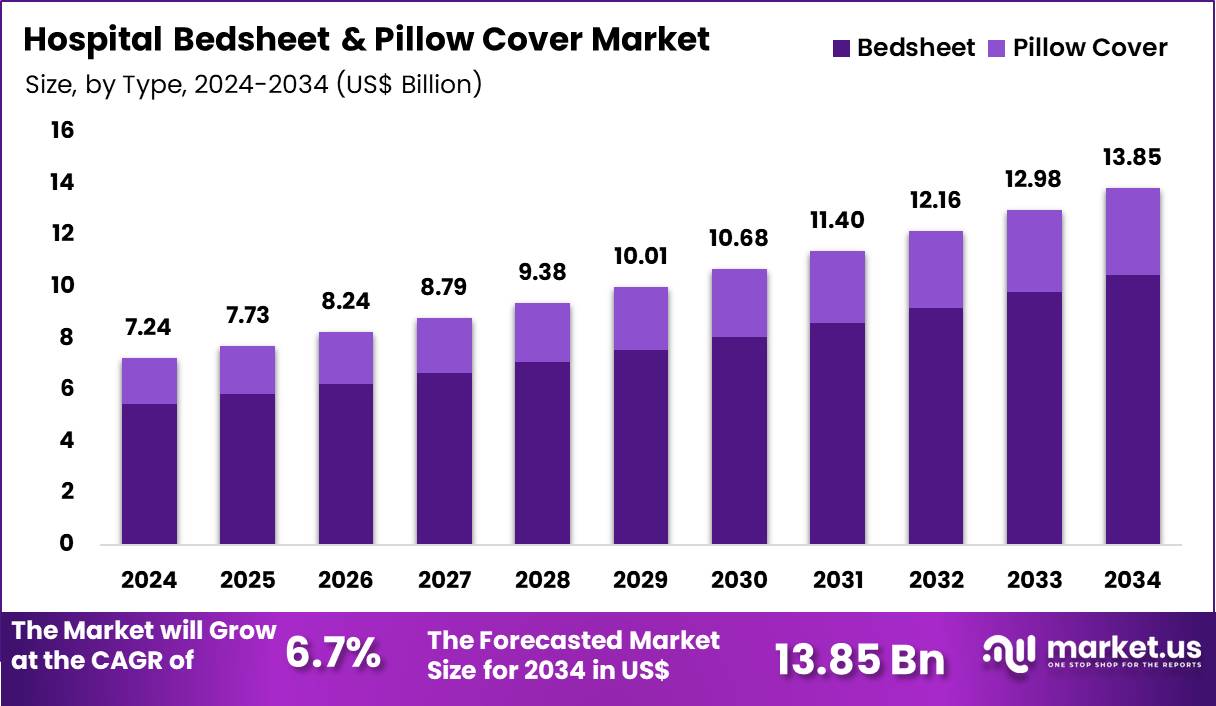
Key Takeaways
- The global Hospital Bedsheet & Pillow Cover Market was valued at US$ 7.24 Billion in 2024 and is projected to reach US$ 13.85 Billion by 2034, expanding at a CAGR of 6.7% during the forecast period.
- By Type, the market is segmented into Bedsheet and Pillow Cover, with the Bedsheet segment accounting for the largest share of 75.6% in 2024.
- By Product, the market is categorized into Reusable and Disposable, with Reusable products leading the market with a 77.8% share in 2024, supported by their lower lifecycle cost and compatibility with hospital laundry systems.
- By End User, the market is segmented into Hospitals & Clinics, Outpatient Care Centers, Rehabilitation Centers, and Others, with Hospitals & Clinics dominating the segment with a 68.3% market share in 2024.
- Asia Pacific emerged as the leading regional market, capturing a 33.4% share of the global Hospital Bedsheet & Pillow Cover Market in 2024.
Market Segmentation Overview
- Type Analysis: Bedsheets dominated the market with a 75.6% share in 2024, driven by frequent linen replacement requirements across hospitals. Each patient bed typically requires 3–5 linen sets, while ICUs and surgical wards may change bedsheets 2–3 times daily. The growing adoption of antimicrobial, fluid-resistant, and durable cotton-polyester fabrics further supports demand for high-performance hospital bedsheets.
- Product Analysis: Reusable hospital bedsheets and pillow covers accounted for 77.8% of the market in 2024 due to their lower lifecycle cost and long service life. Reusable linens can withstand 150–200 industrial wash cycles, making them cost-effective for hospitals. Their compatibility with commercial laundry systems and contribution to reducing textile waste continue to strengthen market adoption.
- End-User Analysis: Hospitals & Clinics held the largest market share of 68.3% in 2024, supported by high patient admissions and continuous linen requirements. A 300-bed hospital may process 2–3 tonnes of linen daily, with every discharged or surgical patient requiring fresh bedsheets and pillow covers. Rising surgical volumes and infection-control protocols continue to drive strong demand in this segment.
Statistical Information
- United States Hospital Bed Base Supports Linen Demand: United States hospitals comprise 6,100 facilities, 907,216 staffed beds, and 35,658,583 admissions, according to the American Hospital Association. Community hospitals alone account for 5,121 facilities, 775,297 staffed beds, and 33,553,725 admissions. These metrics define the institutional base requiring bed sheets, pillow covers, replenishment inventory, laundering capacity, and replacement purchases as patients move through inpatient care in the United States annually for suppliers.
- England’s Elevated Bed Occupancy Increases Linen Circulation Needs: NHS England recorded 95.3% adult general-and-acute bed occupancy in October 2024, increasing from 94.6% during September. More than 50% of occupied beds involved stays of seven days or longer; nearly 30% involved stays exceeding 14 days, while 19% exceeded 21 days. High occupancy and longer stays increase sheet changes, pillow-cover usage, laundry loads, reserve stock needs, and textile replacement requirements across hospitals.
- Australian Residential Care Occupancy Expands Institutional Linen Demand: Australia’s residential aged-care sector recorded 89.9% average occupancy in 2024–25, rising from 88.0% in 2023–24. Major-city facilities operated at 90.4% occupancy, while remote facilities recorded 76.3%. Although this is aged care rather than acute hospitals, it is a significant institutional bedding segment. High resident occupancy supports recurring demand for sheets, pillow covers, collection, washing, reserve inventory, and replacements nationally.
- United States Hospital Segments Create Distinct Linen Requirements: Of 5,121 U.S. community hospitals, 1,797 are rural, and 3,324 are urban. Additionally, 3,567 community hospitals operate within hospital systems. Rural facilities may prioritise reliable delivery coverage and lower inventory risk, while large urban systems can centralise linen contracts, laundry operations, procurement specifications, and stock management. This segmentation is important for suppliers developing hospital sheet and pillow-cover distribution strategies.
- Australian Residential Care Population Expands Institutional Bedding Requirements: At 30 June 2025, 204,000 Australians were using permanent or respite residential aged care, while 5,700 used transition care or short-term restorative care. The Commonwealth Home Support Program assisted about 839,000 people during 2024–25. Residential-care facilities require continuous bedding availability, supporting demand for durable sheets, pillow covers, laundry collection, room-turnover stock, and infection-control-compliant textile handling across this institutional care base
Regional Analysis
Asia Pacific led the market by securing a market share of 33.4% in 2024.
Asia Pacific held the largest share of the Hospital Bedsheet & Pillow Cover Market in 2024, driven by expanding healthcare infrastructure, increasing hospital admissions, and rising investments in medical facilities.
According to the National Bureau of Statistics of China, China had approximately 7.5 million hospital beds in 2023, while the OECD reports that Japan has nearly 13 hospital beds per 1,000 population, among the highest globally. Growing surgical volumes and stricter infection-control practices continue to increase demand for hospital linen across the region.
Meanwhile, North America is expected to register the fastest growth due to advanced healthcare systems and high healthcare utilization. The American Hospital Association reports that the U.S. operates approximately 6,120 hospitals with nearly 920,000 staffed beds, while the CDC estimates that healthcare facilities process around 5 billion pounds of healthcare textiles annually. Increasing adoption of antimicrobial fabrics, automated laundry systems, and RFID-enabled linen tracking further supports regional market expansion.
Business Opportunities
The Hospital Bedsheet & Pillow Cover Market offers significant business opportunities due to increasing healthcare infrastructure, rising patient admissions, and growing demand for infection-control solutions. Manufacturers can capitalize on the rising adoption of antimicrobial, fluid-resistant, and sustainable healthcare textiles that improve hygiene and reduce replacement costs.
Hospitals are increasingly investing in reusable linen systems, RFID-based tracking solutions, and automated laundry management to improve operational efficiency. The expansion of specialty hospitals, ambulatory surgical centers, rehabilitation facilities, and long-term care centers is creating additional demand for durable medical linens.
Companies focusing on eco-friendly fabrics, advanced textile coatings, and customized hospital linen solutions can gain competitive advantages. Growing healthcare expenditure, stricter sanitation standards, and government initiatives to improve healthcare quality are further encouraging partnerships between hospitals, textile manufacturers, and linen service providers, creating long-term growth opportunities across developed and emerging healthcare markets.
Emerging Trends
- Growing Adoption of Antimicrobial Hospital Textiles: Hospitals are increasingly using antimicrobial bedsheets and pillow covers to reduce microbial contamination and improve infection control. Advanced textile coatings have demonstrated antibacterial effectiveness even after multiple wash cycles, supporting their use in ICUs, isolation rooms, and surgical departments.
- Shift Toward Sustainable Reusable Linen Solutions: Healthcare facilities are adopting reusable bedsheets and pillow covers to reduce textile waste and improve cost efficiency. The WHO reports that around 85% of healthcare waste is non-hazardous, encouraging hospitals to implement sustainable textile management practices.
- Integration of Smart Linen Tracking Systems: Hospitals are adopting RFID-based linen tracking technologies to monitor inventory, reduce linen losses, and improve laundry operations. Large healthcare facilities managing thousands of linen items daily are using digital solutions to optimize circulation and availability.
- Increasing Demand for Infection-Control Linen Management: Rising awareness of healthcare-associated infections is driving demand for high-quality hospital linens. The CDC estimates U.S. healthcare facilities process nearly 5 billion pounds of healthcare textiles annually, requiring efficient washing, handling, and storage systems.
- Expansion of Specialized Medical Linen Products: Demand is increasing for customized bedsheets and pillow covers designed for ICUs, neonatal care units, oncology centers, and long-term care facilities. Healthcare providers are focusing on fluid-resistant, skin-friendly, durable, and patient-comfort-oriented textile solutions.
Use Cases
- Intensive Care Units (ICUs) and Critical Care: Hospital bedsheets and pillow covers are widely used in ICUs where patients require frequent linen changes due to infection risks, fluid exposure, and prolonged stays. Antimicrobial and fluid-resistant textiles help maintain hygiene standards and support patient safety in high-risk environments.
- Surgical and Operating Rooms: Hospitals use specialized clean and sterile linen products before and after surgical procedures. With more than 310 million major surgeries performed globally each year, healthcare facilities require reliable bedsheets and pillow covers for recovery areas and post-operative care.
- Isolation and Infection-Control Units: Disposable and antimicrobial hospital linens are increasingly used in isolation wards to reduce cross-contamination risks. The CDC recommends proper handling, washing, and storage of healthcare textiles to prevent the spread of infectious microorganisms within healthcare facilities.
- Long-Term Care and Rehabilitation Centers: Rehabilitation facilities and nursing homes depend on durable reusable bedsheets and pillow covers for patients with extended stays. Comfortable, skin-friendly, and washable textiles help improve patient experience while reducing operational costs.
- Outpatient and Specialty Healthcare Facilities: Diagnostic centers, dialysis units, infusion clinics, and ambulatory surgery centers use hospital linens for short-duration patient care. Rising outpatient procedures and same-day treatments are increasing demand for easy-to-maintain and hygienic bedding solutions.
Recent Development
- In January 2026, ImageFIRST Healthcare Laundry Specialists announced that all 30 healthcare plants and 34 affiliated branches achieved Healthcare Laundry Accreditation Council (HLAC) accreditation. The recognition highlights the company’s focus on infection prevention, quality control, and safe processing of healthcare textiles, including hospital bedsheets, pillow covers, and linen products.
- In February 2026, Healthcare Services Group, Inc. reported US$ 1.84 billion annual revenue for 2025, representing 7.1% year-over-year growth, and announced a new US$75 million share repurchase program. The company also provided a mid-single-digit growth outlook for 2026, supporting continued expansion of healthcare support services.
- In April 2026, Healthcare Services Group, Inc. reported US$ 462.8 million revenue in Q1 2026, showing a 3.4% increase compared with the previous year. The company highlighted new client growth and operational improvements across its healthcare service operations.
- In July 2026, Healthcare Services Group, Inc. announced US$ 470.8 million in revenue for Q2 2026 with US$ 22.7 million in net income. The company reaffirmed its mid-single-digit revenue growth outlook for 2026, reflecting continued demand for healthcare facility management and support solutions.
- In 2026, ImageFIRST continued strengthening healthcare linen service standards through accreditation programs and operational quality initiatives. The company’s network-wide HLAC accreditation across 64 locations (30 plants and 34 branches) supports improved hygiene compliance and reliable linen management for healthcare facilities.
Frequently Asked Questions on Hospital Bedsheet & Pillow Cover
- What factors are driving the growth of the Hospital Bedsheet & Pillow Cover Market?
The market growth is driven by increasing hospital admissions, rising surgical procedures, strict infection-control regulations, and growing demand for durable healthcare textiles. Hospitals are adopting antimicrobial, fluid-resistant, and reusable linen solutions to improve hygiene standards and reduce operational costs. - Which type segment dominates the Hospital Bedsheet & Pillow Cover Market?
The Bedsheet segment dominated the market with a 75.6% share in 2024 due to frequent replacement requirements in hospitals. Continuous patient admissions, surgical procedures, and strict cleanliness protocols increase the demand for hospital bedsheets across different healthcare departments. - Which end-user segment dominates the Hospital Bedsheet & Pillow Cover Market?
The Hospitals & Clinics segment held the largest share of 68.3% in 2024 due to high patient admissions, continuous bed occupancy, surgical activities, and frequent linen replacement requirements across emergency rooms, intensive care units, and inpatient departments. - How do hospital bedsheets support infection prevention?
Hospital bedsheets support infection prevention by creating a clean barrier between patients and healthcare environments. Antimicrobial fabrics, proper laundering procedures, and regular replacement schedules help reduce contamination risks and support healthcare facilities in maintaining patient safety and hygiene standards. - What materials are used for manufacturing hospital bedsheets and pillow covers?
Hospital bedsheets and pillow covers are manufactured using materials such as cotton, polyester blends, microfiber, and antimicrobial-treated fabrics. These materials provide durability, comfort, breathability, and resistance to frequent washing required in hospitals and healthcare environments. - Which region dominates the Hospital Bedsheet & Pillow Cover Market?
The Asia Pacific region dominated the market with a 33.4% share in 2024 due to expanding healthcare infrastructure, increasing hospital capacity, rising patient admissions, and government investments aimed at improving healthcare facilities and sanitation standards. - What are the emerging trends in the Hospital Bedsheet & Pillow Cover Market?
Emerging trends include antimicrobial textile development, sustainable reusable linen adoption, RFID-based linen tracking systems, automated laundry management, and advanced fabric technologies. These innovations help hospitals improve hygiene compliance, reduce operational costs, and enhance overall patient care quality.
Conclusion
The Hospital Bedsheet & Pillow Cover Market is expected to witness steady growth due to increasing healthcare infrastructure, rising patient admissions, and growing emphasis on infection prevention. The market reached US$7.24 Billion in 2024 and is projected to expand with a 6.7% CAGR through 2034, driven by demand for reusable, antimicrobial, and durable healthcare textiles.
Hospitals and clinics remain the largest end users due to continuous linen requirements. Asia Pacific leads market growth with expanding healthcare facilities, while North America benefits from advanced infection-control practices and technology adoption. Future opportunities will arise from sustainable textiles, smart tracking systems, and innovative medical linen solutions.
Discuss your needs with our analyst
Please share your requirements with more details so our analyst can check if they can solve your problem(s)




