


Overview
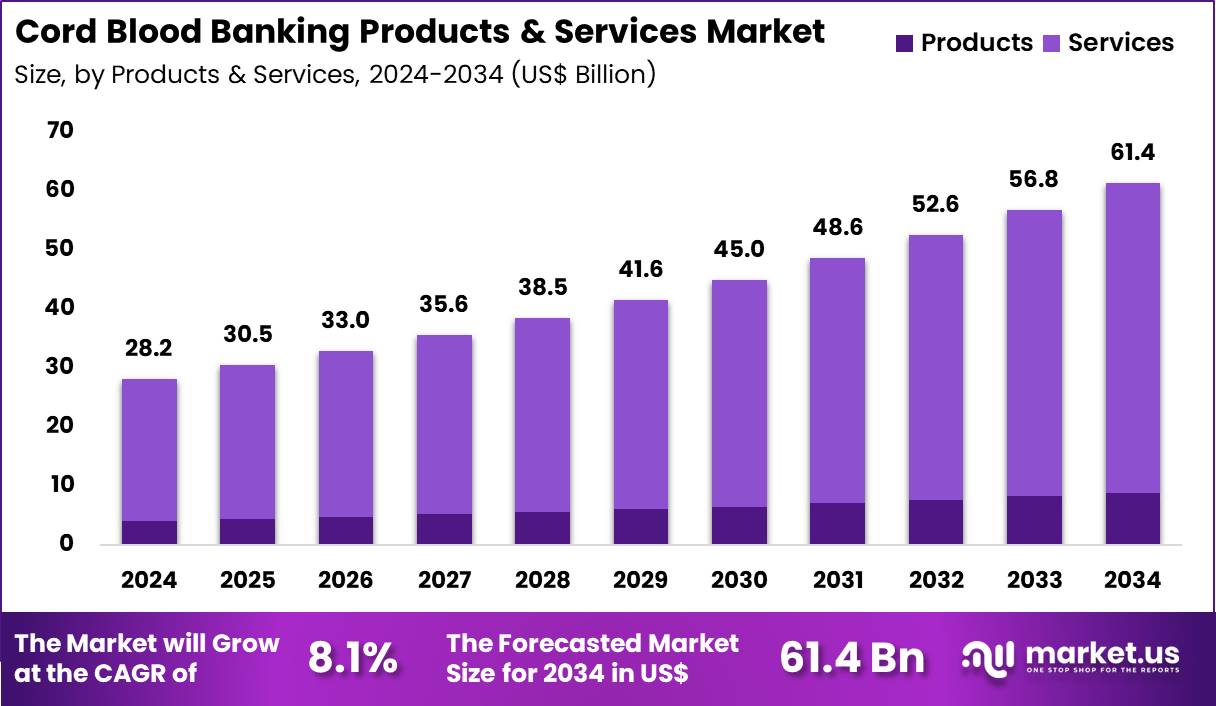
New York, NY – Oct 06, 2026 – The Global Cord Blood Banking Products & Services Market size is expected to be worth around US$ 61.4 Billion by 2034 from US$ 28.2 Billion in 2024, growing at a CAGR of 8.1% during the forecast period 2025 to 2034. In 2024, North America led the market, achieving over 43.2% share with a revenue of US$ 12.2 Billion.
The global Cord Blood Banking Products & Services Market is witnessing steady growth, driven by increasing awareness of the therapeutic potential of cord blood stem cells and rising investments in regenerative medicine. Cord blood, collected from the umbilical cord and placenta after childbirth, is a valuable source of hematopoietic stem cells used in the treatment of various blood and immune system disorders.
The market is being supported by growing demand for private and public cord blood banking, advancements in stem cell preservation technologies, and increasing research into applications for regenerative and cellular therapies. Improved healthcare infrastructure and greater awareness among expectant parents are also contributing to market expansion.
Key market participants are focusing on technological advancements, improved cryopreservation methods, enhanced storage solutions, and strategic collaborations to strengthen their market positions. Public awareness campaigns and supportive initiatives for stem cell banking are further creating opportunities across developed and emerging economies.
Despite these growth prospects, high storage costs, regulatory requirements, and limited awareness in certain developing regions remain important challenges. However, continued research into stem cell-based therapies and expanding applications of cord blood are expected to create significant opportunities over the coming years.
For detailed market size, trends, competitive landscape, segmentation, and forecasts, refer to the Cord Blood Banking Products & Services Market report by Market.us.
Key Takeaways
- In 2024, the market was valued at US$ 28.2 billion and is projected to expand at a CAGR of 8.1%, reaching US$ 61.4 billion by 2034.
- Based on products and services, the market is segmented into products and services. The services segment dominated in 2024, accounting for 85.6% of the total market share.
- By storage status, the market is categorized into frozen/cryopreserved and fresh. The frozen/cryopreserved segment held the leading position, with a market share of 67.3% in 2024.
- By application, the market is segmented into hematopoietic stem cell transplantation (HSCT), genetic and inherited disorders, and regenerative medicine. Hematopoietic stem cell transplantation (HSCT) dominated the market, accounting for 58.0% of total revenue.
- Based on bank type, the market is classified into private, public, and hybrid (emerging model). The private segment led the market, capturing a revenue share of 44.2% in 2024.
- By end-user, the market is segmented into hospitals and transplant centers, academic and research institutes, and others. Hospitals and transplant centers accounted for the largest share, at 56.1%.
- Regionally, North America dominated the global market in 2024, accounting for 43.2% of the total market share.
Key Market Segments
- Product & Services Analysis: Services dominated the cord blood banking market with an 85.6% share, supported by collection, processing, testing, storage, and monitoring solutions. Recurring storage fees, rising parental awareness, quality standards, advanced cryopreservation, and customer support are expected to sustain the segment’s leading position.
- Storage Status Analysis: Frozen or cryopreserved storage held a 67.3% market share, supported by long-term stem cell preservation, established clinical applications, and standardized protocols. Advances in freezing technologies, regulatory acceptance, and investments in cryogenic infrastructure are expected to reinforce its market leadership.
- Application Analysis: Hematopoietic stem cell transplantation (HSCT) accounted for 58.0% of the market, driven by its established use in blood cancers and inherited disorders. Growing transplant demand, pediatric applications, improved treatment protocols, and expanding transplant centers are expected to support continued segment dominance.
- Bank Type Analysis: Private cord blood banks accounted for 44.2% of the market, supported by parental preference for exclusive sample access and growing awareness of potential therapeutic applications. Rising disposable incomes, flexible payment options, prenatal awareness, and recurring storage revenues are expected to drive growth.
- End-User Analysis: Hospitals and transplant centers represented 56.1% of the market, reflecting their central role in cord blood collection, storage, and clinical utilization. Established transplant programs, trained personnel, institutional trust, increasing procedure volumes, and expanding clinical research are expected to maintain segment dominance.
Regional Analysis
North America led the Cord Blood Banking Products & Services Market in 2024, accounting for 43.2% of the global market. Growth was supported by increasing awareness of regenerative medicine and the therapeutic potential of cord blood in hematologic disorders, immune deficiencies, and emerging cellular therapies. Integration of standardized collection and processing services within hospitals improved enrollment and sample quality.
Technological advancements in cryopreservation, testing, and long-term storage further strengthened confidence in clinical applications. The established use of cord blood transplantation also supported market adoption across the region.
Asia Pacific is projected to register the highest CAGR during the forecast period, driven by expanding stem cell research, growing public and private banking networks, and increasing healthcare investments.
Enhanced processing technologies, flexible storage plans, hospital partnerships, and rising clinical trials are improving accessibility and awareness. Expansion of regenerative medicine applications and cross-border healthcare collaborations is expected to further support regional demand.
Emerging Trends
- Growing focus on public cord blood banking: Public banking is gaining importance because donated cord blood can be matched with unrelated patients requiring stem cell transplantation. Greater diversity in donor inventories is also being encouraged because some ethnic groups remain underrepresented in cord blood registries.
- Expansion of quality and regulatory standards: Cord blood banks are placing greater emphasis on donor screening, infectious-disease testing, traceability, processing, labeling, and controlled storage. Regulatory compliance is becoming an important factor in selecting banking providers and maintaining the clinical usability of stored units.
- Increasing interest in directed family banking: Although routine private banking is not recommended by ACOG, demand remains relevant where a biological family member already has a disease that could potentially be treated using cord blood stem cells. This supports specialized directed-donation services.
- Research beyond established transplantation applications: Cord blood stem cells are being studied for regenerative medicine and other emerging medical applications. However, the U.S. FDA states that approved cord-blood stem-cell products are currently limited to blood-forming disorders, creating a clear distinction between established applications and research-stage opportunities.
- Greater emphasis on patient education and informed choice: Healthcare providers and cord blood banks are increasingly expected to explain public versus private banking, collection limitations, costs, storage requirements, and actual medical uses. This trend is likely to favor providers offering transparent information rather than relying mainly on consumer marketing.
Use Cases
- Treatment of blood cancers: Cord blood-derived blood-forming stem cells are used in transplantation for selected blood cancers, including leukemia and lymphoma. The cells can replace diseased blood-forming cells and provide a treatment option when an appropriate donor or other transplant source is required.
- Treatment of inherited metabolic disorders: Cord blood transplantation can be used for certain inherited metabolic diseases. In these cases, healthy blood-forming stem cells from cord blood may help replace or rebuild the patient’s affected blood-forming system under appropriate clinical conditions.
- Treatment of immune-system disorders: Certain inherited immune-system disorders can be treated using hematopoietic stem-cell transplantation. Cord blood provides another source of these cells and can be particularly useful when a suitable matched donor is difficult to identify.
- Directed donation for an affected sibling: Cord blood may be collected and stored specifically for a biological sibling who already has a disease that could potentially be treated through transplantation. Such directed banking can receive special consideration and may be available at little or no cost for eligible families.
- Research and clinical development: Stored cord blood is also relevant to research involving regenerative medicine and other emerging applications. These uses remain under investigation, and many marketed regenerative applications are not FDA-approved, making clinical evidence and regulatory status important considerations.
Frequently Asked Questions About Cord Blood Banking Products & Services
- What is cord blood banking
Cord blood banking is the process of collecting blood remaining in the umbilical cord and placenta after birth, testing and processing it, and freezing it for future use. This blood contains hematopoietic stem cells that can be used in selected transplantation procedures. - What products and services are offered by cord blood banks?
Cord blood banking providers generally offer collection kits, birth-time collection services, laboratory testing, processing, cryogenic storage, sample tracking, and release services when medically required. Some providers also offer family banking, directed donation support, transportation, and long-term storage services. - What is the difference between public and private cord blood banking?
Public banks store donated cord blood for use by patients who need a compatible transplant, while private banks store cord blood for the child or family. Public donation generally has no cost to parents, whereas private banking normally involves collection, processing, and continuing storage fees. - Can a child use their own stored cord blood?
A child’s own cord blood has important limitations because genetic diseases and some malignancies may also be present in the stored cells. ACOG states that routine private banking is not supported by available evidence and recommends public banking as the preferred option for transplantation. - Does cord blood collection affect normal childbirth care?
Cord blood collection should not compromise the health or care of the mother or newborn. Collection may sometimes be unsuccessful because of medical emergencies, insufficient blood volume, premature birth, or delayed cord clamping, which can reduce the amount available for banking. - What are the major market segments?
The market can be segmented by banking type, including public and private banking, and by service such as collection, processing, testing, storage, transportation, and retrieval. Additional segmentation can be based on application, including transplantation, family-directed use, and research activities. - What factors are driving market demand?
Market demand is supported by the clinical use of hematopoietic stem cells, greater awareness of cord blood donation, development of public inventories, demand for family-directed banking, and continuing stem-cell research. Healthcare infrastructure and regulatory quality requirements also influence demand for specialized banking services. - Why is public cord blood banking important for market development?
Public banking increases the number of cord blood units available for patients requiring transplantation and can improve access for people from genetically diverse populations. HRSA and ACOG emphasize the importance of broader donation because diverse inventories can improve the possibility of finding suitable matches.
Conclusion
The global Cord Blood Banking Products & Services Market is expected to maintain strong growth, supported by rising awareness of cord blood stem cells, increasing demand for hematopoietic stem cell transplantation, and continued investments in regenerative medicine.
Services, cryopreserved storage, HSCT applications, private banking, and hospitals and transplant centers are expected to remain important market segments. North America currently leads the market, while Asia Pacific is expected to record the fastest growth due to expanding healthcare infrastructure and stem cell research.
Despite high storage costs, regulatory challenges, and limited awareness, technological advancements, public banking initiatives, and expanding clinical applications are expected to create significant long-term opportunities.
Discuss your needs with our analyst
Please share your requirements with more details so our analyst can check if they can solve your problem(s)




