


Overview
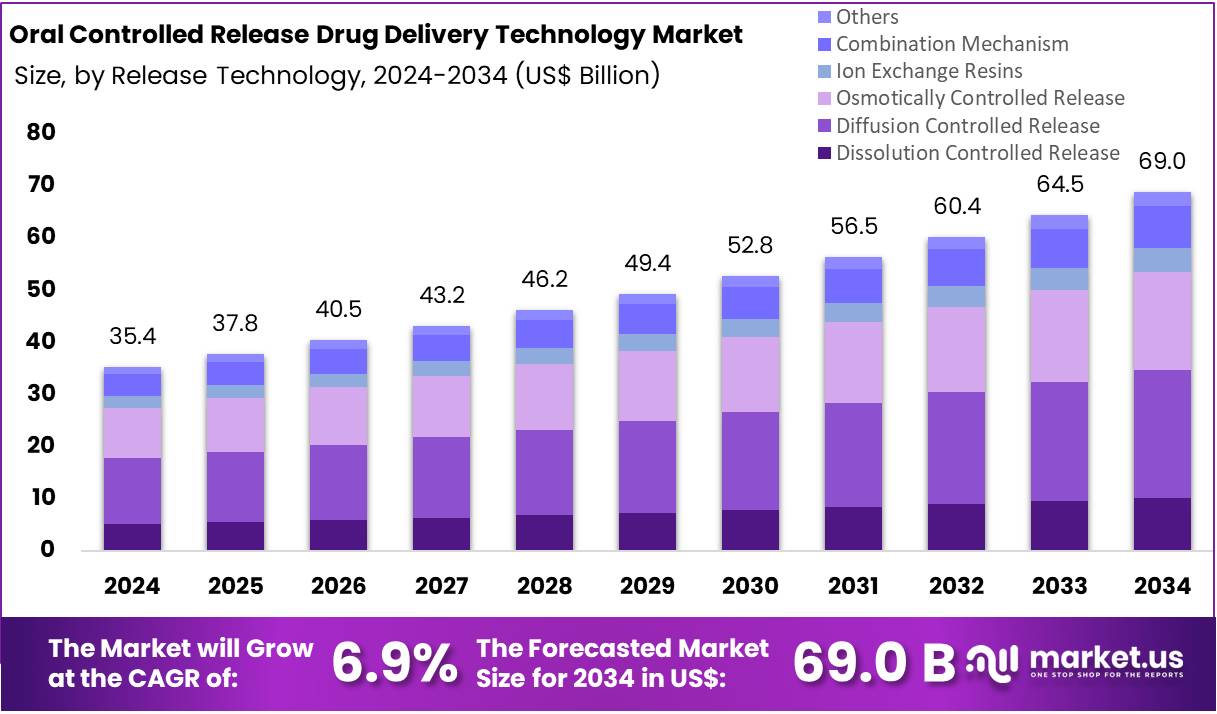
The Global Oral Controlled Release Drug Delivery Technology Marketsize is expected to be worth around US$ 69 Billion by 2034, from US$ 35.4 Billion in 2024, growing at a CAGR of 6.9% during the forecast period from 2025 to 2034. North America held a dominant market position, capturing more than a 41.3% share and holding a market value of US$ 14.6 Billion for the year.
The global Oral Controlled Release Drug Delivery Technology market is gaining momentum as pharmaceutical companies focus on improving patient adherence, reducing dosing frequency, and enhancing therapeutic outcomes.
Controlled release formulations are designed to release active pharmaceutical ingredients at a predetermined rate, helping maintain consistent drug concentrations in the body over extended periods. This technology is widely used for treating chronic conditions such as diabetes, cardiovascular diseases, neurological disorders, and pain management.
Advancements in polymer science, multiparticulate formulations, osmotic pump systems, and matrix-based tablets are driving innovation across the industry. Pharmaceutical manufacturers are increasingly investing in extended-release technologies to improve product differentiation and lifecycle management. The rising prevalence of chronic diseases, growing elderly population, and increasing demand for once-daily medications continue to support market expansion.
North America currently represents the largest regional market due to its advanced pharmaceutical manufacturing capabilities and strong regulatory framework, while Asia-Pacific is emerging as the fastest-growing region, supported by expanding healthcare infrastructure, increasing generic drug production, and rising investments in pharmaceutical research and development.
Key Takeaways
- The global oral controlled release drug delivery technology market was valued at US$ 35.4 billion in 2024 and is projected to reach approximately US$ 69 billion by 2034, expanding at a CAGR of 6.9% during the forecast period.
- Diffusion-controlled release technology dominated the market in 2024, capturing over 35.6% of the overall oral controlled release technology segment.
- Solid dosage forms led the dosage form segment in 2024, accounting for more than 83.1% of the total market share.
- North America held the leading regional position in 2024, representing over 41.3% of the global market and generating approximately US$ 14.6 billion in revenue.
Statistical Information
- A 2025 push-pull osmotic pump formulation for oral norfloxacin achieved 98.5% cumulative drug release over 15 hours, demonstrating sustained zero-order release suitable for controlled drug delivery.
- The same 2025 study reported drug content uniformity ranging from 98.00% to 99.67%, indicating highly consistent drug distribution across controlled-release tablets.
- In a 2025 FDA bioequivalence study, an extended-release osmotic methylphenidate formulation was evaluated in 60 healthy volunteers receiving a 72 mg dose compared with two 36 mg reference tablets.
- The second 2025 bioequivalence trial included 36 healthy volunteers, comparing a 54 mg controlled-release tablet with a 54 mg reference formulation and successfully demonstrated bioequivalence.
- The FDA-required pharmacokinetic evaluation confirmed bioequivalence across three partial exposure windows (0–3 h, 3–7 h, and 7–12 h) together with total drug exposure, ensuring consistent controlled drug release throughout the dosing period.
- The newly approved osmotic extended-release methylphenidate in 2025 is available in 7 tablet strengths: 18, 27, 36, 45, 54, 63, and 72 mg, allowing finer dose adjustment while maintaining controlled release.
- A 2025 FDA Generic Drug Science Report evaluated extended-release formulations under 0.1 N HCl with 5%, 20%, and 40% ethanol to assess alcohol-induced dose dumping, providing quantitative testing conditions for oral modified-release products.
- A 2025 study on bilayer osmotic tablets found that formulations with drug loading above 20% may retain more than 5% unreleased drug, identifying an important technical limitation for high-load controlled-release systems.
- The same 2025 investigation emphasized reducing residual drug below the observed >5% level through improved tablet design instead of using formulation overages, supporting safer controlled-release manufacturing.
- A 2025 FDA-approved osmotic controlled-release methylphenidate product supports 7–12 hours of validated pharmacokinetic performance, meeting regulatory bioequivalence criteria throughout this critical therapeutic window.
Regional Analysis
North America maintained its leadership in the oral controlled release drug delivery technology market in 2024, accounting for 41.3% of the global market and reaching a value of US$ 14.6 million. The region’s strong position is supported by the high prevalence of chronic diseases requiring long-term medication. According to the U.S. Centers for Disease Control and Prevention (CDC), nearly 6 in 10 U.S. adults have at least one chronic disease, while 4 in 10 have two or more, driving demand for once-daily and extended-release formulations that improve treatment adherence.
High prescription medicine use and advanced healthcare infrastructure further encourage the adoption of controlled release technologies. The Organisation for Economic Co-operation and Development (OECD) reported that U.S. healthcare expenditure exceeded US$ 13,000 per capita in 2023, supporting investment in innovative drug delivery systems.
Additionally, the European Federation of Pharmaceutical Industries and Associations (EFPIA) reported that North America represented 53.3% of global pharmaceutical sales in 2023, reinforcing the region’s leadership in adopting advanced oral drug delivery technologies.
Emerging Trends
- Advanced polymer-based controlled release systems are expanding: Drug developers are increasingly using hydrophilic and hydrophobic matrix polymers, osmotic pumps, and diffusion-controlled technologies to maintain stable drug levels. These systems help reduce dosing frequency from 3–4 doses daily to 1–2 doses, improving patient convenience and treatment adherence.
- 3D-printed oral dosage forms are becoming an important innovation: Recent pharmaceutical research from 2025–2026 highlights growing interest in personalized tablets with customized release profiles, enabling precise dosing for individual patients while improving bioavailability and therapeutic performance.
- Better in vitro–in vivo correlation (IVIVC) is improving product development: Pharmaceutical companies increasingly apply IVIVC models to predict how extended-release tablets behave in patients, reducing unnecessary bioequivalence studies and supporting faster formulation optimization while maintaining product quality.
- Poorly soluble medicines are driving new formulation technologies: Many new drug molecules have limited water solubility, encouraging the adoption of lipid-based carriers, amorphous dispersions, and nanoparticle-enabled controlled release systems to improve oral absorption and therapeutic effectiveness.
- Focus on medication adherence continues to grow: The U.S. healthcare system estimates that improving medication adherence could reduce healthcare costs by up to US$300 billion annually, encouraging wider development of oral controlled-release medicines that reduce dosing frequency for chronic disease patients.
Use Cases
- Chronic cardiovascular disease management: Controlled-release tablets are widely used for hypertension and heart disease, providing continuous drug delivery for 24 hours with fewer daily doses, helping patients maintain consistent therapy and reducing fluctuations in blood drug concentrations.
- Diabetes treatment support: Extended-release oral formulations help maintain steadier medicine exposure throughout the day while reducing pill burden. Once-daily dosing improves convenience for patients requiring long-term glucose control and supports better treatment compliance.
- Neurological disorder therapy: Extended-release oral medicines are widely applied in epilepsy management because they reduce peak-to-trough drug concentration changes, simplify dosing schedules, and improve adherence for patients needing lifelong treatment.
- Pain management applications: Controlled-release oral formulations for analgesics provide prolonged therapeutic effects, reducing the need for frequent dosing. Recent formulation research covering 2020–2025 focuses on improving sustained pain relief while minimizing dose variability.
- Gastrointestinal-targeted drug delivery: Modern oral controlled-release technologies use enteric coatings and site-specific release mechanisms to deliver medicines at selected regions of the gastrointestinal tract, improving treatment efficiency while reducing unnecessary drug exposure in the stomach.
Frequently Asked Questions on Oral Controlled Release Drug Delivery Technology
- How does Oral Controlled Release Drug Delivery Technology work?
The technology uses specially designed tablets or capsules containing polymers, coatings, or matrix systems that regulate how quickly the drug dissolves. Depending on the formulation, the medicine may be released over several hours, providing a steady therapeutic effect and reducing sudden concentration changes. - Which diseases commonly use oral controlled-release medicines?
Oral controlled release formulations are widely used for chronic diseases such as hypertension, diabetes, cardiovascular disorders, asthma, neurological disorders, and chronic pain. These therapies improve medication adherence by reducing the number of doses patients need to take each day. - What factors are driving the Oral Controlled Release Drug Delivery Technology Market?
The market is growing because of the increasing prevalence of chronic diseases, rising aging populations, greater demand for patient-friendly medicines, advances in pharmaceutical formulation technologies, and continued investment in research that improves drug safety, effectiveness, and long-term treatment outcomes. - Which regions lead the Oral Controlled Release Drug Delivery Technology Market?
North America leads the market because of its advanced pharmaceutical industry, strong healthcare infrastructure, high chronic disease burden, and continuous research investments. Europe also represents a significant market, while Asia-Pacific is experiencing rapid growth due to expanding healthcare access and pharmaceutical manufacturing. - What industries benefit from Oral Controlled Release Drug Delivery Technology?
Pharmaceutical companies, biotechnology firms, contract development and manufacturing organizations (CDMOs), hospitals, healthcare providers, and research institutions benefit from this technology. It supports improved therapeutic performance, product differentiation, patient compliance, and efficient long-term disease management across multiple therapeutic areas. - What innovations are shaping the future of Oral Controlled Release Drug Delivery Technology?
Emerging innovations include smart polymers, biodegradable materials, 3D-printed oral dosage forms, AI-assisted formulation development, and personalized drug delivery systems. These advances aim to improve release precision, manufacturing efficiency, patient-specific therapies, and overall treatment effectiveness in modern healthcare. - What is the future outlook for the Oral Controlled Release Drug Delivery Technology Market?
The market is expected to grow steadily as pharmaceutical companies develop advanced formulations for chronic diseases and personalized medicine. Increasing regulatory support for innovative drug delivery systems, along with expanding global healthcare demand, is expected to create new commercial opportunities over the coming years.
Conclusion
The oral controlled release drug delivery technology market is poised for sustained expansion, driven by increasing demand for therapies that enhance medication adherence and maintain consistent drug levels over extended periods. Growth in chronic disease prevalence, an aging global population, and continued investment in advanced drug formulation technologies are accelerating adoption across therapeutic areas.
Ongoing innovation in diffusion-controlled, dissolution-controlled, and osmotic delivery systems, combined with expanding pharmaceutical research and manufacturing capabilities, will continue to strengthen the market’s long-term growth potential.
Discuss your needs with our analyst
Please share your requirements with more details so our analyst can check if they can solve your problem(s)




