


Overview
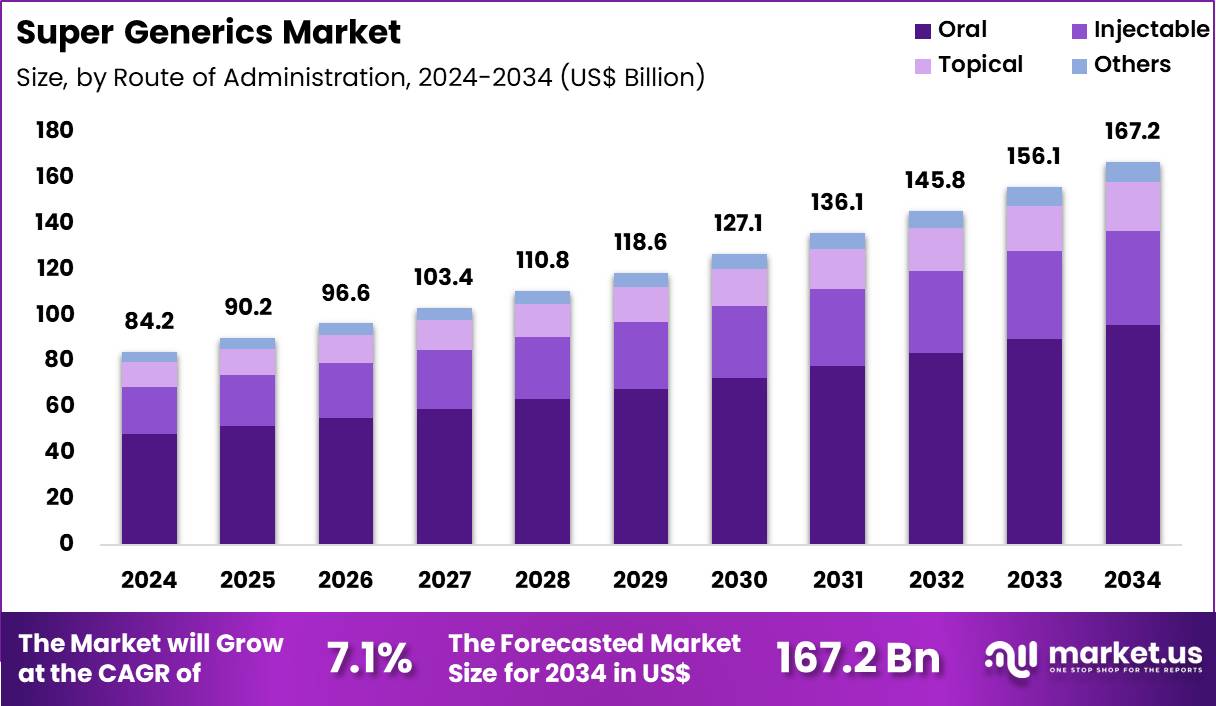
New York, NY – Oct 07, 2026 – The Global Super Generics Market size is expected to be worth around US$ 167.2 Billion by 2034 from US$ 84.2 Billion in 2024, growing at a CAGR of 7.1% during the forecast period 2025 to 2034. In 2024, North America led the market, achieving over 44.2% share with a revenue of US$ 37.2 Billion.
Super Generics is a pharmaceutical company focused on the development, manufacturing, and supply of generic medicines and healthcare products. The company operates with an emphasis on providing cost-effective and quality-assured pharmaceutical solutions to meet the healthcare needs of patients and healthcare providers.
Super Generics supports the availability of essential medicines across therapeutic areas, with its activities covering pharmaceutical product development, manufacturing, quality control, and distribution. The company’s generic medicine portfolio is positioned to provide affordable alternatives to branded pharmaceutical products while maintaining required standards of safety, efficacy, and quality.
The pharmaceutical industry is witnessing continued demand for generic medicines due to increasing healthcare expenditure, the need for affordable treatment options, and the growing focus on improving access to essential medicines. Against this backdrop, companies operating in the generic pharmaceutical segment are increasingly focusing on product expansion, manufacturing capabilities, regulatory compliance, and market reach.
Super Generics is expected to benefit from these industry trends by strengthening its product portfolio and expanding its presence across relevant markets. Through a focus on quality, affordability, and operational capabilities, the company aims to contribute to improved access to pharmaceutical treatments while supporting the evolving requirements of the global healthcare sector.
Key Takeaways
- In 2024, the market generated US$ 84.2 billion in revenue and is projected to expand at a CAGR of 7.1%, reaching US$ 167.2 billion by 2034.
- By product type, the market is segmented into oral solid dosage forms, inhalable dosage forms, injectables, topical dosage forms, and others. Oral solid dosage forms dominated in 2024, accounting for 44.8% of the market share.
- Based on route of administration, the market is categorized into oral, topical, injectable, and other routes. The oral segment held the leading position, accounting for 57.4% of the market.
- By application, the market is segmented into oncology, chronic pain, central nervous system (CNS) disorders, cardiovascular diseases, respiratory disorders, and others. Oncology emerged as the leading application segment, capturing a 36.9% revenue share.
- By distribution channel, the market is segmented into retail pharmacies, hospital pharmacies, online pharmacies, and drug stores. Retail pharmacies accounted for the largest revenue share of 48.6%.
- Regionally, North America dominated the market in 2024, accounting for a 44.2% market share.
Key Market Segments
- Product Type Analysis: Oral solid dosage forms accounted for 44.8% of the Super Generics market, maintaining segment leadership. Their dominance is supported by scalable manufacturing, cost efficiency, convenient administration, longer shelf life, and established regulatory pathways. Modified-release, sustained-release, and bioavailability-enhancing formulations further strengthen segment growth and differentiation.
- Route of Administration Analysis: The oral route accounted for 57.4% of the Super Generics market, representing the leading administration pathway. Its dominance is driven by convenient, non-invasive dosing, easier self-administration, lower healthcare costs, and suitability for chronic disease management. Advanced formulations also support improved bioavailability and reduced dosing frequency.
- Application Analysis: Oncology represented 36.9% of the Super Generics market, making it the leading application segment. Growth is supported by increasing cancer incidence, demand for affordable treatments, patent expirations, and greater adoption of differentiated formulations. Improved bioavailability, simplified dosing, and cost-containment initiatives further support oncology applications.
- Distribution Channel Analysis: Retail pharmacies accounted for 48.6% of the Super Generics market, securing the leading distribution position. Their dominance is supported by broad geographic accessibility, established patient trust, prescription fulfillment, and chronic therapy continuity. Digital prescriptions, pharmacist recommendations, and increasing outpatient treatment further strengthen retail pharmacy adoption.
Regional Analysis
North America led the Super Generics Market in 2024, accounting for 44.2% of the global market. Growth was supported by rising healthcare costs and increasing demand for affordable therapies offering improved bioavailability, reduced side effects, and extended-release benefits.
Pharmaceutical companies expanded value-added generic development to address patent expirations across chronic disease treatments, including hypertension, diabetes, oncology, and neurological disorders. Favorable regulatory pathways, insurance coverage, and growing chronic disease prevalence further supported adoption. The U.S. FDA approved 856 abbreviated new drug applications in fiscal year 2024, highlighting continued regulatory activity.
Asia Pacific is projected to register the highest CAGR during the forecast period. Growth is being driven by government initiatives promoting affordable medicines, investments in domestic pharmaceutical manufacturing, and increasing non-communicable disease prevalence.
Manufacturers are developing stable, reformulated products for cardiovascular, respiratory, antidiabetic, and anti-inflammatory applications. Technology transfers, regional bioequivalence studies, and faster regulatory approvals are supporting production and market expansion. In 2024, China’s Center for Drug Evaluation recommended approval of 3,041 chemical generic drug marketing applications.
Emerging Trends
- Growing focus on complex generics: Development is increasingly moving toward complex formulations, extended-release products, complex active ingredients, and specialized delivery systems. FDA notes that complex products are harder to develop and therefore often face less generic competition, creating opportunities for differentiated manufacturers.
- Advanced drug-delivery technologies: Super generics are increasingly associated with improved delivery technologies, including long-acting formulations, inhalation systems, injectable products, and drug-device combinations. These technologies can improve convenience while creating additional opportunities beyond traditional tablet-based generic medicines.
- Greater use of analytical and digital tools: Advanced analytical methods, modeling, data analytics, and artificial intelligence are becoming important in complex generic development. FDA’s FY2024 research program specifically includes quantitative methods, models, data analytics, and AI as research priorities.
- Rising demand for affordable specialty medicines: Super generics can support wider access to complex treatments where conventional generic competition is limited. FDA reports that generic medicines improve affordability, while its complex-generic initiatives aim to increase access to these harder-to-develop products.
- More regulatory support for complex products: Regulatory agencies are providing clearer product-specific guidance to reduce uncertainty during generic development. In August 2026, FDA issued 55 new and revised product-specific guidances, including 18 covering complex products.
Use Cases
- Extended-release treatments: Super generics can be developed with modified-release technologies to maintain drug levels for longer periods and potentially reduce dosing frequency, particularly for chronic conditions requiring long-term medication.
- Complex injectable medicines: Complex generic approaches can support injectable products where formulation, delivery, or device characteristics create additional development challenges. FDA identifies extended-release injectables and complex drug-device combinations among complex generic products.
- Inhaled medicines: Improved generic inhalation products can provide alternative treatment options for respiratory diseases while addressing formulation and delivery challenges associated with inhaled medicines. FDA identifies inhalers among complex products requiring specialized development approaches.
- Drug-device combination products: Super generics can combine established medicines with improved delivery devices, such as autoinjectors or other specialized systems. FDA specifically recognizes drug-device combinations where device design affects drug delivery or absorption.
- Specialized formulations: Reformulated generic medicines can be designed to address specific delivery, stability, dosing, or administration requirements. Such products can expand affordable treatment options in areas where conventional generic alternatives are limited.
Frequently Asked Questions About Super Generics
- How are super generics different from conventional generics?
Conventional generics are designed to match an approved reference medicine in key characteristics, including active ingredient, strength, dosage form, route, quality, and bioequivalence. Super generics generally seek additional differentiation through formulation, delivery technology, or improved usability. - Are super generics approved by the FDA?
Products described commercially as super generics must follow an applicable FDA approval pathway. FDA regulates generic medicines according to established scientific and quality standards, while complex products may require specialized evidence and development approaches. - Are super generics cheaper than branded medicines?
Super generics can provide cost advantages compared with branded products, although pricing depends on development costs, competition, manufacturing complexity, and market conditions. FDA reports that generic competition generally reduces medicine prices and improves access to treatment. - What technologies are used in super generics?
Super generics may use technologies such as extended-release formulations, advanced delivery systems, complex formulations, inhalation technologies, injectable systems, and drug-device combinations. These approaches are particularly relevant where conventional generic development methods are insufficient. - What are the major opportunities in the super generics market?
Major opportunities exist in complex injectables, inhaled medicines, extended-release formulations, specialty treatments, and drug-device combinations. These areas can offer opportunities because technically difficult products typically face fewer generic competitors and require specialized development capabilities. - How does regulation affect the super generics market?
Regulation has a major influence because differentiated generic products must demonstrate appropriate quality, safety, performance, and equivalence according to their approval pathway. FDA continues publishing product-specific guidance to provide developers with clearer expectations for generic development. - Why are pharmaceutical companies interested in super generics?
Pharmaceutical companies can use super generics to compete in established therapeutic markets through differentiated products rather than simple copies. Improved formulations, delivery systems, and devices can create additional commercial opportunities while supporting broader patient access to medicines. - How can super generics improve patient access?
Super generics can improve access by combining the affordability advantages of generic medicines with improvements in administration, dosing, delivery, or convenience. Increased competition can also contribute to lower prices, as demonstrated by FDA research on generic drug savings.
Conclusion
The Super Generics market is positioned for strong expansion, supported by rising demand for affordable medicines, increasing chronic disease prevalence, and growing interest in differentiated generic products. Oral solid dosage forms, oral administration, oncology applications, and retail pharmacies remain key market segments.
North America currently leads, while Asia Pacific offers significant future growth opportunities. Advances in complex formulations, drug delivery, analytical technologies, and regulatory support are expected to encourage innovation and market entry. FDA initiatives to improve complex generic development further support broader access to quality and cost-effective treatments.
Discuss your needs with our analyst
Please share your requirements with more details so our analyst can check if they can solve your problem(s)




