


Overview
New York, NY – Aug 13, 2026 – The Global Healthcare Natural Language Processing Market Size is expected to be worth around US$ 19.4 billion by 2034 from US$ 3.9 billion in 2024, growing at a CAGR of 17.4% during the forecast period 2025 to 2034. North America held a dominant market position, capturing more than a 41.8% share and holding a US$ 1.6 billion market value for the year.
The healthcare natural language processing (NLP) market is witnessing strong growth as healthcare organizations increasingly adopt artificial intelligence (AI) solutions to manage and analyze complex medical data. Approximately 80% of healthcare data is unstructured, including physician notes, clinical reports, laboratory results, and patient communications, creating a major need for advanced NLP technologies that can convert raw information into actionable insights.
The rapid adoption of Electronic Health Records (EHRs) is further accelerating market expansion. In the United States, nearly 96% of hospitals use certified EHR systems, generating vast amounts of clinical information that NLP platforms can analyze to improve documentation accuracy, streamline workflows, and support data-driven decision-making.
The integration of generative AI and large language models (LLMs) is emerging as a major trend in healthcare NLP. These technologies enable automated clinical documentation, patient communication, medical research support, and clinical trial matching by analyzing large volumes of patient data. A recent industry survey indicated that around 75% of healthcare organizations are exploring or scaling generative AI applications to enhance healthcare delivery.
Healthcare NLP is also advancing through specialized medical AI models and multimodal solutions that combine clinical text with imaging and diagnostic data. For instance, AI systems trained on datasets involving more than 2 million patient records are demonstrating capabilities in predicting risks for over 1,000 diseases, including cancer and diabetes. These innovations are expected to improve personalized care, operational efficiency, and clinical outcomes, strengthening the future growth potential of the healthcare NLP market.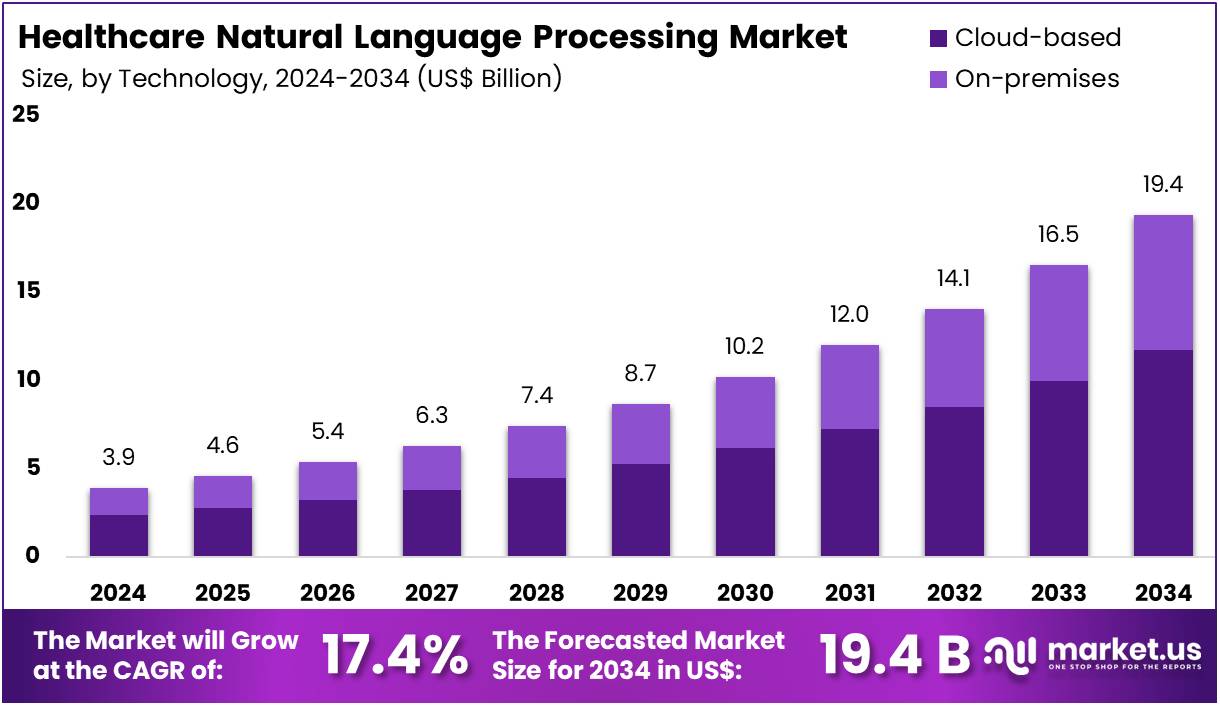
Key Takeaways
- In 2024, the healthcare natural language processing (NLP) market generated US$ 3.9 billion in revenue and is projected to reach US$ 19.4 billion by 2034, growing at a CAGR of 17.4% during the forecast period.
- Based on product type, the market is segmented into software, platforms, and services. The software segment dominated in 2024, accounting for the largest market share of 40.5%.
- By technology, the healthcare NLP market is categorized into cloud-based and on-premises solutions. The cloud-based segment held a significant market share of 60.5% in 2024.
- Based on application, the market is divided into clinical documentation, data mining, and patient interaction. The clinical documentation segment emerged as the leading application area, capturing the highest revenue share of 45.5%.
- By end user, the market is segmented into hospitals & clinics and pharmaceutical companies. The hospitals & clinics segment dominated the market, holding a revenue share of 55.3% in 2024.
- Regionally, North America accounted for the largest share of the healthcare NLP market in 2024, representing 41.8% of the global market.
Statistical Information
- EHR Adoption Increased More Than 10 Times Compared With Earlier Years: The growth of digital healthcare records has significantly expanded the amount of clinical information available for NLP applications. ONC reported that certified EHR adoption among U.S. hospitals increased from less than 10% in 2008 to more than 99% in 2024, creating a massive repository of structured and unstructured healthcare information.
- Clinical Documentation Burden Creates Demand for NLP Automation: Healthcare professionals spend significant time managing documentation tasks, increasing demand for NLP-powered solutions such as automated clinical notes, medical summarization, and speech-to-text systems. The AMIA 25×5 Task Force survey collected responses from 1,253 healthcare professionals across 49 U.S. states and Washington, D.C., and found that nearly 75% of respondents believed documentation burden affects patient care.
- Claim Denial Rates and NLP‑Enabled Reduction Potential: The American Academy of Family Physicians reports an average claim denial rate of 5–10% across healthcare. AI/NLP tools that extract documentation details and check medical necessity before submission are used to reduce these denials; some hospital case studies with broader AI report 15% denial-rate reduction in six months, illustrating potential revenue‑cycle impact when NLP is embedded in billing workflows.
- Adverse Drug Event Detection Performance Using NLP: An ADE detection accelerator using clinical NLP applied a Biomed/BioBERT model to 20,000 texts, of which 4,200 contained adverse drug events (ADEs). Performance evaluation used sensitivity and specificity against ground truth labels; this setup demonstrates that NLP can process tens of thousands of free‑text records and reliably separate ADE‑positive from ADE‑negative documents for pharmacovigilance.
- Consumer Use of AI Tools for Healthcare: A 2026 US survey found 59% of respondents used some AI tool in the last 30 days, yet only 36% used AI specifically for healthcare purposes. Additionally, 52% preferred government regulation of healthcare AI. These numeric shares quantify a significant gap between general AI familiarity and actual healthcare use, and strong demand for oversight.
- AI Scribes Quantified Documentation Time Reduction: A 2026 study of AI scribes found daily reductions of 13 minutes in EHR use (3% decrease) and 16 minutes in documentation time (10% decrease) per clinician. Clinicians using AI scribes for more than 50% of visits experienced twice the reduction in total EHR time and three times the reduction in documentation time, quantifying productivity benefits of NLP‑driven ambient documentation.
- NLP Error Detection in Speech‑Recognition Medical Notes: An AHRQ‑funded project found a 7.4% error rate in pre‑edited speech‑recognition clinical notes, falling to 0.4% after transcriptionist editing and 0.3% after physician review. NLP error‑detection models achieved F1 scores up to 81%, demonstrating strong capability to automatically flag documentation errors and improve note accuracy and patient safety.
- Overall F1 Performance of NLP ADE Error‑Detection Models: In the AHRQ speech‑recognition note study, the best NLP error‑detection model achieved an F1 score of 81%, a recurrent‑neural‑network model reached 77%, and a topic‑model classifier only 24%. These numbers quantify how modern NLP architectures substantially outperform simpler models in identifying problematic segments in dictated medical documents.
Regional Analysis
North America led the market by securing a market share of 41.8% in 2024.
North America remains a major hub for healthcare NLP adoption due to strong digital healthcare infrastructure, widespread EHR implementation, and increasing investment in artificial intelligence. According to the U.S. Office of the National Coordinator for Health Information Technology (ONC), more than 99% of U.S. acute care hospitals use certified EHR systems, creating a large data ecosystem for NLP-based clinical analytics. The U.S. FDA is also supporting responsible AI development through regulatory frameworks for AI-enabled healthcare technologies.
The NIH continues to fund artificial intelligence research, supporting innovations in clinical data analysis, precision medicine, and population health management. Asia Pacific is advancing healthcare NLP adoption through government-led digital health initiatives and expanding healthcare IT infrastructure. Australia invested US$107.2 million in digital health initiatives during 2022–23, supporting electronic health records and healthcare innovation. Countries across the region are focusing on AI-driven healthcare solutions, multilingual data processing, and improved access to digital healthcare services.
Emerging Trends
- Generative AI and Large Language Models: Generative AI is becoming a major trend in healthcare NLP by helping physicians summarize records, create clinical notes, and extract medical insights. An AMA survey found that 66% of physicians used AI tools in 2024, up from 38% in 2023, showing rapid adoption of AI-supported healthcare workflows
- AI-Powered Clinical Documentation Reduces Administrative Burden: Automated clinical documentation is emerging as one of the fastest-growing NLP applications. Healthcare AI tools can convert physician-patient conversations into structured notes, reducing manual workload. The AMA reported that 57% of physicians identified administrative automation as a major AI opportunity, highlighting strong demand for NLP documentation solutions.
- EHR-Based NLP Enables Better Clinical Decision Support: NLP integration with Electronic Health Records (EHRs) is expanding as hospitals seek better ways to analyze unstructured clinical information. A systematic review analyzed 261 healthcare NLP studies and included 127 research papers, identifying major applications such as clinical note analysis, medical entity recognition, text summarization, and decision support
- Multimodal NLP Combines Text, Images, and Clinical Data: Healthcare NLP is moving beyond text-only analysis toward multimodal AI systems that combine clinical notes, medical images, laboratory results, and patient records. Research shows that large-scale multimodal clinical datasets and transformer-based language models are improving healthcare text generation, summarization, and medical dialogue applications.
- AI-Based Patient Communication and Virtual Healthcare Assistants Expand: Conversational AI and NLP-based assistants are increasingly used for patient messaging, discharge instructions, and healthcare information support. Recent AMA data showed physicians are applying AI for multiple communication-related tasks, including 19% using AI for draft patient portal message responses and 30% for discharge instructions, care plans, or progress notes.
Use Cases
- Automated Clinical Documentation and Medical Note Generation: Healthcare NLP systems are increasingly used to generate structured clinical notes from physician conversations and medical records. AI-based documentation solutions use speech recognition and language models to create draft notes, helping clinicians save time and improve documentation quality. Studies highlight NLP and LLM-based systems for SOAP notes and clinical documentation automation.
- Disease Identification and Patient Risk Prediction: NLP tools analyze medical records to identify diseases, symptoms, medications, and risk factors from unstructured clinical text. Research has shown NLP models can extract social determinants of health from clinical notes. One study analyzed 225,089 patients and 430,406 clinical notes, demonstrating improved identification of health risk factors through NLP extraction.
- Clinical Trial Matching and Research Support: NLP is increasingly applied in clinical research to identify eligible patients for clinical trials by analyzing electronic medical records. AI systems can extract information such as diagnoses, previous treatments, and patient characteristics, helping researchers improve recruitment efficiency and reduce manual record review.
- Medical Literature Search and Knowledge Extraction: Healthcare NLP helps researchers analyze large volumes of biomedical publications, clinical guidelines, and research documents. The National Library of Medicine’s PubMed database contains more than 40 million biomedical citations, creating a significant opportunity for NLP-powered medical search, summarization, and knowledge discovery.
- Healthcare Coding, Billing, and Administrative Automation: NLP solutions are increasingly used for extracting diagnoses, procedures, and clinical information from physician notes to support coding workflows. AI-based documentation tools help reduce administrative workload, while AMA surveys show that 28% of physicians use AI for documentation of billing codes, medical charts, or visit notes.
Frequently Asked Questions on Healthcare Natural Language Processing
- What factors are driving the Healthcare NLP Market growth?
The Healthcare NLP market is driven by increasing healthcare data volumes, widespread EHR adoption, demand for automated clinical documentation, and growing AI integration. Healthcare organizations are using NLP solutions to improve workflow efficiency, reduce administrative burden, and enhance patient care quality. - Why are Electronic Health Records (EHRs) important for Healthcare NLP?
Electronic Health Records provide large volumes of digital healthcare information that NLP systems can analyze. Growing EHR adoption enables healthcare organizations to extract insights from unstructured clinical notes, improve reporting processes, and support better diagnosis and treatment decisions. - What are the major applications of Healthcare NLP?
Major Healthcare NLP applications include clinical documentation, medical coding, patient interaction, clinical trial matching, disease identification, research analysis, and decision support. These applications help healthcare organizations manage complex medical information and improve operational efficiency. - How is Generative AI influencing the Healthcare NLP Market?
Generative AI and large language models are transforming healthcare NLP by enabling automated summaries, conversational assistants, clinical note generation, and medical information extraction. These technologies help healthcare professionals analyze patient records faster and improve access to relevant clinical insights. - Which segment dominates the Healthcare NLP Market?
The software segment dominates the Healthcare NLP market due to increasing adoption of AI-powered platforms for clinical data analysis, documentation automation, and healthcare workflow optimization. Healthcare providers are investing in software solutions that integrate with existing EHR platforms. - Why is cloud-based NLP technology gaining popularity?
Cloud-based NLP solutions are gaining popularity because they provide scalable infrastructure, flexible deployment, and easier access to advanced AI capabilities. Healthcare organizations use cloud platforms to process large clinical datasets and implement NLP applications without significant hardware investments. - Why is North America leading the Healthcare NLP Market?
North America leads the Healthcare NLP market due to advanced healthcare infrastructure, high EHR adoption, strong artificial intelligence investments, and supportive regulatory frameworks. Hospitals and technology companies are actively implementing NLP solutions for improving documentation and healthcare data management.
Conclusion
The Healthcare Natural Language Processing (NLP) market is experiencing significant growth due to increasing healthcare data volumes, widespread EHR adoption, and rising demand for AI-driven clinical solutions. NLP technologies are helping healthcare organizations transform unstructured medical information into actionable insights, improving documentation, decision-making, and patient engagement.
Advancements in generative AI, large language models, and cloud-based platforms are further expanding applications across clinical workflows, research, and healthcare automation. With strong adoption in North America and growing digital health initiatives worldwide, Healthcare NLP is expected to play a critical role in improving efficiency, personalized care, and future healthcare delivery systems.
Discuss your needs with our analyst
Please share your requirements with more details so our analyst can check if they can solve your problem(s)




