


Overview
New York, NY – Aug 12, 2026 –The Global Home Healthcare Software Market size is expected to reach around US$ 155.71 Billion by 2034, up from US$ 11.47 Billion in 2024, growing at a CAGR of 29.8% during the forecast period from 2025 to 2034. North America held a dominant market position, capturing more than a 40.3% share and reaching a market value of US$4.62 billion.
The Global Home Healthcare Software Market is expanding rapidly as healthcare systems shift toward patient-centric, technology-enabled care models. Home healthcare software solutions support clinical documentation, electronic health records (EHR), billing, scheduling, telehealth, remote patient monitoring, and care coordination. These platforms help healthcare providers deliver efficient medical and personal care services while improving communication between patients, caregivers, and clinicians.
The market growth is strongly influenced by the rising elderly population and increasing chronic disease burden. According to the World Health Organization (WHO), 1 in 6 people globally will be aged 60 years or older by 2030, while the population aged 80 years and above is expected to nearly triple between 2020 and 2050. This demographic shift is increasing demand for digital solutions that enable safe and continuous care at home.
Growing healthcare expenditure is also supporting adoption. In the United States, national health spending reached $4.9 trillion in 2023, increasing by 7.5% compared with the previous year. Healthcare providers and payers are increasingly adopting home-based digital platforms to reduce hospital visits and improve cost efficiency.
Technological advancements, including cloud computing, artificial intelligence (AI), interoperability, and remote monitoring, are further accelerating market development. The U.S. telehealth adoption trend highlights this transformation, with telemedicine claims increasing from 0.2% in 2019 to 15.4% in 2020. Additionally, 80.5% of office-based physicians used telemedicine in 2021, demonstrating strong acceptance of virtual care models. These factors position home healthcare software as a key component of future healthcare delivery.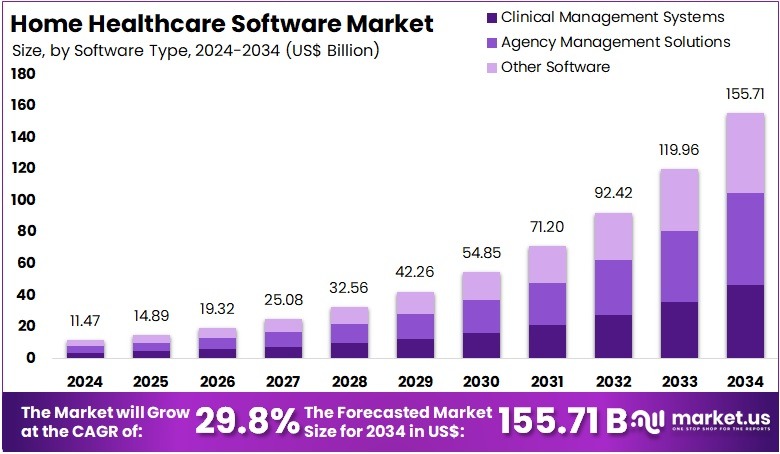
Key Takeaways
- The global Home Healthcare Software Market is projected to reach US$155.71 billion by 2034, expanding significantly from US$11.47 billion in 2024.
- Clinical Management Systems dominated the software type segment in 2024, capturing more than 37.5% of the total Home Healthcare Software Market share.
- Skilled Nursing Services held the leading position in the service segment in 2024, accounting for over 43.1% market share.
- Cloud-Based Solutions emerged as the preferred delivery model in 2024, securing more than 58.1% share of the Home Healthcare Software Market.
- Home Health Agencies represented the largest end-user segment in 2024, contributing over 61.0% market share.
- North America maintained its market leadership in 2024, holding more than 40.3% share and generating a market value of US$4.62 billion.
Statistical Information
- Aging Population Increasing Demand for Home-Based Care: The ageing population is becoming a major factor supporting home healthcare software adoption. According to the World Health Organization (WHO), by 2030, 1 in 6 people globally will be aged 60 years or older, increasing from 1 billion people in 2020 to 1.4 billion by 2030. By 2050, the global population aged 60+ is expected to reach 2.1 billion. This demographic shift is increasing demand for digital platforms that support elderly care, remote monitoring, medication management, and home-based clinical services.
- Rising Telehealth Usage Supporting Home Healthcare Software Growth: Consumer and provider acceptance of virtual care has increased significantly, strengthening demand for telehealth-enabled home healthcare software. According to the CDC National Center for Health Statistics, the percentage of U.S. office-based physicians using telemedicine increased from 16.0% in 2019 to 80.5% in 2021.Another CDC analysis found telemedicine technology usage among office-based physicians increased from 15.4% in 2019 to 85.9% in 2021, showing rapid integration of virtual care into routine healthcare delivery.
- Increasing Healthcare Cybersecurity Requirements: As home healthcare software manages sensitive patient information, cybersecurity has become a critical adoption factor. The U.S. Department of Health and Human Services (HHS) reported that large healthcare data breaches increased by 102% between 2018 and 2023, while individuals affected by these breaches increased by 1,002% during the same period. In 2023, more than 167 million individuals were affected by large healthcare breaches.
- Telehealth Adoption Accelerating Home Healthcare Software Usage: Telehealth expansion has significantly increased demand for software supporting virtual visits, remote monitoring, and digital communication. According to the CDC National Center for Health Statistics, telemedicine use among U.S. office-based physicians increased from 15.4% in 2019 to 85.9% in 2021. In 2021, telemedicine adoption reached 91.4% among primary care physicians, 87.2% among medical specialists, and 74.8% among surgical specialists. These trends demonstrate growing acceptance of digital healthcare delivery models.
- Increasing Healthcare Spending Encouraging Cost-Efficient Home Care Models: Rising healthcare expenditure is encouraging providers and payers to adopt home healthcare software to improve efficiency and reduce avoidable hospital utilization. According to the U.S. Centres for Medicare & Medicaid Services (CMS), U.S. national healthcare expenditure reached approximately $4.9 trillion in 2023, representing around 17.6% of GDP. Medicare spending increased to approximately $1.03 trillion in 2023, while Medicaid spending reached about $871 billion, increasing pressure on healthcare systems to adopt lower-cost digital care delivery models.
- Broadband Expansion Improving Telehealth Accessibility: Reliable internet connectivity is enabling cloud-based home healthcare software and virtual care. According to the World Bank, global fixed broadband subscriptions increased to approximately 20.7 subscriptions per 100 people in 2024, while mobile cellular subscriptions exceeded 110 subscriptions per 100 people globally. Better connectivity supports video consultations, remote monitoring, and cloud documentation.
- Medicare Home Health Spending Demonstrates Strong Demand: The growing number of Medicare beneficiaries receiving home healthcare services is driving demand for digital software solutions. According to the Centers for Medicare & Medicaid Services (CMS), Medicare spending reached $1.03 trillion in 2023, increasing 8.1% from 2022 and accounting for 21% of total U.S. healthcare spending.
- Healthcare Cyberattacks Continue to Rise: According to the U.S. Department of Health and Human Services (HHS), the number of individuals affected by major healthcare data breaches increased from approximately 16.6 million in 2018 to more than 167 million in 2023, representing an increase of over 900%. This trend is accelerating investment in secure home healthcare software platforms.
Regional Analysis
North America maintained regional leadership in 2024, with a market share exceeding 40.3%
North America dominated the Home Healthcare Software Market in 2024, accounting for over 40.3% of global revenue. The region’s leadership is supported by high healthcare spending, widespread digital health adoption, and a well-established home healthcare infrastructure. According to the Centers for Medicare & Medicaid Services (CMS), U.S. national health expenditure reached US$4.9 trillion in 2023, while spending on home health care services increased to US$147.8 billion, up 10.8% from the previous year.
The Centers for Disease Control and Prevention (CDC) reports that chronic diseases affect 6 in 10 U.S. adults, increasing demand for remote patient monitoring and home-based care solutions. Additionally, the Office of the National Coordinator for Health Information Technology (ONC) states that 96% of non-federal acute care hospitals have adopted certified electronic health records, supporting interoperability and digital care coordination.
In Canada, the Canadian Institute for Health Information (CIHI) projects total healthcare spending to reach C$372 billion in 2024, reflecting continued investment in digital health infrastructure. Favorable government policies, an aging population, and expanding telehealth services continue to strengthen North America’s leadership in the home healthcare software market.
Emerging Trends
- AI-powered remote patient monitoring is becoming mainstream: AI helps detect early health changes using wearable devices and connected sensors. According to the U.S. FDA, it has authorized more than 1,000 AI/ML-enabled medical devices, supporting wider adoption of intelligent home healthcare solutions.
- Cloud-based telehealth platforms continue to expand: The U.S. Department of Health and Human Services (HHS) reports that 95% of HRSA-funded health centers used telehealth for primary care in 2024, while 25% of Medicare fee-for-service beneficiaries received at least one telehealth service in 2024, encouraging cloud software adoption.
- Interoperability is becoming a standard feature: The Office of the National Coordinator for Health IT (ONC) reports that 96% of U.S. non-federal acute care hospitals use certified EHR technology, increasing demand for software capable of securely sharing patient information across healthcare providers.
- Quality reporting is driving software modernization: According to CMS, 11,474 Medicare-certified home health agencies were serving approximately 3 million Medicare beneficiaries in 2021. Agencies increasingly rely on digital platforms for OASIS reporting, documentation, and reimbursement compliance.
- Virtual care is becoming a permanent healthcare model: HHS reports Medicare telehealth visits increased 63-fold during 2020, demonstrating long-term demand for integrated home healthcare software with scheduling, video consultation, and remote monitoring capabilities.
Use Cases
- Chronic disease management at home: Home healthcare software enables clinicians to monitor patients with diabetes, heart disease, COPD, and hypertension remotely through connected devices. The WHO reports that noncommunicable diseases cause 41 million deaths annually, representing 74% of all global deaths, making continuous monitoring increasingly important.
- Care coordination for elderly patients: Digital platforms help caregivers manage medications, appointments, and personalized care plans for older adults. According to the WHO, the global population aged 60 years and older will reach 2.1 billion by 2050, while those aged 80 years and above will reach 426 million.
- Home health agency workflow management: Agencies use software to automate scheduling, billing, compliance, and clinical documentation. CMS reports approximately 3 million Medicare beneficiaries received home healthcare services through 11,474 Medicare-certified agencies, highlighting the need for efficient digital operations.
- Remote telehealth consultations: Software allows physicians to provide follow-up care without requiring patients to travel. According to HHS, more than 20% of U.S. adults reported having a telehealth visit during July 2022, showing strong patient acceptance of virtual healthcare.
- Digital documentation and reimbursement management: Home healthcare software supports electronic records, claims processing, and quality reporting. CMS continues to require standardized digital OASIS reporting for Medicare-certified agencies, improving reimbursement accuracy and patient care documentation while supporting millions of home healthcare visits annually.
Frequently Asked Questions on Home Healthcare Software
- Which software segment dominates the Home Healthcare Software Market?
Clinical Management Systems lead the market because they simplify patient record management, care planning, medication tracking, documentation, and compliance reporting. These solutions improve workflow efficiency and enable healthcare professionals to deliver better coordinated home-based care. - Who are the major end users of home healthcare software?
Home health agencies are the primary end users because they manage skilled nursing, rehabilitation, chronic disease management, and personal care services. Software helps these organizations automate scheduling, billing, clinical documentation, caregiver coordination, and regulatory reporting. - How does home healthcare software improve patient care?
It enables healthcare professionals to monitor patients remotely, maintain accurate electronic records, schedule timely visits, track medications, and communicate effectively with caregivers. These features improve treatment continuity, reduce administrative errors, and enhance patient satisfaction. - Why does North America dominate the Home Healthcare Software Market?
North America leads due to its advanced healthcare infrastructure, high healthcare spending, strong telehealth adoption, widespread electronic health record implementation, and supportive government regulations that encourage digital healthcare innovation and interoperability. - How is artificial intelligence used in home healthcare software?
Artificial intelligence supports predictive analytics, automated documentation, remote patient monitoring, clinical decision support, and early health risk detection. These capabilities improve workflow efficiency while enabling healthcare providers to deliver more personalized and proactive patient care. - What challenges does the Home Healthcare Software Market face?
Key challenges include cybersecurity threats, patient data privacy concerns, interoperability issues, implementation costs, workforce training requirements, and compliance with evolving healthcare regulations. Vendors continue investing in secure and interoperable software solutions to address these barriers. - What is the future outlook for the Home Healthcare Software Market?
The market is expected to grow steadily due to increasing demand for home-based care, expanding telehealth services, aging populations, AI-driven innovations, cloud adoption, and continued investments in digital healthcare infrastructure across developed healthcare systems.
Conclusion
The Home Healthcare Software Market is experiencing strong growth as healthcare providers increasingly adopt digital solutions to improve patient care, operational efficiency, and regulatory compliance. Rising demand for home-based healthcare, an aging population, growing chronic disease prevalence, and expanding telehealth services continue to support market expansion.
Cloud-based platforms, artificial intelligence, remote patient monitoring, and interoperable electronic health records are transforming home healthcare delivery. Government initiatives promoting digital health and secure data exchange further strengthen adoption. As healthcare systems focus on cost-effective, patient-centered care, home healthcare software is expected to play an increasingly important role in improving clinical outcomes and healthcare accessibility worldwide.
Discuss your needs with our analyst
Please share your requirements with more details so our analyst can check if they can solve your problem(s)




