


Overview
New York, NY – Sep 10, 2026 –The Global Mortuary Bags Market size is expected to be worth around US$ 2.97 Billion by 2034 from US$ 1.58 Billion in 2024, growing at a CAGR of 6.5% during the forecast period 2025 to 2034. In 2024, North America led the market, achieving over 38.5% share with a revenue of US$ 608.3 Million.
Mortuary bags are expanding due to increasing mortality rates, rising hospital admissions, growing forensic investigations, and the need for efficient disaster management infrastructure. Mortuary bags are essential medical and emergency-use products designed for safe transportation, storage, and handling of deceased individuals while reducing the risk of biological contamination. Demand is increasing across hospitals, morgues, forensic laboratories, military organizations, disaster response units, and funeral service providers.
According to the World Health Organization (WHO), approximately 60 million people die globally each year, creating continuous demand for safe and standardized mortuary handling solutions. WHO data indicates that noncommunicable diseases cause around 41 million deaths annually, accounting for nearly 74% of all deaths worldwide, while infectious diseases and injuries continue to contribute significantly to mortality management requirements.
The increasing burden of chronic diseases, aging populations, and emergency healthcare needs is encouraging hospitals to improve mortuary infrastructure. The United Nations (UN) estimates that the global population aged 65 years and above will reach approximately 1.6 billion by 2050, compared with about 761 million people in 2021, which is expected to increase healthcare and end-of-life service requirements.
The COVID-19 pandemic further highlighted the importance of reliable mortuary supplies. During peak outbreaks, several countries experienced significant pressure on hospital morgue capacities and required large-scale procurement of body bags and related equipment. This increased awareness among governments and healthcare institutions regarding emergency preparedness.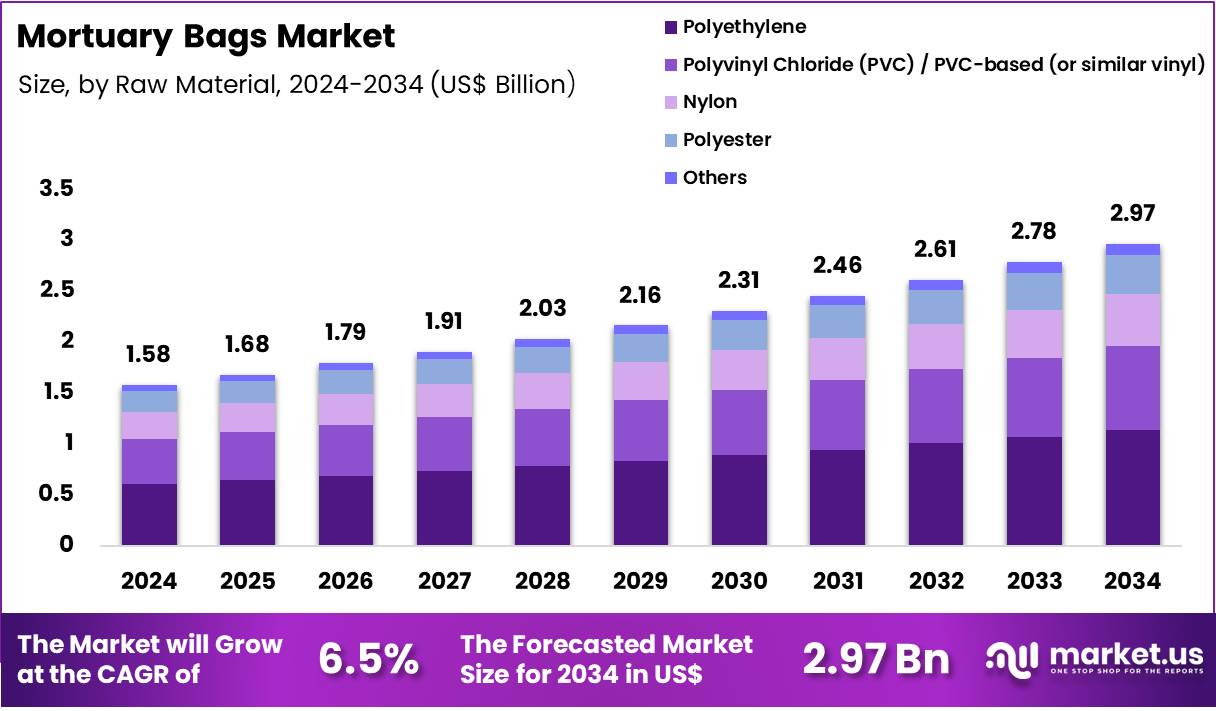
Key Takeaways
- In 2024, the global mortuary bags market generated revenue of US$ 1.58 billion and is projected to grow at a CAGR of 6.5%, reaching approximately US$ 2.97 billion by 2034.
- Based on raw material, the market is segmented into Polyethylene, Polyvinyl Chloride (PVC)/PVC-based materials, Nylon, Polyester, and Others. The Polyethylene segment dominated in 2024, accounting for a 38.5% market share due to its durability, lightweight nature, and cost-effectiveness.
- Based on size, the market is categorized into Adult Bags, Child/Infant Bags, and Heavy Duty & Bariatric Bags. The Adult Bags segment held the leading position in 2024, capturing a 48.7% market share due to higher demand from hospitals and healthcare facilities.
- Based on end-user, the market is segmented into Hospitals and Medical Facilities, Morgues, Funeral Homes, and Others. The Hospitals and Medical Facilities segment led the market in 2024, representing a 38.8% market share driven by increasing requirements for safe body handling and infection control.
- North America dominated the global mortuary bags market in 2024, accounting for a 38.5% market share, supported by advanced healthcare infrastructure, higher adoption of medical safety products, and well-established emergency response systems.
Statistical Information
- Global Death Burden Creates Continuous Demand for Mortuary Bags: The increasing number of deaths worldwide supports the need for safe body transportation and storage solutions. The World Health Organization (WHO) reports that 41 million people die annually from noncommunicable diseases (NCDs), representing approximately 71% of all global deaths. These deaths require organized hospital, morgue, and funeral management systems.
- Cardiovascular Disease Mortality Supports Adult Mortuary Bag Demand: Cardiovascular diseases remain the largest contributor to global mortality. WHO reports that cardiovascular diseases cause approximately 17.9 million deaths every year, followed by cancer with 9.3 million deaths, chronic respiratory diseases with 4.1 million deaths, and diabetes-related deaths of around 2 million annually.
- U.S. Mortality Volume Supports Hospital and Medical Facility Demand: The United States recorded approximately 3,072,666 deaths in 2024, creating continuous demand for hospital mortuary equipment, body transportation products, and forensic handling supplies. Hospitals, medical examiner offices, and funeral service providers require reliable mortuary solutions to manage daily mortality volumes.
- Aging Population Increases Long-Term Demand for Mortuary Services: The global elderly population is expanding rapidly, increasing healthcare utilization and end-of-life service requirements. According to United Nations demographic data, the number of people aged 65 years and older exceeded 760 million globally in 2021 and continues to rise due to longer life expectancy and demographic shifts.
- Obesity Growth Supports Heavy-Duty and Bariatric Mortuary Bag Requirements: The increasing prevalence of obesity is creating demand for higher-capacity healthcare handling products, including bariatric mortuary bags. WHO reports that in 2022, more than 2.5 billion adults were overweight, including 890 million adults living with obesity. Approximately 16% of adults globally were obese.
- Increasing Chronic Disease Cases Drive Long-Term Mortuary Demand: Chronic diseases are responsible for a majority of global deaths. WHO estimates that NCDs cause 15 million premature deaths among people aged 30–69 years annually, increasing the need for healthcare infrastructure, including mortuary management services.
- Global Life Expectancy Growth Increasing Demand for End-of-Life Services: Increasing life expectancy is contributing to a larger elderly population and higher demand for healthcare and end-of-life services. According to WHO, global life expectancy reached approximately 73.4 years in 2019, increasing from 66.8 years in 2000, reflecting long-term demographic changes affecting healthcare systems and mortuary service requirements.
- Noncommunicable Diseases Account for Majority of Global Deaths: Chronic diseases continue to represent the largest share of global mortality. WHO reports that noncommunicable diseases cause around 41 million deaths every year, including approximately 17.9 million cardiovascular disease deaths, 9.3 million cancer deaths, 4.1 million respiratory disease deaths, and 2.0 million diabetes-related deaths.
- Aging Population in North America Supports Mortuary Service Demand: North America has a rapidly aging population requiring expanded healthcare and end-of-life services. The U.S. Census Bureau estimates that the number of Americans aged 65 years and older reached approximately 55.8 million in 2020, representing around 16.8% of the U.S. population.
Regional Analysis
North America led the market by securing a market share of 38.5% in 2024.
North America dominates the mortuary bags market due to its advanced healthcare infrastructure, established forensic systems, and strong emergency preparedness programs. The U.S. maintains national emergency supply mechanisms, including the Strategic National Stockpile (SNS), which stores medical supplies and equipment to support public health emergencies. High hospital capacity, increasing elderly population, and demand from medical examiner offices and funeral service providers support regional growth.
Disaster events such as hurricanes, wildfires, and severe weather emergencies further increase the need for reliable human remains management solutions. Asia Pacific is projected to experience significant growth due to expanding healthcare facilities, rising disaster preparedness investments, and increasing mortality management requirements.
According to UNDRR, the Asia-Pacific region recorded 2 million disaster-related deaths since 1970, accounting for 59% of global disaster fatalities, highlighting the need for effective emergency response systems. Growing urbanization, infectious disease risks, and government-led disaster management programs are increasing demand for durable and cost-effective mortuary bags across the region.
Emerging Trends
- Increasing Adoption of Disaster-Ready Mortuary Bags: Governments and emergency agencies are improving mass fatality preparedness due to natural disasters, pandemics, and accidents. WHO recommends organized dead-body management systems after disasters, including proper identification, transportation, and storage procedures. Disaster response planning is increasing demand for durable and leak-resistant mortuary bags. WHO reported that its disaster management guidance supports first responders handling human remains during major emergencies.
- Growth of Heavy-Duty and Bariatric Mortuary Bag Solutions: Healthcare facilities are adopting stronger mortuary bags with higher weight capacity due to rising obesity rates and changing patient demographics. WHO reports that more than 1 billion people worldwide live with obesity, including approximately 890 million adults, creating demand for reinforced healthcare handling equipment. Heavy-duty bags with improved strength and durability are becoming more important.
- Rising Focus on Infection-Controlled Body Handling Products: Hospitals are increasing use of sealed and protective mortuary bags to reduce exposure risks for healthcare workers handling human remains. WHO highlights that workers handling deceased individuals may face risks from bloodborne viruses, tuberculosis, and other infections in specific situations. This is driving demand for leak-proof and protective designs.
- Expansion of Emergency Stockpiling Programs: Public health agencies are strengthening emergency inventories after lessons from COVID-19 and other health crises. The United States recorded approximately 3.07 million deaths in 2024, creating continuous requirements for hospital, forensic, and emergency response supplies. Government preparedness programs are increasing attention toward mortality management resources.
- Increasing Use of Sustainable Materials in Mortuary Products: Healthcare organizations are exploring environmentally responsible alternatives for disposable medical products. Manufacturers are developing mortuary bags using improved polymer materials and biodegradable options while maintaining protection against leakage and contamination. Government healthcare sustainability programs are encouraging reduction of medical waste and improved material management practices.
Use Cases
- Hospital and Medical Facility Applications: Hospitals remain one of the largest users of mortuary bags due to daily patient mortality management. In the United States, CDC reported 3,072,666 deaths in 2024, with leading causes including heart disease (683,491 deaths) and cancer (619,876 deaths), supporting continuous demand for hospital-based deceased handling solutions.
- Disaster and Mass Fatality Management: Mortuary bags are increasingly used during hurricanes, earthquakes, floods, and other emergencies where rapid human remains management is required. WHO recommends standardized procedures for collection, identification, and transportation of bodies after disasters to support forensic investigations and respectful handling.
- Forensic and Medical Examiner Operations: Forensic laboratories and medical examiner offices use specialized mortuary bags during investigations, autopsies, and identification processes. WHO emphasizes maintaining identification records, body tracking, and documentation during disaster-related fatalities, increasing demand for reliable storage and transportation products.
- Infectious Disease Outbreak Response: Mortuary bags are used during infectious disease outbreaks where additional precautions are required for deceased body management. WHO notes that deaths from diseases such as Ebola, Lassa fever, and cholera may require specialized handling procedures to reduce transmission risks among workers and communities.
- Military and Emergency Response Applications: Military organizations, emergency medical teams, and disaster response units require portable and durable mortuary bags for field operations. WHO disaster guidance highlights the importance of trained responders and appropriate equipment for managing human remains before forensic teams arrive.
Frequently Asked Questions on Mortuary Bag
- Why is the demand for mortuary bags increasing?
Demand for mortuary bags is increasing due to rising global mortality rates, aging populations, healthcare expansion, and growing disaster preparedness requirements. Hospitals and emergency agencies require reliable body handling solutions to maintain hygiene standards and improve operational readiness during critical situations. - What materials are commonly used in mortuary bags?
Mortuary bags are commonly manufactured using materials such as polyethylene, PVC, nylon, and polyester. Polyethylene is widely preferred because it provides durability, moisture resistance, flexibility, and cost-effectiveness, making it suitable for hospitals, forensic facilities, and emergency response applications. - Why are hospitals major users of mortuary bags?
Hospitals are major users because they manage daily patient deaths across emergency departments, intensive care units, and specialized treatment centers. Mortuary bags help hospitals maintain infection control practices, ensure safe transportation, and comply with healthcare safety procedures during deceased handling. - How did COVID-19 impact the mortuary bags market?
COVID-19 increased awareness about the importance of safe deceased body management. Healthcare facilities experienced higher mortality pressures and required additional supplies, including leak-proof and durable mortuary bags, to support infection prevention measures and emergency response activities. - Why are heavy-duty mortuary bags gaining popularity?
Heavy-duty mortuary bags are gaining popularity due to increasing requirements for bariatric patient handling and disaster situations. These bags offer enhanced strength, reinforced handles, and higher weight capacities, making them suitable for hospitals, emergency teams, and forensic operations. - Which region dominates the mortuary bags market?
North America leads the mortuary bags market due to advanced healthcare infrastructure, established forensic systems, and strong emergency preparedness programs. The region benefits from extensive hospital networks, government disaster planning, and demand from medical examiner offices and funeral service providers. - What factors are driving the growth of the mortuary bags market?
Major growth factors include increasing mortality rates, rising healthcare infrastructure investments, disaster preparedness initiatives, infectious disease concerns, and growing demand for hygienic deceased handling solutions. Hospitals and government agencies are improving preparedness with advanced storage and transportation equipment. - What are the emerging trends in the mortuary bags market?
Emerging trends include biodegradable materials, antimicrobial coatings, improved leak-proof designs, and heavy-duty product development. Manufacturers are focusing on sustainability, durability, and enhanced safety features to meet changing requirements from hospitals, emergency organizations, and forensic institutions.
Conclusion
The global mortuary bags market is expected to experience steady growth due to increasing mortality rates, expanding healthcare infrastructure, rising disaster preparedness activities, and growing focus on safe deceased body management. Hospitals, forensic facilities, funeral homes, and emergency response organizations are adopting advanced mortuary bags with improved durability, leak protection, and infection-control features.
Demand for adult, heavy-duty, and sustainable mortuary bag solutions is increasing due to changing healthcare needs and environmental considerations. North America continues to lead due to strong healthcare systems, while emerging regions are improving preparedness capabilities. Technological advancements and government safety initiatives will continue shaping market development.
Discuss your needs with our analyst
Please share your requirements with more details so our analyst can check if they can solve your problem(s)




