


Overview
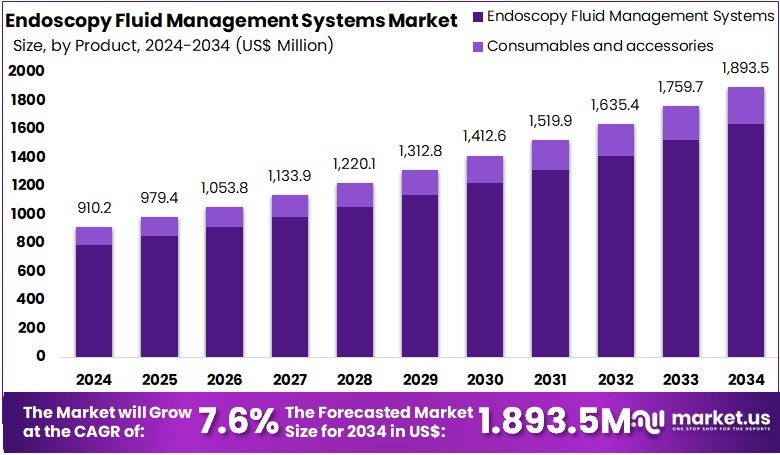
New York, NY – Sep 02, 2026 – The Global Endoscopy Fluid Management Systems Market size is expected to be worth around US$ 1893.5 Million by 2034, from US$ 910.2 Million in 2024, growing at a CAGR of 7.6% during the forecast period from 2025 to 2034. North America held a dominant market position, capturing more than a 38.7% share and holding US$ 352.2 Million market value for the year.
Endoscopy fluid management systems are used to maintain clear visualization during procedures by controlling irrigation, suction, and fluid pressure. Globally, more than 20 million gastrointestinal endoscopy procedures are performed annually in the United States alone, highlighting the increasing demand for efficient endoscopic support systems. The rising incidence of gastrointestinal disorders, including colorectal cancer and inflammatory bowel diseases, is further driving procedural volumes.
The aging population is another major growth factor, with the global population aged 65 years and above expected to reach around 1.6 billion by 2050, increasing the need for diagnostic and therapeutic endoscopy procedures. Hospitals, ambulatory surgical centers, and specialty clinics are adopting advanced fluid management solutions to improve procedural accuracy, reduce complications, and enhance workflow efficiency.
North America accounted for a leading market share in 2024, supported by advanced healthcare infrastructure, high adoption of minimally invasive surgery, and the strong presence of medical device manufacturers. The region benefits from approximately 35%–40% of global healthcare expenditure, enabling faster adoption of advanced surgical technologies.
Major companies are investing in product innovation, automated systems, and integrated endoscopy solutions. Increasing healthcare investments, expanding endoscopic procedure volumes, and technological advancements are expected to create significant opportunities for the Endoscopy Fluid Management Systems Market through 2034.
Key Takeaways
- The Endoscopy Fluid Management Systems Market is projected to reach approximately US$ 1,893.5 million by 2034, increasing from US$ 910.2 million in 2024 at a steady CAGR of 7.6% during the forecast period.
- Endoscopy fluid management systems dominated the product segment in 2024, accounting for more than 86.4% of the market share, driven by their extensive use in diagnostic and therapeutic endoscopic procedures.
- Laparoscopy held the leading position in the application segment in 2024, capturing over 38.0% share, supported by increasing adoption of minimally invasive surgical procedures.
- Hospitals represented the largest end-user segment in 2024, contributing more than 49.1% of the market share, due to high procedure volumes, advanced medical infrastructure, and growing demand for endoscopic treatments.
- North America led the global Endoscopy Fluid Management Systems Market in 2024, accounting for over 38.7% revenue share and generating approximately US$ 352.2 million, supported by advanced healthcare systems, strong technology adoption, and rising minimally invasive procedure volumes.
Market Segmentation
- Product Analysis: Endoscopy Fluid Management Systems dominated the product segment with an 86.4% share in 2024, driven by rising minimally invasive procedures, advanced pressure-control technologies, improved visualization, and growing adoption across gastrointestinal, urology, orthopedic, and gynecology applications in hospitals and specialty centers.
- Application Analysis: Laparoscopy led the application segment with a 38.0% share in 2024 due to increasing minimally invasive surgeries and demand for better visualization. Growth was supported by hysteroscopy, arthroscopy, gastroenterology, and other procedures requiring precise fluid management and improved surgical efficiency.
- End-User Analysis: Hospitals dominated the end-user segment with a 49.1% share in 2024, supported by high surgical volumes, advanced infrastructure, and increasing adoption of minimally invasive treatments. Specialty clinics, ambulatory centers, and diagnostic facilities also contributed through expanding outpatient procedures and equipment upgrades.
Statistical Information
- A 2026 endoscope reprocessing system using ozonated water jets achieved a 4-log reduction (99.99%) in bacterial load on contaminated endoscopes and post-disinfection water samples.
- The 2026 ozonated water jet endoscope reprocessing system completed a disinfection cycle in 15 minutes, reducing processing time compared with conventional endoscope reprocessing approaches.
- The same 2026 reprocessing technology used 8 liters of water per cycle through water recirculation and re-ozonation, demonstrating reduced water consumption during endoscope cleaning operations.
- A 2025 study evaluating an endoscopy cleaning workflow reported that removing a final rinse step reduced water usage by 25 liters per endoscope and generated estimated annual water savings of 725,000 liters.
- The same 2025 endoscopy cleaning study reduced manual cleaning time from 13 minutes 10.2 seconds to 11 minutes 10.7 seconds per endoscope, representing a 15% reduction in technician cleaning time.
- The 2025 workflow improvement study calculated that the reduction in manual cleaning time saved approximately 962.9 technician hours annually in endoscope processing operations.
- A 2025 clinical efficiency study in an endoscopy unit reduced average standard turnover time from 18.51 minutes to 14.25 minutes, improving room workflow performance.
- The same 2025 endoscopy workflow intervention increased the proportion of cases achieving turnover times below 15 minutes from 41.79% to 58.90%.
Regional Analysis
North America maintained a leading position in the Endoscopy Fluid Management Systems Market in 2024, supported by strong healthcare infrastructure and increasing adoption of minimally invasive procedures.
Hospitals, ambulatory surgical centers, and specialty clinics are increasingly integrating advanced fluid management platforms to improve procedural control, efficiency, and safety. Rising gastrointestinal, urological, and diagnostic endoscopy volumes encouraged healthcare providers to adopt automated systems with enhanced pressure regulation and workflow support.
The region benefited from established reimbursement frameworks, skilled medical professionals, and continuous investment in advanced endoscopic technologies. Growing demand for precise visualization, reduced procedural complications, and improved patient outcomes further accelerated adoption.
Additionally, technology upgrades and integration with modern imaging platforms strengthened system utilization across clinical settings. These factors collectively supported North America’s continued leadership in endoscopy fluid management system adoption.
Business opportunities
The Endoscopy Fluid Management Systems Market presents significant business opportunities due to the increasing adoption of minimally invasive procedures and the growing need for advanced solutions that improve procedural accuracy, safety, and workflow efficiency. Healthcare providers are investing in automated fluid management platforms that offer precise pressure control, continuous monitoring, and improved visualization during endoscopic interventions.
A major opportunity exists in developing integrated smart fluid management systems that combine automated irrigation, suction control, real-time pressure monitoring, and connectivity with endoscopy imaging platforms. Hospitals and ambulatory surgical centers are seeking technologies that reduce manual intervention, improve operational efficiency, and support consistent clinical outcomes.
The expansion of outpatient and ambulatory surgical centers creates additional growth potential, as these facilities require compact, efficient, and easy-to-use systems to manage increasing procedure volumes. Companies offering cost-effective and scalable solutions can benefit from rising demand in these settings.
Emerging markets also provide attractive opportunities as healthcare infrastructure improves and access to advanced diagnostic and therapeutic endoscopy procedures expands. Local partnerships, training programs, and affordable product offerings can help manufacturers strengthen their presence in developing regions.
Furthermore, collaboration with hospitals, research institutions, and endoscopy device manufacturers can accelerate product development. Companies focusing on artificial intelligence integration, workflow automation, and data-driven monitoring capabilities are positioned to capture future opportunities in the evolving endoscopy ecosystem.
Emerging Trends
- Automated Fluid Control and Smart Monitoring Integration: Endoscopy fluid management systems are increasingly adopting automated pressure regulation and monitoring features. Modern platforms focus on maintaining stable irrigation flow during procedures. FDA-cleared automated endoscope reprocessing systems require validated performance data, including microbial reduction testing of 99.9999% for certain applications.
- Focus on Infection Prevention and Reprocessing Safety: Healthcare facilities are prioritizing advanced fluid handling solutions to improve infection control. FDA guidelines highlight automated endoscope reprocessors as important systems for reusable device safety. Validation processes evaluate cleaning effectiveness, with some systems tested against highly resistant microorganisms requiring 6-log reduction performance.
- Water and Resource Optimization in Endoscopy Workflows: Sustainability is becoming an important trend as hospitals evaluate water consumption during endoscopy operations. Newer fluid management approaches aim to reduce unnecessary water usage while maintaining cleaning performance. Studies in endoscopy workflows reported savings of 25 liters per endoscope through process optimization.
- Integration With Advanced Endoscopic Procedures: Fluid management systems are expanding beyond basic irrigation support into complex therapeutic procedures. Endoscopy units are using controlled irrigation and suction technologies for improved visualization. Clinical recommendations emphasize sterile water use for procedures involving mucosal penetration, including advanced interventions such as EUS and POEM.
- Increased Adoption of Automated Reprocessing Technologies: Hospitals are moving toward automated systems that standardize cleaning and fluid delivery processes. FDA classifies automated endoscope cleaning systems as Class II medical devices, requiring regulatory review through the 510(k) pathway and validated processing instructions.
Use Cases
- Gastrointestinal Diagnostic and Therapeutic Endoscopy: Fluid management systems are widely used during gastrointestinal procedures such as colonoscopy and upper GI endoscopy. Controlled irrigation improves visualization and procedural efficiency. Healthcare guidelines recommend replacing or disinfecting endoscopy water bottles at least once daily to maintain safety standards.
- Urological Endoscopic Procedures: Endoscopy fluid management platforms support urological interventions by controlling irrigation pressure and maintaining visibility. In laboratory evaluations of irrigation systems, flow performance was tested across multiple settings ranging from 100 mL/min to 300 mL/min, helping optimize fluid delivery.
- Ambulatory Surgical Center Workflow Improvement: Outpatient centers use automated fluid management solutions to handle increasing procedure volumes while maintaining standardized workflows. Automated systems help reduce manual variation by controlling fluid delivery, suction, and pressure parameters across multiple procedures performed daily.
- Infection Control and Endoscope Reprocessing Applications: Fluid management technologies are applied in automated cleaning and reprocessing workflows to reduce contamination risks. FDA guidance states that reusable endoscope processing requires validated cleaning and disinfection procedures, with manufacturers required to provide supporting validation data for applicable devices.
- Advanced Therapeutic Endoscopy Support: Complex procedures such as endoscopic submucosal dissection and ultrasound-guided interventions require precise irrigation management. New synchronized irrigation systems are being evaluated for clinical applications, including successful use in 1 reported clinical procedure involving ulcerative colitis-associated neoplasia.
Recent development
- In February 2025, CONMED launched HydroSeal™, a silicone cannula technology designed to improve fluid management during shoulder arthroscopy procedures by reducing fluid leakage and maintaining a clearer surgical workspace.
- In February 2025, Stryker completed the acquisition of Inari Medical, expanding its minimally invasive intervention portfolio and strengthening capabilities in advanced procedural technologies used across hospital environments.
- In April 2025, KARL STORZ acquired intellectual property and talent from Diaspective Vision to strengthen its digital surgery and imaging capabilities, supporting future development of integrated surgical visualization solutions.
Frequently Asked Questions on Endoscopy Fluid Management Systems
- How do Endoscopy Fluid Management Systems improve clinical procedures?
These systems improve procedures by providing controlled fluid delivery and efficient removal of fluids during endoscopy. Stable pressure management enhances visibility, supports precise instrument movement, and helps clinicians perform complex gastrointestinal, urological, and surgical procedures more effectively. - What factors are driving the growth of the Endoscopy Fluid Management Systems Market?
The market growth is driven by increasing minimally invasive procedures, rising endoscopy volumes, demand for better visualization, and adoption of automated technologies. Healthcare providers are investing in advanced systems that improve workflow efficiency, patient safety, and procedural consistency. - Which procedures use Endoscopy Fluid Management Systems?
Endoscopy Fluid Management Systems are used in gastrointestinal endoscopy, arthroscopy, urology, gynecology, and other minimally invasive procedures. These systems support irrigation and suction requirements during diagnostic and therapeutic interventions where controlled fluid management is essential. - What are the key benefits of automated Endoscopy Fluid Management Systems?
Automated systems provide precise fluid control, consistent pressure regulation, reduced manual intervention, and improved workflow efficiency. They help clinicians maintain optimal procedural conditions while minimizing risks associated with excessive fluid pressure or inadequate visualization during endoscopic procedures. - How is technology influencing the Endoscopy Fluid Management Systems Market?
Technological advancements are introducing smart monitoring, automated pressure adjustment, digital connectivity, and integration with imaging platforms. These innovations help healthcare facilities improve procedural control, enhance clinical outcomes, and support efficient management of increasing endoscopic procedure volumes. - Who are the major companies operating in the Endoscopy Fluid Management Systems Market?
Key companies include Arthrex Inc., B. Braun Melsungen AG, STERIS plc, Stryker Corporation, CONMED Corporation, KARL STORZ SE & Co. KG, Medtronic Plc, Olympus Corporation, Richard Wolf GmbH, and Smith & Nephew Plc. - What is the future outlook for Endoscopy Fluid Management Systems?
The future outlook is influenced by increasing minimally invasive procedures, digital healthcare integration, and demand for efficient surgical workflows. Companies are focusing on connected systems, improved automation, and advanced monitoring technologies to enhance performance across different endoscopic applications.
Conclusion
The Endoscopy Fluid Management Systems Market is witnessing steady growth as healthcare providers increasingly adopt advanced technologies to improve visualization, fluid control, and procedural efficiency. Rising demand for minimally invasive surgeries, increasing endoscopy procedures, and advancements in automated irrigation and suction systems are strengthening market expansion.
Leading companies such as Arthrex, Stryker, Olympus, Medtronic, KARL STORZ, and STERIS are focusing on product innovation, workflow integration, and improved clinical performance. The competitive landscape is evolving toward smart, connected, and procedure-specific solutions that enhance safety and operational efficiency.
As hospitals and ambulatory centers continue upgrading endoscopic infrastructure, the market is expected to benefit from continuous technological advancements and growing adoption across multiple specialties.
Discuss your needs with our analyst
Please share your requirements with more details so our analyst can check if they can solve your problem(s)




