


Overview
New York, NY – Aug 18, 2026 – The Global ePrescribing Market size is expected to be worth around US$ 49.2 billion by 2034 from US$ 4.8 billion in 2024, growing at a CAGR of 26.2% during the forecast period 2025 to 2034. North America held a dominant market position, capturing more than a 43.6% share and a US$2.1 billion market value for the year.
ePrescribing (electronic prescribing) is transforming healthcare by enabling physicians and other authorized healthcare professionals to create and send prescriptions electronically to pharmacies. The technology reduces handwritten prescription errors, improves medication safety, shortens prescription processing time, and enhances communication among healthcare providers, pharmacies, and patients.
Growing investments in healthcare digitalization and interoperability are supporting the widespread adoption of ePrescribing solutions across hospitals, clinics, and retail pharmacies.
According to the Office of the National Coordinator for Health Information Technology, approximately 88% of office-based physicians in the United States use certified Electronic Health Record systems, providing a strong foundation for ePrescribing.
The U.S. Centers for Disease Control and Prevention reports that physicians conduct more than 1 billion office visits annually, generating millions of prescriptions each year.
In addition, the U.S. Drug Enforcement Administration supports Electronic Prescriptions for Controlled Substances through secure authentication standards, encouraging the digital management of controlled medications.
The World Health Organization estimates that medication errors cause at least one death every day and affect around 1.3 million people annually, with a global economic burden of approximately US$42 billion each year. Furthermore, noncommunicable diseases account for nearly 43 million deaths annually, increasing the need for continuous prescription management.
As healthcare providers continue adopting digital health technologies, ePrescribing is expected to play a vital role in improving patient safety, reducing administrative burden, supporting regulatory compliance, and delivering more efficient and connected healthcare services worldwide.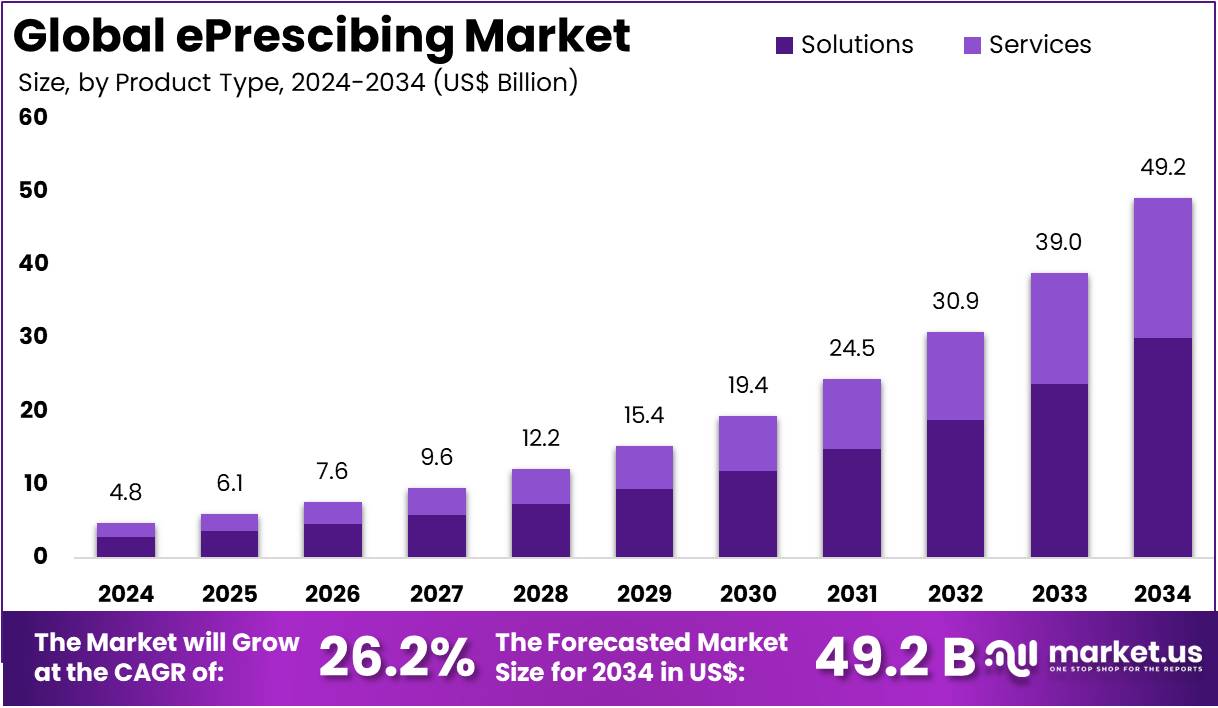
Key Takeaways
- In 2024, the ePrescribing market was valued at US$ 4.8 billion and is projected to reach US$ 49.2 billion by 2034, expanding at a CAGR of 26.2% during the forecast period.
- Based on product type, the market is segmented into solutions and services, with the solutions segment accounting for the largest share of 61.2% in 2024.
- By substance, the market is categorized into controlled and non-controlled prescriptions, with the controlled segment capturing a leading 55.4% market share in 2024.
- In terms of technology, the market is divided into web/cloud-based and on-premise solutions. The web/cloud-based segment dominated the market with a 58.7% revenue share in 2024.
- Based on application, the market includes oncology, cardiology, neurology, sports medicine, and others. The oncology segment led the market, contributing 28.6% of total revenue in 2024.
- By usage, the market is segmented into handheld and computer-based devices, with handheld devices holding the largest share of 53.8% in 2024.
- Based on end user, the market is classified into hospitals, pharmacies, and office-based physicians. The hospital segment emerged as the leading end user, accounting for 41.7% of market revenue in 2024.
- North America dominated the global ePrescribing market in 2024, representing 43.6% of the total market share.
Statistical Information
- Certified Electronic Health Record (EHR) Adoption Supports ePrescribing Growth: As of 2024, 91% of U.S. office-based physicians had adopted a Certified Electronic Health Record (EHR), while 95% had adopted any EHR system. High EHR adoption provides the digital infrastructure required for ePrescribing, prescription history, clinical decision support, and pharmacy connectivity.
- ePrescribing Usage Has Increased Significantly Among U.S. Physicians: Before the HITECH Act, fewer than 7% of U.S. physicians electronically prescribed medications through an EHR. Within five years, nearly 70% of physicians were ePrescribing through certified EHR systems, demonstrating rapid digital adoption across healthcare practices.
- Billions of Electronic Prescriptions Are Processed Every Year: According to Surescripts, its network processed 2.64 billion e-prescriptions in 2025. The network also connected 1.39 million prescribers and virtually all U.S. pharmacies, highlighting the large-scale adoption of electronic prescribing across the healthcare ecosystem.
- Electronic Prescribing for Controlled Substances (EPCS) Is Becoming Standard: In 2025, 84.4% of e-prescribers and 98.3% of pharmacies connected to the Surescripts network were enabled for Electronic Prescriptions for Controlled Substances (EPCS), reflecting widespread implementation of secure prescribing technologies.
- Physician Adoption of Controlled Substance ePrescribing Continues to Rise: A national survey found that 71% of office-based physicians who prescribe controlled substances reported using EPCS often or sometimes in 2021. The percentage using EPCS often increased from 37% in 2019 to 62% in 2021, indicating strong physician acceptance.
- Prescription Drug Monitoring Program (PDMP) Integration Is Expanding: Among physicians prescribing controlled medications, 78% reported checking their state’s Prescription Drug Monitoring Program (PDMP) often or sometimes before prescribing in 2021. Additionally, EHR-based PDMP access increased by 62% between 2019 and 2021, improving workflow efficiency.
- Medication Errors Create a Major Global Health Burden: The World Health Organization (WHO) estimates that medication errors result in at least one death every day and affect approximately 1.3 million people annually worldwide. The associated cost is estimated at US$42 billion each year, supporting the adoption of technologies such as ePrescribing.
- Cancer Patients Require Extensive Prescription Management: According to the National Cancer Institute (NCI), an estimated 2,041,910 new cancer cases were expected in the United States in 2025, with 618,120 cancer-related deaths. Oncology patients typically require multiple prescriptions throughout treatment.
Regional Analysis
North America led the market by securing a market share of 43.6% in 2024.
North America accounted for the largest share of the global ePrescribing market in 2024, supported by widespread adoption of electronic health records (EHRs), strong regulatory frameworks, and advanced healthcare IT infrastructure. The Office of the National Coordinator for Health Information Technology (ONC) reports that 91% of U.S. office-based physicians use certified EHR systems, enabling seamless electronic prescribing and clinical decision support.
The Centers for Medicare & Medicaid Services (CMS) continues to promote electronic prescribing through Medicare Part D requirements, while the DEA’s Electronic Prescriptions for Controlled Substances (EPCS) regulations have strengthened secure prescribing of controlled medications. According to Surescripts, 2.6 billion e-prescriptions were filled in 2024, and the network connected approximately 1.34 million prescribers and virtually all U.S. pharmacies, demonstrating the region’s mature digital prescribing ecosystem. These initiatives continue to improve medication safety, reduce prescription errors, and streamline pharmacy workflows.
Emerging Trends
- AI-powered clinical decision support is improving prescribing accuracy: Modern ePrescribing platforms now use artificial intelligence to standardize prescription instructions and identify errors before they reach patients. In 2025, 12.7% of all e-prescribing transactions on the Surescripts network were enhanced using Sig IQ, while 60% of medication history responses were automatically improved through machine learning.
- Electronic prescribing for controlled substances is becoming the standard: Healthcare providers continue to adopt secure digital prescribing to reduce opioid misuse and prescription fraud. In 2025, 84.4% of e-prescribers and 98.3% of pharmacies connected to the Surescripts network were enabled for Electronic Prescriptions for Controlled Substances (EPCS).
- Real-time prescription benefit tools are supporting affordable treatment: Prescribers increasingly access patient-specific drug pricing before issuing prescriptions. In 2025, more than 900,000 prescribers used Real-Time Prescription Benefit over 1 billion times, generating an estimated US$55.1 million in patient savings through lower-cost medication choices.
- Cloud-based interoperability is strengthening nationwide prescription exchange: Connected healthcare networks continue to expand secure information sharing between providers and pharmacies. During 2025, the Surescripts network exchanged 30.5 billion health intelligence transactions, a 12% increase from 2024, while maintaining 99.998% network uptime.
- Medication safety features are reducing dispensing errors: Healthcare organizations are adopting digital tools that instantly cancel discontinued prescriptions and support pharmacist collaboration. In 2025, 93% of discontinued medications were successfully canceled at pharmacies using CancelRx, while 32.9 million RxChange transactions improved communication between pharmacists and prescribers.
Use Cases
- Managing chronic disease medications efficiently: Electronic prescribing supports continuous treatment for patients with chronic illnesses. According to the CDC, 6 in 10 U.S. adults have at least one chronic disease, and 4 in 10 have two or more, creating ongoing demand for accurate digital prescription management.
- Supporting antibiotic stewardship programs: ePrescribing enables healthcare providers to monitor antibiotic use and improve prescribing practices. The CDC reported that the 2024 outpatient antibiotic prescribing rate was 752 prescriptions per 1,000 people, helping health systems monitor prescribing quality and reduce antimicrobial resistance.
- Improving pharmacy-prescriber collaboration: Digital prescribing systems allow pharmacists to request prescription changes electronically instead of relying on phone calls or paper documentation. In 2025, 32.9 million RxChange transactions were completed across the Surescripts network, improving workflow efficiency and patient care.
- Enhancing medication adherence and first-fill rates: ePrescribing combined with prescription benefit information helps patients obtain medicines more quickly. According to Surescripts, electronic prescribing can increase first-fill medication adherence by up to 10%, rising to 20.5% when combined with eligibility and formulary information.
- Enabling secure nationwide prescription exchange: ePrescribing supports hospitals, clinics, and pharmacies through highly connected digital networks. In 2025, 2.64 billion electronic prescriptions were processed, with 1.39 million prescribers and virtually all U.S. pharmacies connected through the Surescripts network, ensuring secure and efficient medication delivery.
Frequently Asked Questions on ePrescribing
- Why is ePrescribing important in modern healthcare?
ePrescribing improves patient safety by minimizing handwritten prescription errors, checking for drug interactions and allergies, and reducing administrative workload. It also helps healthcare providers deliver faster, more accurate, and efficient medication management across different care settings. - Who uses ePrescribing systems?
ePrescribing systems are widely used by hospitals, office-based physicians, outpatient clinics, retail pharmacies, specialty care centers, and long-term care facilities. These organizations use digital prescribing to improve workflow efficiency, medication safety, and communication across healthcare networks. - What is driving the growth of the ePrescribing market?
The market is growing due to increasing adoption of Electronic Health Records (EHRs), government initiatives promoting digital healthcare, rising chronic disease prevalence, greater focus on medication safety, and expanding investments in healthcare information technology and interoperable digital systems. - Which region dominates the ePrescribing market?
North America leads the global ePrescribing market because of advanced healthcare IT infrastructure, widespread EHR implementation, supportive government regulations, and strong adoption of secure electronic prescribing platforms across hospitals, clinics, and pharmacy networks. - Which technology segment holds the largest market share?
Web and cloud-based ePrescribing solutions dominate the market because they provide secure remote access, lower infrastructure costs, easier software updates, improved scalability, and seamless integration with electronic health records and pharmacy management systems. - What are the emerging opportunities in the ePrescribing market?
Growth opportunities include artificial intelligence integration, cloud-based prescribing platforms, electronic prior authorization, predictive medication management, interoperability improvements, real-time prescription benefit tools, and expanding digital healthcare programs across developed and emerging healthcare systems. - What challenges affect the ePrescribing market?
The market faces challenges including cybersecurity threats, patient data privacy concerns, interoperability issues between healthcare systems, implementation costs for smaller providers, and compliance with evolving regulations governing secure electronic prescribing and health information exchange.
Conclusion
The ePrescribing market is experiencing strong growth as healthcare systems increasingly adopt digital technologies to improve medication safety, prescription accuracy, and operational efficiency. Government initiatives, widespread Electronic Health Record (EHR) adoption, and secure electronic prescribing regulations continue to accelerate implementation across hospitals, clinics, and pharmacies.
Emerging innovations such as artificial intelligence, cloud-based platforms, real-time prescription benefit tools, and electronic prior authorization are further strengthening market development. With rising chronic disease prevalence and growing demand for interoperable healthcare systems, ePrescribing is expected to remain a critical component of modern healthcare, supporting better clinical outcomes, streamlined workflows, and enhanced patient experiences worldwide.
Discuss your needs with our analyst
Please share your requirements with more details so our analyst can check if they can solve your problem(s)




