


Overview
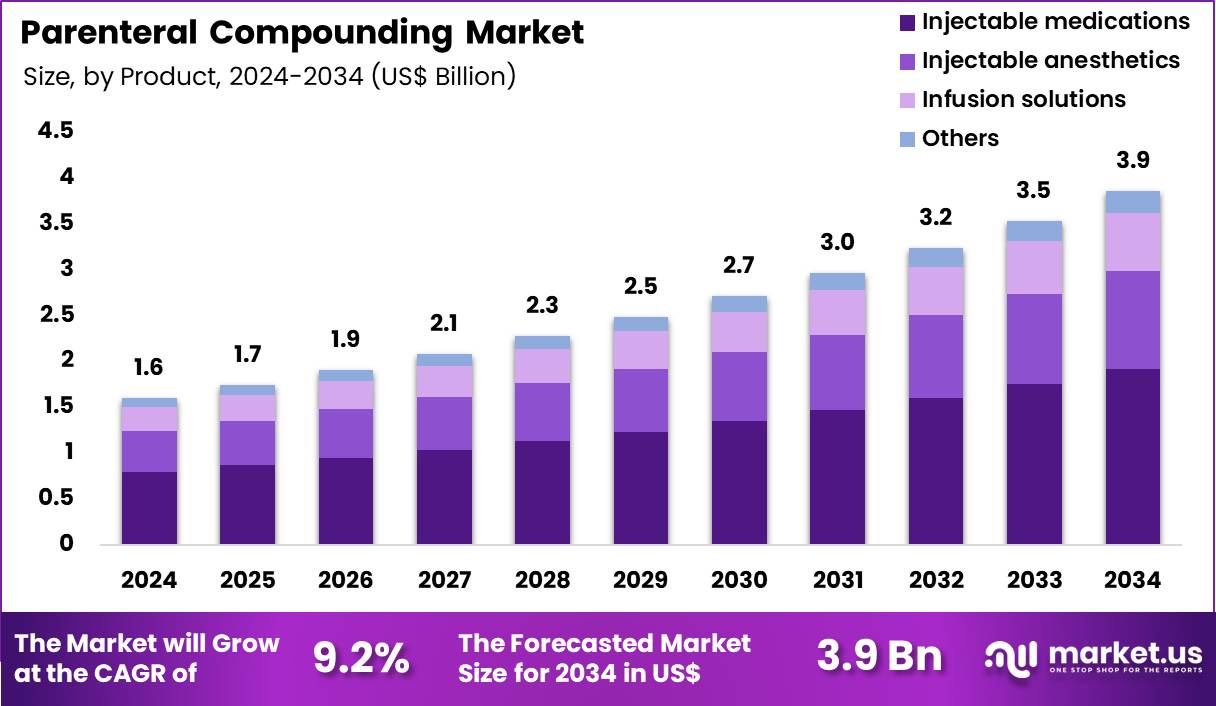
New York, NY – Oct 07, 2026 – The Global Parenteral Compounding Market size is expected to be worth around US$ 3.9 Billion by 2034 from US$ 1.6 Billion in 2024, growing at a CAGR of 9.2% during the forecast period 2025 to 2034. In 2024, North America led the market, achieving over 38.6% share with a revenue of US$ 0.6 Billion.
Parenteral compounding refers to the preparation, mixing, or modification of sterile medications intended for administration through injection or infusion. It plays an important role in healthcare by enabling medications to be prepared according to specific patient requirements, particularly when commercially available formulations are not suitable.
The process involves the precise measurement and combination of active pharmaceutical ingredients, diluents, and other required components under controlled sterile conditions. Key activities include aseptic preparation, ingredient selection, dosage calculation, filtration, filling, labeling, and quality testing. Strict environmental controls and validated procedures are required to minimize the risks of microbial contamination, particulate matter, and preparation errors.
The demand for parenteral compounding is being supported by the growing need for personalized therapies, injectable medicines, hospital-based treatments, and specialized formulations. Advances in compounding technologies, automation, closed-system processing, and quality-control practices are further contributing to improvements in preparation accuracy and operational efficiency.
Parenteral compounding is widely utilized across hospitals, specialty pharmacies, outpatient facilities, and pharmaceutical settings. Increasing emphasis on medication safety, sterile manufacturing practices, regulatory compliance, and patient-specific treatment is expected to create continued opportunities for innovation and development within the parenteral compounding sector.
Key Takeaways
- In 2024, the market generated revenue of US$ 1.6 billion, registering a CAGR of 9.2%, and is projected to reach US$ 3.9 billion by 2034.
- Based on product type, the market is segmented into injectable medications, injectable anesthetics, infusion solutions, and others. Among these, injectable medications dominated the market in 2024, accounting for a 49.6% share.
- By application, the market is segmented into pain management, hormone replacement therapy, and others. Pain management held the largest share of 54.3% in 2024.
- By end user, the market is categorized into adults, pediatric, geriatric, and veterinary segments. The adult segment dominated the market, accounting for the largest revenue share of 58.9% in 2024.
- North America dominated the global market in 2024, accounting for a market share of 38.6%.
Key Market Segments
- Product Type Analysis: Injectable medications dominated the product type segment, accounting for 49.6% of the market. Growth is supported by increasing demand for customized dosages, drug shortage management, sterile formulations, and precise concentration control. Hospitals, oncology centers, critical care units, and specialty clinics continue adopting compounded injectables for personalized treatment.
- Application Analysis: Pain management led the application segment with a 54.3% share. Rising chronic pain prevalence, post-surgical treatments, and interventional procedures are increasing demand for customized injectable therapies. Parenteral compounding enables individualized concentrations, multimodal treatment combinations, and rapid drug delivery, supporting broader adoption across hospitals and specialized pain clinics.
- End-User Analysis: Adults represented the largest end-user segment, accounting for 58.9% of the market. High hospital admissions, chronic disease prevalence, surgical procedures, and demand for personalized therapies are supporting segment growth. Compounded parenterals are widely utilized in adult oncology, cardiology, pain management, and chronic care, sustaining their market dominance.
Regional Analysis
North America dominated the Parenteral Compounding Market in 2024, accounting for 38.6% of the global market. Growth has been supported by rising demand for customized sterile injectables across hospitals, home care, oncology, and pediatric settings.
Increasing drug shortages and chronic disease prevalence have strengthened the need for tailored formulations. The expansion of 503B outsourcing facilities has further supported the production of sterile medications under stringent quality standards.
Regulatory developments and investments in automated compounding technologies have improved preparation accuracy and reduced contamination risks. In fiscal year 2024, the U.S. FDA reported 90 registered outsourcing facilities.
Asia Pacific is projected to register the highest CAGR during the forecast period. Market expansion is being driven by improving healthcare infrastructure, increasing chronic disease prevalence, and growing demand for individualized injectable therapies.
Investments in automated compounding equipment, pharmacist training, local manufacturing, and quality-control systems are expected to strengthen regional capabilities. Rising oncology, neonatal, diabetes, and nutritional care requirements are also supporting adoption across the region.
Emerging Trends
- Increasing adoption of automation and robotics: Automation is becoming an important trend in parenteral compounding as hospitals seek better accuracy, traceability, and workflow control. Barcode systems, gravimetric verification, image capture, automated compounders, and robotics are increasingly being used to reduce manual errors and improve sterile preparation.
- Stronger focus on sterile-compounding quality: Quality and contamination control are becoming major priorities because parenteral medicines directly enter the body. The implementation of USP <797> has strengthened requirements around sterile preparation, personnel practices, environmental controls, quality assurance, and prevention of contamination and incorrect dosing.
- Growth of outsourcing and 503B facilities: Healthcare organizations are increasingly using specialized outsourcing facilities when internal sterile-compounding capacity is limited. FDA-registered 503B facilities must follow current good manufacturing practice requirements and are inspected according to a risk-based approach, supporting demand for specialized sterile-compounding services.
- Technology-enabled verification and traceability: Digital verification is gaining importance across the compounding workflow. Barcode scanning, electronic records, image capture, workflow-management systems, and other technologies can verify ingredients and create an electronic record of preparation, supporting quality control and easier investigation of errors.
- Greater demand during drug shortages: Drug shortages are supporting the role of compounding in selected situations where suitable commercially available products are unavailable. FDA allows specific flexibility for outsourcing facilities when applicable drugs appear on the FDA shortage list, although strict regulatory conditions continue to apply.
Use Cases
- Parenteral nutrition: Parenteral nutrition is a major application because nutrients such as amino acids, carbohydrates, electrolytes, vitamins, and other components may need to be combined into individualized sterile preparations. Automated compounding devices can support accurate preparation while maintaining quality-control procedures.
- Oncology and chemotherapy preparations: Parenteral compounding is widely used to prepare patient-specific injectable oncology medicines. Doses often depend on individual clinical characteristics, making controlled sterile preparation important. Technology-assisted workflows and verification systems can support accurate ingredients, labeling, documentation, and handling of hazardous medicines.
- Hospital intravenous medications: Hospitals use parenteral compounding to prepare customized IV medicines when the required strength, volume, combination, or formulation is not commercially available. IV workflow systems can support ingredient verification, preparation documentation, labeling, and final pharmacist verification.
- Pediatric and neonatal medicines: Children and newborns can require doses that differ considerably from standard adult formulations. Compounding allows pharmacists to prepare appropriate concentrations and volumes when commercial products do not meet patient-specific requirements, supporting individualized treatment in pediatric and neonatal care.
- Critical-care and specialized therapies: Intensive-care and other specialized departments may require customized injectable medicines because of patient condition, dosage requirements, fluid restrictions, or formulation needs. Parenteral compounding enables pharmacies to prepare sterile products according to specific medication orders under controlled conditions.
Frequently Asked Questions About Parenteral Compounding
- Why is parenteral compounding important?
Parenteral compounding is important when commercially available medicines cannot meet a patient’s specific dose, concentration, volume, or formulation requirement. It can also support treatment when certain injectable medicines are unavailable, provided applicable regulatory and clinical requirements are satisfied. - What types of medicines are prepared through parenteral compounding?
Parenteral compounding can include intravenous medications, injectable preparations, parenteral nutrition, oncology medicines, and other sterile preparations. The exact products depend on clinical needs, pharmacy capabilities, applicable regulations, and whether suitable commercially manufactured alternatives are available. - What are the main risks of parenteral compounding?
The major risks include microbial contamination, incorrect drug strength, incorrect ingredients, endotoxin contamination, chemical or physical contamination, and preparation errors. These risks are particularly important because parenteral medicines are administered directly into the body. - What factors are driving the parenteral compounding market?
Market growth is being supported by demand for customized medicines, increasing focus on medication safety, complex injectable therapies, drug shortages, outsourcing, and adoption of compounding technologies. The need for sterile preparations that are not commercially available also supports market demand. - How is automation affecting the parenteral compounding market?
Automation is improving the accuracy, documentation, and efficiency of sterile preparation. Barcode verification, gravimetric systems, image capture, workflow software, and robotics can reduce manual steps and create better traceability, encouraging healthcare organizations to invest in technology-enabled compounding processes. - How do drug shortages affect the parenteral compounding market?
Drug shortages can increase demand for compounded preparations when appropriate commercially available alternatives are unavailable. FDA provides specific regulatory flexibility for certain compounded medicines during shortages, but facilities must satisfy applicable requirements and cannot freely substitute compounded products for approved medicines. - Which technologies are gaining importance in parenteral compounding?
Important technologies include automated compounding systems, robotics, barcode scanning, gravimetric verification, electronic workflow systems, image capture, and pharmacy information systems. These technologies are being adopted to improve accuracy, traceability, documentation, workflow efficiency, and patient safety.
Conclusion
The global parenteral compounding market is poised for significant growth, driven by increasing demand for personalized injectable therapies, specialized formulations, and hospital-based treatments. The market is projected to increase from US$ 1.6 billion in 2024 to US$ 3.9 billion by 2034, at a CAGR of 9.2%.
Injectable medications, pain management, and adult patients represent leading market segments. North America held the largest regional share in 2024, while Asia Pacific is expected to record faster growth.
Rising drug shortages, outsourcing, automation, robotics, digital verification, and stronger sterile-compounding standards are further supporting market development. These trends are expected to create sustained opportunities for innovation and expansion.
Discuss your needs with our analyst
Please share your requirements with more details so our analyst can check if they can solve your problem(s)




