


Overview
New York, NY – Sep 23, 2026 – The Global Hybrid Operating Room Market size is expected to be worth around US$ 3.3 Billion by 2034 from US$ 1.6 Billion in 2024, growing at a CAGR of 7.6% during the forecast period 2025 to 2034. In 2024, North America led the market, achieving over 35.3% share with a revenue of US$ 564.8 Million.
A Hybrid Operating Room (Hybrid OR) is an advanced surgical facility that combines a fully equipped conventional operating theatre with real-time medical imaging technologies, enabling surgeons to perform open, minimally invasive, diagnostic, and image-guided procedures in a single location. Hybrid ORs commonly integrate systems such as fluoroscopy, digital subtraction angiography (DSA), CT, MRI, or cone-beam CT with specialized operating tables and surgical equipment.
The technology is increasingly applied across vascular surgery, cardiology, neurosurgery, trauma, interventional radiology, cardiothoracic surgery, and orthopedics. By eliminating the need to transfer patients between imaging and surgical rooms, Hybrid ORs can support faster intraoperative assessment and allow clinicians to switch between surgical and endovascular techniques during the same procedure.
Financially, a hybrid OR infrastructure requires substantial investment. A Canadian health-technology assessment reported estimated construction and furnishing costs of approximately US$ 1.5 million to US$ 3.6 million per suite, depending on configuration and technology.
Recent clinical research also highlights growing adoption in complex neurovascular procedures. A 2025 study from Kepler University Hospital evaluated 152 cerebrovascular patients treated in a Hybrid OR, including 106 patients with cerebral aneurysms and 49 with carotid stenosis or occlusion.
With continued advances in intraoperative imaging, navigation, robotics, and minimally invasive techniques, Hybrid ORs are becoming an important component of high-acuity and technology-driven surgical infrastructure.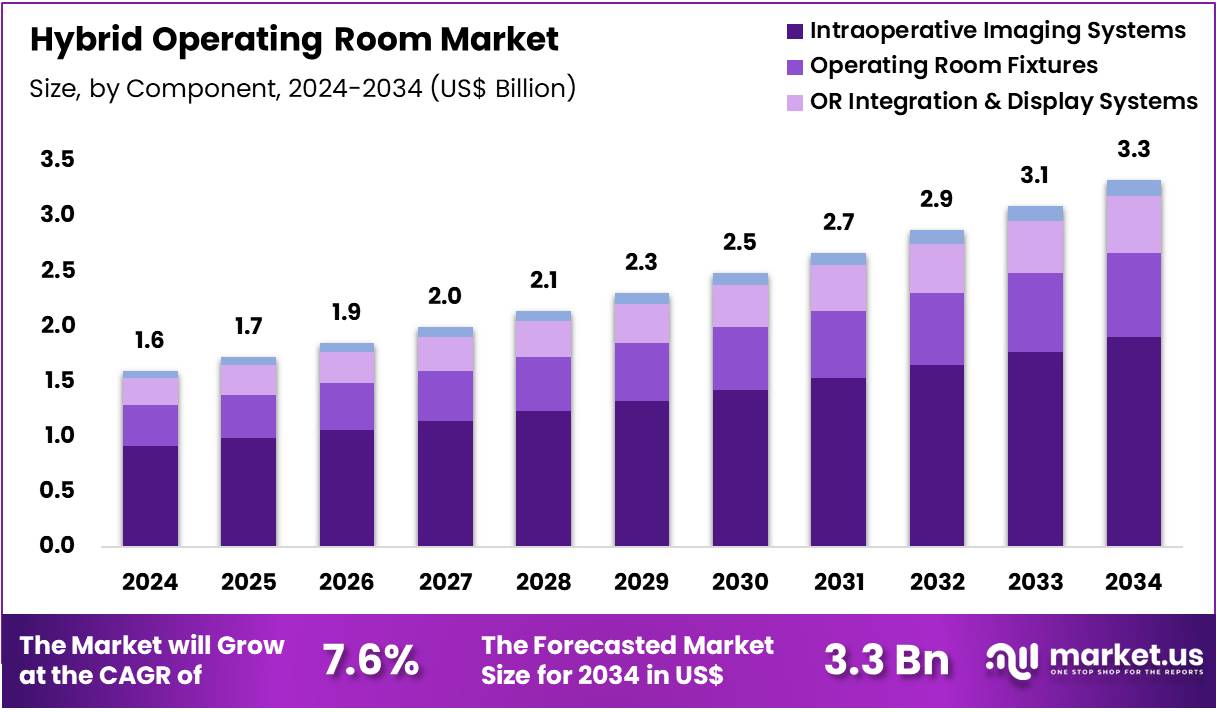
Key Takeaways
- In 2024, the Hybrid Operating Room Market generated revenue of US$ 1.6 billion and is projected to expand at a CAGR of 7.6%, reaching approximately US$ 3.3 billion by 2034.
- By component, the market is segmented into intraoperative imaging systems, operating room fixtures, OR integration & display systems, and others. Intraoperative imaging systems dominated in 2024, accounting for a 57.3% market share.
- Based on application, the market is categorized into cardiovascular & endovascular surgery, neurosurgery, orthopedic & trauma surgery, thoracic surgery, and other surgeries. Cardiovascular & endovascular surgery led the segment with a 46.1% share in 2024.
- By end user, the market is divided into hospitals and ambulatory surgical centers. Hospitals represented the dominant segment in 2024, accounting for the largest revenue share of 69.5%.
- Regionally, North America dominated the Hybrid Operating Room Market in 2024, capturing a leading 35.3% market share, supported by advanced healthcare infrastructure and increasing adoption of image-guided surgical technologies.
Market segmentation
- Component Analysis: Intraoperative imaging systems, holding 57.3%, are expected to dominate the Hybrid Operating Room Market due to increasing demand for real-time, high-resolution visualization during complex procedures. Advanced angiography, CT, and MRI systems improve surgical precision, support minimally invasive interventions, reduce procedural risks, and enable efficient diagnosis and treatment within a single operating environment.
- Application Analysis: Cardiovascular and endovascular surgery, accounting for 46.1%, is projected to remain the leading application segment. Rising cardiovascular disease prevalence, aging populations, and increasing adoption of minimally invasive procedures such as transcatheter valve replacement and endovascular aneurysm repair are driving demand. Hybrid ORs provide integrated imaging and surgical capabilities for complex cardiovascular interventions.
- End-User Analysis: Hospitals, representing 69.5%, are expected to dominate the Hybrid Operating Room Market due to their high volume of complex surgical procedures and greater infrastructure capabilities. Tertiary and quaternary hospitals increasingly adopt hybrid ORs for cardiovascular, neurovascular, trauma, and other advanced procedures, supported by substantial capital investments and multidisciplinary surgical requirements.
Statistical Information
- A 2026 prospective hybrid operating room study involving 20 patients achieved a 90% technical success rate for extended-reality-assisted pulmonary nodule localization.
- The same 2026 study reported a mean localization error of 7.9 mm, demonstrating the measured positioning accuracy of extended-reality guidance during hybrid OR procedures.
- Extended-reality-assisted localization in the 2026 hybrid OR study required a median procedure time of 13.5 minutes, providing a quantitative measure of workflow efficiency for pulmonary nodule localization.
- The 2026 prospective study used a median of 1 confirmatory cone-beam CT scan per patient, indicating the imaging requirement for confirming localization within the hybrid operating room.
- The reported complication rate for the extended-reality hybrid OR technique was 5%, with 1 pneumothorax case among 20 patients and no reported intrapulmonary hemorrhage or air embolism.
- A 2026 neuroendovascular hybrid OR study analyzed 49 procedures, comprising 28 digital subtraction angiographies, 6 middle meningeal artery embolizations, and 15 mechanical thrombectomies using a monoplane robotic C-arm.
- In the 2026 study, 100% procedural success was achieved for both digital subtraction angiography and middle meningeal artery embolization, while mechanical thrombectomy achieved 93.3% successful reperfusion.
- Median procedure duration in the 2026 hybrid OR study was 34.0 minutes for DSA, 70.0 minutes for MMA embolization, and 84.0 minutes for mechanical thrombectomy, demonstrating procedure-specific operating times.
Regional Analysis
North America remains a major region for Hybrid Operating Room adoption, supported by advanced cardiovascular and neurovascular care infrastructure and increasing use of integrated intraoperative imaging. A 2025 expert consensus involving major North American cardiovascular organizations highlighted expanding use of real-time imaging for structural heart interventions.
Asia Pacific is witnessing increasing clinical application of Hybrid Operating Rooms, particularly for cardiovascular, neurovascular, and minimally invasive procedures. A 2025 case series from Renji Hospital, Shanghai, evaluated multimodal image-fusion guidance for structural heart disease and aortic dissection procedures, demonstrating the region’s growing integration of advanced imaging technologies into hybrid surgical workflows.
Europe is also strengthening Hybrid OR capabilities for vascular and neurosurgical procedures. A 2025 publication from University Hospital Dijon Bourgogne described the implementation of a hybrid room combining microsurgery with intraoperative digital subtraction angiography, supporting immediate imaging and treatment decisions.
Business opportunities
The Hybrid Operating Room Market offers significant business opportunities through the integration of advanced imaging, surgical robotics, navigation, artificial intelligence, and connected operating-room technologies. Companies can focus on developing intraoperative angiography, cone-beam CT, 3D imaging, and integrated OR platforms that improve visualization and workflow during complex procedures.
Another opportunity exists in robotic-assisted hybrid surgery, particularly for cardiovascular, neurovascular, thoracic, and orthopedic applications. Businesses can also provide AI-based image analysis, surgical navigation, workflow optimization, and clinical decision-support solutions.
Demand for customized hybrid OR infrastructure, including radiation shielding, specialized operating tables, surgical booms, and integrated displays, creates opportunities for engineering and installation providers.
Asia-Pacific offers additional opportunities through healthcare infrastructure development and increasing adoption of minimally invasive procedures. Companies can also generate recurring revenue through equipment maintenance, software upgrades, staff training, simulation services, and technical support.
Mobile imaging platforms and interoperable data-management systems provide further opportunities for hospitals seeking flexible and connected hybrid surgical environments.
Emerging Trends
- Extended Reality Integration: Extended reality is emerging as a practical hybrid OR technology for continuous image guidance. A 2026 prospective study involving 20 patients achieved 90% technical success, with a 7.9-mm mean localization error, supporting XR-assisted navigation for complex thoracic procedures.
- AI-Assisted Surgical Imaging: AI is increasingly being developed for real-time recognition of surgical instruments and intraoperative events. A 2025 study trained YOLOv8 using 7,400+ frames and 17,175 annotations, achieving 0.77 mean average precision for binary instrument detection.
- Robotic Imaging Systems: Robotic C-arms are becoming an important trend in hybrid ORs because they can support precise imaging without repeatedly repositioning equipment manually. A 2026 feasibility study evaluated 49 neuroendovascular procedures, demonstrating growing clinical use of robotic imaging workflows.
- Multimodal Image Fusion: Hybrid ORs are increasingly combining different imaging modalities to provide better anatomical information during cardiovascular procedures. A 2025 Shanghai case series evaluated multimodal image-fusion guidance for structural heart disease and aortic dissection, reflecting growing adoption of integrated navigation.
- Expansion Beyond Cardiovascular Surgery: Hybrid OR applications are broadening into vascular neurosurgery, trauma, thoracic surgery, and orthopedics. A 2025 clinical review specifically examined hybrid OR applications for aneurysms, arteriovenous malformations, dural fistulas, and other neurovascular conditions.
Use Cases
- Pulmonary Nodule Localization: Hybrid ORs can combine thoracic surgery with cone-beam CT and extended-reality guidance for small lung nodules. In a 2026 study, 20 patients underwent localization, with a 13.5-minute median localization time and 1 median confirmatory CT scan.
- Neuroendovascular Procedures: Hybrid ORs support digital subtraction angiography, embolization, and mechanical thrombectomy in one environment. A 2026 study evaluated 28 DSA procedures, 6 MMA embolizations, and 15 thrombectomies, demonstrating practical use across multiple neurovascular interventions.
- Vascular Neurosurgery: Hybrid ORs allow surgeons to combine microsurgery and intraoperative angiography without transferring patients. A 2025 clinical review identified applications including cerebral aneurysm treatment, arteriovenous malformation management, and dural arteriovenous fistula procedures, supporting immediate assessment during surgery.
- Structural Heart Procedures: Multimodal imaging can combine angiography with other cardiovascular imaging techniques to improve intraoperative anatomical visualization. A 2025 case series from Shanghai investigated image-fusion guidance for structural heart disease and aortic dissection, demonstrating its use in complex cardiovascular interventions.
- Vascular Trauma Management: Hybrid ORs provide simultaneous surgical and endovascular capabilities for urgent vascular trauma. A 2025 peer-reviewed analysis examined hybrid OR use and multimodality imaging for vascular trauma, highlighting the value of immediate imaging and treatment within the same operating environment.
Recent development
- In July 2025, Getinge announced a strategic partnership with Zimmer Biomet under which Zimmer Biomet would distribute Getinge’s operating-room capital products to ambulatory surgery center customers. The collaboration expands Getinge’s reach for OR infrastructure and equipment.
- In November 2025, Canon Medical Systems launched Mobirex i9 / Smart Edition, a high-end mobile X-ray system designed for use in operating rooms, wards, and emergency departments. The system incorporates Canon’s digital radiography detector and automated exposure-assistance technology.
- In November 2025, Siemens Healthineers announced its new strategy phase, placing AI at the center of its healthcare technology roadmap and combining Advanced Therapies with other technologies under a new Precision Therapy segment. Its ARTIS portfolio supports image-guided cardiovascular, neurointerventional, and hybrid-surgery workflows.
Frequently Asked Questions About Hybrid Operating Room
- What procedures are performed in Hybrid Operating Rooms?
Hybrid Operating Rooms support cardiovascular, vascular, neurovascular, thoracic, orthopedic, trauma, urological, and gynecological procedures. They are particularly useful for complex interventions requiring simultaneous surgical access and advanced image guidance throughout the treatment process. - What are the major benefits of Hybrid Operating Rooms?
Major benefits include immediate intraoperative imaging, improved procedural accuracy, reduced patient transfers, faster treatment decisions, and the ability to combine surgical and endovascular techniques. These capabilities can improve workflow when treating complex patients requiring multiple intervention approaches. - What imaging technologies are used in Hybrid Operating Rooms?
Hybrid Operating Rooms may incorporate fixed C-arm fluoroscopy, cone-beam CT, multidetector CT, MRI, ultrasound, and other guidance technologies. The selected imaging configuration depends on clinical requirements, surgical specialties, room design, and the procedures performed. - Which application is important in the Hybrid Operating Room Market?
Cardiovascular and vascular procedures represent important Hybrid Operating Room applications because interventions such as valve replacement and endovascular aneurysm repair require sophisticated imaging alongside surgical capabilities. Neurosurgery, thoracic surgery, orthopedics, and trauma are also expanding applications. - What challenges affect Hybrid Operating Room adoption?
Key challenges include high construction and maintenance costs, complex equipment integration, radiation exposure, specialized staff requirements, and workflow coordination. Hospitals must also carefully evaluate utilization because hybrid facilities require substantial infrastructure and multidisciplinary operational planning. - What is the future of the Hybrid Operating Room Market?
Future development is expected to emphasize advanced image guidance, robotics, artificial intelligence, navigation, and multimodal imaging. Hybrid Operating Rooms are also expanding beyond cardiovascular applications into neurosurgery, orthopedics, thoracic surgery, trauma, and other complex procedures.
Conclusion
The Hybrid Operating Room Market is advancing as hospitals increasingly integrate real-time imaging, surgical equipment, robotics, and digital technologies into unified procedural environments. Intraoperative imaging remains central to complex cardiovascular, neurovascular, orthopedic, and trauma procedures, while growing adoption of minimally invasive techniques supports continued demand.
Key companies are strengthening their competitive positions through product innovation, strategic partnerships, advanced imaging platforms, and integrated operating-room solutions. Siemens Healthineers, GE Healthcare, Getinge, Philips, Canon Medical Systems, Stryker, STERIS, and other established participants are contributing to technological development across the sector.
Overall, the market is positioned for continued expansion as healthcare providers prioritize procedural precision, workflow integration, patient safety, and advanced surgical capabilities.
Discuss your needs with our analyst
Please share your requirements with more details so our analyst can check if they can solve your problem(s)




