


Overview
New York, NY – Aug 11, 2026 – The Global Specific Imaging Solution Market Size is expected to be worth around US$ 781.9 Million by 2034 from US$ 408.8 Million in 2024, growing at a CAGR of 6.7% during the forecast period 2025 to 2034. North America held a dominant market position, capturing more than a 39.5% share and a US$ 161.5 Million market value for the year.
The specific imaging solution market is gaining momentum as healthcare systems increasingly adopt advanced imaging technologies for early diagnosis, surgical guidance, and personalized treatment planning. Rising disease burden, increasing surgical procedures, and demand for real-time visualization are driving adoption of solutions such as hyperspectral imaging, intraoperative imaging, and AI-assisted diagnostic platforms.
According to the CDC, approximately 20.1 million U.S. adults are affected by coronary artery disease, while heart disease causes nearly 695,000 deaths annually in the United States, increasing the need for advanced cardiac imaging technologies.
Growing adoption of artificial intelligence (AI) and machine learning is creating new opportunities in medical imaging workflows. The U.S. FDA reported that more than 1,200 AI-enabled medical devices were authorized by September 2024, with imaging and radiology representing one of the largest application areas.
AI-based solutions are improving automated detection, reducing interpretation time, and supporting clinical decision-making across oncology, neurology, dermatology, and orthopedics. Demand for imaging solutions is further supported by rising cancer diagnosis requirements.
The National Cancer Institute estimated approximately 2,001,140 new cancer cases and 611,720 cancer deaths in the U.S. during 2024, increasing the importance of precise imaging for tumor detection and treatment monitoring.
Healthcare facilities are also investing in digital infrastructure, with the U.S. having more than 6,100 hospitals adopting advanced diagnostic technologies. In August 2023, Kent Imaging Inc. expanded its Calgary facility to enhance imaging technology development and production capacity. Increasing use of portable imaging devices, cloud connectivity, and AI-driven analysis is expected to strengthen market growth and improve global healthcare delivery.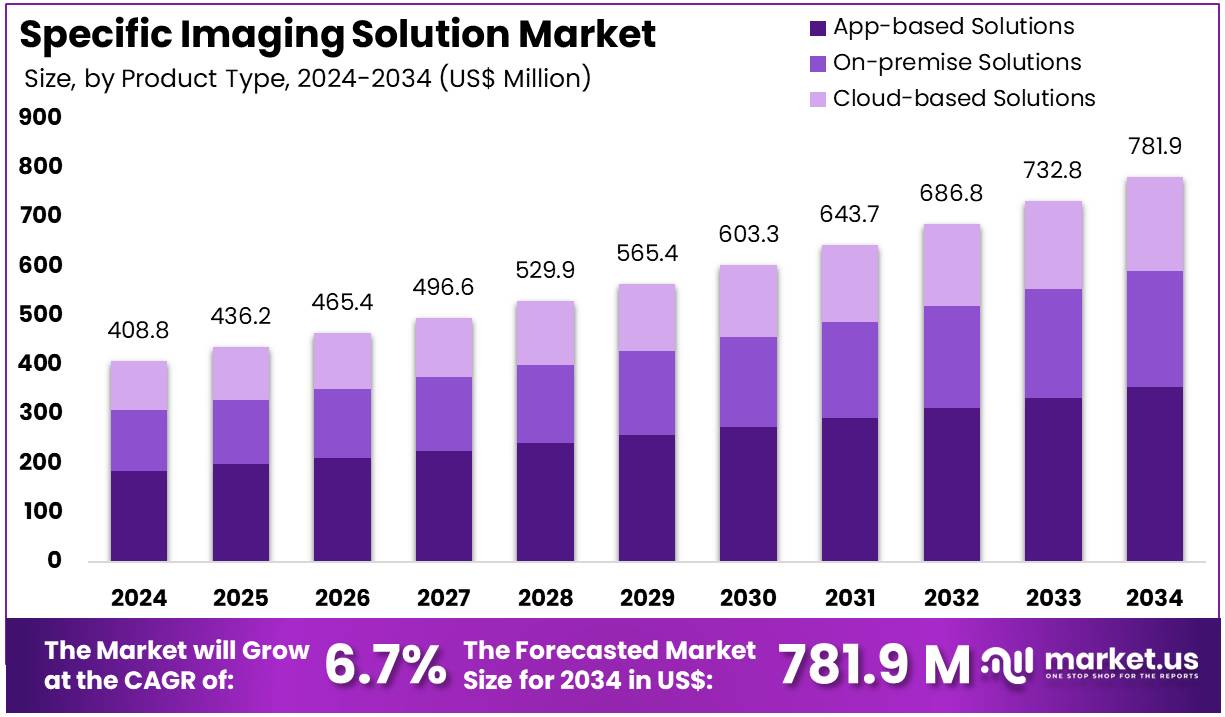
Key Takeaways
- In 2024, the market was valued at US$ 408.8 million and is projected to grow at a CAGR of 6.7%, reaching approximately US$ 781.9 million by 2034.
- Based on product type, the market is categorized into app-based solutions, on-premise solutions, and cloud-based solutions. Among these, app-based solutions dominated in 2024, accounting for a market share of 45.5%.
- By technology, the market is segmented into 3D imaging, 2D imaging, and multispectral imaging. The 3D imaging segment held a significant market position in 2024, capturing 49.7% of the market share.
- Based on application, the market is divided into wound care, orthopedics, ophthalmology, dermatology, and other applications. The wound care segment emerged as the leading application area, holding the largest revenue share of 40.5%.
- By end user, the market is classified into hospitals & clinics, research & academic institutes, diagnostic centers, and others. The hospitals & clinics segment dominated the market with a revenue share of 55.3% in 2024.
- Regionally, North America held the leading position in 2024, accounting for 39.5% of the global market share, supported by advanced healthcare infrastructure and increasing adoption of innovative imaging technologies.
Statistical Information
- Rising Cardiovascular Disease Burden Increasing Demand for Advanced Imaging Solutions: Cardiovascular diseases are creating strong demand for precise imaging technologies such as myocardial perfusion imaging, 3D cardiac visualization, and intraoperative imaging systems. According to the CDC, approximately 20.5 million adults aged 20 years and older in the United States have coronary heart disease, representing nearly 7.1% of the adult population. In addition, heart disease remains the leading cause of death in the U.S., accounting for approximately 702,880 deaths in 2022, increasing the need for early and accurate diagnostic imaging.
- Growing Cancer Incidence Supporting Advanced Imaging Adoption: The increasing cancer burden is driving demand for imaging solutions used in tumor detection, treatment planning, and surgical guidance. According to the National Cancer Institute (NCI), approximately 2,001,140 new cancer cases and 611,720 cancer deaths were projected in the United States in 2024. The NCI also reports that more than 18 million cancer survivors were living in the U.S. as of January 2022, highlighting the continued need for advanced imaging-based monitoring and personalized treatment approaches.
- Artificial Intelligence Accelerating Medical Imaging Applications: AI-based imaging solutions are rapidly expanding across radiology, pathology, cardiology, and oncology applications. The U.S. FDA reported that more than 1,000 AI-enabled medical devices had received authorization by 2023, increasing to over 1,200 AI-enabled devices by September 2024. A large proportion of these devices are related to medical imaging, including radiology analysis, ultrasound interpretation, and diagnostic decision support.
- Rising Chronic Wound Cases Increasing Need for Hyperspectral Imaging: Advanced imaging technologies are improving wound assessment by measuring tissue oxygenation, blood flow, and healing progress. According to a study published through the National Library of Medicine, chronic wounds affect approximately 8.2 million Medicare beneficiaries in the United States, creating a significant healthcare challenge. Medicare spending associated with chronic wound care has been estimated at approximately $28.1 billion annually, increasing demand for advanced wound imaging technologies.
- Increasing Demand for 3D Imaging in Orthopedics and Surgical Planning: 3D imaging technologies are improving surgical accuracy by providing detailed anatomical models for procedures such as joint replacement, trauma surgery, and implant planning. According to the American Academy of Orthopaedic Surgeons (AAOS), more than 1 million total knee replacement procedures are performed annually in the United States, while hip replacement procedures exceed 450,000 cases each year, supporting demand for advanced orthopedic imaging solutions.
- Rising Diabetes Prevalence Increasing Need for Wound Imaging Solutions: Diabetes-related complications are increasing demand for advanced wound monitoring and tissue imaging technologies. According to the CDC, approximately 38.4 million people in the United States had diabetes in 2021, representing about 11.6% of the U.S. population. Additionally, around 97.6 million U.S. adults had prediabetes, increasing the future burden of diabetic wounds and the need for technologies that support early tissue damage detection.
- Aging Population Supporting Growth of Imaging-Based Healthcare Solutions: The aging population is increasing the need for diagnostic imaging in chronic disease management, cancer screening, and orthopedic care. According to the U.S. Census Bureau, the number of Americans aged 65 years and older reached approximately 58 million in 2022, representing nearly 17% of the total U.S. population. Older adults experience higher rates of cardiovascular disease, cancer, and musculoskeletal disorders, supporting demand for advanced imaging systems.
- Neurological Disease Burden Increasing Demand for Brain Imaging Technologies: Advanced imaging solutions are becoming increasingly important for neurological diagnosis, including epilepsy, stroke, and brain tumors. According to the National Institute of Neurological Disorders and Stroke (NINDS), more than 795,000 people experience a stroke annually in the United States, including approximately 610,000 first-time strokes. Imaging technologies such as MRI, CT, and AI-assisted analysis support faster diagnosis and treatment decisions.
Regional Analysis
North America led the market by securing a market share of 39.5% in 2024.
North America dominated the specific imaging solution market due to advanced healthcare infrastructure, strong adoption of AI-based diagnostics, and increasing demand for precision imaging in oncology, cardiology, and surgery. The U.S. FDA has authorized more than 1,200 AI-enabled medical devices by 2024, including numerous imaging-focused solutions that improve diagnostic accuracy and workflow efficiency.
The region’s healthcare network, supported by over 6,000 hospitals in the United States, continues to drive adoption of advanced MRI, CT, ultrasound, and cloud-based imaging platforms. Asia Pacific is expected to witness significant growth due to rising chronic disease cases, healthcare digitalization, and investments in advanced diagnostic technologies.
Countries including Japan, China, South Korea, and Australia are expanding AI-powered imaging, telemedicine, and portable diagnostic solutions. Australia allocated approximately US$107.2 million for digital health programs in 2022–23, supporting innovation in connected healthcare and medical imaging technologies.
Emerging Trends
- Artificial Intelligence Integration in Medical Imaging: AI-powered imaging solutions are becoming a major trend as healthcare providers use machine learning for faster diagnosis, automated image analysis, and improved accuracy. The U.S. FDA reported more than 1,200 AI-enabled medical devices authorized by 2024, with many supporting imaging and diagnostic applications.
- Growth of Cloud-Based Imaging Platforms: Cloud-based imaging solutions are gaining adoption as hospitals seek secure data sharing, remote consultations, and faster collaboration between specialists. According to the ONC, approximately 96% of non-federal acute care hospitals in the U.S. adopted certified electronic health record systems, supporting connected healthcare infrastructure and digital imaging workflows.
- Expansion of Portable and Point-of-Care Imaging: Portable imaging devices are becoming increasingly important for emergency care, rural healthcare, and bedside diagnosis. The CDC estimates that approximately 46 million people in the U.S. live in rural areas, increasing demand for accessible diagnostic technologies such as handheld ultrasound and mobile imaging systems.
- Increasing Adoption of 3D Imaging Technologies: 3D imaging is advancing surgical planning, orthopedics, and personalized treatment by providing detailed anatomical visualization. The American Academy of Orthopaedic Surgeons reports that more than 1 million knee replacement procedures and over 450,000 hip replacement procedures are performed annually in the U.S., creating demand for accurate 3D planning tools.
- Integration of Advanced Imaging in Precision Medicine: Precision medicine is increasing the use of advanced imaging for personalized diagnosis and treatment monitoring. The NIH’s All of Us Research Program aims to enroll 1 million or more participants to improve healthcare research using diverse health data, supporting future imaging-driven personalized medicine approaches.
Use Cases
- Oncology and Tumor Detection: Specific imaging solutions are widely used in cancer diagnosis, tumor mapping, and treatment monitoring. The National Cancer Institute estimated approximately 2.0 million new cancer cases in the U.S. during 2024, increasing demand for advanced imaging technologies that support early detection and targeted therapies.
- Cardiovascular Disease Diagnosis: Advanced imaging solutions support heart disease diagnosis through cardiac MRI, CT imaging, and blood flow visualization technologies. According to the CDC, approximately 20.5 million adults in the U.S. have coronary heart disease, creating strong demand for accurate cardiovascular imaging tools.
- Chronic Wound Assessment and Monitoring: Hyperspectral and near-infrared imaging technologies are increasingly used for wound evaluation by measuring tissue oxygen levels and healing progress. Research published through NIH indicates chronic wounds affect approximately 8.2 million Medicare beneficiaries in the U.S., increasing demand for advanced wound imaging solutions.
- Orthopedic Surgery Planning: Imaging solutions support orthopedic procedures by creating 3D anatomical models for implant selection and surgical navigation. With millions of joint replacement procedures performed each year globally, hospitals are adopting advanced imaging platforms to improve surgical precision and patient outcomes.
- Remote Diagnostics and Telemedicine: Connected imaging platforms enable specialists to review scans remotely and improve healthcare access. According to HHS, Medicare telehealth visits increased from approximately 840,000 visits in 2019 to 52.7 million visits in 2020, accelerating adoption of digital healthcare and remote imaging workflows.
Frequently Asked Questions On Specific Imaging Solution
- What factors are driving the growth of the Specific Imaging Solution Market?
The market is growing due to rising chronic disease prevalence, increasing demand for early diagnosis, advancements in artificial intelligence, and adoption of precision medicine. Healthcare providers are using advanced imaging solutions to improve diagnostic accuracy and enhance patient care outcomes. - How is artificial intelligence impacting the Specific Imaging Solution Market?
Artificial intelligence is improving medical imaging through automated analysis, faster detection of abnormalities, and enhanced diagnostic accuracy. AI-powered imaging tools support healthcare professionals in oncology, cardiology, dermatology, and neurology by improving workflow efficiency and clinical decision-making. - Which technology segment dominates the Specific Imaging Solution Market?
The technology segment includes 3D imaging, 2D imaging, and multispectral imaging. Among these, 3D imaging is gaining strong adoption because it provides detailed anatomical visualization, supports surgical planning, and improves treatment accuracy in various medical procedures. - What are the major applications of Specific Imaging Solutions?
Specific imaging solutions are widely used in wound care, orthopedics, ophthalmology, dermatology, oncology, and cardiovascular diagnosis. These technologies help healthcare professionals detect diseases earlier, monitor treatment progress, and perform complex procedures with improved precision. - Why are hospitals adopting Specific Imaging Solutions?
Hospitals and clinics are major users of specific imaging solutions due to increasing diagnostic needs and demand for efficient healthcare services. These technologies help improve clinical workflows, reduce diagnosis time, support remote consultations, and enhance patient management. - Which region dominates the Specific Imaging Solution Market?
North America holds a leading position in the specific imaging solution market due to advanced healthcare infrastructure, high adoption of AI technologies, and strong investments in diagnostic innovation. The region widely uses imaging solutions in oncology, cardiology, and surgical applications. - What are the future trends in the Specific Imaging Solution Market?
Future trends include increased AI integration, portable imaging devices, cloud-based diagnostic platforms, and advanced 3D visualization technologies. These innovations are expected to improve diagnostic accuracy, healthcare accessibility, and personalized treatment approaches across multiple medical specialties.
Conclusion
The specific imaging solution market is experiencing significant growth due to increasing demand for accurate diagnostics, early disease detection, and personalized treatment approaches. Advancements in AI, 3D imaging, cloud-based platforms, and portable imaging technologies are transforming healthcare delivery across oncology, cardiology, wound care, and surgical applications.
Rising chronic disease cases, growing hospital investments, and supportive regulatory approvals are further accelerating adoption. North America continues to lead due to advanced healthcare infrastructure, while Asia Pacific shows strong growth potential through digital health expansion. With continuous innovation and integration of intelligent imaging technologies, the market is expected to play a vital role in improving diagnostic precision and patient outcomes.
Discuss your needs with our analyst
Please share your requirements with more details so our analyst can check if they can solve your problem(s)




