


Overview
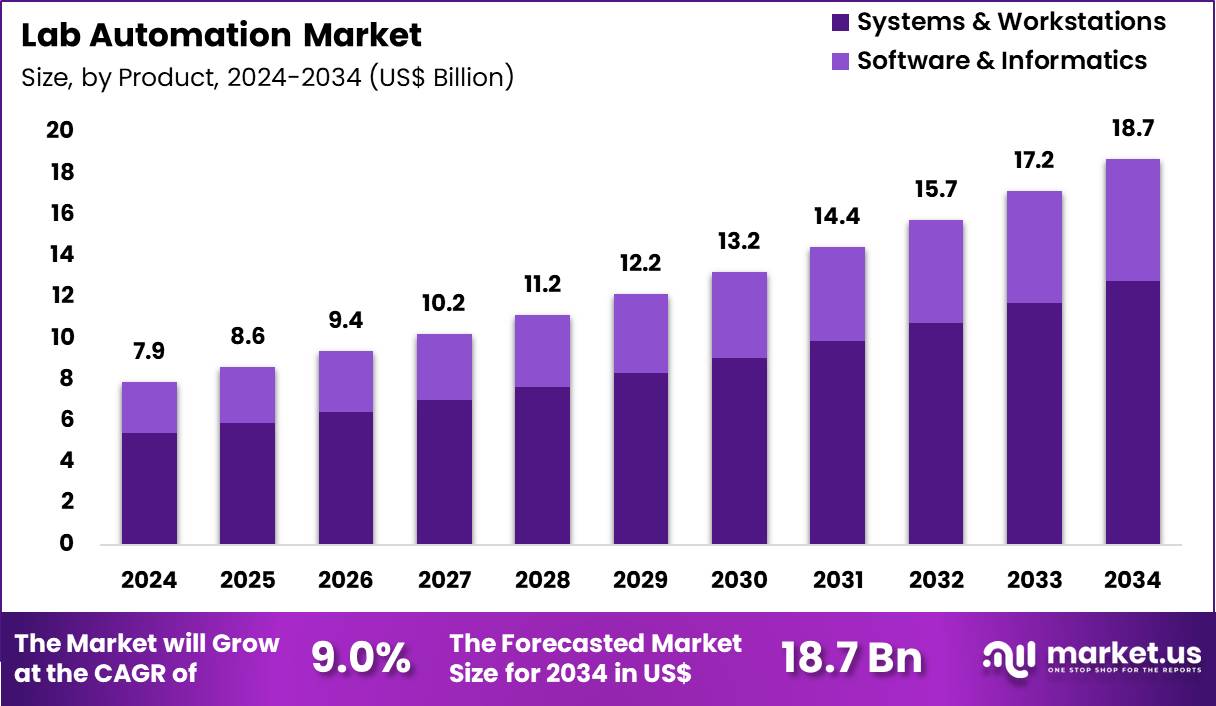
New York, NY – Sep 28, 2026 – The Global Lab Automation Market size is expected to be worth around US$ 18.7 Billion by 2034 from US$ 7.9 Billion in 2024, growing at a CAGR of 9.0% during the forecast period 2025 to 2034. In 2024, North America led the market, achieving over 38.2% share with a revenue of US$ 3.0 Billion.
Lab automation refers to the use of advanced technologies, robotics, software, and automated instruments to perform laboratory tasks with minimal human intervention. It is widely used in pharmaceutical and biotechnology research, clinical diagnostics, academic institutions, and chemical testing laboratories.
The growth of laboratory automation is being driven by the increasing demand for accurate results, higher testing volumes, faster research processes, and improved operational efficiency. Automated systems, including robotic liquid handling, automated sample preparation, laboratory information management systems (LIMS), and analytical instruments, are helping laboratories streamline workflows and reduce manual errors.
The pharmaceutical and biotechnology sectors represent key application areas, where automation supports drug discovery, clinical research, genomic studies, and high-throughput screening. Additionally, the growing adoption of personalized medicine and the increasing focus on laboratory productivity are creating opportunities for advanced automation solutions.
Technological advancements in artificial intelligence, machine learning, robotics, and digital laboratory platforms are further transforming laboratory operations. These technologies enable real-time monitoring, improved data management, and greater process consistency.
However, high initial investment costs, system integration challenges, and the need for skilled professionals may limit adoption among smaller laboratories.
Overall, laboratory automation is expected to remain an important component of modern laboratory infrastructure, supporting research innovation, operational standardization, and efficient scientific workflows across multiple industries.
 ;
;
Key Takeaways
- In 2024, the Lab Automation Market was valued at US$ 7.9 billion and is projected to grow at a CAGR of 9.0%, reaching US$ 18.7 billion by 2034.
- Based on the type of automation, the market is segmented into modular automation, total laboratory automation, and robotic process automation. Total laboratory automation dominated the market in 2024, accounting for a share of 56.1%.
- By product, the market is categorized into systems & workstations and software & informatics. Systems & workstations held the largest market share of 68.4%.
- Based on workflow stage, the market is divided into pre-analytical automation, analytical automation, and post-analytical automation. Analytical automation led the segment, capturing the largest revenue share of 45.3%.
- By application, the market is segmented into clinical diagnostics, drug discovery, genomics & proteomics, microbiology, and others. Drug discovery emerged as the leading application, accounting for 39.0% of the market revenue.
- Based on end-user, the market comprises pharmaceutical & biotechnology companies, academic & research institutes, hospitals & clinical diagnostic laboratories, industrial & environmental testing laboratories, and others. Pharmaceutical & biotechnology companies held a significant market share of 36.6%.
- Regionally, North America dominated the Lab Automation Market in 2024, accounting for 38.2% of the total market share.
Key Market Segments
- Type of Automation Analysis: Total laboratory automation held the largest share of 56.1% and is expected to maintain its dominance. Rising test volumes, demand for end-to-end workflow integration, workforce shortages, quality requirements, and the need to reduce manual intervention are supporting adoption across large laboratories.
- Product Analysis: Systems and workstations accounted for 68.4% of the market and are projected to lead. Their role in automated sample handling, processing, analysis, and data capture supports demand. Laboratory modernization, instrument integration, scalability, reliability, and higher throughput are further strengthening adoption.
- Workflow Stage Analysis: Analytical automation represented 45.3% of the market and is expected to remain dominant. Increasing demand for precision, reproducibility, standardized testing, faster processing, and higher throughput is supporting adoption. Integration with analytical instruments and data systems further enhances operational efficiency and traceability.
- Application Analysis: Drug discovery accounted for 39.0% of the market and is projected to maintain its leading position. Increasing pharmaceutical research activity, high-throughput screening, assay development, compound optimization, and demand for faster development timelines are driving automation adoption across drug discovery laboratories.
- End-User Analysis: Pharmaceutical and biotechnology companies held 36.6% of the market and are expected to remain the leading end-user segment. Growing research and development activities, expanding pipelines, regulatory requirements, increasing sample volumes, and demand for scalable laboratory workflows are supporting sustained automation adoption.
Regional Analysis
North America led the Lab Automation Market in 2024, accounting for 38.2% of the global market. Market growth is supported by strong investments in research infrastructure, increasing adoption of artificial intelligence, and widespread use of robotic systems in clinical and research laboratories.
Pharmaceutical and biotechnology companies are deploying automated screening, liquid handling, and sample management technologies to improve accuracy, throughput, and operational efficiency. Growing demand for advanced genomic, proteomic, and diagnostic testing is further supporting regional adoption.
Asia Pacific is expected to register the highest CAGR during the forecast period. Increasing investments in healthcare infrastructure, biotechnology research, pharmaceutical manufacturing, and laboratory modernization are creating significant opportunities.
Countries across the region are adopting automated sequencing, sample management, robotics, and AI-enabled laboratory systems to improve productivity and address workforce constraints. Government initiatives, technology investments, and expanding research capabilities are expected to further accelerate the adoption of laboratory automation solutions across Asia Pacific.
Emerging Trends
- Integration of AI and machine learning: Artificial intelligence and machine learning are increasingly being combined with laboratory automation to support data analysis, quality control, result verification, and predictive tasks. Recent clinical laboratory research identifies AI, machine learning, and predictive analytics as important areas of future automation development.
- Growth of total laboratory automation: Laboratories are moving from automating individual tasks toward total laboratory automation (TLA). These systems can connect pre-analytical, analytical, and post-analytical activities, including sample handling, testing, storage, and result processing. This trend is being supported by rising test volumes and workforce pressures.
- Greater use of digital laboratory data: Laboratory automation is increasingly linked with laboratory information systems, electronic test orders, and electronic result reporting. The CDC reports that electronic test-order and result systems can reduce manual data entry, improve data completeness, and increase laboratory efficiency.
- Expansion into microbiology: Automation is expanding beyond traditional chemistry, immunoassay, and hematology applications into clinical microbiology. Automated systems are increasingly being used for specimen processing, culture handling, identification, and antimicrobial susceptibility workflows, supporting faster and more standardized laboratory operations.
- Focus on quality, safety, and workforce efficiency: Automation is increasingly being adopted to reduce repetitive manual work, standardize processes, improve worker safety, and manage laboratory workforce shortages. However, implementation still requires staff training, system integration, infrastructure investment, and appropriate quality controls.
Use Cases
- Automated sample handling: Robotic systems can automate repetitive activities such as sample transport, tube sorting, aliquoting, preparation, and storage. This reduces manual handling and allows laboratory personnel to spend more time on higher-value technical activities.
- Automated clinical chemistry and immunoassay testing: Automation is widely applied to chemistry and immunoassay workflows. Integrated analyzers and laboratory tracks can process large numbers of specimens with standardized procedures, helping laboratories manage high testing volumes and maintain consistent turnaround times.
- Automated hematology testing: Hematology laboratories use automation for routine blood testing, sample movement, analysis, and related workflow activities. Integration between analyzers and laboratory automation systems can reduce repetitive manual steps and support consistent processing of large sample volumes.
- Microbiology and infectious-disease testing: Automated microbiology systems can support specimen processing, culture workflows, pathogen identification, and antimicrobial susceptibility testing. These applications are particularly relevant where laboratories need standardized processing and faster handling of large numbers of clinical specimens.
- Automated quality control and result verification: Automation is increasingly being used for quality-control checks, specimen-quality assessment, and auto-verification of laboratory results. These functions can help identify results requiring additional review while reducing unnecessary manual checking of routine results.
Frequently Asked Questions About Lab Automation
- Why is lab automation important?
Lab automation is important because laboratories handle increasing testing volumes while facing pressure to improve speed, accuracy, safety, and operational efficiency. Automation can standardize repetitive processes, reduce manual handling, and allow laboratory staff to focus on more complex activities. - What processes can be automated in a laboratory?
Several laboratory processes can be automated, including specimen sorting, transportation, aliquoting, preparation, analysis, storage, quality control, result verification, and data transfer. The exact level of automation depends on laboratory size, testing volume, infrastructure, budget, and clinical requirements. - Does lab automation reduce human involvement?
Lab automation reduces manual involvement but does not remove the need for laboratory professionals. Staff are still required for system monitoring, quality assessment, troubleshooting, interpretation, maintenance, and activities where professional judgment is necessary.ion of digital technologies. These factors are encouraging laboratories to automate repetitive and high-volume workflows. - What is the future outlook for lab automation?
The future of lab automation is expected to involve greater integration of AI, robotics, laboratory information systems, advanced analytics, and automated quality control. At the same time, laboratories are likely to focus more on interoperability, workforce skills, cybersecurity, and sustainable operations. - How is digitalization supporting the lab automation market?
Digitalization allows laboratory instruments, information systems, electronic orders, and test results to communicate more efficiently. CDC initiatives demonstrate the growing importance of automated laboratory data exchange for reducing manual work, improving data quality, and supporting faster public-health decision-making. - Can automation improve laboratory turnaround time?
Yes. Automation can reduce manual processing steps and improve workflow continuity, which can support faster turnaround times. Recent research reports substantial improvements in processing efficiency, although the actual benefit varies according to laboratory design, testing volume, workflow, and automation level. - How does lab automation support laboratory safety?
Automation can reduce the amount of direct human handling of biological specimens, including transportation, preparation, testing, and waste-related activities. This can reduce occupational exposure to potentially hazardous materials and support safer laboratory workflows.
Conclusion
The global Lab Automation Market is undergoing steady expansion, supported by rising testing volumes, demand for accurate and faster results, workforce constraints, and the need for improved laboratory efficiency. The market is projected to grow from US$ 7.9 billion in 2024 to US$ 18.7 billion by 2034, at a 9.0% CAGR.
Total laboratory automation, systems and workstations, analytical automation, drug discovery, and pharmaceutical and biotechnology companies represent major market segments. North America currently leads the market, while Asia Pacific is expected to record strong growth.
Increasing adoption of AI, robotics, digital platforms, and automated workflows is expected to further strengthen laboratory automation across healthcare, research, pharmaceutical, and biotechnology applications.
Discuss your needs with our analyst
Please share your requirements with more details so our analyst can check if they can solve your problem(s)




