


Overview
New York, NY – Sep 17, 2026 –The Global Disposable Medical Gowns Market size is expected to be worth around US$ 7.84 Billion by 2034 from US$ 3.84 Billion in 2024, growing at a CAGR of 7.4% during the forecast period 2025 to 2034. In 2024, North America led the market, achieving over 39.3% share with a revenue of US$ 1.51 Billion.
Disposable Medical Gowns are growing significantly due to increasing infection prevention measures, rising surgical procedures, and growing demand for personal protective equipment (PPE) across hospitals, clinics, and healthcare facilities. Disposable medical gowns are widely used to protect healthcare professionals from exposure to blood, body fluids, infectious materials, and hazardous substances during patient care and medical procedures.
The increasing prevalence of healthcare-associated infections (HAIs) is a major factor supporting market expansion. According to the Centers for Disease Control and Prevention (CDC), approximately 1 in 31 hospitalized patients in the United States develops at least one HAI on any given day, increasing the requirement for protective medical apparel. Globally, more than 310 million major surgical procedures are performed annually, generating continuous demand for sterile and isolation gowns.
The healthcare industry includes over 60 million healthcare workers worldwide, creating a large requirement for protective clothing. During the COVID-19 pandemic, global demand for disposable gowns increased rapidly, with healthcare systems strengthening PPE inventories and supply chains. The U.S. healthcare system alone uses millions of PPE units annually across hospitals and medical centers.
Disposable medical gowns are primarily manufactured using polypropylene nonwoven fabrics, polyethylene coatings, and laminated materials that provide high fluid resistance and durability. Advanced Level 3 and Level 4 protective gowns are increasingly adopted for intensive care units, emergency departments, and surgical environments.
Growing healthcare expenditure, expansion of hospitals, increasing awareness of occupational safety, and development of eco-friendly disposable materials are expected to drive the Disposable Medical Gowns Market. Rising investments in infection control infrastructure will further create new opportunities for manufacturers worldwide.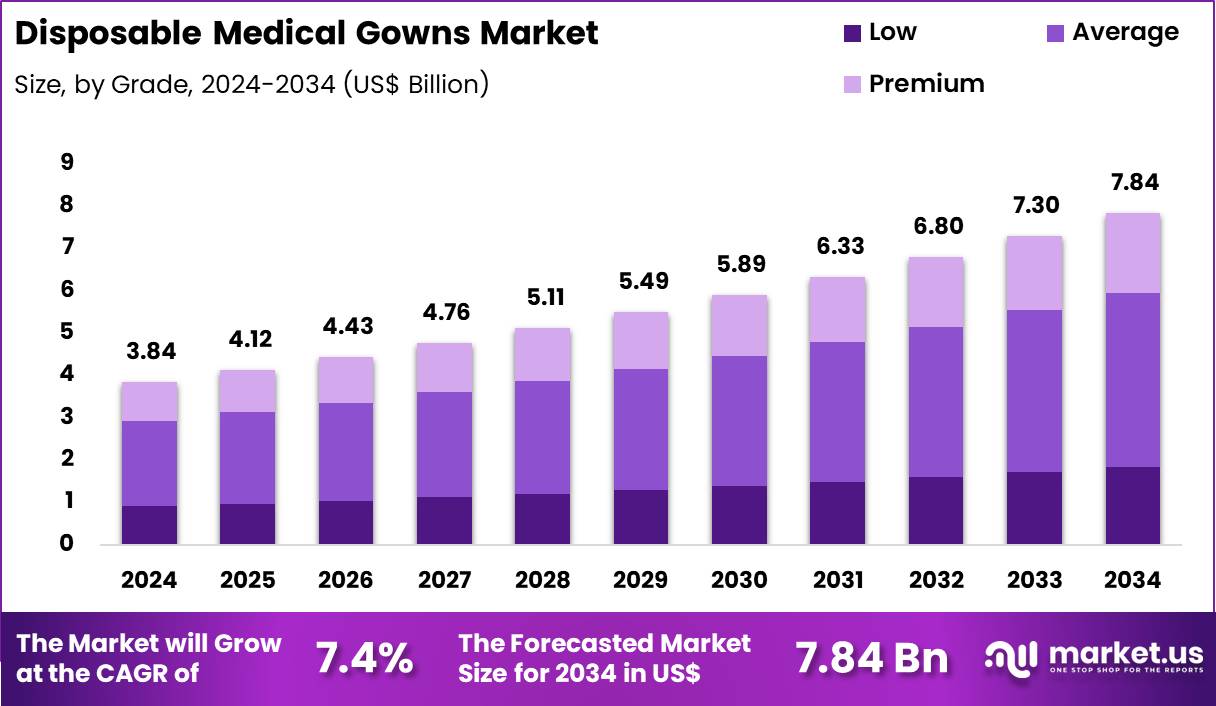
Key Takeaways
- In 2024, the Disposable Medical Gowns Market generated revenue of US$ 3.84 billion and is projected to reach US$ 7.84 billion by 2034, expanding at a CAGR of 7.4% during the forecast period.
- Based on Grade, the market is segmented into Low, Average, and Premium grades, with the Average Grade segment leading in 2024, accounting for a 52.3% market share.
- Based on Product, the market is categorized into Surgical Gowns, Non-surgical Gowns, and Patient Gowns, with Surgical Gowns dominating in 2024 with a 48.7% market share.
- Based on Protection Level, the market is segmented into Low-risk, Moderate-risk, and High-risk categories, with the High-risk segment leading in 2024, capturing a 44.8% market share.
- North America dominated the Disposable Medical Gowns Market in 2024, accounting for a significant 39.3% market share due to advanced healthcare infrastructure and strong demand for infection-control products.
Market Segmentation Overview
- Grade Analysis: Average-grade gowns dominated the market with a 52.3% share in 2024, driven by their extensive use in hospitals, emergency departments, critical care units, and general medical wards. These gowns provide a balance of protection, comfort, and durability, making them suitable for routine infection-control procedures and moderate-risk healthcare applications.
- Product Analysis: Surgical gowns led the product segment with a 48.7% market share in 2024, supported by increasing surgical procedures, strict sterilization requirements, and rising demand from operating rooms, emergency care units, and specialized surgical facilities. Their superior barrier protection and compliance with healthcare safety standards contribute to strong market adoption.
- Protection Level Analysis: High-risk gowns accounted for the largest protection-level segment with a 44.8% market share in 2024, owing to their use in intensive care units, infectious-disease management, trauma care, and aerosol-generating procedures. Growing focus on healthcare worker safety and infection prevention is increasing demand for advanced protective gowns.
Statistical Information
- Disposable Gown Import Prices Declined During Supply Normalisation: U.S. import unit values for disposable surgical and isolation gowns declined from $37.21 per dozen in March 2020 to $27.23 per dozen in January 2021. This was a decline of $9.98 per dozen, or approximately 26.8%. The reduction followed the COVID-19 emergency procurement period and reflects the effect of increased availability, inventory accumulation, and weaker emergency-driven buying.
- Surgical Procedure Volumes Require Higher Barrier Gown Specifications: In 2018, the United States recorded 9.6 million inpatient stays involving operating-room procedures and 14.4 million total operating-room procedures, equal to 4,399.3 procedures per 100,000 population. Surgical gowns used during these procedures must meet higher protection requirements when fluid exposure is likely. This makes procedure intensity and specialty mix important variables in disposable medical-gown purchasing.
- Severe Influenza Seasons Increase Patient Isolation Gown Requirements: CDC estimated 710,000 influenza-related U.S. hospitalisations and 45,000 deaths during the 2024–25 influenza season. This followed 470,000 influenza-related hospitalisations and 28,000 deaths during 2023–24. Influenza hospitalisation does not automatically equal disposable-gown consumption, but respiratory-infection surges increase patient-care activity requiring personal protective-equipment assessment. Procurement teams therefore need emergency stock, supplier capacity, and contingency purchasing plans for seasonal peaks.
- Ambulatory Surgery Centers Expand Disposable Surgical Gown Consumption: In 2023, approximately 6,300 U.S. ambulatory surgical centres treated 3.4 million Medicare fee-for-service beneficiaries. Surgical-procedure volume per beneficiary increased 5.7% during 2023 and grew at an average annual rate of 2.1% from 2019 through 2023. These centres are a distinct purchasing channel for single-use surgical apparel, particularly moderate- and high-barrier gowns used in invasive procedural settings across the national healthcare delivery system.
- National Stockpile Gown Inventory Fell Far Below Targets: In July 2020, the U.S. Strategic National Stockpile had 1.2 million gowns or coveralls, compared with a planned 90-day inventory target of 265 million units. Available inventory was therefore only 0.45% of the target, leaving a gap of about 263.8 million units. This historic shortage demonstrates why hospitals and governments increasingly assess disposable-gown supply resilience and emergency inventory coverage.
- Federal Emergency Response Distributed Millions Of Nonsurgical Gowns: By 1 September 2020, the U.S. federal COVID-19 response had provided approximately 28.1 million nonsurgical gowns to state, tribal, and territorial entities. As of 4 August 2020, FEMA still had open requests for 11 million surgical gowns. The simultaneous distribution and unmet requests demonstrate the scale of emergency disposable-gown consumption and supply-chain pressure during infectious-disease surges.
Regional Analysis
North America led the market by securing a market share of 39.3% in 2024.
North America holds a leading position in the disposable medical gowns market due to advanced healthcare infrastructure, high adoption of infection-control practices, and strict regulatory standards. Healthcare facilities across the region follow CDC and OSHA guidelines for PPE use during procedures involving blood, body fluids, and infectious materials.
The region’s demand is further supported by emergency preparedness programs. In 2024, the U.S. government announced investments to manufacture approximately 250 million medical gowns for the Strategic National Stockpile, supported by up to US$510 million in funding to strengthen domestic PPE supply chains. Asia Pacific is expected to witness significant growth due to expanding healthcare infrastructure, increasing hospital capacity, and rising adoption of infection-prevention measures.
Growing investments in medical facilities, diagnostic centers, and emergency care services are increasing demand for disposable protective apparel. Healthcare providers are adopting surgical, isolation, and procedural gowns to improve safety standards and reduce contamination risks. CDC highlights that appropriate protective clothing helps reduce exposure to biological fluids and infectious agents among healthcare workers. The region’s manufacturing capabilities and increasing healthcare preparedness initiatives further support market expansion.
Business Opportunities
The Disposable Medical Gowns Market offers significant growth opportunities through rising healthcare safety requirements, infection-control initiatives, and increasing demand for advanced protective apparel. Manufacturers can capitalize on the growing adoption of high-barrier Level 3 and Level 4 gowns for intensive care units, surgical procedures, and infectious disease management.
The shift toward sustainable healthcare solutions is creating opportunities for biodegradable and recyclable gown materials that reduce environmental impact. Expanding hospital infrastructure and outpatient care facilities in emerging regions are increasing demand for affordable and reliable protective gowns. Companies can also benefit from local manufacturing investments aimed at strengthening PPE supply chains and reducing dependence on imports.
Innovation in lightweight fabrics, antimicrobial coatings, improved breathability, and customized gown designs will further support market differentiation. Strategic partnerships with hospitals, government agencies, and healthcare distributors can help companies secure long-term supply agreements and expand market presence.
Emerging Trends
- Rising Adoption of High-Barrier Protective Gowns: Healthcare facilities are increasingly using Level 3 and Level 4 gowns for ICUs, surgeries, trauma care, and infectious disease management. FDA recognizes four protection levels for medical gowns based on liquid barrier performance and safety requirements.
- Expansion of Domestic PPE Manufacturing: Governments are strengthening local production of disposable medical gowns to improve supply security. The U.S. government invested up to US$510 million in domestic PPE manufacturing initiatives to support emergency preparedness and reduce supply chain risks.
- Growing Demand for Sustainable Medical Gowns: Healthcare providers are exploring biodegradable, recyclable, and environmentally friendly gown materials to reduce medical waste. Sustainability initiatives are encouraging manufacturers to develop protective apparel with lower environmental impact while maintaining required safety standards.
- Increasing Use in Surgical and Critical Care Settings: Rising surgical procedures, intensive care admissions, and infection-control requirements are increasing demand for disposable gowns. Surgical gowns are widely used in operating rooms, emergency departments, and specialized care units requiring reliable barrier protection.
- Innovation in Advanced Protective Materials: Manufacturers are focusing on lightweight fabrics, multilayer nonwoven materials, antimicrobial coatings, and improved breathability technologies. These innovations aim to enhance healthcare worker comfort while maintaining strong fluid resistance and compliance with ANSI/AAMI protection standards.
Use Cases
- Surgical Procedures and Operating Rooms: Disposable medical gowns are widely used during surgeries to protect healthcare professionals from blood, body fluids, and microbial contamination. Surgical gowns support sterile environments during procedures such as orthopedic, cardiovascular, and emergency surgeries where infection prevention is critical.
- Intensive Care Units (ICUs) and Emergency Care: High-risk gowns are used in ICUs, trauma centers, and emergency departments to protect healthcare workers during patient care involving infectious diseases, respiratory conditions, and fluid exposure. These gowns help reduce cross-contamination risks in critical healthcare environments.
- Infectious Disease Management: Disposable gowns are essential in isolation wards and infectious disease units for managing patients with contagious conditions. CDC recommends appropriate PPE, including gowns, when healthcare workers may come into contact with infectious materials or contaminated surfaces.
- Diagnostic Laboratories and Testing Facilities: Medical gowns are used in pathology laboratories, sample collection centers, and diagnostic facilities to protect specimen handling and testing procedures involving biological samples and potentially hazardous materials.
- Outpatient and Long-Term Care Facilities: Clinics, rehabilitation centers, and nursing facilities use disposable gowns during routine examinations, wound care, and patient interactions. Increasing healthcare visits and focus on infection-control practices are expanding gown usage beyond traditional hospital settings.
Recent Development
- In January 2026, Cardinal Health continued expanding its surgical and infection-prevention product portfolio, supporting hospitals with disposable medical gowns designed for operating rooms, isolation areas, and critical-care environments. The company focused on improving product availability, supply-chain reliability, and compliance with healthcare safety standards.
- In 2026, 3M continued advancing healthcare protection solutions through its personal protective equipment portfolio, focusing on innovative materials, improved comfort, and enhanced barrier technologies for healthcare workers requiring protection from fluids and contaminants.
- In February 2026, Mölnlycke Health Care strengthened its healthcare protection offerings by focusing on advanced surgical and infection-prevention solutions. The company continued investing in product innovation and manufacturing capabilities to support hospitals with reliable protective apparel and surgical solutions.
- In 2026, Owens & Minor (Halyard Health) expanded its healthcare supply solutions by supporting hospitals with surgical gowns, isolation gowns, and other infection-control products. The company continued improving healthcare distribution networks to ensure consistent availability of essential medical supplies.
- In March 2026, Kimberly-Clark Professional Healthcare continued developing protective apparel solutions with a focus on fluid-resistant materials, ergonomic designs, and improved comfort for healthcare professionals. Its medical gown portfolio supports surgical, isolation, and clinical applications.
- In 2026, Standard Textile advanced its healthcare textile innovations by focusing on sustainable materials, durability improvements, and performance-based protective apparel solutions. The company continued supporting healthcare facilities seeking comfortable and efficient infection-control products.
Frequently Asked Questions on Disposable Medical Gowns
- What are the major factors driving the Disposable Medical Gowns Market?
The market growth is driven by increasing infection-control requirements, rising surgical procedures, healthcare-associated infection prevention, expansion of hospitals, and growing demand for personal protective equipment across healthcare facilities worldwide. - Which region dominates the Disposable Medical Gowns Market?
North America dominated the market in 2024 with a 39.3% share due to advanced healthcare infrastructure, strict infection-control regulations, high surgical volumes, and strong adoption of disposable protective apparel across hospitals and healthcare facilities. - What are the different types of disposable medical gowns?
The major types of disposable medical gowns include surgical gowns, non-surgical gowns, isolation gowns, and patient gowns. Each type is designed for specific healthcare applications, including surgery, routine care, diagnostics, and infection-control procedures. - How does FDA regulate disposable medical gowns?
The FDA regulates medical gowns by evaluating their safety, labeling, and protective performance. Gowns are classified according to barrier protection levels, with higher levels providing greater resistance against fluids and contamination during medical procedures. - What are the emerging trends in the Disposable Medical Gowns Market?
Key trends include development of sustainable gown materials, advanced breathable fabrics, improved barrier technologies, domestic PPE manufacturing, and increasing adoption of high-protection gowns for critical care and infectious disease management. - How did COVID-19 impact the Disposable Medical Gowns Market?
COVID-19 significantly increased demand for disposable medical gowns as hospitals expanded PPE usage and governments strengthened emergency stockpiles. The pandemic highlighted the importance of reliable protective equipment supply chains and infection-control preparedness.
Conclusion
The Disposable Medical Gowns Market is expected to witness strong growth due to increasing infection-control awareness, rising surgical procedures, and growing demand for healthcare protective equipment. The market is projected to grow from US$ 3.84 billion in 2024 to US$ 7.84 billion by 2034, driven by advancements in protective materials, regulatory standards, and healthcare infrastructure expansion.
Surgical gowns, high-risk protection gowns, and average-grade products continue to dominate demand across hospitals and clinical settings. North America remains a leading region due to advanced healthcare systems, while emerging markets offer new growth opportunities through increasing healthcare investments and PPE adoption.
Discuss your needs with our analyst
Please share your requirements with more details so our analyst can check if they can solve your problem(s)




