


Overview
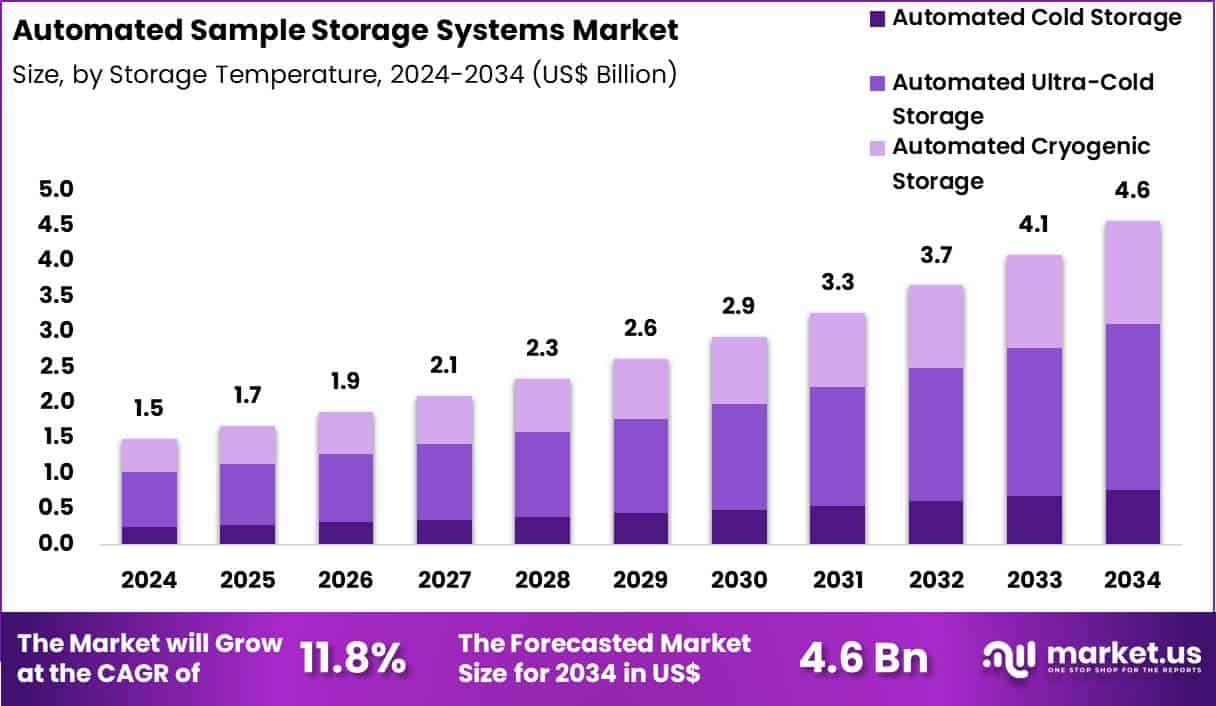
New York, NY – Sep 29, 2026 – The Global Automated Sample Storage Systems Market size is expected to be worth around US$ 4.6 Billion by 2034 from US$ 1.5 Billion in 2024, growing at a CAGR of 11.8% during the forecast period 2025 to 2034. In 2024, North America led the market, achieving over 38.5% share with a revenue of US$ 577.5 Million.
The global Automated Sample Storage Systems market is gaining importance as laboratories, biobanks, pharmaceutical companies, and research institutions increasingly require secure, high-capacity, and reliable sample management solutions. Automated sample storage systems are designed to store, retrieve, track, and manage biological specimens with limited manual intervention, improving operational efficiency and reducing the risk of sample handling errors.
These systems integrate automated robotics, temperature-controlled environments, sample identification technologies, and laboratory information management systems (LIMS) to support the organized storage of samples such as DNA, RNA, blood, tissue, cells, and other biological materials. Depending on application requirements, solutions can operate at ambient, refrigerated, or ultra-low temperatures.
Market growth is being supported by the expansion of biobanking activities, increasing pharmaceutical and biotechnology research, rising demand for personalized medicine, and the growing volume of biological samples generated through research and clinical activities. Automation also enables laboratories to optimize storage capacity, improve sample traceability, and maintain consistent environmental conditions.
Technological developments, including advanced robotics, barcode and RFID-based identification, remote monitoring, and software-driven inventory management, are further enhancing system capabilities. As laboratories continue to prioritize accuracy, scalability, and operational efficiency, automated sample storage systems are expected to become an increasingly important component of modern laboratory infrastructure.
Key Takeaways
- In 2024, the Automated Sample Storage Systems market generated US$ 1.5 billion in revenue and is projected to grow at a CAGR of 11.8%, reaching US$ 4.6 billion by 2034.
- By storage temperature, the market is segmented into automated cold storage, automated ultra-cold storage, and automated cryogenic storage. Automated ultra-cold storage (−80°C) dominated the segment in 2024, accounting for 51.1% of the market.
- Based on components, the market is categorized into system platforms/hardware, software, and others. System platforms/hardware held the largest share, accounting for 73.5% of the market.
- By sample type, the market is segmented into chemical & compound samples, biological samples, and others. Chemical & compound samples represented the leading segment, with a 65.5% revenue share.
- By application, the market includes long-term sample preservation, high-throughput sample retrieval and handling, regulatory-compliant sample management, and others. Long-term sample preservation led the market with a 39.2% revenue share.
- By end user, the market is divided into pharmaceutical and biotechnology companies, academic and clinical research laboratories, biobanks, and others. Pharmaceutical and biotechnology companies accounted for the largest share at 43.0%.
- Regionally, North America dominated the Automated Sample Storage Systems market in 2024, accounting for 38.5% of the global market.
Key Market Segments
- Storage Temperature Analysis: Automated ultra-cold storage at −80°C accounted for 51.1% of the market in 2024. Its dominance is supported by growing biologics research, precision medicine, and biorepository activities. Automation improves sample integrity, reduces contamination risks, minimizes temperature fluctuations, and strengthens monitoring and regulatory compliance.
- Component Analysis: System platforms and hardware represented 73.5% of the market in 2024, supported by substantial investments in robotic handling, storage infrastructure, and retrieval systems. Rising laboratory workloads, demand for scalable automation, improved traceability, and replacement of manual systems continue to support hardware adoption.
- Sample Type Analysis: Chemical and compound samples held the largest share at 65.5% in 2024, driven by extensive use in drug discovery, screening, and combinatorial chemistry. Automated systems enable accurate cataloging, rapid retrieval, consistent storage conditions, and improved sample tracking across pharmaceutical research workflows.
- Application Analysis: Long-term sample preservation accounted for 39.2% of the market in 2024. Growth is supported by increasing requirements for research reproducibility, regulatory compliance, and extended sample retention. Automated systems improve inventory tracking, minimize handling-related degradation, and support biobanking, clinical research, and disaster recovery.
- End-User Analysis: Pharmaceutical and biotechnology companies represented 43.0% of the market in 2024, supported by extensive sample inventories generated through drug discovery and development. Increasing R&D activity, regulatory requirements, biologics research, personalized medicine, and laboratory digitalization continue to drive investment in automated storage infrastructure.
Regional Analysis
North America
North America accounted for 38.5% of the global Automated Sample Storage Systems market in 2024, supported by strong genomic research, pharmaceutical R&D, clinical trials, and advanced biobanking infrastructure. Pharmaceutical and biotechnology companies increasingly deploy robotic retrieval systems, automated cryogenic storage, and ultra-low-temperature platforms to preserve high-value samples and compound libraries.
Integration of automated inventory tracking, redundant monitoring, and digital data systems is improving sample traceability, regulatory compliance, and operational efficiency. Public-private research initiatives are also strengthening demand for scalable storage solutions. The NIH All of Us Research Program had received more than 524,000 biosamples by November 2023, highlighting the scale of biological sample collection in the region.
Asia Pacific
Asia Pacific is expected to record the highest CAGR during the forecast period, driven by expanding precision medicine programs, biobanking activities, pharmaceutical research, and genomics initiatives. Governments and research institutions are investing in centralized cryogenic facilities, robotic freezers, and sensor-enabled storage systems.
Growing biotechnology activity and clinical research are further supporting adoption. The Westlake BioBank for Chinese pilot project included genomic analyses from 10,376 individuals, reflecting increasing regional investment in large-scale biological research.
Emerging Trends
- Integration with digital sample tracking: Automated storage is increasingly being connected with laboratory information management systems (LIMS), barcode readers, and electronic inventory databases. This enables each sample to have a traceable identity, storage location, processing history, and retrieval record, reducing manual tracking errors.
- Greater use of robotics for sample retrieval: Robotic systems are being used to move samples between storage locations and laboratory workstations. NCI facilities have demonstrated automated systems that retrieve samples from cold-storage units, supporting faster handling while reducing repetitive manual work and improving consistency.
- Growth of high-density and automation-ready sample formats: The increasing use of automated laboratories is encouraging biorepositories to adopt standardized tubes, racks, and two-dimensional barcodes. NIDDK specifically recommends automation-compatible vial formats and high-density SBS rack configurations where possible.
- Stronger focus on sample quality and temperature control: Modern automated systems are placing greater emphasis on maintaining stable storage conditions, monitoring temperatures, and reducing unnecessary sample exposure during retrieval. This is important because handling and storage conditions can affect downstream molecular and research results.
- Expansion toward fully automated biobanking workflows: The market is moving beyond automated storage alone toward integrated workflows covering sample receipt, identification, processing, storage, retrieval, and distribution. Recent research identifies automated storage, retrieval, liquid handling, and environmental monitoring as important components of automated biobanking.
Use Cases
- Biobanks and biorepositories: Automated systems are used to store large collections of blood, tissue, DNA, RNA, cells, and other biospecimens. Samples can be assigned permanent locations and retrieved through computerized inventory systems, supporting long-term research and future sample reuse.
- Pharmaceutical and drug discovery research: Pharmaceutical laboratories can use automated storage to manage large numbers of biological samples generated during drug discovery and development. Robotic retrieval and standardized storage can support high-throughput workflows while reducing manual handling and improving sample traceability.
- Clinical research and clinical trials: Clinical studies generate samples that may need to be stored for future testing or secondary research. Automated systems can support barcode-based identification, controlled storage, inventory management, and retrieval while maintaining records associated with individual specimens.
- Genomics, proteomics, and other high-throughput research: Large-scale genomics, proteomics, and metabolomics studies require well-identified biological samples and reliable storage. Automation can help laboratories handle increasing sample volumes while maintaining consistent storage and retrieval procedures.
- Precision medicine and cancer research: Cancer research increasingly depends on high-quality biospecimens and associated clinical information. Automated storage can support the controlled preservation, tracking, retrieval, and distribution of specimens used for biomarker research, molecular studies, and precision-medicine programs.
Frequently Asked Questions About Automated Sample Storage Systems
- What types of samples can these systems store?
Automated systems can store many biological materials, including blood, plasma, serum, DNA, RNA, tissue, cells, and other research specimens. The required storage temperature and container format depend on the sample type and intended future use. - What temperatures are used in automated sample storage?
Storage temperatures vary according to the biological material and research requirements. Automated repositories may support refrigerated, frozen, ultra-low-temperature, and cryogenic conditions. The NCI Central Repository, for example, provides cryogenic storage services ranging from +4°C to −196°C. - What is driving the automated sample storage systems market?
Market demand is being supported by growing biobanking activities, high-throughput research, increasing sample volumes, and the need for stronger sample traceability. Advances in genomics and other large-scale research methods are also increasing operational requirements for biorepositories. - Which industries use automated sample storage systems?
The main application areas include pharmaceutical research, biotechnology, clinical research, academic research, hospitals, diagnostic laboratories, and biobanks. These organizations use automated storage to manage biological samples that require controlled conditions, accurate tracking, and repeated retrieval. - What factors are important when selecting an automated storage system?
Important considerations include storage capacity, temperature range, sample type, retrieval speed, barcode compatibility, system integration, monitoring, reliability, and scalability. Container and rack standards are also important because automation-compatible formats can improve system compatibility and throughput. - How does automation improve sample quality?
Automation can reduce unnecessary handling and help maintain consistent storage and retrieval procedures. This is important because repeated handling, temperature changes, and inconsistent processing can affect biospecimen quality and potentially influence downstream research findings. - What is the future outlook for the automated sample storage systems market?
The market is expected to increasingly focus on integrated automation, higher storage density, digital inventory systems, robotics, environmental monitoring, and compatibility with high-throughput laboratory workflows. These developments are aligned with the broader movement toward standardized and scalable biobanking.
Conclusion
The global Automated Sample Storage Systems market is witnessing strong growth as laboratories, pharmaceutical and biotechnology companies, biobanks, and research institutions increasingly adopt automated solutions for efficient sample management.
Rising demand for high-capacity storage, improved traceability, temperature control, and reduced manual handling is supporting market expansion. Ultra-cold storage, hardware platforms, chemical and compound samples, long-term preservation, and pharmaceutical and biotechnology applications represent key market segments.
North America currently leads the market, while Asia Pacific is expected to experience rapid growth. Advancements in robotics, digital tracking, LIMS integration, remote monitoring, and high-density storage are further strengthening adoption, positioning automated sample storage as an important component of modern laboratory infrastructure.
Discuss your needs with our analyst
Please share your requirements with more details so our analyst can check if they can solve your problem(s)




