


Overview
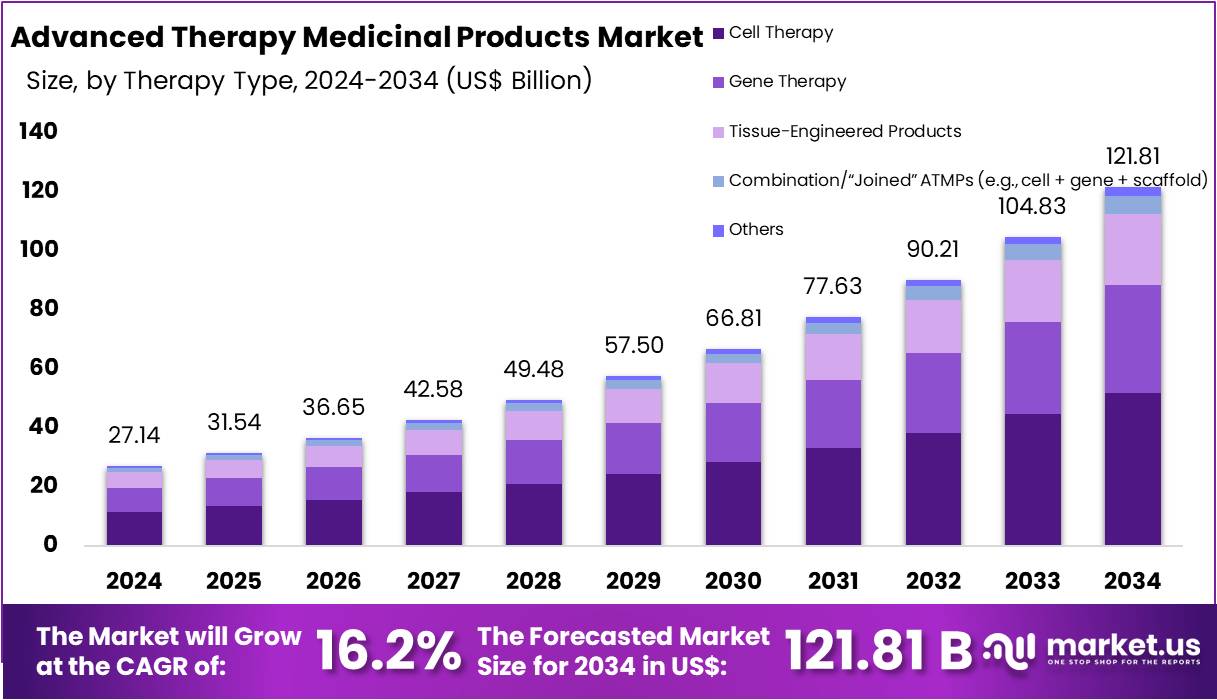
New York, NY – 31 Aug, 2026 – The Global Advanced Therapy Medicinal Products Market size is expected to be worth around US$ 121.81 Billion by 2034, from US$ 27.14 Billion in 2024, growing at a CAGR of 16.2% during the forecast period from 2025 to 2034. North America held a dominant market position, capturing more than a 43.8% share and holding US$ 11.88 Billion market value for the year.
The global Advanced Therapy Medicinal Products (ATMPs) market is gaining strong momentum due to rising investments in gene therapy, cell therapy, and tissue-engineered medicines. ATMPs represent a new generation of personalized treatments designed to address complex diseases, including cancer, rare genetic disorders, and immune-related conditions. The market is supported by advancements in biotechnology, improved manufacturing platforms, and increasing regulatory approvals for innovative therapies.
Regulatory progress has accelerated ATMP adoption worldwide. As of recent years, regulatory agencies have approved more than 30 gene and cell therapy products globally, including treatments for oncology, inherited disorders, and blood diseases. The United States Food and Drug Administration (FDA) has approved multiple cell and gene therapies since 2017, reflecting increasing confidence in advanced therapeutic technologies.
Growing clinical trial activity is further strengthening market expansion. Thousands of ATMP clinical studies are currently being evaluated worldwide, with oncology applications representing a significant share of research efforts. Increasing healthcare investments, rising rare disease awareness, and the development of scalable manufacturing technologies are expected to create new opportunities for ATMP companies during the forecast period.
Key Takeaways
- The global ATMPs market is projected to reach US$ 121.81 billion by 2034, expanding from US$ 27.14 billion in 2024 at a CAGR of 16.2% during the forecast period.
- Cell Therapy emerged as the leading therapy segment in 2024, accounting for more than 42.6% of the market share due to strong clinical adoption and increasing therapeutic applications.
- Somatic Cell Therapy Products represented the dominant product category in 2024, capturing over 38.9% share of the overall ATMPs portfolio.
- The Oncology segment led the application landscape in 2024, holding more than 34.8% market share, driven by growing demand for advanced cancer treatment solutions.
- Hospitals and Clinics were the leading end-user segment in 2024, contributing over 45.5% share due to improved access to advanced therapies and specialized healthcare infrastructure.
- North America dominated the global ATMPs market in 2024, accounting for more than 43.8% share and generating approximately US$11.88 billion in revenue.
Statistical Information
- Closed-system manufacturing approaches for cell and gene therapies reduced batch failures by 3× and lowered manufacturing costs by up to 45% while increasing production throughput by 3× in 2025 technical evaluations.
- Automated multiplexed closed systems for autologous cell therapy manufacturing achieved a 50% reduction in total manufacturing costs and more than 50% reduction in labor costs in 2026 research analysis.
- Automated closed-system cell therapy platforms demonstrated more than 80% reduction in facility-related costs and enabled a 15-fold increase in throughput per facility footprint in 2026 manufacturing modeling
- Fully automated CAR-T manufacturing models reduced production cost per product to approximately €42,000 compared with €61,000 for conventional approaches, representing about a 31% cost reduction in 2025 analysis.
- Automated CAR-T manufacturing systems reduced estimated production failure rates from 10% in manual production to 1% in automated production, representing a 90% reduction in manufacturing failures in 2025 modeling.
- Automated NK-cell manufacturing using closed systems achieved CD34+ cell recovery rates of 68.18%, 68.46%, and 71.94% across low, medium, and high starting cell-content groups in 2025 GMP manufacturing evaluations.
- Closed-system NK-cell manufacturing processes achieved final harvest yields of 74.59% for low-volume batches, 82.69% for medium-volume batches, and 83.74% for high-volume batches in 2025 process studies.
- Automated NK-cell manufacturing maintained cell purity above 80% while keeping B-cell and T-cell impurities low or undetectable during 2025 manufacturing validation studies.
- A 2025 analysis of EMA-approved ATMPs found that PRIME designation reduced marketing authorization timelines by 42.7%, shortening approval time by approximately 1 year compared with non-PRIME ATMPs.
- The same 2025 EMA ATMP analysis showed orphan designation reduced marketing authorization timelines by 32.8% for advanced therapy medicinal products.
- Automated CAR-T manufacturing achieved productivity of 11.7 products per square meter of cleanroom space compared with approximately 0.5 products per square meter for manual production in 2025 facility modeling.
- Automated ATMP manufacturing platforms reduced required cleanroom space by enabling 12 CAR-T products to be produced in 34 m² compared with 182 m² for semi-automated approaches in 2025 analysis.
Regional Analysis
In 2024, North America accounted for more than 43.8% of the global Advanced Therapy Medicinal Products (ATMP) market, reaching a value of US$ 11.88 billion. The region maintained its leadership through a strong biotechnology ecosystem, extensive clinical research infrastructure, and early adoption of advanced cell and gene therapies.
The United States continues to drive regional growth with supportive regulatory pathways such as the FDA’s Regenerative Medicine Advanced Therapy (RMAT) designation, which accelerates the development and review of promising regenerative therapies for serious diseases.
North America’s leadership is further supported by substantial investments in research and development, strong collaboration between biotechnology companies, academic institutions, and contract development and manufacturing organizations (CDMOs). Expanding manufacturing capacity, increasing clinical trials, and the growing prevalence of chronic, genetic, and rare diseases continue to fuel demand for personalized therapies.
The region also benefits from advanced healthcare infrastructure, favorable reimbursement systems, and continuous innovation in genome editing and regenerative medicine. With ongoing regulatory support and commercialization of new therapies, North America is expected to remain the leading regional market for ATMPs throughout the forecast period.
Emerging Trends
- Gene editing therapies are expanding rapidly: CRISPR-based treatments are moving from research into commercial healthcare after recent regulatory approvals. By the end of 2025, the FDA had approved 38 cell and gene therapy products, showing steady growth in advanced treatment options for rare diseases and cancer.
- Regulators are accelerating ATMP development: More therapies are receiving special regulatory support through orphan and expedited programs. A 2025 analysis found 86.8% of FDA-approved cell and gene therapies had orphan designation, while 92.1% used at least one expedited regulatory pathway, reducing development timelines.
- Manufacturing quality is becoming a major focus: Companies are investing in better potency testing, comparability studies, and process controls. A regulatory review found over 80% of approved cell and gene therapies faced manufacturing-related quality questions before approval, highlighting the importance of standardized production systems.
- Long-term patient monitoring is increasing: Because ATMPs can provide lasting biological effects, regulators now require stronger follow-up after approval. In 2025, the FDA issued draft guidance promoting structured post-market safety and effectiveness data collection for advanced cell and gene therapies.
- Protection against unregulated therapies is strengthening: Health authorities are increasing awareness campaigns to prevent patients from using unauthorized cell-based treatments. In 2025, the European Medicines Agency and national regulators issued updated public guidance warning against unapproved ATMPs promoted outside regulated clinical trials.
Use Cases
- Cancer treatment is the largest clinical application: CAR-T cell therapies and tumor-infiltrating lymphocyte therapies are providing new options for blood cancers and some solid tumors. The FDA’s approved cellular and gene therapy list now includes dozens of oncology-related products, reflecting growing clinical adoption.
- Rare genetic disorders are being treated with one-time gene therapies: ATMPs are replacing faulty genes or restoring missing proteins in inherited diseases. Recent FDA approvals include therapies for sickle cell disease, hemophilia, and several rare immune and metabolic disorders, expanding precision medicine applications.
- Regenerative medicine is repairing damaged tissues: Tissue-engineered skin, vascular grafts, and stem cell-based therapies are helping patients recover from severe injuries and inherited disorders. FDA approvals now include regenerative products for complex wounds and vascular reconstruction requiring advanced biological repair.
- Personalized medicine is improving treatment outcomes: Many ATMPs use a patient’s own cells to develop individualized therapies, reducing immune rejection risks. Regulatory studies found 73.7% of approved cell and gene therapies were supported by a single pivotal study, reflecting targeted development for small patient populations.
- Severe immune disorders are gaining new treatment options: Advanced gene therapies are offering long-term disease correction where conventional medicines provide limited benefit. Clinical evidence supporting a recent FDA approval showed 93% fewer severe infections and 60% less major bleeding in treated patients with a rare immune disorder.
Frequently Asked Questions on Advanced Therapy Medicinal Products
- What factors are driving the growth of the ATMP market?
Market growth is supported by rising cases of genetic disorders and cancer, advances in gene-editing technologies, increasing clinical research, government funding, improved manufacturing capabilities, and supportive regulatory pathways that accelerate the development and approval of advanced therapies worldwide. - Which therapy type dominates the ATMP market?
Cell therapy currently represents the largest share of the ATMP market because of its broad application in oncology, autoimmune disorders, and regenerative medicine. Continuous research, increasing clinical evidence, and expanding manufacturing capacity further strengthen its commercial adoption across healthcare systems. - Which diseases are commonly treated using ATMPs?
ATMPs are widely studied and used for cancers, inherited genetic disorders, blood diseases, immune deficiencies, neurological conditions, and tissue injuries. Researchers are also evaluating these therapies for cardiovascular diseases, eye disorders, and several rare conditions with limited treatment options. - What challenges does the Advanced Therapy Medicinal Products Market face?
The market faces challenges including high manufacturing costs, complex supply chains, strict regulatory requirements, specialized storage and transportation needs, reimbursement limitations, and difficulties in scaling production while maintaining consistent product quality and patient safety. - Why are regulatory agencies important for ATMP development?
Regulatory agencies establish standards for product quality, manufacturing, clinical testing, and patient safety before approving ATMPs. Their scientific evaluations help ensure therapies are effective, reliable, and manufactured according to internationally accepted guidelines before reaching healthcare providers. - Which region leads the Advanced Therapy Medicinal Products Market?
North America leads the ATMP market because of strong biotechnology infrastructure, high healthcare expenditure, significant research funding, increasing clinical trial activity, advanced manufacturing facilities, and supportive regulatory frameworks that encourage innovation and commercialization of advanced therapeutic products. - How is artificial intelligence supporting the ATMP market?
Artificial intelligence improves ATMP development by accelerating drug discovery, analyzing biological data, optimizing manufacturing processes, predicting treatment outcomes, and enhancing quality control. These capabilities reduce development timelines while supporting more efficient and personalized therapeutic solutions. - What is the future outlook for the Advanced Therapy Medicinal Products Market?
The ATMP market is expected to experience sustained long-term growth as more therapies receive regulatory approval, manufacturing technologies improve, personalized medicine expands, and investments in gene and cell therapy research continue increasing across both developed and emerging healthcare markets.
Conclusion
The Advanced Therapy Medicinal Products (ATMPs) market is poised for strong long-term growth as regenerative medicine transforms the treatment of cancer, rare genetic disorders, neurological diseases, and other chronic conditions. Growth is supported by rising approvals of cell and gene therapies, expanding clinical research, technological advances in manufacturing, and increasing healthcare investments.
North America remains the leading regional market, while demand continues to grow globally as personalized medicine gains wider acceptance. Continued regulatory support and innovation are expected to strengthen commercialization and improve patient access to advanced therapies.
Discuss your needs with our analyst
Please share your requirements with more details so our analyst can check if they can solve your problem(s)




