


Overview
New York, NY – Aug 12, 2026 – The Global Healthcare Biometrics Market size is expected to reach around US$ 40.4 Billion by 2034, up from US$ 8.7 Billion in 2024, growing at a CAGR of 16.6% during the forecast period from 2025 to 2034. North America held a dominant market position, capturing more than a 35.9% share and holding a US$ 3.1 billion market value for the year.
The Global Healthcare Biometrics Market is gaining momentum as healthcare providers increasingly adopt fingerprint recognition, iris scanning, facial recognition, and voice authentication to improve patient identification, data security, and digital healthcare access. These technologies are replacing traditional passwords and physical ID cards with secure identity verification solutions. The adoption aligns with the World Health Organization’s Global Strategy on Digital Health (2020–2025), which highlights the importance of trusted digital identity systems for safer healthcare delivery.
Patient safety remains a major growth factor for healthcare biometrics. According to the WHO, medication errors create an estimated USD 42 billion economic burden annually worldwide, increasing demand for accurate patient matching systems. Biometric authentication helps reduce wrong-patient incidents during registration, medication administration, diagnostics, and medical procedures by ensuring real-time identity verification.
The expansion of telemedicine is also accelerating demand for biometric-enabled healthcare platforms. In the United States, approximately 37% of adults used telehealth services in 2021, creating greater need for secure remote patient authentication. Healthcare organizations are integrating biometric login features into mobile applications to improve convenience while maintaining privacy and security standards.
Growing healthcare data breaches are further supporting market adoption. The U.S. Department of Health & Human Services continues to report large-scale protected health information exposures, encouraging hospitals to strengthen identity and access management systems. Additionally, the aging population and increasing healthcare interactions are driving demand for fast and reliable identification solutions. With around 850 million people globally lacking official identification, biometric-based digital identity initiatives are expected to play an important role in expanding secure healthcare access worldwide.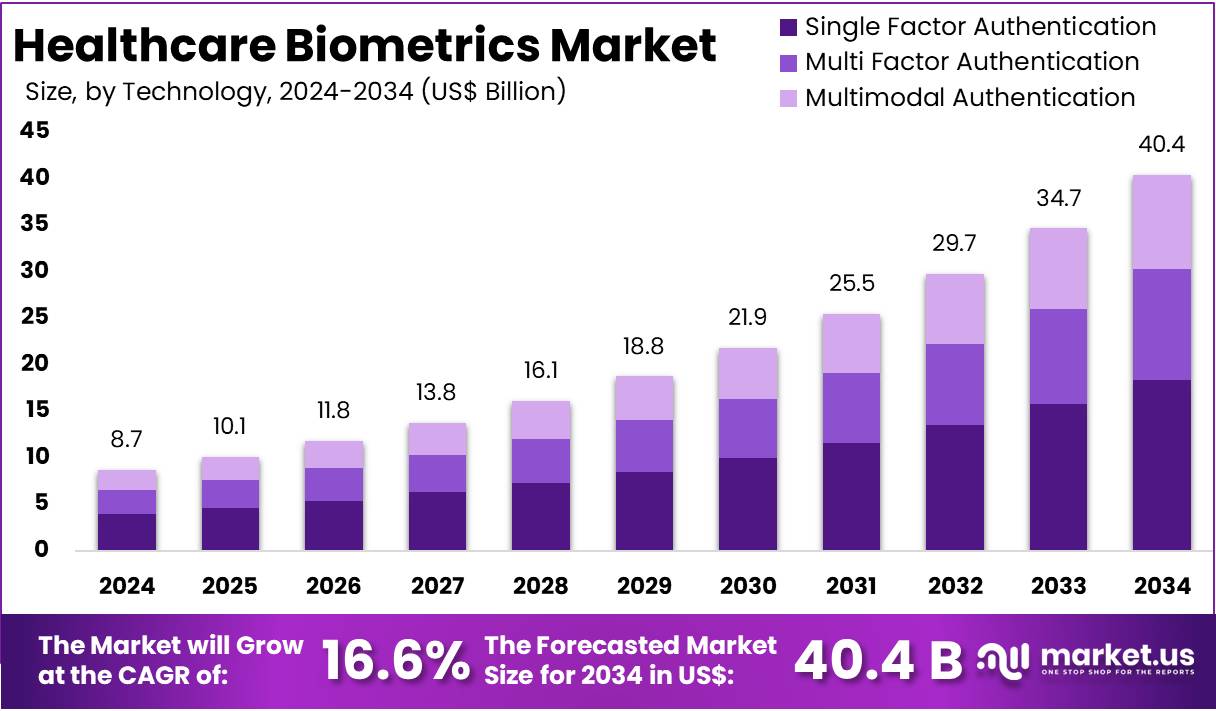
Key Takeaways
- The global healthcare biometrics market is estimated to expand from US$ 8.7 billion in 2024 to nearly US$ 40.4 billion by 2034.
- The healthcare biometrics market is expected to register a CAGR of 16.6% between 2025 and 2034, driven by increasing adoption of secure patient identification and digital healthcare solutions.
- In 2024, the Single Factor Authentication segment dominated the technology category, accounting for more than 45.5% of the global healthcare biometrics market share.
- The Hardware segment led the component category in 2024, contributing over 47.1% share of the overall healthcare biometrics market.
- The Patient Identification & Tracking segment held the largest share in the application category, representing more than 31% of the market in 2024.
- Hospitals and Clinics emerged as the leading end-user segment in 2024, capturing over 42.4% share of the global healthcare biometrics market.
- North America maintained a leading regional position in 2024, accounting for more than 35.9% market share, with a market value of approximately US$ 3.1 billion.
Statistical Information
- Patient Misidentification Risks Increasing Demand for Biometric Patient Matching: Patient identification errors are driving healthcare providers to adopt biometric solutions such as fingerprint, facial, and iris recognition systems. According to the WHO, unsafe healthcare practices contribute to significant patient harm globally, with approximately 1 in 10 patients experiencing harm during healthcare delivery. More than 3 million deaths annually are associated with unsafe care, and over 50% of patient harm is considered preventable.
- Telemedicine Expansion Supporting Biometric Authentication Adoption: The rapid growth of virtual healthcare services is increasing demand for secure patient authentication solutions. According to the U.S. National Center for Health Statistics, 37.0% of U.S. adults used telemedicine services in 2021. Usage was higher among women at 42.0% compared with men at 31.7%. Among adults aged 65 years and older, telemedicine usage reached 43.3%, showing strong adoption among populations requiring frequent healthcare interactions.
- Global Digital Identity Gaps Creating Demand for Biometric Healthcare Access: Biometric-enabled digital identity systems are expanding healthcare accessibility by helping individuals without traditional identification documents access essential services. The World Bank’s Identification for Development (ID4D) initiative estimates that approximately 800 million people worldwide lack official proof of identity, while around 2.8 billion people lack access to digital ID systems for online services.
- Electronic Health Record Expansion Supporting Biometric Patient Matching: The increasing adoption of electronic health records is creating demand for accurate patient identity management solutions. According to the Office of the National Coordinator for Health Information Technology (ONC), approximately 96% of non-federal acute care hospitals in the United States had adopted certified electronic health record technology by 2021, while more than 80% of office-based physicians used certified EHR systems.
- Patient Record Matching Accuracy: A healthcare IT firm reports that matching patients to their medical records can be as low as 80% accurate within a single care setting and drops to 50% accuracy when organizations exchange electronic health information, illustrating substantial identity risk that drives demand for biometric patient‑matching technologies.
- Frequency And Cost Of Misidentification: Analysis of 227 Veterans Health Administration root‑cause reports found that 182 of 253 errors in one test cycle were due to patient misidentification. A Ponemon‑based national report cited by PSNet notes hospitals lose an average of USD 17.4 million annually in denied claims linked to misidentification, highlighting a strong economic driver for biometric identification.
- Laboratory and Specimen Identification Error Rates: A comprehensive evidence review of patient identification errors found patient ID error rates of 0.04% for electronic laboratory registration and 0.075% for manual registration in a multisite study of over 161,000 lab events. Across various institutions, 11.6–36% of clinical laboratory errors involved patient ID problems, and wrong‑blood‑in‑tube rates ranged from 0.0018% to 0.04%.
- Misidentification and Error Rates Across Settings: Forward Advantage, citing ONC and other data, reports that 7 of every 100 patient records are mismatched, with error rates of 10–20% within a single healthcare entity and 50–60% when entities exchange records. The same source notes that about 10% of patients are misidentified at check‑in, reinforcing the case for biometric solutions.
Regional Analysis
North America held a dominant regional position in 2024, capturing over 35.9% market share
North America represents a leading region in healthcare biometrics adoption due to advanced healthcare infrastructure, strong digital health adoption, and strict data security regulations. In the United States, the Office of the National Coordinator for Health IT (ONC) reported that nearly 96% of non-federal acute care hospitals adopted certified electronic health record (EHR) systems by 2021, creating a strong foundation for biometric patient identification and secure access management.
Healthcare spending also supports technology investments, with OECD reporting that U.S. health expenditure reached $12,555 per person in 2022, among the highest globally. Regulatory initiatives, including DEA requirements for secure electronic prescribing of controlled substances, encourage stronger authentication methods. Additionally, rising healthcare cybersecurity incidents reported by the U.S. Department of Health & Human Services (HHS) are driving demand for biometric solutions to protect patient data and improve identity verification across healthcare systems.
Emerging Trends
- AI-Powered Facial Recognition and Contactless Biometrics Adoption: Healthcare providers are increasingly using AI-based facial recognition and contactless biometric systems for patient identification, hospital access, and digital healthcare services. These solutions reduce manual verification time and improve accuracy. The FDA has listed more than 1,000 AI-enabled medical devices by 2024, showing increasing adoption of AI technologies in healthcare environments. Facial biometrics is gaining importance in touch-free healthcare workflows, especially for patient registration and remote care access.
- Biometric Patient Identification Integration with Electronic Health Records (EHR): Healthcare organizations are integrating biometric identification with electronic health record systems to improve patient matching accuracy and reduce duplicate records. According to ONC, approximately 96% of non-federal acute care hospitals in the United States adopted certified EHR systems by 2021. This widespread digital record adoption creates opportunities for fingerprint, facial, and iris-based authentication systems to improve healthcare data accuracy and security.
- Multi-Factor Authentication and Passwordless Healthcare Security: Healthcare organizations are moving toward biometric-enabled multi-factor authentication to protect sensitive patient information and reduce password-related risks. NIST recommends phishing-resistant authentication methods for securing digital services. Growing cyber threats have increased demand for stronger identity verification, especially as healthcare providers manage electronic medical records, telemedicine platforms, and connected medical systems. HHS continues to report large healthcare breaches involving unauthorized access and hacking incidents affecting thousands of individuals.
- Telehealth Platforms Increasing Demand for Biometric Authentication: The expansion of telemedicine is creating demand for secure biometric login solutions that verify patients remotely. According to CDC data, 37% of U.S. adults used telemedicine services in 2021, highlighting strong consumer adoption of virtual healthcare. Healthcare applications are increasingly using fingerprint, facial recognition, and voice authentication to provide secure access to online consultations, prescriptions, and patient portals.
- Biometric Security for Healthcare Cybersecurity and Data Protection: Rising healthcare cybersecurity incidents are accelerating the adoption of biometric identity solutions. HHS requires healthcare organizations to report breaches affecting 500 or more individuals, and its breach portal continues to record incidents involving hacking, unauthorized access, and electronic health information exposure. Healthcare providers are using biometrics as an additional security layer to protect patient records, reduce credential misuse, and strengthen identity management systems.
Use Cases
- Patient Registration and Identification in Hospitals: Biometric patient identification is increasingly used during hospital registration, emergency care, and outpatient visits to ensure accurate patient matching. Hospitals use fingerprint, facial, and iris recognition technologies to connect patients with correct medical records. With U.S. hospitals handling approximately 139 million emergency department visits in 2022, faster identity verification has become important for improving patient safety and reducing administrative errors.
- Secure Access to Electronic Medical Records: Healthcare providers are using biometric authentication to control access to electronic medical records and prevent unauthorized viewing of patient information. With nearly 96% of U.S. hospitals using certified EHR systems, secure authentication has become essential for protecting digital health data. Fingerprint and facial recognition systems allow authorized healthcare workers to access records quickly while maintaining privacy compliance.
- Biometric Authentication in Telemedicine Applications: Telemedicine platforms are adopting biometric login systems to verify patients before virtual consultations. These solutions improve security by replacing traditional passwords with fingerprint, facial, or voice authentication. With 37% of U.S. adults using telemedicine in 2021, healthcare providers require reliable digital identity solutions to support remote patient interactions.
- Medication Management and Prescription Verification: Biometric systems are being used in hospitals and pharmacies to verify patient identity before medication dispensing and administration. These solutions help reduce medication errors by ensuring that medicines are provided to the correct patient. WHO estimates medication errors create approximately US$42 billion in economic losses annually worldwide, increasing demand for safer identification methods.
- Staff Authentication and Healthcare Facility Security: Hospitals are implementing biometric access control systems for healthcare workers to secure restricted areas, medical equipment, and patient information systems. The U.S. healthcare and social assistance sector employed approximately 22 million workers in 2023, creating demand for reliable staff authentication methods. Biometrics helps organizations verify authorized personnel and improve healthcare facility security.
Frequently Asked Questions on Healthcare Biometrics
- Why is healthcare biometrics important in healthcare systems?
Healthcare biometrics improves patient identification accuracy, reduces medical errors, and strengthens protection of sensitive health information. By replacing traditional passwords and identity cards, biometric systems help healthcare providers deliver safer services, prevent unauthorized access, and improve operational efficiency across healthcare environments. - What types of biometric technologies are used in healthcare?
Healthcare organizations use fingerprint recognition, facial recognition, iris scanning, palm recognition, and voice authentication technologies. These systems are integrated into patient registration platforms, hospital security systems, electronic health records, and telehealth applications to provide secure identity verification. - How does healthcare biometrics support telemedicine services?
Healthcare biometrics supports telemedicine by providing secure patient authentication during virtual consultations and digital healthcare interactions. Facial recognition, fingerprint login, and voice verification allow patients to access telehealth platforms conveniently while helping providers protect medical information and maintain privacy standards. - How does biometric authentication improve healthcare cybersecurity?
Biometric authentication strengthens healthcare cybersecurity by reducing dependence on passwords vulnerable to theft and phishing attacks. Fingerprint and facial recognition systems provide stronger identity verification, helping hospitals protect electronic health records, patient portals, and healthcare applications from unauthorized access. - How does artificial intelligence influence healthcare biometrics?
Artificial intelligence improves healthcare biometrics by enhancing facial recognition accuracy, voice authentication, and automated identity verification. AI-powered systems analyze biometric data faster and support healthcare organizations in improving patient registration, digital healthcare access, and secure authentication processes. - What role does biometric authentication play in electronic health records?
Biometric authentication helps secure electronic health records by ensuring only authorized patients and healthcare professionals can access sensitive information. Integrating biometrics with EHR systems improves identity accuracy, protects medical data, and reduces risks related to unauthorized record access. - What is the future outlook for the healthcare biometrics market?
The healthcare biometrics market is expected to grow with digital health transformation, cybersecurity requirements, telemedicine expansion, and increasing demand for secure patient identification. Healthcare organizations are likely to adopt advanced biometric solutions to improve safety, efficiency, data protection, and patient engagement.
Conclusion
The healthcare biometrics market is experiencing strong growth as healthcare providers increasingly prioritize secure patient identification, digital health access, and data protection. Rising adoption of electronic health records, telemedicine, remote monitoring, and cybersecurity solutions is accelerating demand for biometric authentication technologies.
Fingerprint recognition, facial recognition, iris scanning, and voice authentication are improving patient safety, reducing medical errors, and strengthening healthcare workflows. Supportive government initiatives, increasing digital transformation, and growing security concerns are further driving adoption across hospitals, clinics, and healthcare platforms. With continuous advancements in artificial intelligence and identity management, healthcare biometrics is expected to become an essential component of future healthcare systems.
Discuss your needs with our analyst
Please share your requirements with more details so our analyst can check if they can solve your problem(s)




