
Overview
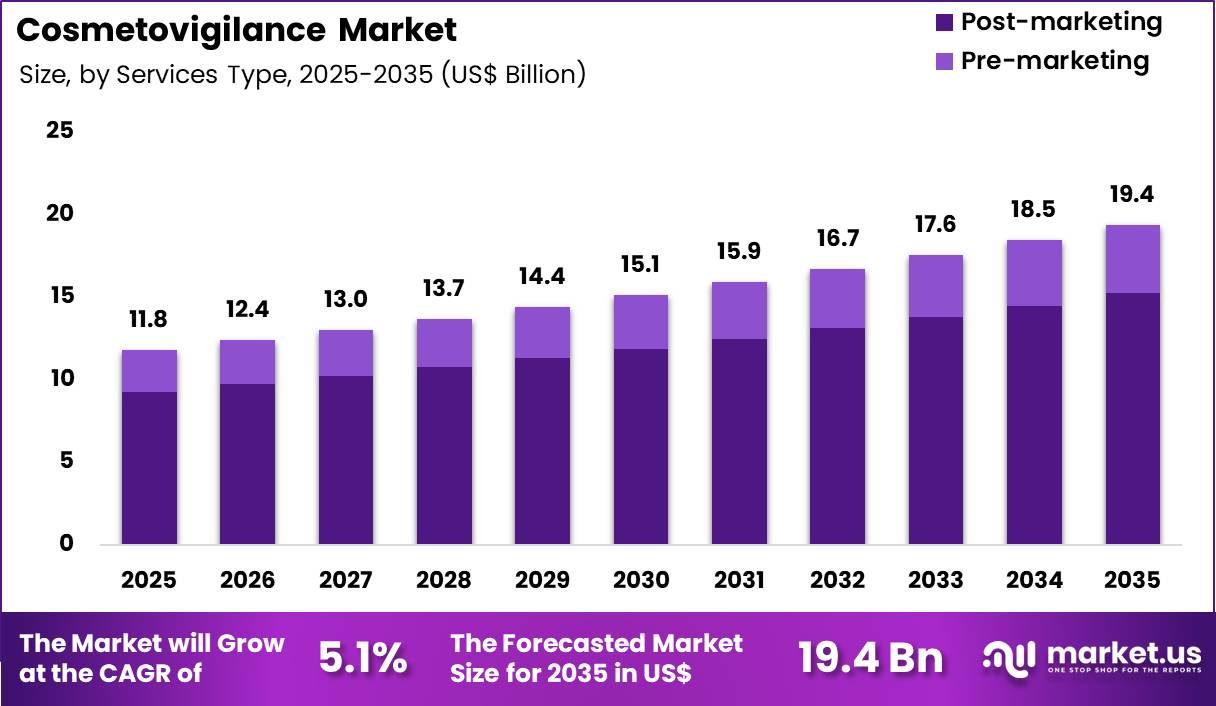
New York, NY – Nov 26 2026 – The Global Cosmetovigilance Market size is expected to be worth around US$ 19.4 Billion by 2035 from US$ 11.8 Billion in 2025, growing at a CAGR of 5.1% during the forecast period 2026-2035. In 2025, Europe led the market, achieving over 38.4% share with a revenue of US$ 4.5 Billion.
Cosmetovigilance refers to the systematic monitoring, collection, assessment, and prevention of adverse effects associated with the use of cosmetic products. It plays an important role in ensuring consumer safety by identifying potential risks, including skin irritation, allergic reactions, eye irritation, and other unwanted effects resulting from cosmetic product use.
With the growing demand for skincare, haircare, makeup, and personal care products, the importance of cosmetovigilance has increased significantly. The expanding use of innovative ingredients, active formulations, and multifunctional cosmetic products has further highlighted the need for effective safety monitoring systems.
Cosmetovigilance involves adverse event reporting, safety assessments, product monitoring, risk evaluation, and regulatory compliance. It enables manufacturers, regulatory authorities, and healthcare professionals to identify potential product-related safety concerns and take appropriate corrective measures. These measures may include product reformulation, updated safety warnings, improved labelling, or product recalls when necessary.
In addition, increasing consumer awareness regarding product safety, rising regulatory expectations, and the growing adoption of transparent manufacturing practices are supporting the development of cosmetovigilance systems worldwide.
Overall, cosmetovigilance is becoming an essential component of the cosmetics industry, helping manufacturers strengthen consumer confidence, improve product safety, and support the sustainable growth of the global beauty and personal care market.
Key Takeaways
- In 2025, the market was valued at US$ 11.8 billion, registering a CAGR of 5.1%, and is projected to reach US$ 19.4 billion by 2035.
- Based on phase type, the market is segmented into pre-clinical, Phase I, Phase II, Phase III, and Phase IV, with Phase IV dominating the market with a 75.1% share.
- By service type, the market is categorized into pre-marketing and post-marketing, with post-marketing accounting for the largest share of 78.5%.
- By category, the market is segmented into skincare, makeup, haircare, and perfumes & deodorants, with skincare leading the market with a revenue share of 33.1%.
- Based on service providers, the market is divided into in-house and contract outsourcing, with contract outsourcing holding the dominant revenue share of 60.5%.
- Regionally, Europe dominated the market, accounting for a revenue share of 38.4%.
Key Market Segments
- Phase Type Analysis: Phase IV dominates the cosmetovigilance market, accounting for 75.1% of the segment share, driven by the growing need for post-marketing safety monitoring. Continuous adverse event reporting, regulatory compliance, and real-world product assessments are supporting segment growth. Increasing consumer awareness and digital reporting systems are further strengthening demand for Phase IV activities.
- Services Type Analysis: Post-marketing leads the cosmetovigilance market with a 78.5% share, supported by the growing need for continuous product safety monitoring after commercialization. Regulatory reporting requirements, increasing cosmetic consumption, and rising consumer awareness are driving demand. Additionally, digital reporting platforms and advanced data analytics are improving adverse event tracking and safety assessments.
- Category Analysis: Skincare dominates the category segment, accounting for 33.1% of the cosmetovigilance market, driven by frequent product usage and prolonged skin exposure. Increasing concerns regarding allergies, irritation, and sensitivity are strengthening safety monitoring requirements. Moreover, rising demand for active ingredients and complex formulations is encouraging manufacturers to adopt comprehensive cosmetovigilance practices.
- Service Provider Analysis: Contract outsourcing holds the leading position in the service provider segment, accounting for 60.5% of the market share. Its dominance is driven by the growing preference for specialized safety monitoring services, regulatory expertise, and cost-effective solutions. Increasing demand for scalable reporting systems and efficient adverse event management is further supporting segment growth.
Regional Analysis
Europe is leading the Cosmetovigilance Market
Europe dominated the cosmetovigilance market in 2025, accounting for 38.4% of the market share. The region’s leadership is attributed to stringent cosmetic safety regulations, mandatory adverse event reporting, and well-established post-marketing surveillance systems. The EU regulatory framework requires manufacturers to maintain product safety assessments and monitor undesirable effects.
Growing consumer awareness regarding ingredient safety, skin sensitivity, and allergic reactions is further strengthening demand for cosmetovigilance services. Additionally, increasing investments in digital safety monitoring platforms are improving adverse event reporting, data management, and regulatory compliance across the region.
The Asia Pacific region is expected to experience the highest CAGR during the forecast period
Asia Pacific is anticipated to register the highest CAGR during the forecast period, driven by rising cosmetic consumption, increasing disposable incomes, and growing beauty awareness.
Countries such as China, Japan, South Korea, and India are strengthening cosmetic safety regulations and monitoring practices. Furthermore, increasing investments in digital reporting systems, ingredient transparency, and quality assurance are expected to accelerate the adoption of cosmetovigilance services across the region.
Emerging Trends
- Digital adverse event reporting systems: The adoption of digital reporting platforms is increasing the efficiency of cosmetic safety monitoring. In September 2025, the US FDA launched a public dashboard for cosmetic adverse event reports, allowing users to access and download updated reporting data.
- Artificial intelligence and automated safety monitoring: Artificial intelligence and automated data analysis are emerging as useful tools for identifying patterns in cosmetic-related complaints. These technologies can help manufacturers review large volumes of consumer feedback, identify repeated reactions, and support faster safety investigations.
- Stronger regulatory requirements for cosmetic safety: Regulatory requirements are becoming more structured across major markets. Under the US MoCRA framework, responsible persons must report serious cosmetic-related adverse events to the FDA within 15 business days and maintain supporting product safety records.
- Growing focus on ingredient safety and allergen monitoring: Greater attention is being given to fragrance ingredients, preservatives, colourants, and other substances that may cause allergic reactions or skin irritation. Cosmetic manufacturers are increasingly assessing ingredient-related risks to improve product safety and reduce consumer complaints.
- Greater transparency and international safety cooperation: Regulatory authorities are strengthening information sharing and public access to cosmetic safety information. In Europe, market surveillance authorities cooperate through PEMSAC to exchange information, coordinate activities, and improve the monitoring of serious undesirable effects.
Use Cases
- Monitoring skin allergies and irritation: Cosmetovigilance is used to identify and investigate skin reactions associated with skincare products, including moisturisers, sunscreens, face washes, and serums. Reported cases help manufacturers identify problematic ingredients and improve product formulations.
- Evaluating haircare product safety: Hair dyes, shampoos, conditioners, and hair treatments are monitored for unwanted effects such as scalp irritation, allergic reactions, burns, and unexpected hair loss. The collected information supports product safety assessments and corrective actions.
- Monitoring makeup and personal care products: Cosmetic safety monitoring is applied to foundations, mascaras, lipsticks, and other personal care products. Reports of eye irritation, rashes, infections, and allergic reactions can be assessed to identify potential product-related safety concerns.
- Supporting product recalls and regulatory compliance: Cosmetovigilance data helps manufacturers and regulatory authorities investigate serious product-related incidents. When a safety risk is identified, the findings can support product withdrawals, recalls, regulatory reporting, and other corrective measures.
- Assessing the safety of newly launched cosmetics: Manufacturers use post-market safety monitoring to assess products after commercial launch. Consumer complaints, healthcare professional reports, and adverse event information can be reviewed to identify safety concerns that may not have been detected during initial product testing.
Frequently Asked Questions About Cosmetovigilance
- Why is cosmetovigilance important?
Cosmetovigilance is important because cosmetic products are used regularly and may cause allergic reactions, skin irritation, infections, or other unwanted effects. Continuous safety monitoring helps identify these problems and supports better consumer protection. - What types of adverse effects are monitored through cosmetovigilance?
Cosmetovigilance monitors several unwanted effects, including skin rashes, redness, itching, burns, swelling, eye irritation, allergic reactions, infections, and unexpected hair loss. Serious cases may require medical treatment or regulatory investigation. - Who is responsible for cosmetovigilance activities?
Cosmetic manufacturers, distributors, importers, healthcare professionals, and regulatory authorities contribute to cosmetic safety monitoring. Their responsibilities include collecting complaints, investigating adverse reactions, maintaining safety information, and reporting serious incidents according to applicable regulations. - How are adverse events reported in cosmetovigilance?
Adverse events can be reported through regulatory reporting portals, consumer complaint systems, healthcare professionals, or directly to manufacturers. Reports generally include product details, symptoms, exposure information, and relevant medical documentation. - What factors are driving the growth of the cosmetovigilance market?
The market is being supported by increasing cosmetic product consumption, stronger safety regulations, growing consumer awareness, and the need for effective adverse event reporting. Digital monitoring solutions are also improving cosmetic safety management. - Which product categories require cosmetovigilance monitoring?
Cosmetovigilance monitoring covers skincare, haircare, makeup, fragrances, sunscreens, and personal hygiene products. These categories are assessed for potential adverse effects, including allergic reactions, irritation, infections, and other unwanted health-related outcomes. - What is the role of technology in the cosmetovigilance market?
Technology supports digital complaint collection, adverse event documentation, safety data analysis, and regulatory reporting. Artificial intelligence and automated monitoring can help identify repeated safety concerns and improve the efficiency of product safety investigations. - What opportunities are emerging in the cosmetovigilance market?
Opportunities are emerging through AI-based safety analysis, cloud-based reporting platforms, outsourced monitoring services, and improved consumer reporting systems. Growing regulatory attention is also creating demand for specialised cosmetic safety assessment and compliance solutions.
Conclusion
The global cosmetovigilance market is expected to witness steady growth, driven by increasing cosmetic product consumption, stringent regulatory requirements, and rising consumer awareness regarding product safety. The growing adoption of digital reporting platforms, artificial intelligence, and advanced safety monitoring solutions is further strengthening market development.
Post-marketing surveillance, skincare safety monitoring, and contract outsourcing are expected to remain key growth areas. Europe is anticipated to maintain its leading position, while Asia Pacific is expected to offer significant growth opportunities. Overall, increasing investments in regulatory compliance, adverse event management, and product safety assessment will support the long-term expansion of the global cosmetovigilance market.
Discuss your needs with our analyst
Please share your requirements with more details so our analyst can check if they can solve your problem(s)