
Overview
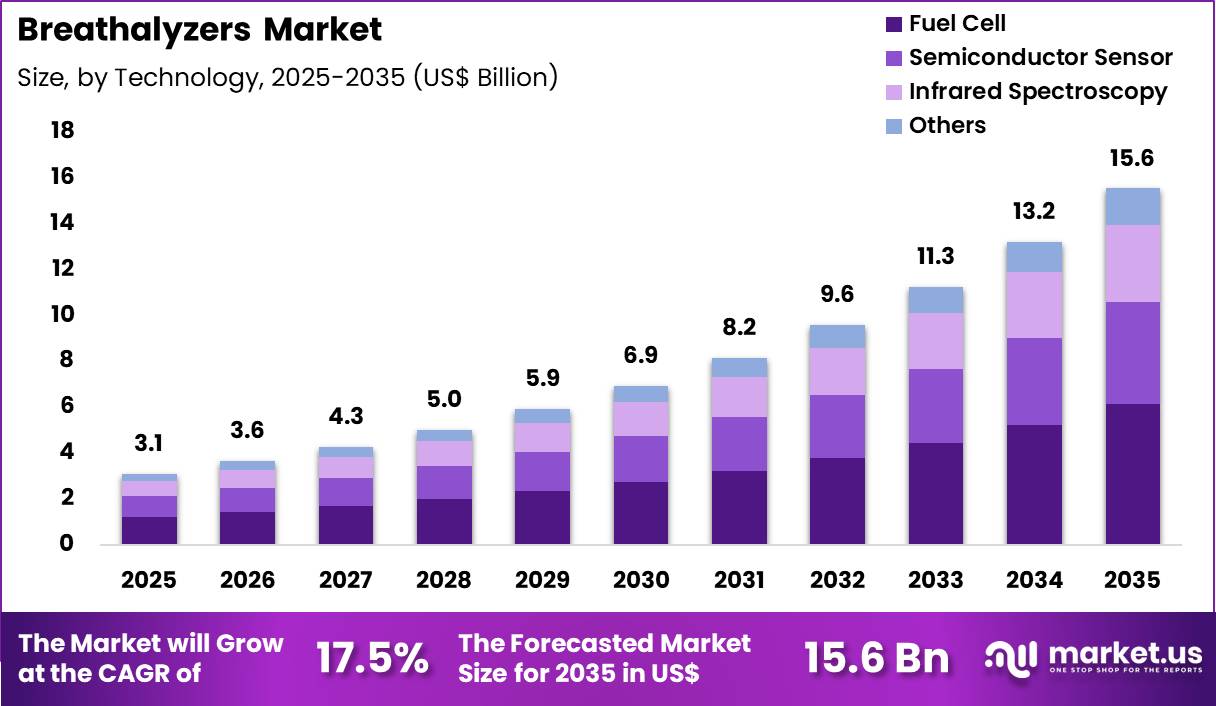
New York, NY – Nov 26 2026 – The Global Breathalyzers Market size is expected to be worth around US$ 15.6 Billion by 2035 from US$ 3.1 Billion in 2025, growing at a CAGR of 17.5% during the forecast period 2026-2035. In 2025, North Americaled the market, achieving over 32.6% share with a revenue of US$ 1.0 Billion.
Breathalyzers are electronic devices used to measure the concentration of alcohol in a person’s breath and estimate their blood alcohol concentration (BAC). These devices play an important role in road safety, workplace alcohol testing, law enforcement, and personal health monitoring. Breathalyzers generally operate using three main technologies: fuel cell sensors, semiconductor sensors, and infrared spectroscopy. Among these, fuel cell technology is widely used in professional-grade devices due to its accuracy and reliability.
The growing emphasis on preventing drunk driving, increasing road safety regulations, and rising awareness of alcohol-related risks is supporting the demand for breathalyzers across various sectors. Law enforcement agencies use these devices for roadside alcohol screening, while employers in transportation, construction, aviation, and manufacturing use them to maintain workplace safety. Personal breathalyzers are also gaining attention among consumers seeking convenient alcohol monitoring solutions.
Technological advancements, including smartphone connectivity, portable designs, digital displays, and improved sensor accuracy, are further enhancing product functionality. Additionally, the implementation of stricter drink-driving regulations and government-led road safety initiatives is expected to create new growth opportunities for the industry.
Going forward, increasing adoption of advanced alcohol detection technologies, expanding workplace safety requirements, and continued investments in public safety infrastructure are expected to support the development of the global breathalyzer market.
Key Takeaways
- In 2025, the global breathalyzer market was valued at US$ 3.1 Billion and is projected to grow at a CAGR of 17.5%, reaching US$ 15.6 Billion by 2035.
- Based on technology, the market is segmented into fuel cell, semiconductor sensor, infrared spectroscopy, and others. Among these, the fuel cell segment dominated the market, accounting for 39.5% of the total market share.
- By application, the market is categorized into drug abuse detection, alcohol detection, medical applications, and others. The alcohol detection segment emerged as the leading category, capturing 51.2% of the market share.
- Based on end use, the market is divided into law enforcement agencies, enterprises, individuals, and others. The law enforcement agencies segment dominated the market, accounting for 41.6% of the total revenue share.
- Regionally, North America dominated the global breathalyzer market, accounting for 32.6% of the overall market share.
Key Market Segments
- Technology Analysis: The fuel cell segment dominated the breathalyzers market, accounting for 39.5% of the technology segment. Its growth is driven by high accuracy, reliability, and selectivity in alcohol detection. Widespread adoption by law enforcement agencies, stringent testing regulations, and advancements in sensor durability and calibration stability are further supporting segment growth.
- Application Analysis: The alcohol detection segment dominated the breathalyzers market, accounting for 51.2% of the application segment. Growth is primarily driven by stringent drunk driving regulations, increasing road safety awareness, and rising demand for alcohol testing. Widespread use in roadside inspections, workplace safety programs, and public safety initiatives is further strengthening segment demand.
- End-Use Analysis: The law enforcement agencies segment dominated the breathalyzers market, accounting for 41.6% of the end-use segment. Its leading position is supported by extensive device deployment for roadside screening and evidential testing. Increasing government investments in road safety initiatives, stricter drunk driving regulations, and growing demand for accurate alcohol detection are further driving adoption.
Regional Analysis
North America Breathalyzers Market Analysis
North America dominated the breathalyzers market in 2025, accounting for 32.6% of the global market share. Regional growth is supported by stringent drunk driving regulations, increasing roadside alcohol testing, and growing adoption of workplace safety programs. Law enforcement agencies across the United States and Canada widely use handheld and evidential breathalyzers for alcohol screening.
According to the National Highway Traffic Safety Administration (NHTSA), alcohol-impaired driving accounted for 32% of all US traffic fatalities in 2022. Additionally, technological advancements in fuel cell sensors, improved accuracy, and digital connectivity are supporting regional adoption.
Asia Pacific Breathalyzers Market Analysis
Asia Pacific is expected to register the highest CAGR during the forecast period, driven by stricter road safety regulations, rising vehicle ownership, and increasing awareness of alcohol-impaired driving.
Countries such as China, India, Japan, and Australia are strengthening alcohol detection measures. Expanding roadside testing programs, workplace screening requirements, and government-led awareness initiatives are further supporting demand. Additionally, growing availability of affordable, portable breathalyzers is expected to accelerate adoption across the region.
Emerging Trends
- Growing adoption of smartphone-connected breathalyzers: Smartphone-connected breathalyzers are gaining attention because they allow users to view alcohol readings through mobile applications. Bluetooth connectivity, digital records, and safety alerts are making these devices more convenient for personal monitoring and responsible drinking decisions.
- Development of advanced fuel-cell sensor technology: Fuel-cell sensors are increasingly important in professional breathalyzers because they provide more selective alcohol detection than basic semiconductor sensors. Improvements in sensor stability, measurement consistency, and calibration are supporting their use in law enforcement and workplace testing.
- Integration of alcohol detection systems into vehicles: Automotive manufacturers and safety organizations are exploring technologies that can detect alcohol through a driver’s breath or touch. These systems are being developed to prevent vehicles from operating when alcohol is detected, creating new opportunities for integrated vehicle safety solutions.
- Increasing use of remote alcohol monitoring technologies: Remote alcohol monitoring is emerging as an important area for individuals undergoing alcohol treatment, rehabilitation, or legal supervision. Connected testing devices can support scheduled breath checks, digital reporting, and remote monitoring, reducing the need for frequent in-person testing.
- Greater focus on certified and evidence-based testing devices: Regulatory requirements are increasing the importance of accurate, approved, and properly maintained breathalyzers. Government agencies maintain approved device lists and testing standards, encouraging organizations to select reliable equipment for screening and legally required alcohol confirmation tests.
Use Cases
- Law enforcement and roadside alcohol testing: Breathalyzers are widely used by traffic police to identify drivers who may be operating vehicles under the influence of alcohol. Portable devices help officers conduct roadside screening, while approved evidential devices can provide results for legal proceedings.
- Workplace alcohol testing: Organizations operating in transportation, construction, manufacturing, and other safety-sensitive industries use breathalyzers to conduct employee alcohol screening. These devices help employers identify potential impairment and support workplace safety policies, particularly in regulated testing programmes.
- Vehicle ignition interlock systems: Breathalyzers are installed in ignition interlock systems to prevent vehicles from starting when a driver’s breath alcohol level exceeds a preset limit. These systems are particularly useful for individuals convicted of driving while impaired and help reduce repeat offences.
- Healthcare and alcohol-related clinical assessment: Healthcare professionals may use breath-alcohol measurements as part of the assessment of suspected alcohol intoxication. These devices can support clinical evaluation by providing an immediate measurement of alcohol in exhaled breath, alongside other medical assessments.
- Personal alcohol monitoring and responsible drinking: Individuals use personal breathalyzers to check their breath alcohol levels after consuming alcoholic beverages. Smartphone-connected models can display readings and provide safety reminders, helping users make more informed decisions about transportation and avoiding impaired driving.
Frequently Asked Questions About Breathalyzers
- How does a breathalyzer work?
A breathalyzer measures alcohol present in exhaled air using sensors. Depending on the device, it may use fuel-cell or semiconductor technology to detect alcohol and convert the measurement into an estimated breath or blood alcohol concentration. - What are the different types of breathalyzers?
The major types include fuel-cell breathalyzers, semiconductor breathalyzers, infrared evidential breathalyzers, and ignition interlock devices. These products differ in detection technology, accuracy, intended application, portability, and suitability for professional or personal alcohol testing. - How accurate are breathalyzer devices?
Breathalyzer accuracy depends on sensor quality, calibration, device maintenance, and testing procedures. Professional evidential devices follow defined performance standards, while inexpensive personal devices should not be treated as substitutes for legally approved testing equipment. - Can breathalyzers detect alcohol immediately after drinking?
Breathalyzers can detect alcohol in exhaled breath, but recent drinking may affect readings because alcohol can remain in the mouth. Testing procedures may require a waiting period to reduce inaccurate results. - What is the difference between a personal and professional breathalyzer?
Personal breathalyzers are designed for individual alcohol monitoring, whereas professional devices are developed for law enforcement, workplaces, and regulated testing. Professional equipment generally follows stricter approval, documentation, calibration, and performance requirements. - What are the major factors driving the breathalyzers market?
The market is supported by road safety initiatives, stricter alcohol testing requirements, workplace safety programmes, and growing awareness of impaired driving. Increasing adoption of vehicle ignition interlocks is also creating demand for alcohol detection technologies. - How is technology influencing the breathalyzers market?
Technological improvements are supporting the development of connected devices, advanced fuel-cell sensors, digital reporting, and vehicle-integrated detection systems. These developments are improving testing convenience and creating additional applications across personal monitoring and professional environments. - What is the future outlook for the breathalyzers market?
The market is expected to benefit from continued road safety efforts, workplace testing requirements, and advances in alcohol detection technology. Vehicle-integrated systems and remote monitoring solutions may create additional opportunities as their technical capabilities develop. - What are the emerging opportunities in the breathalyzers market?
Emerging opportunities include smartphone-connected testing devices, advanced fuel-cell sensors, remote alcohol monitoring, and integrated vehicle detection systems. These technologies may expand product applications across consumer safety, transportation, rehabilitation, and occupational health.
Conclusion
The global breathalyzers market is expected to witness strong growth, supported by increasing road safety regulations, rising awareness of alcohol-impaired driving, and growing workplace testing requirements. Valued at US$ 3.1 billion in 2025, the market is projected to reach US$ 15.6 billion by 2035, expanding at a CAGR of 17.5%.
Fuel-cell technology, alcohol detection applications, and law enforcement agencies remain key market segments. Additionally, smartphone connectivity, advanced sensors, remote monitoring, and vehicle-integrated detection systems are creating new growth opportunities. Increasing adoption across North America and Asia Pacific is expected to further support market expansion.
Discuss your needs with our analyst
Please share your requirements with more details so our analyst can check if they can solve your problem(s)