
Overview
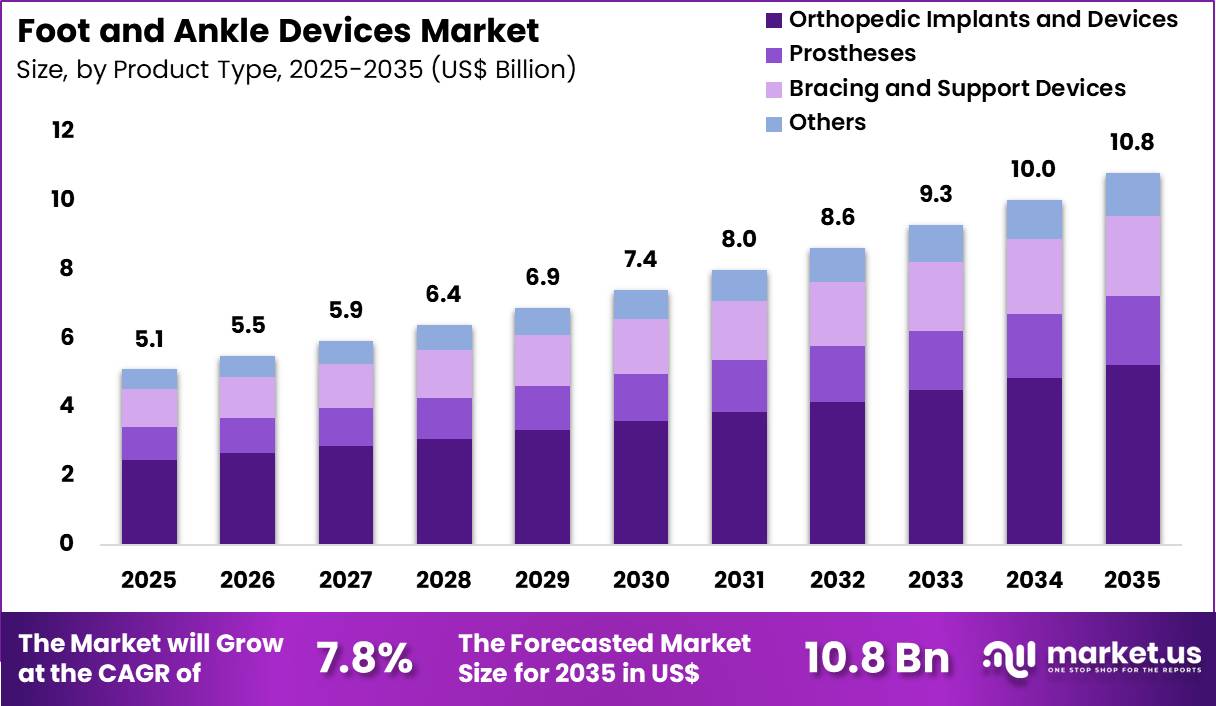
New York, NY – Nov 26 2026 – The Global Foot and Ankle Devices Market size is expected to be worth around US$ 10.8 Billion by 2035 from US$ 5.1 Billion in 2025, growing at a CAGR of 7.8% during the forecast period 2026-2035. In 2025, North America led the market, achieving over 43.6% share with a revenue of US$ 2.2 Billion.
The global Foot and Ankle Devices Market is witnessing steady growth, driven by the rising prevalence of orthopedic disorders, increasing cases of sports-related injuries, and the growing geriatric population. Foot and ankle devices are medical products used for the diagnosis, treatment, stabilization, and rehabilitation of injuries and disorders affecting the foot and ankle. These devices include orthopedic implants, fixation devices, joint replacement systems, prosthetics, braces, and external support devices.
The increasing incidence of fractures, arthritis, diabetic foot complications, and degenerative joint conditions is contributing to the growing demand for advanced foot and ankle treatment solutions. Furthermore, technological advancements in 3D printing, minimally invasive surgical procedures, and patient-specific implants are improving treatment outcomes and supporting market expansion.
Hospitals, orthopedic clinics, ambulatory surgical centers, and specialty care facilities represent key end users of these devices. In addition, rising healthcare expenditure, improved access to orthopedic care, and increasing awareness regarding early diagnosis and treatment are creating new growth opportunities.
North America holds a significant position in the market due to its advanced healthcare infrastructure and high adoption of innovative medical technologies. Meanwhile, Asia-Pacific is expected to offer considerable growth opportunities, supported by expanding healthcare facilities, increasing patient populations, and improving access to specialized orthopedic treatments.
Key Takeaways
- In 2025, the global Foot and Ankle Devices Market was valued at US$ 5.1 Billion and is projected to grow at a CAGR of 7.8% during 2025–2035, reaching US$ 10.8 Billion by 2035.
- Based on product type, the market is segmented into orthopedic implants and devices, prostheses, bracing and support devices, and others. Among these, orthopedic implants and devices dominated the market, accounting for a 48.3% share.
- By application, the market is categorized into trauma and hairline fractures, rheumatoid arthritis and osteoarthritis, diabetic foot diseases, ligament injuries, hammertoe, neurological disorders, and others. Trauma and hairline fractures emerged as the leading application segment, capturing a 40.2% market share.
- Based on end user, the market is segmented into hospitals, ambulatory surgical centers (ASCs), orthopedic clinics, and rehabilitation centers. Hospitals dominated the segment, accounting for the largest revenue share of 55.9%.
- Regionally, North America dominated the global Foot and Ankle Devices Market, accounting for a significant revenue share of 43.6%.
Key Market Segments
- Product Type Analysis: Orthopedic implants and devices dominated the product type segment, accounting for 48.3% of the market share. Their leadership is driven by increasing demand for fracture fixation, bone reconstruction, and joint stabilization procedures. Rising orthopedic injuries, advancements in implant materials, and growing adoption of minimally invasive surgeries are further supporting segment growth.
- Application Analysis: Trauma and hairline fractures dominated the application segment, accounting for 40.2% of the market share. The segment’s growth is primarily driven by increasing road accidents, sports-related injuries, and age-related fractures. Rising demand for surgical fixation, early injury management, and advanced orthopedic treatment solutions is further strengthening the adoption of foot and ankle devices.
- End-User Analysis: Hospitals dominated the end-user segment, accounting for 55.9% of the market share. Their leading position is attributed to advanced surgical infrastructure, availability of skilled orthopedic specialists, and capacity to manage complex trauma cases. Increasing hospital admissions for fractures, reconstructive procedures, and orthopedic disorders is further supporting segment growth.
Regional Analysis
North America Dominates the Foot and Ankle Devices Market
North America dominated the Foot and Ankle Devices Market in 2025, accounting for 43.6% of the market share. The region’s leadership is attributed to advanced healthcare infrastructure, increasing orthopedic procedures, and rising cases of sports-related injuries, fractures, and chronic joint disorders.
The strong presence of specialized orthopedic surgeons, hospitals, and rehabilitation facilities further supports market growth. Additionally, the growing adoption of minimally invasive surgical techniques, anatomically designed implants, and advanced imaging technologies is improving treatment outcomes. Increasing investments in healthcare infrastructure and the expansion of ambulatory surgical centers are also contributing to the widespread adoption of foot and ankle devices across the region.
Asia Pacific Expected to Register the Highest CAGR
Asia Pacific is expected to register the highest CAGR during the forecast period, driven by rising orthopedic injuries, expanding healthcare infrastructure, and increasing healthcare expenditure. Growing cases of fractures, ligament injuries, and diabetes-related foot complications are strengthening demand.
Furthermore, government investments, expanding specialized orthopedic centers, and the availability of cost-effective implants are expected to accelerate market adoption across China, India, and Southeast Asia.
Emerging Trends
- Increasing Adoption of 3D-Printed Implants: The use of 3D printing is gaining attention in foot and ankle surgery. These implants can be designed using patient imaging data to match individual bone structures. This approach is creating new possibilities for complex bone reconstruction and implant placement.
- Growing Demand for Patient-Specific Surgical Instruments: Patient-specific surgical guides are emerging as an important development in orthopedic procedures. These instruments are designed using CT scans and other imaging data to support accurate implant positioning, bone cutting, and alignment during complex foot and ankle surgeries.
- Advancements in Total Ankle Replacement Technology: Improvements in total ankle replacement systems are supporting the development of more anatomically designed implants. Newer designs focus on maintaining joint movement, improving implant positioning, and reducing unnecessary bone removal during ankle replacement procedures.
- Development of Advanced Implant Materials: Research into advanced biomaterials is creating opportunities for improved foot and ankle implants. Porous titanium, surface-engineered metals, and bioresorbable materials are being investigated to support bone integration, mechanical stability, and reconstruction in challenging surgical conditions.
- Greater Focus on Implant Safety and Long-Term Performance: Greater attention is being given to implant durability, revision procedures, and long-term patient outcomes. Regulatory monitoring and post-approval studies are helping identify device-related risks and support improvements in implant design and clinical use.
Use Cases
- Treatment of Foot and Ankle Fractures: Plates, screws, pins, and fixation systems are used to stabilize broken foot and ankle bones. These devices help maintain correct bone alignment during healing and are commonly applied in severe fractures that require surgical treatment.
- Correction of Foot Deformities: Foot and ankle implants are used in procedures for bunions, hammertoes, flatfoot, and other structural deformities. Screws, plates, staples, and fusion devices help correct bone positioning and maintain the required structure following surgery.
- Management of Ankle Arthritis: Total ankle replacement devices are used to replace damaged ankle joint surfaces in patients with advanced arthritis. These implants are designed to support joint movement and improve the ability to perform daily activities such as walking.
- Reconstruction of Complex Foot Conditions: Specialized implants and fixation devices are used to reconstruct damaged foot structures caused by Charcot foot, severe deformities, bone loss, and failed previous surgeries. Custom implants can provide additional treatment options in complex reconstruction cases.
- Support for Diabetic Foot Conditions: Orthotic footwear, shoe inserts, braces, and protective devices are used to reduce pressure on vulnerable areas of diabetic feet. These products help accommodate foot deformities and reduce the risk of pressure-related injuries and ulcers.
Frequently Asked Questions About Foot and Ankle Devices
- What are the different types of foot and ankle devices?
Common types include ankle replacement implants, bone fixation plates, screws, pins, intramedullary nails, external fixation systems, orthotic devices, and surgical instruments. Each category is designed to address specific orthopedic conditions and treatment requirements. - What are foot and ankle implants used for?
Foot and ankle implants are used to stabilize fractured bones, replace damaged joints, correct deformities, and support bone reconstruction. Their primary purpose is to improve structural stability, promote healing, and help restore normal foot function. - How do foot and ankle fixation devices work?
Fixation devices hold broken or surgically repositioned bones in the required position. Plates, screws, pins, and other implants provide mechanical support while the natural healing process takes place, helping maintain alignment and stability. - What materials are commonly used in foot and ankle devices?
Common materials include titanium, stainless steel, cobalt-chromium alloys, and medical-grade polymers. Material selection depends on the device type, mechanical strength requirements, compatibility with body tissues, and the intended duration of implantation. - How long do foot and ankle implants last?
The lifespan of foot and ankle implants varies according to implant design, material, patient activity, bone quality, and surgical outcomes. Some implants remain in place permanently, while others may require revision or removal due to complications. - Which applications contribute to demand for foot and ankle devices?
Major applications include fracture treatment, bunion correction, ankle replacement, flatfoot reconstruction, Charcot foot treatment, and sports injury management. These procedures require specialized devices to restore bone stability, correct deformities, and improve joint function. - How is technological advancement influencing the foot and ankle devices market?
Technological developments are supporting the introduction of 3D-printed implants, patient-specific surgical guides, improved implant materials, and advanced joint replacement systems. These innovations are helping surgeons address complex anatomical conditions with more personalized treatment approaches. - What is the future outlook for the foot and ankle devices market?
The market is expected to benefit from continued improvements in implant design, personalized surgical solutions, advanced biomaterials, and increasing treatment options. Greater focus on patient mobility and long-term surgical outcomes is likely to support future innovation.
Conclusion
The global Foot and Ankle Devices Market is expected to witness steady growth, driven by rising orthopedic injuries, increasing cases of arthritis and diabetic foot conditions, and an ageing population. Valued at US$ 5.1 billion in 2025, the market is projected to reach US$ 10.8 billion by 2035, growing at a CAGR of 7.8%.
Technological advancements in 3D-printed implants, patient-specific instruments, and advanced biomaterials are creating new opportunities. While North America maintains market leadership, Asia-Pacific is expected to experience the fastest growth, supported by expanding healthcare infrastructure and improving access to orthopedic treatments.
Discuss your needs with our analyst
Please share your requirements with more details so our analyst can check if they can solve your problem(s)