


Overview
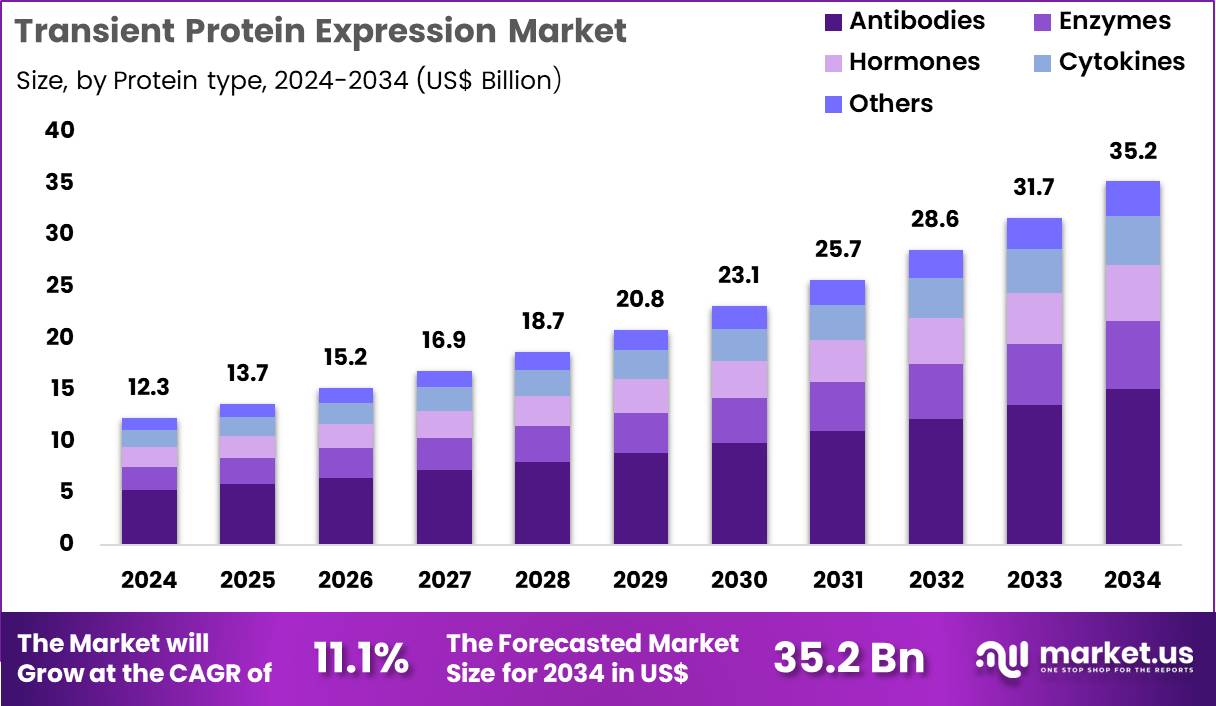
New York, NY – Oct 19, 2026 – The Global Transient Protein Expression Market size is expected to be worth around US$ 35.2 Billion by 2034 from US$ 12.3 Billion in 2024, growing at a CAGR of 11.1% during the forecast period 2025 to 2034. In 2024, North America led the market, achieving over 44.5% share with a revenue of US$ 5.5 Billion.
Transient protein expression is a widely used biotechnology technique that enables the rapid production of recombinant proteins in host cells without permanently integrating the introduced genetic material into the host genome. This method is commonly used in mammalian, insect, plant, and bacterial expression systems, depending on the protein’s structure and intended application.
The process involves introducing DNA or RNA encoding the target protein into host cells using suitable delivery methods. The cells then produce the desired protein for a limited period, eliminating the need to develop stable cell lines. This approach offers several advantages, including shorter production timelines, greater flexibility, and suitability for early-stage research, protein characterization, and small-scale manufacturing.
Transient protein expression plays an important role in pharmaceutical research, vaccine development, antibody production, drug discovery, and the evaluation of potential therapeutic candidates. It is particularly valuable when rapid access to functional proteins is required for research and development activities.
With continued advances in genetic engineering, cell culture technologies, and transfection methods, transient protein expression is expected to remain an important tool in biopharmaceutical development. Its ability to support rapid protein production and flexible experimental workflows makes it a valuable approach for biotechnology companies, pharmaceutical manufacturers, academic institutions, and research laboratories seeking to accelerate innovation and reduce development timelines.
Key Takeaways
- In 2024, the transient protein expression market was valued at US$ 12.3 billion and is projected to grow at a CAGR of 11.1%, reaching US$ 35.2 billion by 2034.
- By expression system, the market is segmented into mammalian, yeast, insect, bacterial, and other expression systems. Mammalian expression systems dominated the market, accounting for 46.3% of the total share.
- Based on protein type, the market is categorized into antibodies, hormones, enzymes, cytokines, and others. Antibodies held a significant market share of 42.8%.
- By application, the market is segmented into therapeutic protein production, proteomics research, vaccine development, structural biology, and others. Therapeutic protein production led the segment, accounting for 44.9% of the total market revenue.
- By technology, the market is divided into transient transfection, lentivirus-based transient expression, viral vector-based transient expression, and other technologies. Transient transfection dominated the segment, capturing a revenue share of 53.7%.
- Regionally, North America dominated the transient protein expression market, accounting for 44.5% of the total market share.
Key Market Segments
- Expression System Analysis: Mammalian expression systems dominated the transient protein expression market, accounting for 46.3% of the segment. Their ability to produce complex proteins with appropriate folding and post-translational modifications supports widespread use in therapeutic development. Growing biologics pipelines, improved culture media, scalable suspension systems, and increased investments by CROs and CDMOs are expected to sustain demand for mammalian expression platforms.
- Protein Type Analysis: Antibodies represented 42.8% of the transient protein expression market by protein type. Growing demand for therapeutic antibodies, including bispecific antibodies and antibody fragments, supports segment growth. Transient expression enables rapid antibody production for binding studies, functional assays, and preclinical research. Increasing antibody discovery programs and outsourced research activities are expected to strengthen demand for flexible, high-throughput antibody expression platforms.
- Application Analysis: Therapeutic protein production accounted for 44.9% of the transient protein expression market by application. The segment benefits from increasing demand for biologics and rapid production of candidate proteins for preclinical testing. Transient expression supports early-stage evaluation, functional studies, and process development before stable manufacturing systems are established. Expanding pharmaceutical pipelines and outsourced development activities are expected to support continued segment growth.
- Transient Technology Analysis: Transient transfection dominated the transient technology segment, accounting for 53.7% of the market. Its rapid workflow, flexibility, and compatibility with mammalian expression systems make it suitable for protein production and high-throughput screening. Advances in transfection reagents, automation, and liquid handling are improving efficiency and reproducibility. Growing demand for rapid protein generation in discovery and early-stage development is expected to sustain segment leadership.
Regional Analysis
North America Leads the Transient Protein Expression Market
North America accounted for 44.5% of the global transient protein expression market in 2024, supported by strong biotechnology infrastructure and extensive biopharmaceutical research activities. Leading companies, including Thermo Fisher Scientific and Merck, contribute to advancements in transfection reagents and mammalian cell expression platforms.
The region benefits from established biotechnology clusters, academic research institutions, federal research funding, and growing demand for rapid protein production in drug discovery, antibody development, and vaccine research. Improvements in HEK293 and CHO-based systems, alongside automation and high-throughput screening, further strengthen regional adoption.
Asia Pacific Expected to Record the Highest CAGR
Asia Pacific is expected to register the highest CAGR during the forecast period, driven by expanding biopharmaceutical manufacturing capabilities and increasing investments in biotechnology research. China and India are strengthening domestic research infrastructure to meet growing demand for therapeutic proteins and biosimilars.
Government initiatives, international technology partnerships, and improvements in cell culture and transfection technologies are supporting market expansion. Rising pharmaceutical research activities and increasing adoption of high-throughput protein expression are expected to create further growth opportunities across the region.
Emerging Trends
- Increasing use of artificial intelligence and laboratory automation: Artificial intelligence (AI), automated liquid handling, and data-based process optimisation are increasingly being explored to improve protein production. These technologies can help researchers identify suitable cell conditions, reduce manual work, compare multiple experiments, and improve consistency. This trend is supported by recent research on automated optimisation of transient protein production.
- Growing adoption of mammalian cell expression systems: Mammalian cells, particularly HEK293 and Chinese hamster ovary (CHO) cells, remain important platforms for producing complex proteins. Improvements in cell culture conditions, gene delivery methods, and growth media are helping researchers improve protein output. These developments are strengthening the role of transient expression in early-stage biopharmaceutical research.
- Development of plant-based protein production: Plant-based transient expression is gaining attention as an alternative platform for producing selected recombinant proteins. Research is exploring its potential for therapeutic proteins and other biological materials, supported by opportunities for flexible production and reduced dependence on conventional mammalian cell systems. Commercial adoption will depend on product quality, process control, and manufacturing requirements.
- Greater focus on precision medicine and personalised treatments: The growing interest in precision medicine is creating demand for flexible research platforms that can produce and evaluate different protein candidates. Transient expression enables researchers to test multiple protein variants relatively quickly, supporting the investigation of disease-related targets and the early development of targeted biological treatments.
- Improvements in large-scale production and process consistency: Researchers are working to improve transient expression yields, bioreactor performance, and production consistency. Better transfection methods and optimised culture processes may allow the technology to support larger protein batches. However, yield limitations and purification challenges remain important considerations when moving from laboratory research to larger manufacturing volumes.
Use Cases
- Drug discovery and early-stage drug development: Transient protein expression is used to produce target proteins and candidate antibodies for early drug research. Researchers use these materials to study biological activity, compare candidate molecules, and identify promising drug candidates before investing in more extensive development and manufacturing processes.
- Monoclonal antibody development: Biotechnology and pharmaceutical companies use transient expression to produce antibodies for screening and initial characterisation. Multiple antibody candidates can be evaluated in parallel, helping research teams compare binding properties and biological performance before selecting candidates for further development.
- Vaccine research and development: Transient expression can produce selected viral proteins and antigens for vaccine research. These materials can be used to study immune responses, evaluate candidate antigens, and support early vaccine development. The technology offers flexibility when researchers need to test several candidate proteins within a limited timeframe.
- Structural biology and protein function studies: Researchers use transiently produced proteins to investigate molecular structures, protein interactions, and biological functions. The resulting materials can support biochemical experiments and structural studies, helping scientists understand how proteins behave and interact with other molecules under controlled laboratory conditions.
- Diagnostic assay and research reagent development: Transient expression can produce recombinant antigens, antibodies, and other proteins used in laboratory testing and assay development. These materials help researchers evaluate assay performance, investigate disease biomarkers, and develop research reagents. Additional validation is required before materials are used in regulated diagnostic products.
Frequently Asked Questions About Transient Protein Expression
- How does transient protein expression work?
The process involves introducing a gene into suitable host cells, allowing the cells to produce the target protein, and collecting the resulting material. The protein is then purified and tested according to the requirements of the research application. - Which cell lines are commonly used for transient protein expression?
HEK293 and CHO cells are commonly used mammalian expression systems. HEK293 cells are widely used in research, while CHO cells are important in biopharmaceutical development. The selection depends on protein complexity, required quality, expression yield, and experimental objectives. - What are the main advantages of transient protein expression?
Transient expression offers relatively fast protein production, flexibility, and reduced need for lengthy stable cell-line development. It also enables researchers to evaluate multiple protein candidates in parallel, making it valuable for early-stage research and development programmes. - What is the difference between transient and stable protein expression?
Transient expression produces proteins for a limited period without requiring permanent genetic integration. Stable expression involves maintaining genetic instructions over successive cell generations. Transient methods support rapid research, whereas stable systems are often preferred for consistent, long-term production requirements. - What factors affect transient protein expression efficiency?
Expression efficiency depends on the host cell, expression vector, gene delivery method, culture medium, cell health, and process conditions. Optimising these factors can improve protein yield and quality, although results vary across different proteins and experimental systems. - What factors are driving the growth of the transient protein expression market?
Market growth is supported by rising biotechnology research, increasing demand for recombinant proteins, and the need for faster drug discovery. Advances in cell engineering, automation, and expression methods are also helping research organisations improve productivity and expand applications. - Which end users drive demand for transient protein expression products?
Pharmaceutical and biotechnology companies are major end users because they require recombinant proteins for drug discovery, antibody screening, and early-stage development. Academic institutions and contract research organisations also contribute through molecular biology research, experimental testing, and outsourced protein production. - What opportunities are emerging in the transient protein expression market?
Opportunities include automated protein production, improved mammalian expression systems, plant-based production platforms, and research supporting precision medicine. Expanding demand for antibodies, therapeutic proteins, and biological research materials may create further opportunities for suppliers of expression technologies and associated laboratory products.
Conclusion
The transient protein expression market is poised for substantial growth, driven by increasing demand for recombinant proteins, expanding biopharmaceutical research, and the need for rapid protein production. Valued at US$ 12.3 billion in 2024, the market is projected to reach US$ 35.2 billion by 2034, growing at a CAGR of 11.1%.
Mammalian expression systems, antibodies, therapeutic protein production, and transient transfection remain key market segments. North America currently leads the market, while Asia Pacific is expected to experience the fastest growth. Advancements in automation, artificial intelligence, and expression technologies will create further opportunities for industry participants.
Discuss your needs with our analyst
Please share your requirements with more details so our analyst can check if they can solve your problem(s)



