
Overview
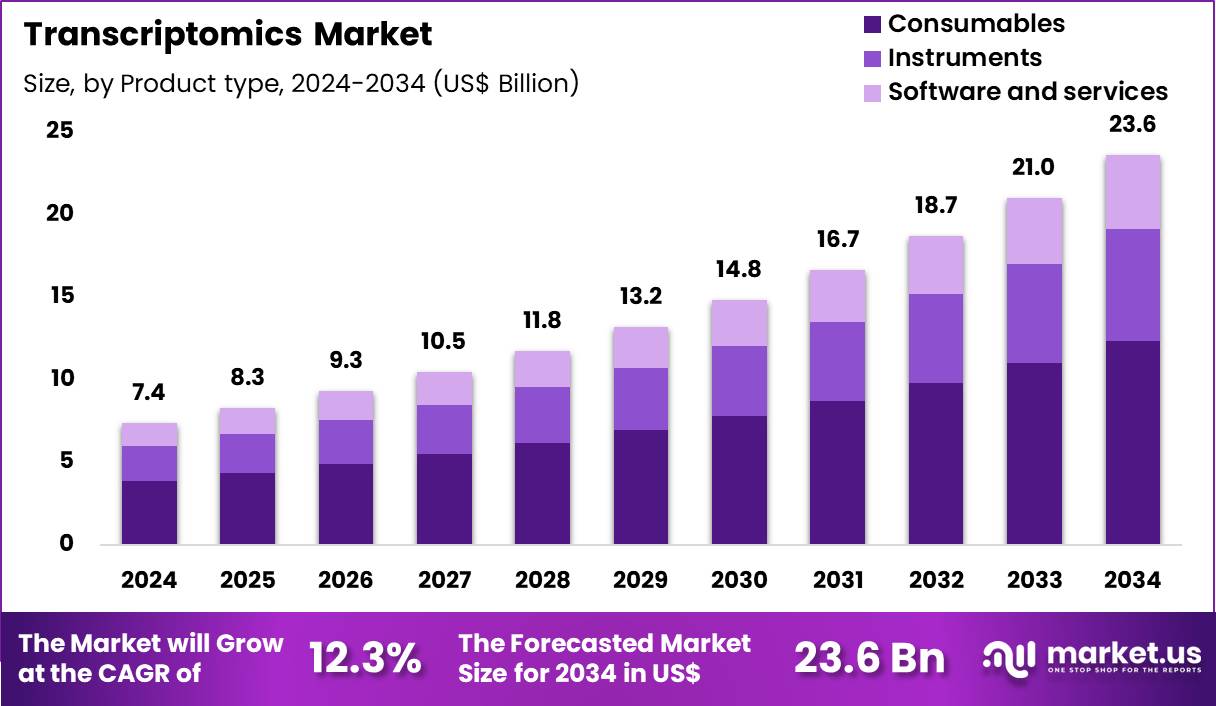
New York, NY – Oct 19, 2026 – Global Transcriptomics Market size is expected to be worth around US$ 23.6 Billion by 2034 from US$ 7.4 Billion in 2024, growing at a CAGR of 12.3% during the forecast period 2025 to 2034. In 2024, North America led the market, achieving over 42.1% share with a revenue of US$ 3.1 Billion.
Transcriptomics is a branch of molecular biology that focuses on the study of the complete set of RNA transcripts produced by cells, tissues, or organisms under specific conditions. It provides valuable insights into gene expression, cellular functions, and biological responses to environmental changes, diseases, and treatments.
The transcriptomics field is gaining importance due to advancements in sequencing technologies, bioinformatics, and molecular diagnostic tools. Technologies such as RNA sequencing (RNA-seq) and microarrays enable researchers to identify gene expression patterns, discover potential disease biomarkers, and understand complex biological processes with greater accuracy.
Transcriptomics is widely used across healthcare, pharmaceutical research, biotechnology, agriculture, and academic research. In drug discovery and development, it supports the identification of therapeutic targets and the evaluation of treatment responses. In clinical research, transcriptomic analysis contributes to disease classification, personalized medicine, and the investigation of cancer, infectious diseases, and genetic disorders.
The growing demand for precision medicine, increasing investments in life sciences research, and the expanding adoption of next-generation sequencing technologies are supporting the development of the transcriptomics field. Furthermore, the integration of artificial intelligence and advanced data analytics is improving the interpretation of complex gene expression data.
Despite these opportunities, challenges such as high analysis costs, data complexity, and the need for specialized expertise remain. Continued technological innovation and expanding research applications are expected to strengthen the role of transcriptomics in advancing biomedical research and healthcare innovation.
Key Takeaways
- In 2024, the transcriptomics market was valued at US$ 7.4 billion and is projected to reach US$ 23.6 billion by 2034, expanding at a CAGR of 12.3% during the forecast period.
- By product type, the market is segmented into consumables, instruments, and software & services. The consumables segment dominated the market, accounting for 52.4% of the total market share.
- Based on technology, the market is categorized into next-generation sequencing (NGS), microarray, polymerase chain reaction (PCR), and others. The NGS segment held a leading share of 56.8%.
- By application, the market is divided into drug discovery & development, diagnostics & disease profiling, and others. The drug discovery & development segment dominated the market, capturing 46.9% of the total revenue share.
- By end user, the market is segmented into academic & research institutes, biotechnology companies, pharmaceutical companies, and others. Academic & research institutes led the market, accounting for 41.6% of the total revenue share.
- Regionally, North America dominated the transcriptomics market, accounting for 42.1% of the global market share.
Key Market Segments
- Product Type Analysis: Consumables dominated the transcriptomics market with a 52.4% share, driven by recurring demand for reagents, library preparation kits, enzymes, and laboratory plastics. Growing sequencing volumes, single-cell analysis, and large-scale research projects continue to support frequent purchases and sustained segment growth.
- Technology Analysis: Next-generation sequencing (NGS) led the transcriptomics market with a 56.8% share, supported by its ability to deliver comprehensive gene expression data. Declining sequencing costs, increasing single-cell research, and expanding applications in oncology, immunology, and precision medicine further strengthen adoption.
- Application Analysis: Drug discovery and development accounted for 46.9% of the transcriptomics market, driven by growing demand for target identification, pathway analysis, and biomarker discovery. Pharmaceutical and biotechnology companies increasingly use transcriptomic data to evaluate drug responses, assess safety, and improve development decisions.
- End-User Analysis: Academic and research institutes held a 41.6% share of the transcriptomics market, supported by extensive genomic research, grant-funded projects, and university-based sequencing facilities. Growing adoption of RNA sequencing, single-cell analysis, and collaborative research initiatives continues to drive demand across this segment.
Regional Analysis
North America Leads the Transcriptomics Market
North America dominated the global transcriptomics market in 2024, accounting for 42.1% of the market share. Regional growth is supported by advanced sequencing technologies, strong biotechnology infrastructure, and increasing investments in precision medicine. The United States benefits from established research institutions, leading companies such as Illumina and Thermo Fisher Scientific, and government funding for genomics research.
Collaborations between pharmaceutical companies and academic institutions are further advancing gene expression studies, biomarker discovery, and drug development. Support from organizations such as the National Institutes of Health continues to strengthen research activities across the region.
Asia Pacific Expected to Record the Highest CAGR
Asia Pacific is projected to register the highest CAGR during the forecast period, driven by rising biotechnology investments and expanding genomics research in China, India, and Japan. Government initiatives, growing chronic disease burdens, and increasing adoption of advanced sequencing technologies are supporting regional demand.
Pharmaceutical companies and research institutions are also expanding collaborations to accelerate drug discovery, personalized medicine, and molecular diagnostics. These developments are expected to create significant growth opportunities for the transcriptomics market across Asia Pacific.
Emerging Trends
- Growth of single-cell transcriptomics: Single-cell transcriptomics is gaining importance because it measures gene activity in individual cells rather than averaging results across a group of cells. This approach helps researchers identify rare cell types and understand differences between healthy and diseased tissues. Demand is expected to benefit suppliers of sequencing platforms, reagents, and data analysis tools.
- Increasing adoption of spatial transcriptomics: Spatial transcriptomics allows researchers to study gene activity while retaining information about the location of cells within a tissue. This technology is becoming important in cancer research, kidney disease studies, and tissue biology. The development of methods that provide greater cellular detail is creating opportunities for specialized instruments, laboratory services, and analytical software.
- Integration of artificial intelligence and machine learning: Artificial intelligence and machine learning are increasingly being applied to transcriptomics data to identify patterns, reduce technical noise, compare datasets, and study interactions between cells. These tools can help researchers process complex biological information more efficiently. This trend is supporting demand for bioinformatics software, cloud computing, and integrated data analysis services.
- Expansion of multi-omics integration: Researchers are increasingly combining transcriptomics with other methods, such as proteomics and epigenomics, to develop a more complete understanding of biological systems. This approach connects gene activity with protein production and gene regulation. It creates opportunities for companies offering integrated laboratory workflows, advanced sequencing technologies, and software that can analyze multiple types of biological data.
- Greater focus on precision medicine and clinical research: Precision medicine aims to tailor healthcare decisions to differences between patients. Transcriptomics can help researchers identify disease-related gene expression patterns and investigate why patients respond differently to treatments. The FDA identifies omics technologies as useful areas for advancing diagnosis, prognosis, and treatment research, supporting continued interest in transcriptomic tools.
Use Cases
- Drug discovery and development: Transcriptomics is used to identify genes and biological pathways affected by a potential drug. Researchers can compare gene expression before and after treatment to investigate how a compound works. This supports target identification, drug screening, and the evaluation of treatment effects during preclinical research.
- Cancer research and tumor profiling: Transcriptomics helps researchers study differences between cancer cells and surrounding healthy cells. It can reveal gene expression patterns associated with tumor growth, immune activity, and treatment response. Spatial transcriptomics further helps map these patterns within tumor tissue, supporting research into tumor diversity and the surrounding microenvironment.
- Biomarker discovery and disease diagnosis research: Gene expression analysis can help identify biological markers associated with a disease or a particular disease stage. These markers may support the development of diagnostic tests and disease classification methods. Additional validation is required before a research finding can be adopted as a reliable clinical diagnostic tool.
- Infectious disease and immune response research: Transcriptomics enables researchers to examine how host cells respond to infections and how immune-related genes change during disease progression. It can also help investigate differences between immune responses under different conditions. These insights support research into disease mechanisms, vaccine development, and potential therapeutic approaches.
- Toxicogenomics and drug safety assessment: Toxicogenomics uses gene expression data to investigate how chemicals, drugs, and other substances affect biological systems. Researchers can identify molecular changes associated with potential toxicity and compare responses across experimental conditions. This supports early-stage safety assessment and can help prioritize compounds for further testing.
Frequently Asked Questions About Transcriptomics
- What is the difference between genomics and transcriptomics?
Genomics studies an organism’s complete DNA, which contains its genetic information. Transcriptomics studies RNA molecules produced from that information. While DNA generally remains stable across cells, RNA expression can change with cell type, environmental conditions, disease, and treatment. - Which technologies are used in transcriptomics?
Common transcriptomics technologies include next-generation sequencing, microarrays, and quantitative polymerase chain reaction (qPCR). Single-cell sequencing and spatial transcriptomics provide more detailed information about individual cells and tissue locations, depending on the method, research objective, and sample requirements. - Why is transcriptomics important in medical research?
Transcriptomics helps researchers understand disease mechanisms by identifying changes in gene expression. It supports investigations into cancer, immune responses, tissue damage, and drug effects. These findings can guide biomarker discovery and therapeutic research, although clinical use requires appropriate validation. - What is single-cell transcriptomics?
Single-cell transcriptomics measures RNA expression separately in individual cells. It helps researchers identify distinct cell populations, detect rare cells, and study cellular differences that may be hidden when results are averaged across an entire tissue sample. - What is driving growth in the transcriptomics market?
Market growth is supported by increasing biomedical research, demand for advanced sequencing, drug discovery activities, and interest in precision medicine. Improvements in single-cell technologies, spatial profiling, and data analysis are also expanding research capabilities and commercial opportunities. - What challenges affect the transcriptomics market?
Market adoption can be limited by high equipment and testing costs, complex data analysis, sample preparation requirements, and shortages of skilled professionals. Differences in experimental methods and data quality can also affect reproducibility and increase the need for standardized workflows. - What opportunities exist in the transcriptomics market?
Key opportunities include spatial analysis, single-cell sequencing, integrated multi-omics, and AI-supported data interpretation. These areas may help researchers obtain more detailed biological insights and improve research efficiency, creating potential demand for advanced instruments, specialized consumables, software, and analytical services.
Conclusion
The transcriptomics market is expected to witness significant growth, supported by advancements in sequencing technologies, increasing investments in life sciences research, and rising demand for precision medicine. Valued at US$ 7.4 billion in 2024, the market is projected to reach US$ 23.6 billion by 2034, growing at a CAGR of 12.3%.
Next-generation sequencing, single-cell analysis, spatial transcriptomics, and artificial intelligence are expanding research capabilities and commercial opportunities. North America currently leads the market, while Asia Pacific is expected to record the highest growth. Despite cost and data complexity challenges, continued innovation is anticipated to strengthen long-term market prospects.
Discuss your needs with our analyst
Please share your requirements with more details so our analyst can check if they can solve your problem(s)