


Overview
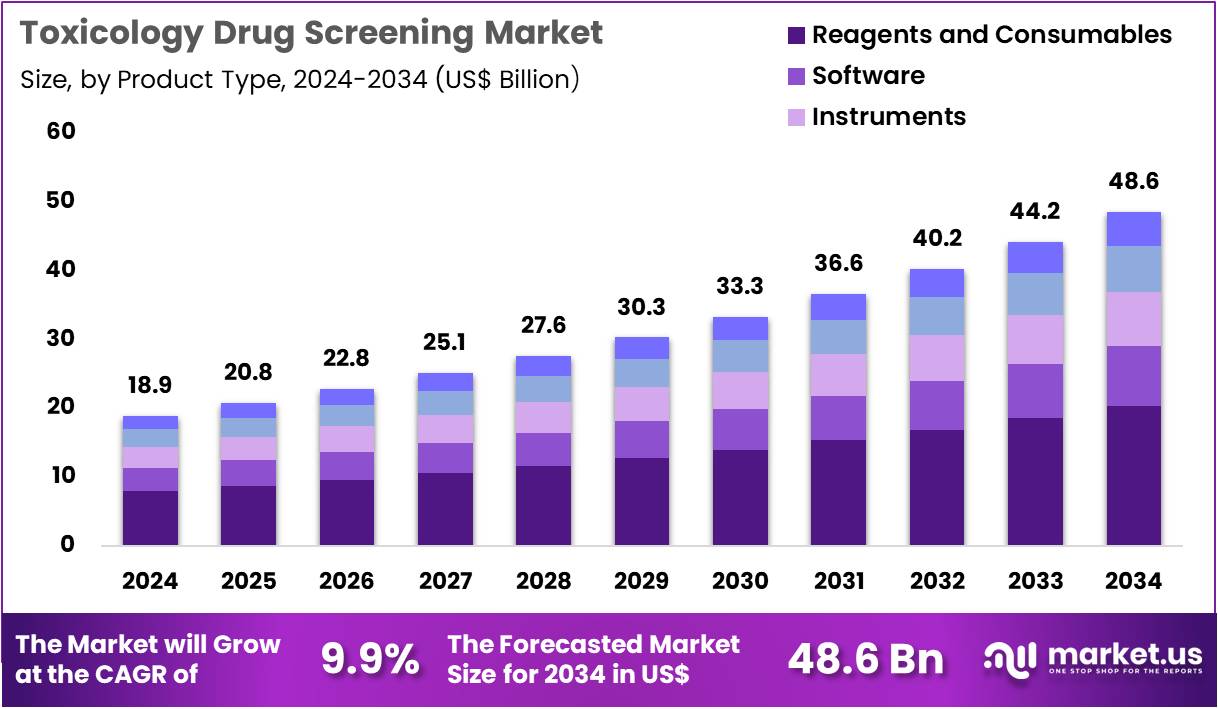
New York, NY – Sep 04, 2026 – The Global Toxicology Drug Screening Market size is expected to be worth around US$ 48.6 Billion by 2034 from US$ 18.9 Billion in 2024, growing at a CAGR of 9.9% during the forecast period 2025 to 2034. In 2024, North America led the market, achieving over 44.3% share with a revenue of US$ 8.4 Billion.
The Global Toxicology Drug Screening market is experiencing steady growth as healthcare providers, forensic laboratories, workplaces, and law enforcement agencies increasingly rely on rapid and accurate drug detection technologies.
Toxicology drug screening plays a critical role in identifying prescription medications, illicit drugs, alcohol, and toxic substances in biological samples such as urine, blood, saliva, hair, and oral fluid. Growing concerns over substance abuse, opioid misuse, and workplace safety continue to support market expansion worldwide.
Modern screening platforms utilize immunoassays, chromatography, and mass spectrometry to deliver highly sensitive and reliable results. Hospitals, diagnostic laboratories, rehabilitation centers, and criminal justice agencies are expanding the adoption of automated analyzers that improve testing speed while reducing manual errors. Portable point-of-care testing devices are also gaining popularity because they provide results within minutes, enabling faster clinical and forensic decision-making.
According to international public health estimates, more than 296 million people worldwide used drugs in a recent reporting year, while approximately 39.5 million individuals were affected by drug use disorders. In addition, opioids account for nearly 70% of drug-related deaths globally, emphasizing the growing need for comprehensive toxicology testing programs.
Increasing government investments in public health surveillance, stricter workplace drug-testing regulations, and continuous technological innovations are expected to accelerate market growth. The integration of artificial intelligence, laboratory automation, and digital data management systems is further enhancing testing accuracy, operational efficiency, and regulatory compliance, positioning toxicology drug screening as an essential component of modern healthcare and forensic diagnostics.
Key Takeaways
- The global Toxicology Drug Screening market was valued at US$18.9 billion in 2024 and is projected to reach US$48.6 billion by 2034, expanding at a CAGR of 9.9% during the forecast period.
- By product type, the market is segmented into reagents & consumables, software, instruments, animal models, and others. Among these, reagents & consumables dominated the market in 2024, accounting for a 41.9% share.
- Based on application, the market is categorized into immunotoxicity, systemic toxicity, developmental & reproductive toxicity, endocrine disruption, and others. Immunotoxicity emerged as the leading application segment, capturing a 38.5% market share in 2024.
- By testing type, the market is classified into in vitro, in vivo, and in silico. The in vitro segment held the largest market share of 52.7% in 2024, maintaining its position as the dominant testing approach.
- North America dominated the global Toxicology Drug Screening market in 2024, securing the highest regional market share of 44.3%.
Market Segmentation
Product Type Analysis: Reagents & consumables accounted for 41.9% of the market in 2024, driven by their recurring use in toxicology testing. Laboratories, pharmaceutical companies, and CROs require assay kits, antibodies, buffers, and detection chemicals for routine screening. Rising drug development activities and expanding automated laboratory workflows continue to support sustained demand for these products.
Application Analysis: Immunotoxicity held a 38.5% market share in 2024 due to increasing emphasis on evaluating immune-related drug safety. The growing adoption of biologics, immunotherapies, gene therapies, and mRNA-based treatments has increased demand for immune toxicity assessments. Advanced testing technologies and stricter regulatory requirements further strengthen the segment’s market leadership.
Testing Type Analysis: In vitro testing dominated the market with a 52.7% share in 2024, supported by its speed, scalability, and reduced dependence on animal testing. Pharmaceutical companies and research laboratories increasingly adopt cell-based assays and high-throughput screening platforms for early toxicity evaluation, improving efficiency while meeting evolving regulatory and ethical standards.
Statistical Information
- Beginning July 7, 2025, the U.S. HHS federal workplace drug-testing program expanded its authorized testing panel to include fentanyl in oral-fluid testing with an initial screening cutoff of 4 ng/mL.
- The 2025 HHS oral-fluid testing panel specifies an initial screening cutoff of 4 ng/mL for Δ9-THC (marijuana).
- For cocaine/benzoylecgonine, the 2025 HHS oral-fluid drug-testing panel establishes an initial screening cutoff of 15 ng/mL.
- The 2025 HHS oral-fluid testing panel uses an initial screening cutoff of 30 ng/mL for codeine and morphine.
- Hydrocodone and hydromorphone are screened at an initial cutoff of 30 ng/mL under the 2025 HHS federal oral-fluid testing panel.
- The 2025 federal oral-fluid panel specifies an initial screening cutoff of 10 ng/mL for phencyclidine (PCP).
- Amphetamine and methamphetamine screening under the 2025 HHS oral-fluid panel is performed using an initial cutoff of 50 ng/mL.
- The 2026 HHS proposal would increase the urine pH threshold used to classify specimens as invalid from 9.0 to 9.5, reducing unnecessary confirmatory testing and specimen recollections while maintaining program quality standards.
Regional Analysis
North America dominated the Toxicology Drug Screening market in 2024, accounting for 44.3% of the global market. The region benefits from advanced clinical laboratory infrastructure, widespread workplace drug-testing programs, and strong regulatory oversight from agencies such as the U.S. Department of Health and Human Services (HHS) and the Substance Abuse and Mental Health Services Administration (SAMHSA).
Rising opioid and synthetic drug misuse has increased demand for rapid toxicology screening in hospitals, emergency departments, forensic laboratories, and rehabilitation centers. According to the U.S. Centers for Disease Control and Prevention (CDC), the country recorded more than 107,000 drug overdose deaths in 2022, reinforcing the need for comprehensive toxicology testing. Continued investments in LC-MS/MS platforms, high-throughput immunoassays, and laboratory automation further support regional leadership.
Asia Pacific is expected to register the fastest growth during the forecast period, driven by expanding healthcare infrastructure, increasing awareness of substance abuse, and growing investments in diagnostic laboratories. Countries including China, Japan, India, South Korea, and Australia are strengthening toxicology capabilities to improve clinical diagnostics, workplace safety, and forensic investigations.
Government initiatives targeting illicit drug monitoring and improvements in laboratory testing capacity are encouraging greater adoption of advanced analytical technologies, including liquid chromatography-mass spectrometry (LC-MS/MS) and automated immunoassay systems. Rising pharmaceutical research, expanding clinical testing services, and increasing regulatory focus on public health surveillance are expected to further accelerate market growth across the region.
Business Opportunities
The Toxicology Drug Screening market offers significant business opportunities as healthcare systems, forensic laboratories, and employers increasingly prioritize rapid and accurate drug detection. Growing concerns over opioid misuse, synthetic drugs, and workplace safety are driving demand for advanced screening technologies across hospitals, rehabilitation centers, and law enforcement agencies.
The expansion of point-of-care (POC) drug testing presents a major opportunity, enabling faster clinical decisions in emergency departments, ambulances, and remote healthcare settings. Manufacturers can also capitalize on the increasing adoption of LC-MS/MS and automated immunoassay platforms that improve laboratory throughput and diagnostic accuracy.
Another promising area is the development of multiplex drug screening panels capable of detecting multiple substances simultaneously, reducing testing time and operational costs. Integration of artificial intelligence (AI), laboratory automation, and cloud-based laboratory information management systems (LIMS) is creating opportunities to streamline workflows, improve result interpretation, and enhance regulatory compliance.
Emerging economies across Asia-Pacific, Latin America, and the Middle East are investing in diagnostic infrastructure and forensic capabilities, creating strong demand for affordable toxicology instruments, reagents, and consumables. In addition, pharmaceutical and biotechnology companies increasingly require toxicology screening during preclinical and clinical drug development, expanding opportunities for contract research organizations (CROs) and specialized testing laboratories.
The rising focus on personalized medicine, therapeutic drug monitoring, and regulatory compliance is expected to encourage continuous innovation, making toxicology drug screening one of the most attractive segments within clinical diagnostics and laboratory testing.
Emerging Trends
- Growing adoption of oral-fluid drug testing: Oral-fluid drug screening is becoming more common because sample collection is simple, non-invasive, and can be directly observed. In 2025, the U.S. HHS added fentanyl to the federal oral-fluid testing panel with an initial screening cutoff of 4 ng/mL, expanding standardized workplace drug testing.
- Expansion of high-throughput clinical drug surveillance: Healthcare providers are increasingly using large-scale toxicology data to monitor substance abuse trends. The CDC Clinical Drug Test Dashboard now analyzes results from more than 650,000 urine specimens collected during October 2024–December 2025, enabling faster public health monitoring and response.
- Greater focus on detecting multiple drugs simultaneously: Drug screening laboratories are shifting toward multiplex toxicology testing because mixed-drug exposure is increasing. During October–December 2025, 84.6% of fentanyl-positive urine samples also tested positive for cocaine or methamphetamine, highlighting the need for comprehensive screening panels.
- Rapid adoption of LC-MS/MS for confirmatory testing: Advanced LC-MS/MS methods continue improving toxicology workflows. A 2025 peer-reviewed study developed an oral-fluid assay capable of detecting eight fentanyl analogs plus xylazine with a 4.5-minute analytical run time, supporting faster laboratory confirmation.
- Regulatory modernization of workplace drug testing: Governments are strengthening toxicology testing standards through updated regulations. In 2025, the U.S. federal oral-fluid panel established standardized screening cutoffs including 4 ng/mL for fentanyl, 15 ng/mL for cocaine, and 50 ng/mL for amphetamines, improving consistency across certified laboratories.
Use Cases
- Emergency department overdose management: Hospitals use rapid toxicology drug screening to identify overdose substances and guide immediate treatment. CDC surveillance showed 12.8% of clinical urine specimens were fentanyl-positive during October–December 2025, emphasizing the importance of rapid emergency toxicology testing.
- Substance use disorder treatment monitoring: Addiction treatment centers routinely perform toxicology screening to monitor patient recovery. CDC data found heroin-positive urine specimens declined by 44.1%, from 4.6% to 2.6% between October–December 2024 and October–December 2025, supporting treatment progress evaluation.
- Forensic and law enforcement investigations: Forensic laboratories use toxicology drug screening to identify drugs involved in impaired driving and unexplained deaths. Updated 2025 forensic recommendations increasingly prioritize blood and oral-fluid testing over urine for drug-impaired driving investigations, improving evidential reliability.
- Workplace drug-testing compliance: Employers in transportation, manufacturing, and public safety use toxicology screening to maintain safe workplaces. The 2025 federal workplace drug-testing program expanded its testing panel to include fentanyl, strengthening occupational safety and regulatory compliance.
- Public health surveillance and outbreak detection: Public health agencies use toxicology screening data to identify emerging drug threats. CDC monitoring reported a 30.1% decline in fentanyl-positive urine specimens in the U.S. South between October and December 2024 and October–December 2025, helping authorities adjust prevention strategies.
Recent Development
- In February 2025, Thermo Fisher Scientific Inc. announced the acquisition of Solventum’s Purification & Filtration business for US$4.1 billion, strengthening its bioprocessing and laboratory solutions portfolio that supports pharmaceutical and toxicology testing laboratories.
- In June 2025, Abbott Laboratories launched its laboratory-based blood test for mild traumatic brain injury (mTBI), designed to run on Alinity i and ARCHITECT i1000SR systems, expanding its core laboratory diagnostics portfolio used in hospital laboratories.
- In November 2025, Abbott Laboratories announced its acquisition of Exact Sciences, expanding its presence in cancer screening and precision diagnostics while strengthening its overall laboratory diagnostics business.
Frequently Asked Questions on Toxicology Drug Screening
- What factors are driving the Toxicology Drug Screening Market?
The market is driven by rising drug misuse, increasing workplace drug-testing requirements, growing forensic investigations, expanding pharmaceutical research, and stronger government regulations. Continuous improvements in laboratory automation and high-accuracy testing technologies also contribute to market expansion. - Which sample types are commonly used in toxicology drug screening?
Urine remains the most widely used sample because it is cost-effective and easy to collect. Blood, saliva, hair, and oral fluid are also widely used depending on the testing purpose, detection window, and clinical or forensic requirements. - Which technologies are widely used in toxicology drug screening?
Common technologies include immunoassays for rapid screening and confirmatory methods such as liquid chromatography-mass spectrometry (LC-MS/MS) and gas chromatography-mass spectrometry (GC-MS). These technologies provide high sensitivity, specificity, and reliable identification of multiple drugs. - Who are the major end users of toxicology drug screening products?
Hospitals, diagnostic laboratories, forensic laboratories, rehabilitation centers, pharmaceutical companies, contract research organizations, and workplace testing facilities are major end users. These organizations depend on toxicology screening for clinical diagnosis, research, compliance, and public safety. - Why is toxicology drug screening important in healthcare?
Toxicology drug screening helps physicians quickly identify harmful substances, manage drug overdoses, monitor prescribed medications, and support emergency treatment decisions. Early detection improves patient outcomes while reducing complications associated with poisoning and substance misuse. - Which region leads the Toxicology Drug Screening Market?
North America currently leads the market because of advanced laboratory infrastructure, strong workplace drug-testing regulations, high healthcare spending, and increasing adoption of sophisticated analytical technologies across clinical, forensic, and pharmaceutical laboratories. - What is the future outlook for the Toxicology Drug Screening Market?
The market is expected to benefit from continued technological innovation, increasing adoption of automated laboratory systems, stronger regulatory compliance, and rising demand for rapid, accurate drug detection across healthcare, forensic science, pharmaceutical development, and workplace safety applications.
Conclusion
The Toxicology Drug Screening Market is poised for sustained growth as the demand for rapid, accurate, and automated drug detection continues to rise across healthcare, forensic, workplace, and pharmaceutical settings. Increasing substance abuse monitoring, stringent regulatory requirements, and advancements in immunoassays, LC-MS/MS, and point-of-care testing are driving technology adoption worldwide.
Growing investments in laboratory automation, digital data management, and high-throughput screening are further improving operational efficiency and diagnostic accuracy. North America maintains market leadership due to its advanced healthcare infrastructure, while Asia Pacific is emerging as the fastest-growing region with expanding diagnostic capabilities.
Strategic collaborations, product innovation, and increasing focus on personalized medicine are expected to create new opportunities for manufacturers and diagnostic providers, supporting long-term market expansion and continuous technological advancement across the global toxicology drug screening industry.
Discuss your needs with our analyst
Please share your requirements with more details so our analyst can check if they can solve your problem(s)




