


Overview
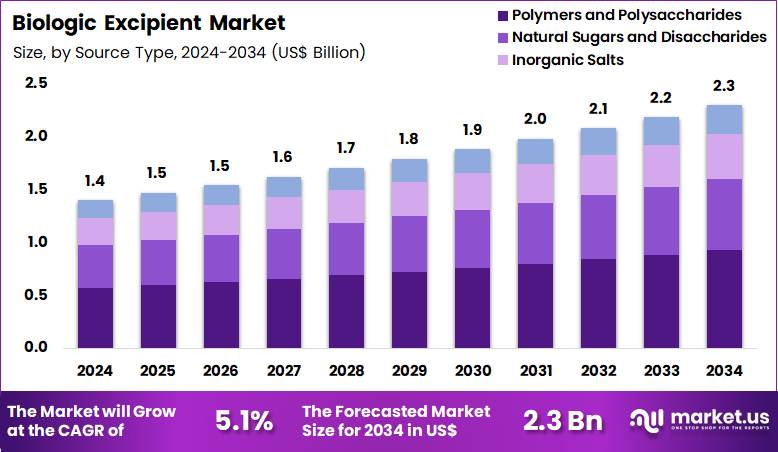
New York, NY – Oct 05, 2026 –The Global Biologic Excipient Market size is expected to be worth around US$ 2.3 Billion by 2034 from US$ 1.4 Billion in 2024, growing at a CAGR of 5.1% during the forecast period 2025 to 2034. In 2024, North America led the market, achieving over 42.4% share with a revenue of US$ 593.6 Billion.
The global Biologic Excipient Market is gaining importance as pharmaceutical manufacturers increasingly focus on improving the stability, safety, and effectiveness of biologic drugs. Excipients are essential components used in biologic formulations to support drug stability, solubility, delivery, and shelf life. The growing development of monoclonal antibodies, vaccines, recombinant proteins, and other advanced biologics is expected to support market expansion.
Rising investments in biopharmaceutical research and development, along with the increasing adoption of biologic therapies for chronic and complex diseases, are creating significant opportunities for excipient manufacturers. The demand for specialized excipients is also being supported by the growing need for improved formulation performance and extended product stability.
Technological advancements in biologic formulation and increasing regulatory focus on product quality are further encouraging pharmaceutical companies to adopt high-quality and innovative excipients. North America is expected to maintain a significant position in the market, supported by its established biopharmaceutical industry, strong research infrastructure, and high healthcare expenditure.
Europe and Asia-Pacific are also anticipated to witness considerable growth due to expanding pharmaceutical manufacturing capabilities and increasing investments in biologics.
As biologic drug pipelines continue to expand, the demand for advanced excipients is expected to increase, creating new opportunities across formulation development, manufacturing, and drug delivery applications.
Key Takeaways
- In 2024, the market was valued at US$ 1.4 billion and is projected to grow at a CAGR of 5.1%, reaching US$ 2.3 billion by 2034.
- By type, the market is segmented into buffering agents, surfactants and solubilizers, lyoprotectants, tonicity-adjusting agents, pH-adjusting components, amino acid stabilizers, chelators and antioxidants, and others. Buffering agents dominated the segment in 2024, accounting for a 36.2% market share.
- Based on source type, the market is categorized into polymers and polysaccharides, natural sugars and disaccharides, inorganic salts, and others. Polymers and polysaccharides held the largest share, representing 40.4% of the market.
- By route of administration, the market is segmented into parenteral, oral, topical, and others. The parenteral segment led the market in 2024, accounting for the largest revenue share of 45.7%.
- By end user, the market is divided into biopharmaceutical manufacturers, CROs & CDMOs, academic and research organizations, and others. Biopharmaceutical manufacturers dominated the market, holding a 43.9% revenue share.
- North America dominated the global market in 2024, accounting for a 42.4% market share.
Key Market Segments
- Type Analysis: Buffering agents held 36.2% of the biologic excipient market, supported by their critical role in maintaining pH stability and preventing protein degradation. Growing monoclonal antibody and recombinant protein development, stringent quality requirements, and formulation advances are expected to sustain segment growth.
- Source Type Analysis: Polymers and polysaccharides accounted for 40.4% of the market, driven by their stabilization, viscosity control, solubility enhancement, and cryoprotective properties. Their strong biocompatibility, formulation versatility, and suitability for long-term storage support continued adoption across biologic drug formulations.
- Route of Administration Analysis: The parenteral segment represented 45.7% of the biologic excipient market, reflecting widespread use of injectable biologics. Increasing monoclonal antibody, vaccine, and chronic disease therapies, along with high-concentration formulations and self-injection technologies, continues to strengthen demand for high-quality excipients.
- End-User Analysis: Biopharmaceutical manufacturers accounted for 43.9% of the market, supported by expanding biologics pipelines and increasing production requirements. Growing biologic approvals, formulation optimization, regulatory compliance, and investments in advanced manufacturing are driving demand for specialized excipients among pharmaceutical manufacturers.
Regional Analysis
North Americ
North America dominated the biologic excipient market in 2024, accounting for 42.4% of global revenue. Growth has been supported by expanding biopharmaceutical pipelines, rising demand for high-purity stabilizers, and increasing production of monoclonal antibodies, fusion proteins, vaccines, and advanced therapies.
Regulatory requirements related to product stability, immunogenicity, and safety have encouraged the adoption of specialized surfactants, cryoprotectants, amino acid stabilizers, and buffering agents. The growing development of cell and gene therapies has further increased demand for excipients that protect sensitive biological materials during storage and transportation.
Strong biopharmaceutical manufacturing capabilities, supply chain development, and research collaborations are expected to maintain North America’s leading position.
Asia Pacific
Asia Pacific is expected to register the highest CAGR during the forecast period. Expansion of domestic biomanufacturing, increasing biosimilar development, and growing healthcare demand are driving excipient adoption.
Government support for pharmaceutical research and technology localization is further strengthening regional manufacturing capabilities. Rising demand for biologics in oncology and chronic disease treatment is expected to create significant opportunities for advanced excipient suppliers.
Emerging Trends
- Greater focus on excipient stability: The market is moving toward excipients that can maintain biological drug stability during storage and transport. This is important because proteins can lose quality under temperature, light, and environmental stress. ICH Q5C specifically addresses stability testing for biological and biotechnology products.
- Growing demand for high-quality surfactants: Polysorbate 20 and polysorbate 80 are widely used to protect therapeutic proteins from stresses that can cause instability. However, FDA research has shown that polysorbate degradation can contribute to particle formation, increasing interest in better-controlled and more stable surfactant systems.
- Increasing regulatory attention on excipient quality: Regulatory authorities are placing greater emphasis on the quality, safety, manufacturing process, and control of excipients. WHO issued good manufacturing practice guidance for pharmaceutical excipients in 2025, covering production, control, storage, and distribution.
- Development of excipients for advanced biologics: The expansion of monoclonal antibodies, bispecific antibodies, fusion proteins, cell therapies, and other advanced biological products is increasing formulation requirements. WHO identifies newer antibody formats and technologies as areas requiring appropriate quality, safety, and efficacy controls.
- More attention to patient-friendly formulations: Biologic developers are increasingly evaluating formulations according to the intended administration route and product characteristics. EMA guidance highlights the need to assess excipient composition, stability, particles, and formulation performance, supporting development of formulations suitable for practical patient administration.
Use Cases
- Stabilizing therapeutic proteins: Excipients are used to protect proteins from degradation, aggregation, and structural changes during manufacturing and storage. Buffers, sugars, amino acids, and surfactants can help maintain the required physical and chemical properties of therapeutic proteins.
- Preventing protein aggregation: Surfactants such as polysorbates can reduce unwanted interactions at air-liquid and other interfaces. This is particularly important for protein-based biologics because aggregation or particle formation can affect product quality and may require additional safety assessment.
- Supporting vaccine formulations: Excipients are used in vaccine formulations to support stability and maintain potency throughout storage. WHO states that biological preparations can be unstable and that formulation optimization is important from production through administration to the patient.
- Improving formulation and delivery: Some excipients can support drug delivery by improving formulation properties such as solubility, viscosity, stability, or absorption. FDA notes that excipients may improve drug delivery even though they are not intended to provide the primary therapeutic effect.
- Supporting advanced biologic products: Excipients are increasingly important in formulations containing monoclonal antibodies, antibody fragments, bispecific antibodies, fusion proteins, and other complex biological products. WHO guidance specifically covers these newer antibody-related products and their quality requirements.
Frequently Asked Questions About Biologic Excipient
- Why are excipients important in biologic medicines?
Excipients are important because biological medicines, particularly proteins, can be sensitive to temperature, light, pH, interfaces, and physical stress. Proper excipients help maintain product stability and quality during manufacturing, storage, transportation, and administration. - What types of excipients are used in biologics?
Common excipient groups include buffers, surfactants, sugars, polyols, amino acids, stabilizers, and preservatives where appropriate. The selected ingredients depend on the biological molecule, dosage form, administration route, stability requirements, and regulatory considerations. - Can excipients affect biologic drug stability?
Yes. Excipients can significantly influence biological drug stability because they interact with proteins and other formulation components. FDA recommends evaluating whether excipients prevent protein degradation and assessing possible excipient-protein interactions during formulation development. - What is driving the biologic excipient market?
Market demand is being supported by the increasing complexity of biological medicines and the need for improved stability, quality, and formulation performance. Growth in monoclonal antibodies and other advanced biologics is increasing the need for specialized formulation solutions. - Which factors are important when selecting biologic excipients?
Key selection factors include compatibility with the biological molecule, stability, purity, safety, concentration, administration route, manufacturing quality, and regulatory history. Potential interactions with proteins and packaging materials must also be evaluated during formulation development. - Why is excipient quality important for biologic manufacturers?
Excipient quality directly influences the consistency and stability of biological formulations. WHO’s GMP guidance emphasizes appropriate production, quality control, storage, and distribution practices to ensure excipients meet their stated quality and purity requirements. - What is the outlook for the biologic excipient market?
The outlook remains positive as biological medicines continue to require specialized formulation approaches. Demand is expected to be supported by biologic complexity, stability requirements, regulatory quality expectations, and the development of newer biological products and delivery approaches.
Conclusion
The global biologic excipient market is expected to witness steady growth, supported by the expanding development of biologics, rising biopharmaceutical investments, and increasing demand for stable and effective formulations. The market is being strengthened by growing adoption of monoclonal antibodies, vaccines, recombinant proteins, and advanced biological therapies.
Buffering agents, polymers and polysaccharides, parenteral formulations, and biopharmaceutical manufacturers represented key market segments in 2024. North America maintained its leading position, while Asia Pacific is expected to record strong growth.
Increasing regulatory requirements, formulation advancements, and demand for high-quality excipients are expected to create further opportunities across biologic manufacturing and drug delivery applications.
Discuss your needs with our analyst
Please share your requirements with more details so our analyst can check if they can solve your problem(s)




